 In this post, we’ll explore PulpFest 2014. It took place at the Hyatt Regency Columbus in downtown Columbus, Ohio, from Thursday, August 7 through Sunday, August 10, 2014. We’ll begin with the announcement concerning the convention’s theme on October 6, 2013, and go from there.
2014 marked the seventy-fifth anniversary of what many scholars have labeled the dawn of science fiction’s Golden Age. As Alva Rogers wrote in his classic 1964 study of Astounding Stories, the leading science-fiction pulp of that long-gone era:
We now come to the beginning of what is generally known as the Golden Age of science fiction as a genre . . . These next few years are the high-water mark of Astounding and of magazine science fiction. It is true that today we have men and women of considerable talent writing for the field . . . However, the magic, that hard to define Sense of Wonder, the excitement that surrounded Astounding in the years of the Golden Age (and, in fact, the entire field) seems to be sadly lacking these days . . . No longer is there that unbearable and interminable wait between issues; the thrill of a beautiful Rogers cover standing out like a diamond surrounded by paste as you approach the newsstand; the rush home and the hungry devouring of the entire contents at one sitting; the promise to yourself not to start the latest Heinlein or van Vogt or Smith serial until all the parts are at hand . . . the immediate breaking of that promise, and once again the interminable wait.
As Rogers states, 1939 was not only a golden year for Astounding—publishing the first science-fiction stories of Robert A. Heinlein, Theodore Sturgeon, and A. E. Van Vogt, as well as Isaac Asimov’s first story for the magazine and Hubert Rogers’ first cover—it also witnessed a blossoming of magazine science fiction and fantasy.
Following the introduction of Startling Stories at the end of 1938, no less than eight pulps featuring fantastic fiction debuted in 1939—Dynamic Science Stories, Strange Stories, Science Fiction, Unknown, Fantastic Adventures, Future Fiction, Famous Fantastic Mysteries, and Planet Stories. Three other science-fiction pulps were also in preparation during the year—Astonishing Stories, Captain Future, and Super Science Stories. The first World Science Fiction Convention was also held that year in New York City, home to the World’s Fair and its “World of Tomorrow” theme.
PulpFest 2014 will also be celebrating the eightieth anniversary of Popular Publications’ shudder pulp trio of Dime Mystery Magazine, Terror Tales, and Horror Stories. The ashcan edition of Spicy Mystery Stories also debuted in the summer of 1934. Although the first weird-menace tales appeared in Dime Mystery in the fall of 1933, the genre began to flourish only with the debut of Terror Tales and, later, Horror Stories and Spicy Mystery Stories. Within a few years, additional magazines—Star Detective, Thrilling Mystery, Eerie Mysteries, and others—would appear on America’s newsstands, hoping to scare the dickens out of their readers.
So start planning now to join PulpFest‘s celebration of science fiction’s Golden Age and the weird-menace pulps of 1934!
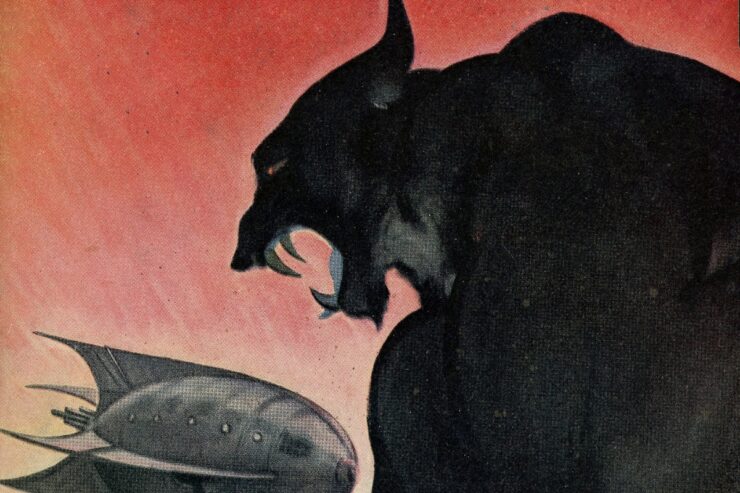
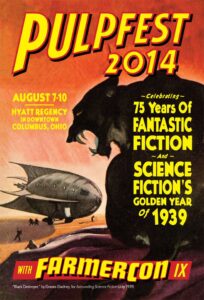
Bill Lampkin adapted Grave’s Gladney’s cover for the July 1939 Astounding Science Fiction for our PulpFest 2014 postcard. An excerpt from Gladney’s cover also serves as our featured image. Alva Rogers’ A Requiem for Astounding was published in 1964 by Advent Publishers of Chicago, Illinois.
PulpFest 2014 Schedule of Events
PulpFest 2014 starts Thursday, August 7. The dealers’ room will be open to registered sellers for setup from 4 to 11 PM. Ohio State’s Thompson Library will also offer a free lecture at 4:30 PM. Early registration for all convention attendees will take place outside the dealers’ room from 5 to 9 PM. Early-bird shopping will be available to PulpFest members staying at the Hyatt Regency Columbus from 6 to 10 PM. Our full slate of programming will get underway at 8 PM.
Thursday, August 7
4:00 PM – 11:00 PM – Dealer Set-Up – the dealers’ room will be open to dealers to assemble their displays.
4:30 PM – Ohio State Lecture Series – author and pulp fan Laurie Powers will be speaking about her grandfather, the noted pulp writer Paul Powers, at Ohio State’s Thompson Library. PulpFest members are invited to attend this annual lecture sponsored by Ohio State University.
5:00 PM – 9:00 PM – Early Registration – general members and dealers can register for PulpFest.
6:00 PM – 10:00 PM – Early-Bird Shopping – the dealers’ room will be open to loyal attendees who help to defray the convention’s costs by staying three nights at our host hotel. The cost is $30 for those who stay elsewhere.
Evening Programming
8:00 PM – Remembering Frank Robinson – winner of the 2000 Lamont Award, Frank Robinson wrote The Power, Pulp Culture, Science Fiction of the 20th Century, and other works. Years before setting pen to paper, Frank was collecting pulp magazines. PulpFest pays tribute to the author, collector, and friend who passed away on June 30th of this year.
8:30 PM – Frank Munsey’s Famous Fantastic Mysteries – Blood ‘n’ Thunder editor Ed Hulse and author Nathan Madison discuss this reprint magazine, one of the major science-fiction titles started in 1939. It introduced new readers to the classic “scientific romances” that originally appeared in the premier Munsey magazines The Argosy and All-Story Weekly.
9:15 PM – The Avenger’s Diamond Jubilee – in 1939, Richard Henry Benson, the chalk-faced crime fighter who founded “Justice, Incorporated,” was the last of Street & Smith’s major pulp heroes to get his own magazine. Pop-culture scholar Rick Lai offers a behind-the-scenes history of the character’s creation and development.
10:00 PM – The Farmerian Vision – moderator Paul Spiteri and panelists Jason Aiken and Christopher Paul Carey will discuss how the Hugo Award-winning author blended pulp elements and themes with his science-fictional works.
11:00 PM – Buck Rogers – Chapters 1–4 of this science fiction classic from the 1939 Universal serial starred Larry “Buster” Crabbe as the time-traveling hero introduced in Philip Nowlan’s 1928 pulp novella “Armageddon 2419 A.D.”
Friday, August 8
9:00 AM – 10 AM – Early Registration – all members can register for PulpFest. The dealers’ room will be open only to dealers for set-up.
10:00 AM – 5 PM – Wheeling and Dealing – the dealers’ room will be open to all.
1:30 PM – The New Fictioneers – Dick Enos, author of the popular Rick Steele adventure books, will read from four of his novels as well as his not-yet-released Rick Steele adventure, The Monster of Chinatown.
2:30 PM – The New Fictioneers – Christopher Paul Carey, coauthor with Philip José Farmer of Gods of Opar: Tales of Lost Khokarsa, and the author of Exiles of Kho, will read from the Farmer-inspired “The Goddess Equation.”
3:30 PM – The New Fictioneers – Ralph L. Angelo, Jr., winner of the 2014 New Pulp Award for Best New Author, will read from his Crystalon series and The Cagliostro Chronicles.
Evening Programming
7:30 PM – Welcome to PulpFest – Chairman Jack Cullers offers an official welcome to all attendees
7:40 PM – 1939: Science Fiction’s Boom Year – a brief overview of the “big bang” that launched six science-fiction pulps and ushered in the genre’s Golden Age.
8:00 PM – Startling Stories: An Overview – designed as a companion to Thrilling Wonder Stories, this pulp outlasted most of its competitors and became one of the most respected science-fiction pulps in the field. PulpFest‘s Ed Hulse presents a slideshow of Startling’s 99 covers and touches on the many famous yarns published in its pages.
8:30 PM – A Feast of Farmer: PJF’s Early Science Fiction – Meteor House publisher Mike Croteau and Book Cave co-host Art Sippo review Philip José Farmer’s pulp and digest stories, including “The Lovers,” a classic tale from Startling Stories that pioneered the intelligent use of sex in science fiction.
9:00 PM – Pulp Promos, Part Two – in a sequel to his extremely well-received presentation from last year, Chris Kalb takes another look at the now-rare premiums pulp fans of yore could get for a dime and a coupon.
9:30 PM – Eighty Years of Terror – weird-menace fiction was less than a year old when its most successful and long-lasting exponent, Terror Tales, first appeared on the nation’s newsstands in the summer of 1934. A blue-ribbon panel of fans and collectors weighs in on this Popular Publications title, as well as other shudder pulps.
10:30 PM – Science Fiction’s “Golden Age” – under the editorship of John W. Campbell, Street & Smith’s Astounding Science Fiction was the genre’s trendsetter, introducing many of the field’s top authors and publishing some of its most memorable stories. This presentation reviews Astounding’s 1939 issues, which featured the early fiction of Isaac Asimov, Robert A. Heinlein, Theodore Sturgeon, and A. E. van Vogt.
11:00 PM – Buck Rogers – Chapters 5–8 follow Buck and his pal Buddy Wade as they battle the ruthless dictator Killer Kane and his army of super-racketeers.
Saturday, August 9
9:00 AM – 4:45 PM – Wheeling and Dealing – the dealers’ room will be open to all.
1:00 PM – New Pulp Fiction Panel – moderator Ron Fortier is joined by writers Ralph Angelo, Jim Beard, Wayne Reinagel, Frank Schildiner, and Art Sippo as they discuss “The Fun of Writing Pulp Fiction.”
2:00 PM – The New Fictioneers – Jim Beard, author of the Captain Action novels and creator of Sgt. Janus, Spirit Breaker, will read from Sgt. Janus Returns, Monster Earth, and Pride of the Mohicans.
3:00 PM – The New Fictioneers – Frank Schildiner, who has written for Black Coat Press, Pulp Obscura, and others, will read from his forthcoming Thunder Jim Wade novella and a story from the Tales of the Shadowmen series.
5:00 PM – 7 PM – Saturday Night Dinner – join your fellow fans of pulp fiction for a delightful meal at Buca di Beppo in this get-together arranged by registration and volunteer coordinator Sally Cullers.
Evening Programming
7:30 PM – PulpFest 2014 Business Meeting – all members are invited to ask questions and offer suggestions at this session.
7:50 PM – 2014 Munsey Award Presentation – Pop Culture Professor and unabashed pulp fan Garyn G. Roberts will present this year’s Munsey Award to a select individual.
8:00 PM – Unknown: The Best in Fantasy Fiction – celebrate the 75th birthday of Street & Smith’s Unknown, the home to many of the pulp era’s most memorable—and oft-anthologized—fantasy and horror stories. We revisit the magazine’s highlights, including Edd Cartier’s magnificent artwork, in our tribute.
8:30 PM – The Mystery and Mastery of John Newton Howitt –art historian David Saunders chronicles the life and career of this prolific pulp artist, paying special attention to his memorable covers for the Popular Publications weird-menace magazines Terror Tales and Horror Stories.
9:30 PM – Saturday Night at the Auction – auctioneers John Gunnison and Joseph Saine are back to sell rare collectibles consigned by PulpFest dealers and attendees.
11:30 PM – Buck Rogers – Chapters 9 – 12 bring the 1939 Universal serial directed by Ford Beebe and Saul A. Goodkind to an exciting and satisfying close.
Sunday, August 10
9:00 AM – 2 PM – Wheeling and Dealing – the dealers’ room will be open to all as our dealers pack up. Buying and selling opportunities may be limited.
The Pulpster #23
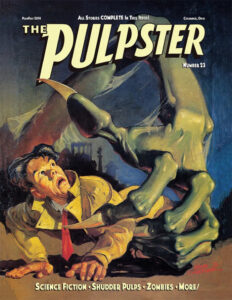 Except for “Sunday Only” attendees, all PulpFest 2014 members—including supporting members—received a complimentary copy of The Pulpster #23.
Like the convention, the new number focuses on the 75th anniversary of the blossoming of science fiction’s Golden Age, when fantastic fiction “grew up.”
The issue opens with “Science Fiction and the Pulps,” the unabridged version of Mike Chomko’s “History of Magazine Science Fiction,” recently serialized on our home page. Last year’s Munsey Award winner, Garyn G. Roberts, is on board with an article on Futuria Fantasia, the fanzine that Ray Bradbury debuted at the first World Science Fiction Convention. Don Herron, creator of San Francisco’s Dashiell Hammett Tour, the longest-running literary tour in the USA, looks at Fafhrd and the Gray Mouser, Fritz Leiber’s classic characters who first appeared in the August 1939 Unknown. Dwayne Olson contributes several letters from Donald Wandrei concerning the death of his friend, Hannes Bok, born July 2, 1914. Christian Lawson also profiles Argentine pulp writer Alfredo Julio Grassi.
Weird-menace fiction came into its own in 1934. The Pulpster will look back to those days with “Pulp Horrors of the Dirty Thirties,” written by Don Hutchison, author of The Great Pulp Heroes and many other works. Archaeologist Jeffrey Shanks will also be on hand to discuss “Zombies from the Pulps,” an overview of the undead writings of H. P. Lovecraft, Robert E. Howard, Manly Wade Wellman, Henry Kuttner, and other great pulpsters.
Bill Lampkin adapted the cover for The Pulpster #23 from Edd Cartier’s cover for the December 1939 number of Street & Smith’s Unknown, illustrating L. Sprague de Camp’s alternative history “Lest Darkness Fall.”
Thursday, August 7, 2014
Laurie’s Wild West at Ohio State—at 4:30 PM at Ohio State’s Thompson Library, Room 150 A/B, at 1858 Neil Avenue, Laurie Powers, granddaughter of author Paul S. Powers, will discuss her grandfather’s life and work. The editor and co-author of Pulp Writer: Twenty Years in the American Grub Street, an autobiography and appreciation of her grandfather, Laurie is the publisher of Laurie’s Wild West, an Internet blog site that has become a favorite destination for those interested in the pulps. She is currently working on a biography of pulp editor Daisy Bacon, editor of Love Story Magazine.
In December 2013, Laurie and her aunt and uncle, Pat and Ted Binkley, generously donated a collection to the Rare Books and Manuscripts Library at Ohio State University. The collection included Paul S. Powers’ personal papers and over 400 pulp magazines featuring his work.
Paul S. Powers was a prolific pulp fiction writer whose career spanned more than 25 years. From 1925 to 1950, Powers wrote over 450 stories for a variety of fiction magazines. An expert in the American West, he wrote over 400 stories for the famous pulp magazine Wild West Weekly alone. His western characters, Sonny Tabor, Kid Wolf, Freckles Malone, and Johnny Forty-five, captivated an entire generation of readers during the Great Depression. Other stories appeared in magazines such as Weird Tales, Thrilling Detective, Mystery Tales, Exciting Western, Thrilling Western, Texas Rangers, Thrilling Wonder Stories, and more.
Remembering Frank M. Robinson—on June 30, 2014, the pulp community lost not only a great collector, but, more importantly, a great friend. Frank M. Robinson died at 87. A science-fiction and thriller writer, editor, speechwriter for gay activist Harvey Milk, and a movie actor, Frank was known in the pulp community as the leading collector of top-grade pulp magazines.
Winner of the 2000 Lamont Award, Frank Robinson wrote The Power, Pulp Culture, Science Fiction of the 20th Century, and other works. On Thursday, August 7, beginning at 8 PM, PulpFest will pay tribute to this fine writer and editor, great collector, and good friend who recently passed.
The Aristocrats of the Pulps—In a letter published in “The Readers’ Viewpoint” column in its June 1948 issue, Robert Boyer labeled Famous Fantastic Mysteries as “. . . the Aristocrat of the Pulps, the acme of stf perfection,” a title that can likewise be conferred upon the magazine’s later companions, Fantastic Novels and A. Merritt’s Fantasy Magazine.
The Frank A. Munsey Company started Famous Fantastic Mysteries in the fall of 1939. Mary Gnaedinger edited it to reprint the scientific romances originally published in The All-Story, Argosy, and The Cavalier. A companion title, Fantastic Novels, joined it in the early summer of 1940. For most of the next year, the two magazines were published in alternating months.
In late 1942, Munsey sold many of its pulps—including their two classic reprint magazines—to Popular Publications. Reluctant to take on a pair of fantasy titles, the new publisher kept Famous Fantastic Mysteries going, but not Fantastic Novels. Popular would wait until 1948 to return Fantastic Novels to the stands, once again relying on the Munsey archives for its content. A third title, A. Merritt’s Fantasy Magazine, was added in late 1949.
On Thursday, August 7, beginning at 8:30 PM, Ed Hulse, author and editor of Blood ‘n’ Thunder, and Nathan Madison, popular culture historian and author of the Eisner-nominated Anti-Foreign Imagery in American Pulps and Comic Books, 1920-1960, discuss Famous Fantastic Mysteries, one of the major science-fiction titles started in 1939, as well as its two brethren, Fantastic Novels and A. Merritt’s Fantasy Magazine. Highly regarded during the pulp era, all three remain highly collectible pulp magazines, given their exceptional fiction and beautiful illustrations.
The Avenger Turns 75—Seventy-five years ago, Astounding Science Fiction published the first science-fiction stories of Robert E. Heinlein, Theodore Sturgeon, and A. E. Van Vogt, as well as Isaac Asimov’s first story for the magazine. The year also witnessed a blossoming of magazine science fiction and fantasy with eight new pulps entering the field. The first World Science Fiction Convention was also held that year in New York City, home to the World’s Fair and its “World of Tomorrow” theme. It was indeed a golden year for fantastic fiction.
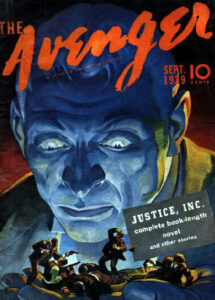 1939 was also the year that Street & Smith attempted to duplicate the success of their leading character pulps, The Shadow and Doc Savage. To get all their ducks in a row, the company’s business manager Henry Ralston and hero-pulp editor John Nanovic hired journeyman author Paul Ernst to write the lead novels for a new single-character magazine titled The Avenger.
With help from Shadow scribe Walter B. Gibson and Lester Dent, the man behind the Doc Savage tales, Ernst was tasked with creating what was hoped to be a very profitable magazine. Writing under the Kenneth Robeson house name, the pseudonym used for the Doc Savage yarns, Ernst put together some excellent stories, particularly early on. In the initial entry in the series, “Justice, Inc.,” Ernst’s character, former adventurer Richard Henry Benson, suffers a nervous breakdown following the disappearance of his wife and daughter during an airline flight. Afterward, Benson’s hair turns white, and his face freezes but remains pliable. This allows him to mold his features into whatever disguise he chooses. He becomes The Avenger and gathers a group of fellow justice-seekers around him.
On Thursday, August 7th, at 9:30 PM, join PulpFest for a salute to “The Avenger’s Diamond Jubilee.” Author and popular culture scholar Rick Lai will offer an illustrated history of the character, exploring The Avenger’s creation and development over time.
Best known for his articles based on the Wold Newton concepts of Philip José Farmer, recently collected by Altus Press as Rick Lai’s Secret Histories: Daring Adventurers, Rick Lai’s Secret Histories: Criminal Masterminds, Chronology of Shadows: A Timeline of The Shadow’s Exploits and The Revised Complete Chronology of Bronze, Rick Lai lives in New York. His short fiction has been collected in Shadows of the Opera (Wild Cat Books, 2011) and two Black Coat Press collections published in 2013–Shadows of the Opera: Retribution in Blood, and Sisters of the Shadows: The Cagliostro Curse. He has also appeared regularly in Black Coat’s Tales of the Shadowmen anthologies.
H. Winfield Scott created the front cover art for The Avenger, dated September 1939 and published by Street & Smith.
The Farmerian Vision: Pulp Meets Science Fiction—in his introduction to The Worlds of Philip José Farmer: Voyages to Strange Days, editor Michael Croteau writes:
“A child of the Golden Age of Science Fiction, Farmer wrote many of the same types of stories as his contemporaries during the last half of the twentieth century: tales of space exploration, alien planets, fantastic journeys, alien invasions, time travel, artificial worlds, the afterlife, space opera, alternate history, mad scientists, robots, dystopias, lost worlds, feral humans, displaced men, artificial intelligence, the future, the distant future, and the really, really far distant future. Name a science fiction trope, and Farmer almost certainly tried his hand at it, sometimes playing it straight, sometimes turning it on its head.”
Although noted for his “pioneering use of sexual and religious themes,” Philip José Farmer was, in short, a pulp writer. This year, FarmerCon IX, our “convention within a convention,” turns its attention to the pulp elements in Peoria’s Grand Master of Science Fiction’s canon. Our annual FarmerCon panel presentation will begin at 10:15 PM on Thursday, August 7.
In The Farmerian Vision: Pulp Meets Science Fiction, moderator Paul Spiteri – editor of the Farmer collection Pearls from Peoria – and panelists Jason Aiken and Christopher Paul Carey will discuss the unique way in which the Hugo Award–winning author blended pulp elements and themes with his science-fictional works.
Jason Aiken became interested in the pulps and works of Philip José Farmer in 2009. He hosts the Pulp Crazy podcast and video blog, where he reviews classic and new pulp fiction. Christopher Paul Carey, one of our 2014 New Fictioneers, coauthored Gods of Opar: Tales of Lost Khokarsa with Mr. Farmer, and authored Exiles of Kho, a prelude to the Khokarsa series.
Since 2011, PulpFest has hosted FarmerCon, a convention that began in Peoria, Illinois, Philip José Farmer’s hometown. As always, PulpFest is pleased to welcome FarmerCon IX members to the Hyatt Regency Columbus.
Buck Rogers in the 25th Century—inspired by the success of its two cliffhanger serials featuring Olympic swimming champion Larry “Buster” Crabbe as comic-strip hero Flash Gordon—Universal Pictures licensed the futuristic firebrand Buck Rogers in 1938. Creator Philip Francis Nowlan originally named him Anthony Rogers, and he first appeared in “Armageddon 2419 A.D.”, a 1928 short novel written for Hugo Gernsback’s pioneering science-fiction pulp Amazing Stories. Rogers was portrayed as a 20th-century Rip Van Winkle who falls into suspended animation and awakes 500 years later to find America overrun by Mongol hordes.
After publishing a sequel, “The Airlords of Han,” in 1929, Nowlan rechristened his character with a snappier first name, “Buck,” and, in partnership with artist Dick Calkins, developed a comic strip for syndication in Chicago-based John F. Dille’s newspapers. Buck Rogers in the 25th Century was an almost instantaneous hit with readers. The character reached the nation’s airwaves in 1932 as a Monday-through-Friday radio serial. Both the comic strip and the radio program softened the racial component of Nowlan’s original story and made the hero’s chief adversary Killer Kane, a space pirate aligned with the galaxy’s worst troublemakers. The capable Wilma Deering partnered with Buck, and the cheerfully eccentric Dr. Huer used his scientific abilities as needed.
Universal’s screenwriters kept most of the characters from the strip and radio show, though they dropped Kane’s paramour, Ardala Valmar, and made Wilma’s younger brother, Buddy, a scientist’s son forced into suspended animation along with Buck. The Nowlan novelette’s concept of an America under siege was retained, with the resistance movement’s headquarters located within a hidden city constructed inside a huge mountain. The plot followed the rebels’ attempts to forge an alliance with Saturn against Kane and his minions, presumably scattered throughout the solar system.
Buster Crabbe was cast as Buck when production of a third Flash Gordon serial was delayed. Universal contract player Constance Moore, then just eighteen, made a surprisingly mature Wilma. Child actor Jackie Moran played Buddy, while C. Montague Shaw brought gravitas and sobriety to Dr. Huer. The villainous faction was headed by Anthony Warde as Kane and Henry Brandon as his right-hand man, Lasca.
Released in April 1939, Buck Rogers played in theaters nationwide throughout the year, as science-fiction pulp magazines enjoyed renewed popularity and grew rapidly. Universal’s chapter play failed to yield profits commensurate with those of the Flash Gordon serials, but it gained considerable popularity when it aired on television in 1951. Since then, Buck Rogers has been in perpetual syndication and is available for home viewing. Several generations, not yet born when it first flashed across theater screens, have been entranced by the simple charm that makes it representative of an earlier era in which wonder predominated and real-life innovations had not yet caught up to the fanciful devices conjured by science-fiction writers.
In 1934, John Dille’s firm underwrote production of a ten-minute promotional film exhibited at that year’s Chicago World’s Fair. Buck Rogers in the 25th Century, produced by prominent magician and entrepreneur Harlan Tarbell, was laughably inept but effectively captured the elaborate costumes, ray guns, and rocket ships artist Calkins designed for the comic strip. The art directors of Universal’s Buck Rogers serial pointedly eschewed these well-known designs (which had served as the basis for innumerable licensed products) in manufacturing sets, props, costumes, and miniatures for the chapter play.
As part of its celebration of “Science Fiction’s Golden Year of 1939,” PulpFest 2014 will run four chapters of Buck Rogers each night of the convention, from August 7 through August 9. Our Thursday and Friday showings will begin around 11 PM, while our Saturday presentation will follow the auction. We will preface the Thursday-night screening of the serial’s first four chapters with the seldom-seen 1934 promotional short produced by John Dille.
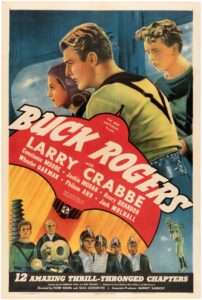
A movie poster for the Universal serial starring Larry Buster Crabbe, Buck Rogers. This post was written by Ed Hulse, with Mike Chomko.
Friday, August 8, 2014
The New Fictioneers—Friday’s afternoon programming was set aside for “New Fictioneers” readings. These featured contemporary writers reading from their recent works and fielding audience questions and comments. To learn more about PulpFest’s “New Fictioneers” readings, click here.
 Startling Stories from First to Last—Ned Pines’ Thrilling Group entered the science-fiction pulp market after purchasing Wonder Stories from Hugo Gernsback. In early 1938, editor Mort Weisinger asked readers for suggestions for a companion to the rechristened Thrilling Wonder Stories. Weisinger’s poll produced Startling Stories, a new pulp that debuted at the end of 1938.
Startling Stories featured a lead novel, complete in each issue, plus several short stories, including one reprint culled from Gernsback’s Wonder magazines. In later years, Thrilling Wonder Stories also became a reprint source for its companion magazine. Many of the novels to appear in Startling Stories were action-packed space operas, while others bordered on the science fantasies of Abraham Merritt.
When Sam Merwin became editor of Startling in 1945, he began mixing more mature novels into the magazine. Highlights of this period include Fredric Brown’s “What Mad Universe,” Arthur C. Clarke’s “Against the Fall of Night,” and Edmond Hamilton’s “The City at World’s End.” The magazine also included short stories by Ray Bradbury, C. M. Kornbluth, Fritz Leiber, Clifford Simak, and others. In the early fifties, Startling published Philip José Farmer’s “The Lovers,” a short novel that pioneered the intelligent use of sex in science fiction.
On Friday, August 8, beginning at 8 PM, Ed Hulse, author and publisher of the Murania Press line of books and magazines, will present a slideshow featuring all 99 covers from Startling‘s nearly twenty-year run. He’ll touch on the many great yarns the magazine published over the years. It’s all part of PulpFest‘s salute to science fiction’s Golden Year of 1939 and 75 years of fantastic fiction!
The first issue of Startling Stories, dated January 1939, featured cover art by Howard V. Brown.
A Feast of Farmer—Although noted for his “pioneering use of sexual and religious themes,” Philip José Farmer was, in short, a pulp writer. While most people don’t think of the pulps when they hear Farmer’s name, he began his career selling stories to pulps such as Adventure, Startling Stories, and Thrilling Wonder Stories. In fact he sold over fifteen stories to pulp magazines and digests before his first novel was published in 1957. In all, Farmer had nearly forty stories published in a wide variety of magazines in the 1950s and 60s.
 “A prolific and popular science fiction writer who shocked readers in the 1950s by depicting sex with aliens and challenged conventional pieties of the genre with caustic fables set on bizarre worlds of his own devising,” Farmer was best known for his novels. Called “sprawling, episodic works that gave him room to explore the nuances of a provocative premise while indulging his taste for lurid, violent action,” his best were set in the Riverworld and World of the Tiers series. Named a Grand Master of Science Fiction in 2001, Farmer is also remembered for his work concerning the Wold Newton Family.
Beginning at 8:30 PM on Friday, August 8th, Farmerphiles Michael Croteau and Art Sippo will explore Philip José Farmer’s work as a magazine writer in the pulps’ waning years. Like many of his contemporaries, Farmer sold stories to over a dozen magazines — five different magazines in 1954 alone — constantly looking for new markets for his work. The presentation will include a slideshow of magazine covers featuring Farmer’s early work.
Michael Croteau, one of the founders of FarmerCon, publishes Meteor House books and edits The Worlds of Philip José Farmer and Farmerphile. Art Sippo is a physician board-certified in Aerospace medicine and Occupational medicine, currently working in various emergency rooms in southwestern Illinois. He co-hosts The Book Cave, a podcast that reviews adventure fiction, comics, movies, and all things pulp-related. He has also written Sun Koh: Heir of Atlantis, a reimagining of a German pulp hero of the 1930s, as well as numerous essays and short stories for magazines and anthologies.
Earle K. Bergey created the cover art for the August 1952 issue of Startling Stories, illustrating Philip José Farmer’s “The Lovers.”
Pulp Promos, Part Two—one of the most popular presentations at PulpFest 2013 was Chris Kalb’s discussion of hero pulp premiums. As Sam Maronie reported, “Graphic designer Chris Kalb presented a dynamite presentation Saturday night on pulp premiums—those little geegaws that readers received for mailing away coupons and a dime to the pulp publishers.”
How did pulp magazine publishers keep readers coming back month after month? Of course the best way was to publish excellent stories. Regardless of genre, the leading pulps—Adventure, Astounding Stories, Black Mask, Blue Book, Dime Western, Doc Savage, G-8 and His Battle Aces, Love Story, The Shadow, The Spider, Sports Stories, Startling Stories, Weird Tales, Wings—attempted to do just that, issue after issue.
Another method publishers used to lure dimes regularly from buyers with thin wallets was to create a club and offer premiums. For a few cents or by clipping coupons from a favorite pulp magazine, a devoted fan could become a member in good standing of the Doc Savage Club, one of the Friends of the Phantom, or Adventure magazine’s Camp-Fire Club. Also available were rings, pins, and items such as the Spider Pencil, a celluloid mechanical pencil with a rubber eraser of The Spider seal, produced in very limited quantity during 1941-42.
Once again, Chris Kalb will take us back to a time when a few cents not only bought a pulp magazine filled with thrills, but also a Shadow board game or a Spider pennant. Please join him on Friday, August 8, at 9 PM to see how pulps, radio, and movie presentations inspired by them were promoted. You’ll also learn which pulps hosted “The Trail’s End Club,” “The Hollow Tree Club,” or “The Globe Trotter’s Club” and all about the “Shadow Christmas” of 1940. And how about those beautiful promotional items that publishers sent to newsstands? Chris will cover these and more in part two of his presentation on pulp premiums and other collectibles.
You’ll find more information about pulp premiums on Bill Lampkin’s ThePulp.Net website. Bill has photographs of rings, membership cards, pins, and other items on the site. Just search for “premiums.”
80 Years of Terror!—Back in the days of bread lines and hobo jungles, millions of readers found escapist thrills in cheaply produced magazines printed on rough pulpwood paper. Pulp magazines catered to every imaginable reading taste, from detective yarns to pirate stories, from jungle adventures to science fiction, from sports stories to romance tales. But the wildest of them all were the notorious horror tomes known collectively as the shudder pulps.
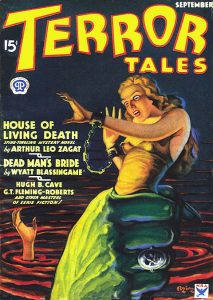 The so-called “shudder” or “weird-menace” titles were a blood-red splash of color in the grey days of the Great Depression. They announced their monthly wares with circus-poster-style covers featuring voluptuous, underdressed beauties pursued by hordes of leering lunatics as bent as boomerangs. Their promise: cheap thrills, and plenty of them. In their nightmare universe, it was always a dark and stormy night. Tethered damsels suffered in the clutches of fiends such as hell-mad surgeons, warped scientists, and masked and cowled cultists, eagerly abetted by legions of demented dwarfs and horny hunchbacks. They stripped, whipped, and boiled their curvaceous victims with the enthusiasm of medieval inquisitors. Even the requisite rock-jawed heroes of these stories suffered a purgatory of horrors in order to rescue their brutally treated fair maidens.
The weird-menace magazines lasted only a few years, roughly from 1933 to 1941, when blue-nosed watchdogs helped push them out of the market. Unlike earlier horror magazines with their literate but dusty eldritch mysteries, the new breed of terror pulps dared to go where no newsstand magazines had gone before. Join PulpFest 2014 on Friday, August 8, at 9:30 PM as we celebrate the eightieth anniversary of Terror Tales, the best of the weird-menace magazines.
Popular culture professor Garyn G. Roberts, winner of the 2013 Munsey Award and editor of some of the best collections from the pulps; Ed Hulse, publisher of Murania Press books and a consultant for the Dime Detective series from Altus Press; and Walker Martin, who writes about pulp collecting for Steve Lewis’ Mystery*File blog, will weigh in on this Popular Publications title, as well as other shudder pulps–Ace Mystery, Dime Mystery, Eerie Mysteries, Eerie Stories, Horror Stories, Mystery Novels and Short Stories, Mystery Tales, Spicy Mystery Stories, Thrilling Mystery, Uncanny Tales, and others.
Our image above is Terror Tales for September 1934, with cover art by Rudolph W. Zirm.
The Golden Age of Astounding Science Fiction—when John W. Campbell became editor of Astounding Stories, he began creating a science-fiction magazine for mature readers. Writers, both new and old, responded: Lester Del Rey with “The Faithful” and “Helen O’Loy”; Jack Williamson with “The Legion of Time”; and L. Ron Hubbard with “The Tramp.” Campbell himself joined in with “Who Goes There,” as did Clifford D. Simak, who had left science fiction, and new writers L. Sprague de Camp and Eric Frank Russell. Seasoned professionals such as Arthur J. Burks, Raymond Z. Gallun, and Manly Wade Wellman also joined in.
But Campbell had been merely tilling the soil in the first year of his editorship, preparing it for the blossoming of science fiction’s Golden Age in 1939. The stage was set when the February Astounding Science-Fiction featured the magazine’s first cover by Hubert Rogers. A freelance illustrator long associated with Adventure, Rogers would paint nearly sixty covers for Campbell’s Astounding.
 Although the outpouring of exceptional fiction continued in the early months of 1939, the July issue is most often cited as the start of Astounding‘s golden age. Behind an effective cover by artist Graves Gladney, readers would find the first prose fiction by A. E. van Vogt, as well as Isaac Asimov’s first story for the magazine. August’s and September’s issues continued the trend, featuring the first stories by Robert A. Heinlein and Theodore Sturgeon. October’s number began serializing E. E. Smith’s “Gray Lensman,” along with another tale by Heinlein.
Under John W. Campbell’s editorship, Street & Smith’s Astounding Science Fiction set the genre’s trends, introducing many of the field’s top authors and publishing some of its most memorable stories. On Friday, August 8th, beginning at 10:30 PM, please join 2013 Munsey Award winner, Professor Garyn G. Roberts, editor of The Prentice Hall Anthology of Science Fiction and Fantasy; Professor Tom Krabacher of California State University, Sacramento, a member of the Pulp Era Amateur Press Society who has written and lectured on the history of pulp magazines and has long owned a lengthy run of Astounding, back to the late thirties; and PulpFest organizer, movie and pulp historian, author, and the editor of Blood ‘n’ Thunder, Ed Hulse who will dissect Astounding’s 1939 issues and the blossoming of science fiction’s Golden Age. A slide show featuring the 1939 issues of Street & Smith’s Astounding Science Fiction will accompany the trio’s presentation.
Hubert Rogers painted the cover art for the October 1939 number of Astounding Science Fiction, illustrating the first segment of E. E. “Doc” Smith’s ” Grey Lensman.”
Saturday, August 9, 2014
The New Fictioneers—Saturday’s afternoon programming was largely set aside for “New Fictioneers” readings. These featured contemporary writers reading from their recent works and fielding audience questions and comments. To learn more about PulpFest’s “New Fictioneers” readings, click here. However, the afternoon began with a panel moderated by Ron Fortier.
The Fun of Writing Pulp Fiction—writing can be a lonely business, but it can also be fun. On Saturday, August 9, at 1 PM, writer, editor-in-chief of Airship 27, and two-time Pulp Factory Award winner Ron Fortier, along with five contemporary authors, will chat about the pleasure they’ve found in writing in the exciting new genre known as “New Pulp.”
Winner of the 2014 New Pulp Award for Best New Author, Ralph L. Angelo, Jr. has written epic fantasy, sword-and-sorcery, science fiction, and new pulp, as well as numerous non-fiction works about motorcycling. Creator of The Cagliostro Chronicles, The Crystalon Saga, and the Torahg the Warrior series, Ralph has also written for Airship 27, Pro Se Press, and other publishers.
A native of Toledo, Jim Beard created Sgt. Janus, Spirit-Breaker, co-created the Monster Earth anthology series, and is the author of the Captain Action novels for Airship 27. His recent work includes stories for White Rocket’s Pride of the Mohicans, The New Adventures of Major Lacy & Amusement, Inc. for Pro Se Press, and an upcoming project from Meteor House.
Veteran comic writer Ron Fortier, best known for his work on The Green Hornet and Terminator, is a pioneer of the New Pulp movement. The managing editor of Airship 27 Productions, Ron writes the adventures of Captain Hazzard and Brother Bones, the Undead Avenger.
Nobody writes non-stop adventure books like Wayne Reinagel. Author, illustrator, and publisher of the epic Pulp Heroes and Modern Marvels series of pulp adventure novels and short stories for Knightraven Studios, Wayne packs his stories with incredible action and breathtaking adventure. Coming soon are Sanctuary Falls, the concluding segment of the Pulp Heroes trilogy, and two more novels in the Gothic horror Modern Marvels trilogy.
A pulp fan since reading Philip José Farmer’s Tarzan Alive, Frank Schildiner is a martial arts instructor from New Jersey. He has written Black Bat, Ravenwood, and Secret Agent X stories for Airship 27; Avenger yarns for Moonstone Books; tales of Thunder Jim Wade and Richard Knight for Pro Se Productions; and contributed to Black CoatPress’s Tales of the Shadowmen series. Frank has also published several articles on horror in comic books, television, and film.
An emergency room physician in southwestern Illinois, Art Sippo co-hosts The Book Cave, a podcast that reviews adventure fiction, novels, comic books, movies, and all things pulp. His first novel, Sun Koh: Heir of Atlantis, was nominated for a 20100 Pulp Factory Award for Best Pulp Novel. Art has also written numerous essays and short stories for magazines and anthologies, and has served as a panelist and moderator at many recent FarmerCons.
 The 2014 Munsey Award—J. Randolph Cox has won the 2014 Munsey Award. Nominated by the pulp community, Randy was selected by a vote of all living Lamont, Munsey, and Rusty Award winners. The award is a fine art print of a painting by David Saunders, presented annually to someone who has worked to better the pulp community. Dan Zimmer of The Illustrated Press published the print.
For more than 45 years, Randy Cox has researched pulp magazines and dime novels. He served as the editor-publisher of Dime Novel Round-Up for over twenty years. His bibliography, Man of Magic & Mystery: A Guide to the Work of Walter B. Gibson, is an excellent resource for those seeking a greater understanding of the work of the man who created The Shadow. With David S. Siegel, Randy authored Flashgun Casey: Crime Photographer, a book-length study of the character originally created for Black Mask by George Harmon Coxe. Other books he has authored include Masters of Mystery and Detective Fiction: An Annotated Bibliography and The Dime Novel Companion: A Source Book. Randy recently donated his collection of comic books, newspaper strips, fanzines, pulps, series books, story papers, and other materials to the University of Minnesota Libraries, and his extensive collection of Walter Gibson books and Shadow pulps and comics to Gibson’s alma mater, Colgate University.
Other nominees for this year’s Munsey Award included Brian Earl Brown, Stephen Haffner, William Lampkin, Stephen T. Miller, Laurie Powers, George Vanderburgh, and Dan Zimmer. William G. Contento, Chris Kalb, Richard Meli, Phil Stephensen-Payne, Shelby Vick, and Howard Wright also received nominations.
The 2014 Rusty Hevelin Service Award—PulpFest 2014 also presented the Rusty Award to J. Barry Traylor. Designed to recognize individuals who have worked long and hard for the pulp community with little thought for individual recognition, it rewards especially good works and is reserved for those most deserving. The award is a fine art print by Dan Zimmer of a painting by David Saunders.
Richard Wentworth, AKA The Spider, had his Ram Singh; G-8 turned to Nippy Weston and Bull Martin for help; and Doc Savage had Monk, Ham, and three other geniuses to lend a hand. But who does a pulp con organizer turn to for assistance? None other than J. Barry Traylor! For over twenty-five years, Barry has been organizing convention auctions, almost single-handedly pulling together a couple hundred lots for a Saturday auction. In 2008, Barry quickly mastered digital photography and stunned the convention crowd with wonderful images of pulps ranging from rarities like Far East Adventure Stories to more common titles such as Amazing Stories. He’s also the person most often performing the “grunt work” that goes into organizing a convention–contacting comic shops and bookstores to help with promotion activities; managing the links on the PulpFest website; hunting down extension cords for use in the dealers’ room and programming area; and much more. A longtime contributor to letter columns–you can find his comments in Age of the Unicorn, Echoes, Xenophile, and other classic fanzines–this unsung hero is a devoted fan of Weird Tales. Barry learned about giving back to the pulp community from his pulp mentor, the late Richard Minter, co-winner of the 1993 Lamont Award.
The Munsey Award, named after the man who invented the pulp magazine, was created in 2009 by talented artist David Saunders. It is an art print, limited to 36 copies, published by Dan Zimmer of The Illustrated Press. The Rusty Award utilizes the same print.
If you believe a person or organization deserves the 2015 Munsey Award, please let us know. Nominations must include a short paragraph or two explaining why you are nominating the person or organization. Send all nominations to PulpFest Marketing and Programming Director Mike Chomko. You can reach him by email at mike@pulpfest.com or by regular mail at 2217 W Fairview St, Allentown, PA 18104-6542.
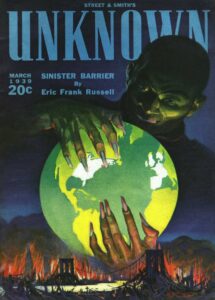 Unknown: The Best in Fantasy Fiction—on Saturday, August 9, at 8 PM, celebrate the 75th anniversary of the publication considered the best fantasy magazine of all time, Street & Smith’s Unknown. Join acclaimed lecturer Professor Tom Krabacher of California State University, Sacramento; commentator Walker Martin, who writes about pulp collecting on Pulpmags and Mystery*File; and Professor Garyn G. Roberts, editor of The Prentice Hall Anthology of Science Fiction and Fantasy, as they revisit the magazine’s highlights.
Debuting in February 1939 and publishing a complete novel in each issue, Unknown featured many works now considered classics of the fantasy genre—Anthony Boucher’s “The Compleat Werewolf,” L. Sprague DeCamp’s “Lest Darkness Fall,” L. Ron Hubbard’s “Fear” and “Typewriter in the Sky,” Fritz Leiber’s “Conjure Wife” and the early Fafhrd and the Gray Mouser stories, Norvell W. Page’s Prester John stories “Flame Wind” and “Sons of the Bear-God,” Theodore Sturgeon’s “It,” Jack Williamson’s “Darker Than You Think,” and many others.
Over its 39-issue run, the magazine went through a variety of changes, including eliminating cover art beginning with the July 1940 issue. The magazine got a new name in late 1941. Despite the changes, Unknown Worlds was canceled after the October 1943 issue.
Krabacher’s, Martin’s, and Robert’s presentation, “Unknown: The Best in Fantasy Fiction,” accompanied by selected cover art, is yet another reason to make PulpFest your “must-see” convention of 2014!
H. Winfield Scott created the front cover art for the first issue of Unknown, dated March 1939.
The Mystery and Mastery of John Newton Howitt—John Newton Howitt studied at the Art Students League with George Bridgman and Walter Clark. A devoted landscape painter, his work was sold at fine art galleries in New York City. In 1905, he began to freelance for The New York Herald Tribune, This Week, and other publications. His later markets included Red Book, Woman’s Home Companion, Maclean’s, and Scribner’s. After the First World War, Howitt’s work appeared in Country Gentleman, Farm Life, Liberty, and The Saturday Evening Post.
The Great Depression vastly diminished the markets to which Howitt had been selling. Needing an income, he turned to the pulps. An excellent painter, Howitt found a ready market in the rough-paper periodicals, selling freelance pulp covers to Adventure, Dime Detective, Dime Mystery, Horror Stories, Love Story, Secret Service Operator #5, The Spider, Terror Tales, Top-Notch, The Whisperer, and Western Story. Although he signed his covers for the western, adventure, and romance pulps with his professional signature, he signed his work for the hero and weird-menace pulps with only his initial, “H.”
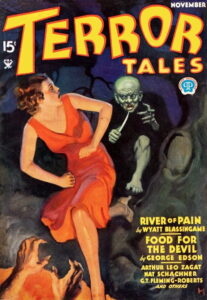 Although John Newton Howitt’s iconic cover images for Terror Tales, Horror Stories, The Spider, and Operator #5 are among the most disturbing in pulp art history, his painting technique is among the most dignified of all pulp artists. On Saturday, August 9, at 8:30 PM, please join art historian David Saunders for an exploration of “The Mystery and Mastery of John Newton Howitt” at PulpFest 2014.
Born in 1954, David Saunders is a New York artist. His work has been exhibited worldwide in museums and corporate and private collections, including the Museum of Modern Art, The Metropolitan Museum of Art, The Brooklyn Museum of Art, and the Hirschhorn Museum of Art in Washington, DC. He has taught art at colleges nationwide, including Yale, Oberlin, R.I.S.D., S.C.A.D., Middlebury, Washington University, as well as art schools in France, Korea, Mexico and Japan.
David’s father was the legendary illustrator, Norman Saunders. His mother, Ellene Politis Saunders, worked at Fawcett Publications as Chief Executive Editor of Woman’s Day Magazine. In 1972, David became his father’s business and correspondence secretary, which started a long project to catalog his father’s 7,000 published illustrations. He spent the next seventeen years gathering published examples of his father’s work from used bookshops and submitting each new entry to his father’s inspection. What began as a sentimental hobby for a father and son grew into an impressive archive of 20th-century American illustration. After his father’s death in 1989, he continued to complete the archive on his own. He interviewed his father’s surviving associates to record their oral histories. These transcripts helped broaden his view of the popular culture publishing industry and recorded vital information about the lives of other historic illustrators. Some of this material has been published as biographical profiles of classic illustrators in Illustration Magazine and a number of book-length biographies and appreciations of pulp artists.
David Saunders is the foremost scholar of American pulp illustrators. His free public website, Field Guide to Wild American Pulp Artists, features over three hundred biographical profiles of these popular-culture creators. David continues to research, document, and promote a greater appreciation of pulp artists. To learn more, please visit pulpartists.com, davidsaunders.biz, and normansaunders.com.
John Newton Howitt’s cover for the November 1934 issue of Terror Tales appears above.
Pulp Artist, Harold Winfield Scott—Harold Winfield Scott studied art with Dean Cornwell at the Pratt Institute. By 1930, he regularly sold freelance cover paintings to pulps such as Danger Trail, Top-Notch, Complete Stories, Wild West Weekly, Star Sports, The Avenger, Doc Savage, Two-Gun Western, Quick-Trigger Western, and others. He later did freelance work for slick magazines such as Liberty, Colliers, and Red Book. In the 1950s, his work appeared on Dell paperback covers and in comic books.
On Saturday evening, August 9, at 9:15, David Saunders will offer a short presentation on the artist. He will be joined onstage by Lisa Scott, the artist’s granddaughter, for a brief profile on the life and work of H. W. Scott. Afterward, Lisa and David will entertain questions.
Weird Tales Author Auction—PulpFest‘s Saturday night auction, featuring auctioneers John Gunnison and Joseph Saine, will immediately follow our presentation on H. W. Scott. Our auctioneers will be selling rare and unusual collectibles consigned by PulpFest dealers and attendees.
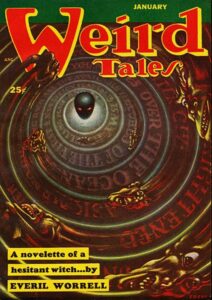 This year’s auction will also feature a selection of books, fanzines, manuscripts, and ephemera from the collection of Everil Worrell, author of nineteen stories for Weird Tales. Starting with “The Bird in Space,” a short novel that copped the cover spot for the September 1926 issue, Worrell began a long association with “The Unique Magazine.” One of her last published stories, “Call Not Their Names,” appeared in the March 1954 number, six months before the magazine’s original run ended.
In addition to Weird Tales, Worrell also wrote short fiction for Macfadden’s Ghost Stories and Ray Palmer’s Mystic Magazine and poetry for The Overland Monthly. Her stories were also reprinted in the Avon Fantasy Reader and Health-Knowledge’s Startling Mystery Stories. “The Canal,” originally published in the December 1927 issue of Weird Tales, was adapted for television by Rod Serling’s Night Gallery. Worrell was a longtime federal employee, retiring on the last day of 1957 from the U.S. Department of the Treasury.
PulpFest is pleased to offer twenty-five lots of collectibles from the Worrell estate, left to a small church in Washington, DC, after the passing of the author’s only child, Eileen Murphy. St. David’s parish is excited about having PulpFest handle this portion of their former parishioner’s estate, hoping that the items will find their way into the hands of those who would appreciate them most–pulp fiction aficionados!
The image above is the January 1953 issue of Weird Tales, with cover art by Frank Kelly Freas.