 On December 16, 2014, pulp fans were urged not to wait for the Grim Reaper to drag them to their first PulpFest. By then, it will be too late!
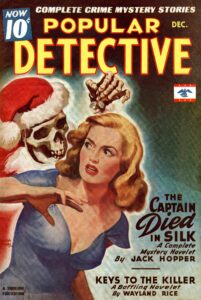
That’s what this fine young woman is about to find out, courtesy of the magnificent brushstrokes of artist Rudolph Belarski, created for the December 1945 Popular Detective, published by Standard Magazines.
Make PulpFest 2015 your pulp resolution for the New Year. We’ll be back at the Hyatt Regency Columbus from Thursday, August 13 through Sunday, August 16. Our themes for the 2015 convention will be H. P. Lovecraft and Weird Tales and Ned Pines’ Standard Magazines, also known as the Thrilling Group.
Pulpcon Founder’s Collection Goes to Iowa—on January 12, 2015, PulpFest‘s Chuck Welch filed a report concerning the late Rusty Hevelin’s collection of fanzines and other material:
An article in the January 12, 2015 edition of the Des Moines Register highlights the University of Iowa’s acquisition of the Rusty Hevelin Collection. Donated by the PulpCon founder upon his death, the collection is now partially accessible to the public.
 “The scope of the collection is astounding,” said Peter Balestrieri, the UI curator in charge of cataloging the Hevelin Collection. “There are fanzines that date back to before World War I all the way into the 21st century. Every topic you could imagine is covered there, and we’ve just begun to unpack it.”
Columnist Daniel Finney writes that “Hevelin was by most accounts the greatest science fiction convention collector and attendee of all time. He built a massive archive in more than 70 years of collecting.” Rusty is, of course, well-known to the PulpFest crowd. His PulpCon preceded the summer pulp festival now held in Columbus, Ohio.
On why Hevelin donated his collection to UI, Finney writes: “He helped found the two largest conventions in Iowa — Icon in the Iowa City and Cedar Rapids area, and DemiCon in Des Moines. His positive experiences apparently led him to donate his archives to UI.”
For more information on the Hevelin Collection, please contact the University of Iowa Library Special Collections at lib-spec@uiowa.edu.
PulpFest 2015 Schedule of Events
PulpFest 2015 starts Thursday, August 13. The dealers’ room will be open to registered sellers for setup from 4 to 11 PM. Early registration for all convention attendees will take place outside the dealers’ room from 4 to 8 PM. Early-bird shopping will be available to PulpFest members staying at the Hyatt Regency Columbus, or to those who elect to purchase an early-bird membership, from 6 to 10 PM. Our full slate of Thursday evening programming will begin at 8 PM. The new PulpFest gaming track begins Friday morning, August 15th, at 10 AM.
Thursday, August 13
Dealers’ Room
4:00 PM – 11:00 PM — Dealers’ Room Set-Up
4:00 PM – 8:00 PM — Early Registration
6:00 PM – 10:00 PM — Dealers’ Room Opens for Early-Bird Shopping
Programming
8:00 PM — Pulpcraft: A Counterintelligence and Espionage Guide to the Pulp Adventures of The Shadow (Tim King)
8:40 PM — Thrilling Detectives (John Wooley and John Gunnison)
9:20 PM — 75 Years of Street & Smith Comics (Anthony Tollin, Tony Isabella, Will Murray, and Michelle Nolan)
10:10 PM — Saddle Up! A Look at the Western Heroes of the Thrilling Group (Ed Hulse)
10:50 PM — Play Ball: A Look at the Sports Pulps (Michelle Nolan)
11:30 PM — Out of Mind and Pickman’s Model (Lovecraft at the Movies)
Friday, August 14
Dealers’ Room
9:00 AM – 10:00 AM — Early Registration and Dealers’ Room Set-Up
10:00 AM – 4:30 PM — Dealers’ Room Open to All
10:00 AM – 10:00 PM — Gaming Track in the Clark Room, Second Floor
Programming
1:00 PM — New Fictioneers Reading: Swords Against Cthulhu (Jason Scott Aiken)
2:00 PM — New Fictioneers Reading: Hardboiled Horrors (John Hegenberger)
3:00 PM — The Pulp Magazines Project (Nathan Madison and Patrick Belk)
7:00 PM — Welcome to PulpFest 2015 (Convention Chairman Jack Cullers)
7:05 PM — Leo Margulies: The Little Giant of the Pulps (Ed Hulse, Will Murray and Philip M. Sherman)
7:55 PM — Our Guest of Honor (Chet Williamson)
8:45 PM — Our Special Guest (Weird Tales Artist Jon Arfstrom)
9:10 PM — FarmerCon X: The Weird Tales of Philip José Farmer (Jason Aiken, Chuck Loridans, and Frank Schildiner)
9:50 PM — The Call of Cthulhu: The Development of Lovecraft’s Mythos (John Haefele, Don Herron, Tom Krabacher, Rick Lai, and Nathan Madison)
10:40 PM — Thrilling Heroes of Standards Pulps and Comics (Matt Moring, Will Murray, Michelle Nolan, and Garyn Roberts)
11:30 pm — The Call of Cthulhu and Cool Air (Lovecraft at the Movies)
Saturday, August 15
Dealers’ Room
10:00 AM – 4:30 PM — Dealers’ Room Open to All
10:00 AM – 10:00 PM — Gaming Track in the Clark Room, Second Floor
Programming
12:30 PM — New Fictioneer Reading: Flying Saucers and Fisticuffs (Duane Spurlock)
1:30 PM — The Heirs of Weird Tales (Jim Beard, Jeff Fournier, John Hegenberger, Rick Lai, Michael Panush, and Frank Schildiner with Ron Fortier, moderator)
2:30 PM — Pulp Macabre: The Art of Lee Brown Coye (Mike Hunchback)
3:30 PM — New Fictioneers Reading: Weird Poetry and Prose (Scott Urban)
5:00 PM — PulpFest 2015 Group Meal at Buca di Beppo (Volunteer coordinator Sally Cullers)
7:10 PM — PulpFest 2015 Business Meeting (meet the convention organizers)
7:40 PM — 2015 Munsey Award Presentation (presented by Randy Cox)
7:55 PM — Weird Editing at “The Unique Magazine” (Don Herron, Morgan Holmes, Tom Krabacher, Will Murray, and Garyn Roberts)
8:45 pm — The Thrilling Adventures of Rudolph Belarski (David Saunders)
9:30 pm — Saturday Night at the Auction (John Gunnison and Joseph Saine)
11:30 pm — The Whisperer in Darkness and Professor Peabody’s Last Lecture (Lovecraft at the Movies)
Sunday, August 16
Dealer’s Room
10:00 AM – 2:00 PM — Dealers’ Room Open to All (many dealers will be packing up; buying opportunities may be limited)
10:00 AM – 2:00 PM — Gaming Track in the Clark Room, Second Floor
The Pulpster #24
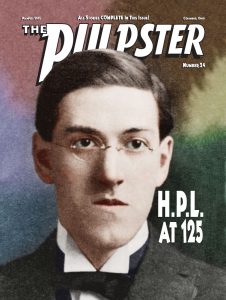 Except for “Sunday Only” attendees, all PulpFest 2015 members—including supporting members—received a complimentary copy of The Pulpster #24.
The issue’s highlight is a round-robin article on H. P. Lovecraft and WEIRD TALES. It features contributions from filmmaker Sean Branney; Marvin Kaye, the current editor of WEIRD TALES W. Paul Ganley, founder of WEIRDBOOK, and Derrick Hussey, the publisher at Hippocampus Press; authors Jason Brock, Ramsey Campbell, Cody Goodfellow, Nick Mamatas, Tim Powers, Wilum Pugmire, Jessica Amanda Salmonson, Darrell Schweitzer, and Chet Williamson; poet Fred Phillips; pulp scholars and collectors John Haefele, Don Herron, Morgan Holmes, S. T. Joshi, Tom Krabacher, Rick Lai, Will Murray, and J. Barry Traylor. So expect a slam-bang issue from the esteemed editor of our highly popular program book.
Also featured in this year’s award-winning PulpFest program book are articles on Major Malcolm Wheeler-Nicholson, the pulp writer who founded DC Comics; the Thrilling Group of pulps and comics; DETECTIVE FICTION WEEKLY; Erle Stanley Gardner; and other topics.
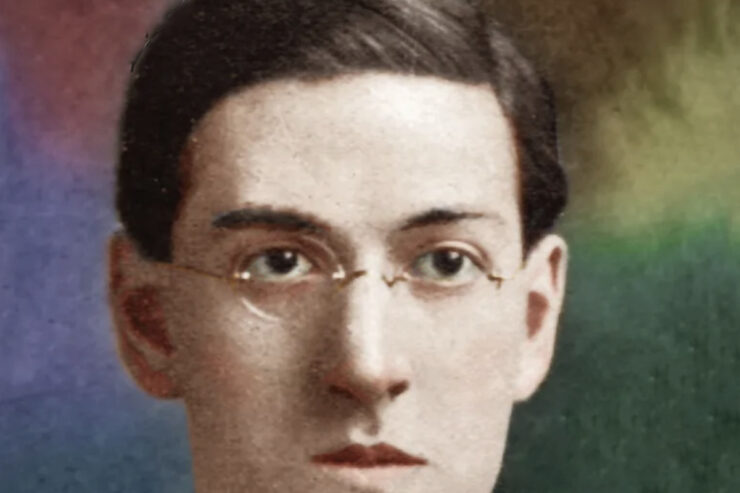
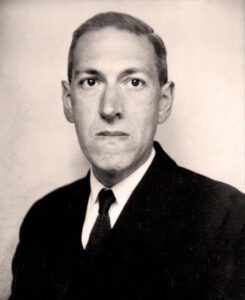
For the cover of The Pulpster #24, William Lampkin adapted and colorized a photograph of H. P. Lovecraft, taken around 1915, when the author was in his mid-twenties. The photograph also serves as our featured image.
PulpFest 2015 Dealers
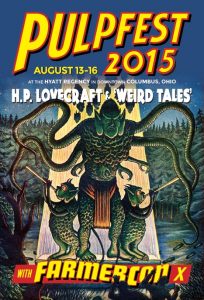 Although PulpFest is well known for its excellent programming, it is also lauded for its very substantial dealers’ room. Beginning Thursday, August 13, the 15,800-square-foot Regency Ballroom at the Hyatt-Regency Columbus will feature collectible pulp magazines and digests, vintage paperbacks, first-edition hardcovers and series books, original art, B-movies and serials, collectible comic books, and more. And remember, members staying at our host hotel can enjoy free early-bird shopping on Thursday evening from 6 to 10 PM.
Who will be selling at PulpFest 2015? Check out the names below:
Adventure House (John Gunnison), Age of Aces (Chris & David Kalb), Airship 27 Productions (Ron Fortier & Rob Davis), Jim & Walter Albert, Mark Alvarado, Jon Arfstrom (veteran Weird Tales artist), Battered Silicon Dispatch Box (George Vanderburgh), Jim Beard, Bold Venture Press (Rich Harvey & Audrey Parente), Gene Carpenter, Mike Catalano (aka Mike Hunchback) & Robyn Chapman, Nick Certo, Chaska Books (Jonathan Sweet), John L. Coker III, Jack Cullers, Curious Bookshop (Ray Walsh), Darkstar Books (Gary Diedriech), Dearly Departed Books (Scott & Linda Edwards), Dreamhaven Books (Greg Ketter), David Earle, Doug Ellis & Deb Fulton, Fantasy Publishing (Dick & Norma Enos), Bob Flowers, Martin Grams, Larry “Doc” & Jasper Grubb, Mark Halegua, Rick Hall, Scott Hartshorn, Heartwood Auctions (Richard Meli & Kara Accettola), Paul Herman, Heroes & Games (Doug Simms), Mark Hickman, Kubik’s Fine Books (Owen Kubek & Rachell Chilton), Brian Livingston, Ren McKinzie, John McMahan, Walker Martin, William Patrick Maynard, Meteor House, Mike Chomko Books, Murania Press (Ed Hulse), Will Murray, Phil & Holly Nelson, Jerry Ohlinger’s Movie Materials (Barbara Fister-Liltz & William Hunt), Craig Poole, Garyn & Virginia Roberts, Sanctum Books (Anthony Tollin), David Saunders, Duane Spurlock, Tim’s Books (Tim Paxton), Barry Traylor, Sheila Vanderbeek, Wilson Warneld, Jon Wehler, Chuck Welch, Chet Williamson, and Dave Willoughby.
William Lampkin adapted the PulpFest 2015 postcard from Matt Fox’s cover for the November 1944 issue of Weird Tales.
Thursday, August 13, 2015
Pulpcraft: Espionage in The Shadow Magazine—fans of The Shadow’s pulp adventures know his mysterious background, including his service as a spy during the First World War; membership in The Seventh Star, the secret Russian intelligence service; and his network of agents in his war on crime. Fans may also know raconteur Walter B. Gibson, who used his background in magic tricks and stage illusions to infuse his pulp stories with mystery and misdirection. But the greatest trick Gibson ever pulled may have been inserting real-world spy techniques into The Shadow’s pulp adventures, and misdirection kept readers’ minds clouded—until now!
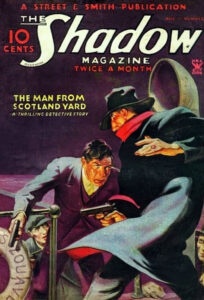 Join Tim King for a rapid-fire presentation on Thursday evening, August 13, about Gibson’s use of real-world counterintelligence and espionage secrets in the pulps. For longtime fans and new readers alike, Tim will highlight select espionage techniques Gibson hid in plain sight while writing as Maxwell Grant. Beyond authoring 283 of the 325 novels for Street and Smith while pounding Smith-Corona typewriters into submission, Walter Gibson may have been secretly showcasing advanced, insider knowledge of espionage methods!
Tim King is a career counterintelligence officer who has worked for the United States Intelligence Community and Fortune 500 companies. Trained in the shadowy arts of human intelligence, spy and counterspy, Tim was introduced to The Shadow through the radio. His love of the character led him to the comics and then the original pulps. Among other things, his membership in the Office of Strategic Services Society and the Society of American Magicians makes him uniquely qualified to explore this previously hidden element of The Shadow.
Agent networks! Secret writing! Intelligence collection! Clandestine communication! Chalk? You may never view The Shadow’s pulp adventures the same way again!
In “The Man from Scotland Yard,” originally published in The Shadow Magazine for August 1, 1935, the Master of Darkness teams with Scotland Yard’s Eric Delka to investigate an international spy ring. The police inspector and the Dark Avenger would meet again in the December 1, 1935 issue as they worked to recover missing submarine plans stolen by the legendary Parisian super-criminal, Gaspard Zemba. George Rozen painted the covers for both issues of the Street & Smith hero pulp.
Thrilling Detectives—Three Gun Terry Mack was the world’s first hard-boiled private eye. The creation of Carroll John Daly, Terry appeared in a pair of stories featured in THE BLACK MASK in 1923 and 1924. He was soon supplanted by Daly’s best-known detective, Race Williams, who debuted in the June 1, 1923 issue of the magazine that would become synonymous with the hard-boiled detective story.
THE BLACK MASK was not the only rough-paper magazine where tough-guy detectives made their home. When Popular Publications launched its line of ten-cent pulps, it got the ball rolling with DIME DETECTIVE MAGAZINE, another classic in the hard-boiled periodical line. Ned Pines’ Standard Magazines was right there with Steeger and Goldsmith, launching its own pulp chain with THRILLING DETECTIVE in the same month. The first issues of Popular’s and Pines’ new periodicals were dated November 1931.
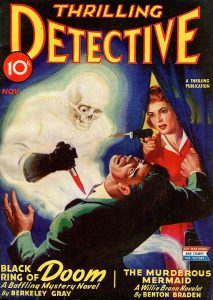 “Action-packed, well-written and well-planned stories. Novels must be of the trip hammer type, with a murder in the first chapter and others later.” Those were the editorial requirements set forth by THRILLING DETECTIVE in a 1933 issue of THE WRITER. Although they were not always well written or planned, no one could fault the magazine for a lack of action … or corpses. Under the guidance of managing editor Leo Margulies and his hand-picked staff, THRILLING DETECTIVE ran “rough-and-tumble, corpse-ridden yarns” featuring “suitably hard-nosed and hard-boiled detectives.” As Margulies often opined, his line was “the fastest bunch of all pulps.”
On Thursday evening, August 13, John Wooley and John Gunnison pay a visit to some of the continuing characters from the Thrilling line of detective pulps: Doctor Coffin, the allegedly dead Hollywood actor turned vigilante, created by pulp and film writer Perley Poore Sheehan; the workaday detectives such as department store detective Don Marko, the creation of Stewart Sterling (whose real name was Prentice Winchell); the extremely prolific Robert Leslie Bellem’s Hollywood gumshoe Nick Ransom who, like his better known counter-part Dan Turner, “torches a gasper” or “sets fire to a coffin nail” when he lights a cigarette; and the bindlestiff crimefighter, Baghdad, Hobo Detective, written by Milton Lowe and featured in a pair of stories that ran in POPULAR DETECTIVE.
Then we’ve got the wartime creation of “Walt Bruce,” an allegedly Chinese crimefighter known as Dr. Zeng who is actually the son of white missionary parents. Written by Bellem and W. T. Ballard, the Zeng stories came about with encouragement from the Office of War Information, which thought playing up our Chinese allies in stories was a wonderful idea. Dr. Zeng’s sidekick, Lai Hu Chow, who is actually Chinese, has an artificial leg that he uses to carry weapons and other useful stuff.
Of course, there’s also Race Williams, a one-time BLACK MASK big dog who famously boosted the magazine’s sales every time he appeared on the cover. The end was coming into sight for Race and his creator. Carroll John Daly moved into comic books after the pulps died out. Race appeared in a handful of stories published in THRILLING DETECTIVE before he found his way into SMASHING DETECTIVE STORIES during the early fifties.
John Wooley is the author, co-author, or editor of more than thirty books, including the recent HARD-BOILED CHRISTMAS STORIES. John also penned the script for the made-for-TV movie DAN TURNER, HOLLYWOOD DETECTIVE, the award-winning independent film CAFE PURGATORY, and the documentary BILL BOYCE–MONEY ACTOR. He has also written comic books, trading cards, and thousands of magazine and newspaper stories, most of them alongside his work as the music and horror-movie writer for the TULSA WORLD, a position he held from 1983 through 2006. He is currently a contributing editor and columnist for OKLAHOMA MAGAZINE and a full-time freelance writer specializing in pop-culture subjects. This year, he was inducted into the Oklahoma Historians’ Hall of Fame.
John Gunnison is one of the world’s foremost pulp dealers. He owns Adventure House, a firm that deals in pulp magazines and other paper collectibles and also publishes pulp replica editions and other material, including the much-admired HIGH ADVENTURE. John is the author of BAUMHOFER: PULP ART MASTER and BELARSKI: PULP ART MASTER, and co-author of THE ADVENTURE HOUSE GUIDE TO THE PULPS, one of the foremost reference works concerning pulp magazines. For Collectors Press, he helped design Frank M. Robinson’s PULP CULTURE, Max Allan Collins’ HISTORY OF MYSTERY, Ron Goulart’s COMIC BOOK CULTURE, and other works. John was formerly the editor and publisher of THE PULP COLLECTOR, a leading pulp fanzine in its day.
Another leading author to appear in Thrilling Detective and other Standard detective pulps was Benton Braden. One of the author’s stories appears in the issue pictured above, the November 1943 number of Thrilling Detective. The cover art is by George Rozen.
Hey Kids, Comics!—when Street & Smith released its first comic book in January 1940, the four-color industry was six years old. The Eastern Color Printing Company started the industry in 1934, and Major Malcolm Wheeler-Nicholson strengthened it the next year; the comic book market exploded after Superman’s introduction in 1938 and Batman’s in 1939. Although its iconic pulp heroes–Doc Savage and The Shadow–helped inspire the creation of these superheroes, the pulp magazine powerhouse waited to join the fledgling industry. Although it never became a leader of the industry–producing only 351 issues of comic books–the Street & Smith four-color line would create some of the best-selling books of the Golden Age of comics, racking up nearly three million issues a month in 1943.
PulpFest 2015 will mark the 75th anniversary of Street & Smith comic books on Thursday, August 13, with a multimedia presentation showcasing work by Walter Gibson, Theodore Sturgeon, Jack and Otto Binder, Edd Cartier, Bob Powell, George Tuska and Joe Maneely from some of the rarest comic book issues of the Golden Age of Comics. Panelists Will Murray, Tony Isabella and Michelle Nolan will join moderator Anthony Tollin to celebrate the 1940 comic book debuts of The Shadow, Doc Savage, Nick Carter, Bill Barnes, The Avenger, Iron Munro, Carrie Cashin and The Whisperer.
The panel will also discuss the 1942 Bill Barnes comic story that predicted the U-235 atomic bombing of Japan, the most successful sports comic book of all time–TRUE SPORT PICTURE STORIES–and original Street & Smith comic book features including Blackstone: Super Magician, Supersnipe, Red Dragon, Ajax the Sun Man, Hooded Wasp and the adventures of Little Nemo in Slumberland by Otto Binder and Robert Windsor McCay.
 Tony Isabella is an American comic-book writer, editor, artist and critic, best known as the creator and writer of DC Comics’ first major African-American superhero, Black Lightning, and the co-creator of Marvel’s Misty Knight and Tigra. He is the author of 1000 COMIC BOOKS YOU MUST READ, a history of the American comic book industry wrapped around commentaries on more than a thousand comic books from 1938 to the present. The first in a series of memoirs of sorts will be published later this year. His latest views and reviews can be found at the nigh-daily Jenny Blake’s Bloggy Thing.
Will Murray is a noted scholar of American popular culture, having written hundreds of essays on the pulps, comic books, motion pictures, and more. He is the author of “The All-New Wild Adventures of Doc Savage” and co-editor of Sanctum Books’ very successful pulp reprint series.
Michelle Nolan has been a newspaper and magazine feature writer for fifty years. She has written more than five hundred comics-related features for magazines such as COMIC BOOK MARKETPLACE, COMICS BUYER’S GUIDE, ALTER EGO, and COMIC BOOK ARTIST.
Anthony Tollin is an authority on comics, pulps, and old-time radio. A former colorist and assistant production manager for DC Comics, he is the editor-publisher of Sanctum Books and is responsible for hundreds of authorized reprints of Street & Smith’s Avenger, Doc Savage, Nick Carter, The Shadow, and The Whisperer. Winner of the 2011 Munsey Award, Anthony will soon be publishing a deluxe hardcover edition reprinting the entire two-year run of The Shadow newspaper comic strip.
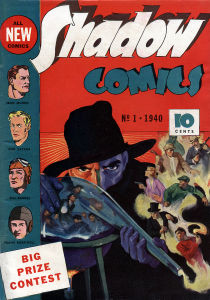
Street & Smith entered the comic book market in January 1940 by publishing an anthology title called Shadow Comics. In addition to the title character, the book also featured such pulp favorites as Doc Savage, Bill Barnes, Iron Munro, and Carrie Cashin. Dime novel stalwarts Frank Merriwell, Nick Carter, and Diamond Dick also appeared in the issue. The front cover art, created by George Rozen, originally appeared on the November 15, 1932 issue of The Shadow Magazine, illustrating Walter B. Gibson’s novel, “Dead Men Live.” Shadow Comics ran for 101 issues. Street & Smith canceled it in 1949 when it pulled the plug on all its pulps and comic books.
Saddle Up!—the western genre began with James Fenimore Cooper’s Leatherstocking Tales, a fictional adaptation of frontiersman Daniel Boone’s adventures. In the years following Cooper’s Natty Bumppo series, authors such as Bret Harte, Francis Parkman, and Mark Twain further expanded the field.
According to an essay by pulp scribe John A. Saxon, published in 1945 by WRITER’S DIGEST, the western story became a genre of its own during the second half of the 19th century. In 1869, writer Edward Zane Carroll Judson convinced hunter, scout, and showman William F. Cody to lend his name and reputation to a fictionalized account of his life, “Buffalo Bill, King of the Borderman,” originally serialized in Street & Smith’s NEW YORK WEEKLY. Phenomenally received, Judson found a public hungry for further adventures of the real-life hero of the American frontier. Thus started “. . . the fictionalized form of the Western story . . . based partly on fact, but mostly on imagination.”
Given the great success of Street & Smith’s Buffalo Bill tales, nickel weeklies and dime novels devoted to western heroes and outlaws soon followed: DEADWOOD DICK LIBRARY, DIAMOND DICK LIBRARY, JAMES BOYS WEEKLY, KLONDIKE KIT LIBRARY, WILD WEST WEEKLY, and more. Dime novel westerns and stories featuring detective heroes such as Nick Carter and Old Sleuth and sports heroes such as Frank Merriwell reigned supreme for nearly forty years. Then, after Frank A. Munsey introduced the pulp magazine in 1896, story papers and dime novels gave way to these more economical, rough-paper periodicals.
The first all-western pulp magazine was introduced by Street & Smith when they converted their tired old story paper, NEW BUFFALO BILL WEEKLY, to WESTERN STORY MAGAZINE in 1919. Within a year, the magazine reached a circulation of 300,000 copies per issue and became a weekly, a status it enjoyed for the next twenty-five years. Soon thereafter, the magazine began publishing the western fantasies of poet-turned-pulp writer Frederick Schiller Faust – better known as Max Brand – and really took off. By the late 1920s, WESTERN STORY was competing against countless imitators – ACE-HIGH, COWBOY STORIES, FRONTIER, GOLDEN WEST, LARIAT, NORTH-WEST STORIES, RANCH ROMANCES, WEST, and others.
With the collapse of the world economy in 1929 and spare change hard to come by, ten-cent western pulps flooded the market. Introduced by Popular Publications in late 1931 when they debuted DIME WESTERN MAGAZINE, other companies followed suit with their own ten-cent western fiction magazines. One of these firms was Ned Pines’ Standard Magazines, with managing editor Leo Margulies riding herd over the new publisher’s Thrilling Group.
Although Margulies seemed to be forever complaining that western writers were “deceiving themselves in the belief that all a Western story needed was plenty of gun slinging; plenty of people killed; plenty of fights, but never mind a good reason,” his line of western pulps featured “. . . thrilling tales of the gallant West where danger lurks, and cowboys are supermen.” According to pulp scholar John Dinan, Standard’s typical western superhero “could absorb more than his share of punishment” and was “characterized by immediate action in response to a dilemma or conflict which was always external.”
 On Thursday, August 13th, Ed Hulse will explore the Standard line of western superhero pulps, from TEXAS RANGERS, launched in 1936 and featuring the “Lone Wolf” Ranger, Jim Hatfield; to MASKED RIDER WESTERN MAGAZINE, purchased from Ranger Publications in 1938 and starring Wayne Morgan, “the Robin Hood of the West;” to RANGE RIDERS and its “stories of western avengers in action;” to THE RIO KID WESTERN, a pulp that featured “the fictional exploits of the Kid . . . interwoven with actual historical characters;” to WEST and its lengthy series featuring Johnston McCulley’s Zorro; and HOPALONG CASSIDY’S WESTERN MAGAZINE, featuring Louis L’Amour’s blend of Clarence E. Mulford’s original character with the movie version popularized by actor William Boyd. Ed will also be touching on such characters as Alamo Paige, Navajo Raine, and W. C. Tuttle’s Tombstone and Speedy, all featured in EXCITING WESTERN, and A. Leslie Scott’s Texas Ranger Walt Slade, whose adventures ran in Standard’s flagship western title, THRILLING WESTERN.
For decades, Ed Hulse has been scouring the back alleys and deserted farmhouses of his home state of New Jersey, searching for old pulps and 16mm prints of vintage motion pictures. Not content with what he found in Jersey, he began rummaging through boxes of old pulp magazines in places as far away as Singapore and Kodiak, Alaska, trying to find a pulp that measures up to his lofty standards. When not sifting through eBay listings, Ed works as a freelance journalist.
One of the founders of PulpFest, Ed has helped organize pulp and film conventions for many years. He’s the guy who runs the movie projector at the Windy City Pulp and Paper Convention, publishes BLOOD ‘N’ THUNDER – the leading pulp and popular culture fanzine of our day and age – and Murania Press books such as J. Allan Dunn’s THE ISLAND and his own HANDSOME HEROES AND VICIOUS VILLAINS. Additionally, Ed has written extensively about both pulp and motion pictures. His THE BLOOD ‘N’ THUNDER GUIDE TO PULP FICTION should be on the bookshelves of every pulp collector. Ed’s publications are available through Amazon.com and other fine booksellers. In 2007, Ed received the Lamont Award for his exceptional work for the pulp community.
“Saddle Up! Thrilling’s Western Heroes” will begin at 9:20 PM on Thursday, August 13, on the second floor of the Hyatt-Regency hotel in downtown Columbus, Ohio. It’s all part of this year’s “Salute to Standard Magazines,” taking place at PulpFest 2015.
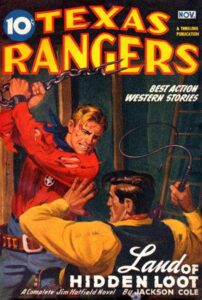
Texas Rangers was by far the most successful western pulp magazine devoted to a single character. Launched in 1936 to commemorate the centennial of the historical Texas Rangers, the magazine ran for over twenty years and totaled 206 issues (more than any other single-character pulp except The Shadow). A. Leslie Scott and Tom Curry wrote many of the lead novels under the house name Jackson Cole. Don Hutchison’s history of the single-character magazines, The Great Pulp Heroes, includes an excellent chapter on Standard’s western superheroes. Pictured above is the November 1946 issue of Texas Rangers, featuring front cover art by Sam Cherry.
To learn more about the evolution of the pulp western, read John Dinan’s The Pulp Western, Ron Goulart’s Cheap Thrills, and Will Murray’s Wordslingers.
Play Ball! A Look at the Sports Pulps—although sports have long been part of our history, Native Americans are known to have played a primitive form of lacrosse; it was not until 1896, with the introduction of Gilbert Patten’s Frank Merriwell, that sports became established in American popular fiction. From 1896 through 1916, Frank and his relatives appeared in more than 1,000 issues of Street & Smith’s story paper TIP TOP WEEKLY and its successors. After the nickel weekly’s demise, the Merriwells’ adventures continued elsewhere in the Street & Smith line of publications, including TOP-NOTCH MAGAZINE and SPORT STORY MAGAZINE, the first all-sports pulp magazine. All told, the publishing giant released more than 500 million copies of Merriwell periodicals over the years.
The first issue of SPORT STORY MAGAZINE, dated September 8, 1923, sold for 15¢ and contained a variety of sports fiction, ranging from baseball, boxing and horse racing to polo, auto racing and tennis stories. Except for the occasional yarn in the general-fiction pulps such as ARGOSY and BLUE BOOK, SPORT STORY would have the market to itself for most of the next five years. Another sports pulp didn’t emerge until FIGHT STORIES debuted in the spring of 1928. Unlike SPORT STORY, the Fiction House pulp focused solely on boxing stories.
With the collapse of the world economy in 1929, the sports pulp market would remain relatively stagnant during the early years of the Great Depression. It would not be until the summer of 1935 and the introduction of DIME SPORT MAGAZINE by Popular Publications that the genre would begin to take off. Over the next five years, twenty-five new sports pulp titles would reach American readers. One of the leading publishers in the rapidly expanding market would be Ned Pines’ Standard Magazines, also known as the “Thrilling Group” of pulps. From 1936 through 1953, Pines’ company would publish about 230 issues of its sports pulps.
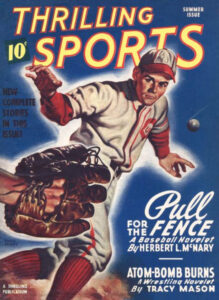 Standard’s foray into the sports pulp market began much like Street & Smith’s. THRILLING SPORTS, introduced in the fall of 1936, featured a wide range of sports fiction, from baseball and football yarns to track-and-field stories and hockey and horse-racing tales. It likewise featured a variety of authors, including western writers Tom Curry, Giles Lutz, and in later years, Louis L’Amour; science-fiction stalwarts Nelson Bond, Ray Cummings, and Oscar Friend; detective dramatists William Campbell Gault, Richard Sale, and Robert Leslie Bellem; and aviation addicts Joe Archibald, George Bruce, and Robert Sidney Bowen. Standard would follow its “Thrilling” title with POPULAR SPORTS MAGAZINE in 1937 and EXCITING SPORTS in 1940. It would enter the specialty sports market – long the province of Fiction House – in the fall of 1939 with THRILLING FOOTBALL. POPULAR FOOTBALL and EXCITING FOOTBALL would follow in 1941.
Like all of the Thrilling titles of the time, the sports magazines were under the guidance of managing editor Leo Margulies–himself a topic at this year’s PulpFest–who wrote:
“The wide field of sports is covered by our magazines … Every branch of amateur, professional, and collegiate athletics is covered; mature and vigorous stories, with real people and a hero facing a realistic problem. Human interest and women’s interest are both desirable – for the stories should be slices of life. Solid story structure must bolster any sport angle. No sport story should ever be so nearly plotless as to read like a newspaper report of a game. Naturally, sport scenes must not be ignored to build up plot, but the plot should be forwarded by them, should grow out of the sport conflict, whether the story is told from the point of view of the hero, the trainer, the coach or an observing friend … Be meticulously careful about the authenticity of the sport material. Keep the story adult! American readers are essentially sport-minded. They are eager for good sports stories, whether about baseball, football, swimming, horse racing, motorboat racing, water polo, golf, tennis, rowing, track, boxing, or any other sports that keep young and old Americans out in the open rooting for their favorite exponents of their favorite game.”
Please join PulpFest 2015 on Thursday evening, August 13, as we welcome journalist Michelle Nolan to discuss the evolution of the sports pulps. Ms. Nolan has been a newspaper and magazine feature writer for fifty years, covering human-interest features, pop culture, and sports. She has written more than five hundred comics-related features for magazines such as COMIC BOOK MARKETPLACE, COMICS BUYER’S GUIDE, ALTER EGO, and COMIC BOOK ARTIST. She wrote 100 consecutive “Nolan’s Notebook” columns for COMIC BOOK MARKETPLACE from 1993 to 2005. She has contributed to dozens of books and wrote the groundbreaking book LOVE ON THE RACKS: A HISTORY OF AMERICAN ROMANCE COMICS, published by McFarland in 2008. She is also the author of BALL TALES: A STUDY OF BASEBALL, BASKETBALL, AND FOOTBALL FICTION OF THE 1930S THROUGH 1960S, published by McFarland in 2010. She received an Inkpot Award for her work at the 2014 San Diego Comic-Con.
“Play Ball: A Look at the Sports Pulps” will begin at 10:50 PM on August 13. Register for “Summer’s Great Pulp Con” so you don’t miss the first pitch.
The image featured above is by Earle K. Bergey, a freelance artist best known for his science fiction covers. However, he painted many sports covers for both the Thrilling Group and other pulp magazine publishers. The issue pictured is Thrilling Sports for Summer 1946.
Out of Mind—although he died a virtual pauper, Howard Phillips Lovecraft is now celebrated worldwide as one of the leading practitioners of the horror story. Called “The Copernicus of the horror story” by Fritz Leiber and “The twentieth century’s greatest practitioner of the classic horror tale,” by Stephen King, Lovecraft was able to effectively blend elements of the supernatural tale with the concepts of science fiction to create what has been termed the tale of cosmic terror. Some call it the “Cthulhu Mythos” and others the “Lovecraft Mythos,” but his ideas inspired many talented writers of his day — Robert Bloch, August Derleth, Robert E. Howard, Henry Kuttner, Frank Belknap Long, Clark Ashton Smith, and others—to develop stories in the same vein. Today, his ideas continue to reverberate, influencing authors, artists, filmmakers, game designers, and other creators as they add to Lovecraft’s Mythos.
 In August, PulpFest 2015 will be celebrating the 125th anniversary of H. P. Lovecraft’s birth. As part of its salute, the convention will be offering several films as part of its nightly programming. Opening its “Lovecraft at the Movies” series will be an hour-long picture directed by Raymond St-Jean, which originally aired on Canada’s Bravo cable network.
Almost universally praised, OUT OF MIND features Christopher Heyerdahl as the author himself, speaking into the camera to create the illusion that the viewer is watching a lost newsreel of Lovecraft. Drawing on his fiction, essays, and the voluminous correspondence Lovecraft wrote during his lifetime, Heyerdahl discusses the author’s life, vision, and work.
Melding its imagined documentary of Lovecraft with a story about a contemporary artist who inherits a copy of Abdul Alhazred’s NECRONOMICON–the fictional book described by Lovecraft that generally brings a premature and undesirable end to those who explore it–OUT OF MIND is one of the most admired films inspired by the master of the cosmic terror tale.
Leading off PulpFest’s “Lovecraft at the Movies” series at 11:30 PM on Thursday, August 13th, OUT OF MIND will be preceded by “Pickman’s Model,” a short film made for ROD SERLING’S NIGHT GALLERY and based on the Lovecraft work of the same title.
Lucius B. Truesdell photographed H. P. Lovecraft in June 1934 in De Land, Florida.
Friday, August 14, 2015
The New Fictioneers—Friday afternoon programming was largely set aside for “New Fictioneers” readings. These featured contemporary writers reading from their recent works and fielding audience questions and comments. To learn more about PulpFest’s “New Fictioneers” readings, click here. Additionally, a presentation on “The Pulp Magazines Project” started at 3 PM.
Pulps in the Digital Age—The Pulp Magazines Project is an open-access digital archive dedicated to the study and preservation of the all-fiction pulpwood magazine. It also provides information on the history of this important but long-neglected medium, along with biographies of pulp authors, artists, and their publishers. Belk launched the site in July 2011. Since then, it has received over 650,000 page views from 182 countries around the world.
At the heart of The Project’s mission is an archive of more than 300 individual issues of pulp magazines, representing 85 different titles from the United States, England, and Australia. It consists of full-text, cover-to-cover scans made directly from the original pulp-paper magazines. The scans have been cross-checked against multiple sources to ensure integrity, and are stored and shared across multiple servers to maintain long-term availability and use. Over time, The Pulp Magazines Project archive will continue to expand, as new magazines are digitized and new contextual materials are added.
The Project is dedicated to fostering ties among collectors, fans, and academics devoted to pulp magazines, and will offer opportunities for research and collaboration for scholars and enthusiasts alike. We will provide information on upcoming conferences and conventions, and promote new working relationships between academics and the hundreds of pulp fans, scholars, and collectors beyond the college and university.
If you have a question or comment about The Pulp Magazines Project, please send an email to info@pulpmags.org. Patrick Scott Belk,, an Andrew Mellon Postdoctoral Fellow in Digital Humanities at Dickinson College in Pennsylvania, and Nathan Madison, a researcher at the American Civil War Center in Virginia and author of the Eisner-nominated ANTI-FOREIGN IMAGERY IN AMERICAN PULPS AND COMICS, will also be happy to take your questions and comments about The Project following their presentation.
Cthulhu is Calling You to PulpFest’s Gaming Track—at PulpFest 2015, the convention premiered a new gaming track for attendees who enjoyed role-playing games and the like. It ran on Friday and Saturday, from 10 AM until 10 PM. On Sunday, games began at 10 AM and continued until the end of the convention.
In late summer 1926, H. P. Lovecraft wrote “The Call of Cthulhu.” Initially rejected by WEIRD TALES editor Farnsworth Wright, it was first published in “The Unique Magazine” in its February 1928 issue. Although a few related stories predated it – “The Nameless City,” “The Hound,” and “The Festival” – in what has come to be known as “The Cthulhu Mythos,” “The Call of Cthulhu” is a seminal work of its author. As writer and Lovecraft correspondent Fritz Leiber observed, “Here for the first time, Lovecraft moves horror from the realm of Earth to the stars.”
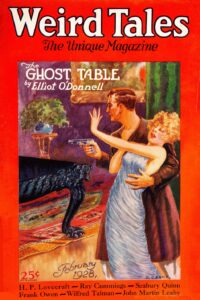 In Lovecraft’s remaining years following the publication of “The Call of Cthulhu,” he expanded on its themes in such tales as “The Whisperer in Darkness,” “At the Mountains of Madness,” and “The Shadow Out of Time,” depicting a universe of mind-numbing horror and reflecting his own materialistic atheism. During his last years, Lovecraft invited other writers to pen their own tales using the “synthetic folklore” he had created. “I think it is rather good fun to have this artificial mythology given an air of verisimilitude by wide citation.” Authors who responded with their own “Cthulhu” fiction included Clark Ashton Smith, Robert E. Howard, Robert Bloch, Frank Belknap Long, and Henry Kuttner.
After the death of “the old gentleman,” August Derleth worked to expand Lovecraft’s so-called “mythos,” shaping it in ways some scholars believe corrupted the original author’s intent. Derleth’s “Cthulhu Mythos,” as the story-type came to be known, shifted away from Lovecraft’s nihilistic universe toward a more ”good versus evil” theme. Other writers, notably Lin Carter and Brian Lumley, continued this process.
Although Derleth may have corrupted Lovecraft’s “synthetic folklore,” he also helped popularize the author’s fiction through Arkham House Publishers and significantly expand Lovecraft’s reputation. His visions increasingly came under academic scrutiny. His fiction became more widely known and popular, leading to adaptations across a variety of media. All of this came to a head in 1981 when a wargame and role-playing-game publisher known as Chaosium released the first edition of CALL OF CTHULHU, a game developed by Sandy Peterson. It is now in its seventh edition and will be featured in PulpFest‘s new gaming track.
Based on H. P. Lovecraft’s observation that “The oldest and strongest emotion of mankind is fear, and the strongest kind of fear is fear of the unknown,” the setting of Chaosium’s CALL OF CTHULHU is a darker and stranger version of our world, where the players try to hold back the darkness. The original game is set in the 1920s, the setting of many of Lovecraft’s stories. There have been numerous interesting adventures written for the game system over the years, including the CTHULHU BY GASLIGHT supplement, a blend of occult and Holmesian mystery set in Victorian England; CTHULHU DARK AGES that takes place about 1000 AD; CTHULHU RISING and its 23rd-century setting; and CTHULHU INVICTUS, which takes place in the first century at the time of the Roman Empire.
Whatever the setting, players take on the roles of detectives, criminals, scholars, artists, war veterans, and others who are drawn into the realm of the mysterious. Often, events begin innocently enough until more and more of reality’s true nature is revealed. As players experience more of the world’s true horrors and humanity’s irrelevance, their sanity inevitably withers. The fun of these games comes from assuming roles different from everyday life and sometimes making choices one would not make in reality.
CALL OF CTHULHU has a reputation as a game in which it is quite common for a player character to die in gruesome circumstances or end up in a mental institution. The players’ eventual triumph is not guaranteed. However, dying heroically or going insane is part of the fun. But who knows? You may gain the tools you need to defeat the creatures of the night – mystical knowledge and magic – and outsmart your opponents. As H. P. Lovecraft wrote in 1926, “The most merciful thing in the world, I think, is the inability of the human mind to correlate all its contents.”
Many thanks to Chaosium, the publisher of Call of Cthulhu, one of the world’s most recognized role-playing games, for donating a selection of books and role-playing-game supplements as prizes for PulpFest’s new gaming track.
The cover for the February 1928 issue of Weird Tales, with art by C. C. Senf, illustrates our post. The issue included H. P. Lovecraft’s “The Call of Cthulhu.”
Evening Presentations
The Little Giant of the Pulps—soon after The American News Company asked Ned Pines to start a chain of pulp magazines it would distribute for him, the young publisher approached former literary agent and Frank A. Munsey employee Leo Margulies to serve as managing editor of the new enterprise. With the country gripped by the Great Depression, the two men came up with a daring idea for the rough-paper market – a ten-cent pulp magazine.
Standard Magazines, better known as “The Thrilling Group,” launched THRILLING DETECTIVE, THRILLING ADVENTURES, and THRILLING LOVE in late 1931, each selling for a dime. Within two years, the line was expanding, first with THE PHANTOM DETECTIVE, followed by THE LONE EAGLE, SKY FIGHTERS, THRILLING RANCH STORIES, and THRILLING WESTERN. As Standard grew, Leo Margulies became the company’s face.
Margulies was born on June 22, 1905, and raised in Brooklyn, New York. After briefly attending Columbia University, he began working for the Munsey magazine chain, selling subsidiary rights to its stories. His mentor was legendary editor Bob Davis, who published many early works by Max Brand, Edgar Rice Burroughs, Ray Cummings, George Allan England, A. Merritt, and other popular writers.
After Davis left the pulp industry, Margulies started a literary agency with a colleague. He later worked as head of East Coast research for Fox Films; helped to establish Tower Magazines, sold exclusively through Woolworth’s; and founded his own literary agency. After joining Ned Pines’ new publishing venture, he developed a reputation “. . . not only for quick decisions on buying stories but also for swift payment, which made him a writers’ favorite.”
Respected by authors and editors alike, Margulies became known as “The Little Giant of the Pulps.” As author and screenwriter Steve Fisher described in an article written for a writer’s magazine, “. . . there was a sudden silence. Fifty people stopped eating and looked up. Leo Margulies made his usual dramatic entrance. . . . I thought for a moment (American Fiction Guild) president Art Burks was going to leap to his feet and salute.”
 During World War II, Margulies enlisted as a war correspondent. He was on board the USS Missouri when the Japanese surrendered. Returning to the USA, he helped launch the Popular Library line of paperback books. In the early fifties, following a lengthy trip to Europe, Leo Margulies left Ned Pines’ employ and started a new publishing venture, King-Size Publications. He returned to the fiction market with two digest magazines — THE SAINT DETECTIVE MAGAZINE and FANTASTIC UNIVERSE.
In later years, he established MIKE SHAYNE MYSTERY MAGAZINE, THE MAN FROM U.N.C.L.E. MAGAZINE, ZANE GREY’S WESTERN MAGAZINE, and other fiction digests. He also revived WEIRD TALES in 1973-1974, for four issues, edited by Sam Moskowitz. Leo Margulies died on December 26, 1975, at the age of seventy-five.
As part of its tribute to Ned Pines’ Standard Magazines, PulpFest 2015 will welcome Leo Margulies’ nephew, Philip M. Sherman, to the convention to discuss his uncle Leo on both a personal and professional level. “Not only was Leo an outstanding editor and publisher . . . he was also an outstanding uncle,” Mr. Sherman writes. Philip – who is working on a biography of his uncle – will discuss Margulies’ relationship with his own family as well as the “Little Giant’s” relationship with writers, as expressed in his personal correspondence. Mr. Sherman, the son of Margulies’ sister Ann, will also be sharing family photos of his Uncle Leo as well as excerpts from letters written by the managing editor of Standard Magazines.”
Joining Mr. Sherman on stage will be popular culture scholars Ed Hulse, editor of BLOOD ‘N’ THUNDER, and Will Murray, author of “The Wild Adventures of Doc Savage and Tarzan” from Altus Press. After Mr. Sherman’s intimate presentation on his uncle, the three will discuss the unique methods Margulies used to manage the Thrilling chain of pulp magazines. The convention would like to thank former organizing committee member Ed Hulse for helping to arrange Philip M. Sherman’s appearance at PulpFest 2015.
“Leo Margulies: The Little Giant of the Pulps” will begin at 7:10 PM on Friday evening, August 14. Join “Summer’s Great Pulp Con” so you don’t miss this historic presentation.
About six years after Margulies’ death, Mike Shayne Mystery Magazine, one of the magazines the longtime editor founded after leaving the Thrilling Group, ceased publication, just seven shy of its 300th issue. In its final year, it ran a seven-part series on pulp heroes written by mystery author Michael Avallone, creator of private eye Ed Noon. Featured in the September 1981 issue–with a cover by Merle Keller–was Avallone’s tribute to The Phantom Detective, the first hero pulp published by Leo Margulies for Standard Magazines.
Chet Williamson—our guest of honor for PulpFest 2015 has collected pulps ever since college. The first pulp he ever bought was the August 1935 WEIRD TALES – pictured here with front cover art by the incomparable Margaret Brundage. The issue’s lead story was Paul Ernst’s first Doctor Satan story. Our guest found a copy of the pulp for $4 at an old magazine shop and never looked back.
He became interested in H. P. Lovecraft as a kid and has remained a devotee ever since. He attended the first World Fantasy Convention in Providence in 1975. There he met all the “younger” Lovecraftians, then in their sixties and seventies. He remains well-versed in Lovecraftiana and HPL scholarship today. He has even written a few Lovecraftian stories: “From the Papers of Helmut Hecker,” appeared in LOVECRAFT’S LEGACY, edited for Tor Books by Robert E. Weinberg and Martin H. Greenberg; and “Appointed,” for S. T. Joshi’s BLACK WINGS II, published by PS Publishing.
Our PulpFest 2015 guest of honor, Chet Williamson, has written in horror, science fiction, and suspense since 1981. Among his many novels are SECOND CHANCE, HUNTERS, DEFENDERS OF THE FAITH, ASH WEDNESDAY, REIGN, and DREAMTHORP. His forthcoming books include THE NIGHT LISTENER AND OTHERS, a story collection from PS Publishing; A LITTLE BLUE BOOK OF BIBLIOMANCY, a collection from Borderlands Press; and PSYCHO: SANITARIUM, an authorized sequel to Robert Bloch’s classic novel. St. Martin’s Press will publish it.
Over one hundred of Mr. Williamson’s short stories have appeared in such magazines as THE NEW YORKER, PLAYBOY, ESQUIRE, THE MAGAZINE OF FANTASY AND SCIENCE FICTION, and many other magazines and anthologies. He has won the International Horror Guild Award, and has been shortlisted twice for the World Fantasy Award, six times for the Horror Writers Association’s Stoker Award, and once for the Mystery Writers of America’s Edgar Award. Nearly all of his works are available as e-books on Amazon’s Kindle Store and through Crossroad Press.
A stage and film actor–his most recent appearance is in Joe R. Lansdale’s film, CHRISTMAS WITH THE DEAD – he has recorded over forty unabridged audiobooks, both of his own work and that of many other writers, available via Audible.
 Our guest of honor will be presenting an informal lecture on Friday, August 14th, beginning at 7:55 PM. Mr. Williamson will be discussing his interest in the pulps and H. P. Lovecraft in particular. He will explain how “the old gentleman” of Providence influenced him in his writing as well as the writing of his peers in the world of modern horror fiction.
Chet will also be available on Saturday, August 15, at 1 PM to meet our members. He will be very happy to provide autographs.
The convention thanks organizing committee member J. Barry Traylor for arranging Chet Williamson’s appearance at PulpFest 2015. A longtime pulp fan, Lovecraft enthusiast, and professional writer and actor, Mr. Williamson is the perfect guest to help us celebrate H. P. Lovecraft’s 125th birthday and salute WEIRD TALES, “the unique magazine,” where most of Lovecraft’s work appeared.
You can follow Chet Williamson on Twitter @chetwill or on his homepage at www.chetwilliamson.com.
Our photograph of Chet Williamson is an official promotional headshot of the author, dating back to at least 2010. It is uncredited.
Special Guest, Weird Tales Artist Jon Arfstrom—thanks to Greg Ketter, proprietor of DreamHaven Books, PulpFest 2015 is pleased to welcome Jon Arfstrom as its special guest. Around 1950, Arfstrom began selling interior drawings to Ray Palmer’s MYSTIC MAGAZINE and OTHER WORLDS SCIENCE STORIES, William Crawford’s SPACEWAY, and Dorothy McIlwraith’s WEIRD TALES. For the latter, he also painted three covers, beginning with the January 1952 issue. He continued working for “The Unique Magazine” until it was discontinued in 1954. Click here to learn more about “The Last of the Weird Tales Artists.”
Beginning at 8:45 PM on Friday, August 14th, and following our guest-of-honor presentation by author Chet Williamson, please join pulp art historian David Saunders for a short interview with fantasy artist Jon Arfstrom, perhaps the last surviving artist to paint covers for the original run of “The Unique Magazine,” WEIRD TALES. Mr. Arfstrom will also have a table at the convention where he will display some of his original art. He will have a sampling of paintings and drawings, mostly from the 1970s onward, which he will sell at the convention. His table will be next to the DreamHaven Books display in the PulpFest 2015 dealers’ room.
Jon Arfstrom passed away on December 2, 2015. PulpFest was honored to host Mr. Arfstrom as a guest at our 2015 convention. Our condolences to the artist’s family.
The Weird Tales of Philip José Farmer—to most pulp enthusiasts, the late Philip José Farmer is best known as “A prolific and popular science fiction writer who shocked readers in the 1950s by depicting sex with aliens and challenged conventional pieties of the genre with caustic fables set on bizarre worlds of his own devising.” In science-fiction circles, Farmer is most remembered for his novels. Called “sprawling, episodic works that gave him room to explore the nuances of a provocative premise while indulging his taste for lurid, violent action,” his best were set in the Riverworld and World of the Tiers series. He was named a Grand Master of Science Fiction in 2001. To those who know and love him the best – the members of FarmerCon who first joined our convention in 2011 – Philip José Farmer is revered for his work concerning the Wold Newton Family. But what about Philip José Farmer, the horror writer? This year, as PulpFest celebrates the 125th anniversary of H. P. Lovecraft’s birth, it seems fitting that our FarmerCon friends turn their attention to Philip José Farmer, the writer of weird tales.
Farmer’s short story “The Freshman,” originally published in the May 1979 issue of THE MAGAZINE OF FANTASY & SCIENCE FICTION, is certainly the story that owes the most to Lovecraft. Set at the New Englander’s fabled Miskatonic University in Arkham, Massachusetts, it concerns a sixty-year-old occult novelist who enrolls at the university. Soon thereafter, he is invited to pledge at a fraternity called the House of Hastur. A fairly playful horror story, it was selected for the 1990 edition of Arkham House’s TALES OF THE CTHULHU MYTHOS.
 Other notable Farmer weird tales include such short stories as “Duo Miaule,” “Evil Be My Good,” “It’s the Queen of Darkness, Pal,” “Monolog,” “Nobody’s Perfect,” “Opening the Door,” “The Rise Gotten,” and “Wolf, Iron and Moth.” There are also the science-fiction/horror novels IMAGE OF THE BEAST and its sequel BLOWN. These concern a private detective who is led into a waking nightmare of sexual brutality and supernatural bestiality in a universe populated by erogenous vampires, werewolves, and other polymorphic creatures from the darkest recesses of the human imagination. Additionally, the collaborative novel THE EVIL IN PEMBERLEY HOUSE – written with Win Scott Eckert – is not only an addition to the Wold Newton cycle, but also plays with pulp and Gothic horror traditions. Finally, there are elements of Lovecraft’s Cthulhu Mythos to be found in his renowned classic DOC SAVAGE: HIS APOCALYPTIC LIFE and “The Monster on Hold,” the first chapter of an unfinished Doc Caliban novel that originally appeared in the World Fantasy Convention program book for 1983. Win Scott Eckert has agreed with the Estate of Philip José Farmer to complete this novel.
Help PulpFest and FarmerCon X celebrate H. P. Lovecraft’s lasting influence, less than a week before the 125th anniversary of his birth, by attending “The Weird Tales of Philip José Farmer” on Friday evening, August 14, at 9:10 PM. Featuring Jason Scott Aiken, Chuck Loridans, and Frank Schildiner, all leading scholars of popular culture and Farmerphilia, our FarmerCon X panel will take place in the second-floor programming area of “Summer’s Great Pulp Con” at the Hyatt Regency Columbus.
Jason Scott Aiken is a fantasy and horror writer and the host of Pulp Crazy, a blog and podcast dedicated to classic popular literature, characters, and themes. He has many episodes devoted to the works of Philip José Farmer and weird fiction from the pulp era. Chuck Loridans is a founding member of the New Wold Newton Meteoritics Society. He has appeared on panels with them at San Diego Comic-Con and ArchCon in St. Louis. His essay “The Daughters of Greystoke” appeared in MYTHS FOR THE MODERN AGE: PHILIP JOSÉ FARMER’S WOLD NEWTON UNIVERSE, published by MonkeyBrain Books. He teaches cartooning at the Renzi Education and Art Center in Shreveport, Louisiana, and serves as the art director for the Gaslight Players theatre group. Frank Schildiner is a “new pulp” author who has also published several articles on horror in comic books, television, and film, including essays on HELLBOY, the Frankenstein films, DARK SHADOWS, and television’s Lovecraftian links. His latest novel, THE QUEST OF FRANKENSTEIN, has Frankenstein’s monster meet H. P. Lovecraft’s Herbert West: Reanimator.
To learn more about Philip José Farmer, please visit The Official Philip José Farmer Web Page. It’s the Brobdingnagian collection of all things Farmerian!
Farmer’s Image of the Beast was originally published in 1968 by Essex House. Our image above is the first printing of the 1979 Playboy Press edition, featuring cover art by Enrich Torres.
The Call of Cthulhu and the Lovecraft Mythos—in late summer 1926, H. P. Lovecraft wrote “The Call of Cthulhu.” Initially rejected by WEIRD TALES editor Farnsworth Wright, it was first published in “The Unique Magazine” in its February 1928 issue. Although three related stories predated it — “The Nameless City,” “The Hound,” and “The Festival” — in what has come to be known as “The Cthulhu Mythos,” “The Call of Cthulhu” is a seminal work by its author. As writer and Lovecraft correspondent Fritz Leiber observed, “Here for the first time, Lovecraft moves horror from the realm of Earth to the stars.”
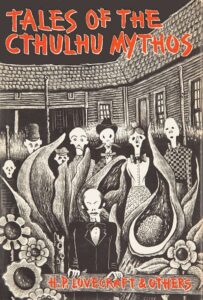 In the years remaining to Lovecraft following the publication of “The Call of Cthulhu,” he expanded on its themes in such tales as “The Whisperer in Darkness,” “At the Mountains of Madness,” and “The Shadow Out of Time,” depicting a universe of mind-numbing horror that was a reflection of his own materialistic atheism. During this period, Lovecraft invited other writers to pen their own tales using the “synthetic folklore” he had created. “I think it is rather good fun to have this artificial mythology given an air of verisimilitude by wide citation.” Authors who responded with their own “Cthulhu” fiction included Clark Ashton Smith, Robert E. Howard, Robert Bloch, Frank Belknap Long, Henry Kuttner, and August Derleth.
“All of our gang frequently allude to the pet daemons of the others — thus Smith uses my Yog-Sothoth, while I use his Tsathoggua. Also, I sometimes insert a devil or two of my own in the tales I revise or ghost-write for professional clients. Thus, our black pantheon acquires an extensive publicity & pseudo-authoritativeness it would not otherwise get.”
In later years, particularly after the death of “the old gentleman,” August Derleth worked to expand Lovecraft’s so-called “mythos,” though some scholars claim he shaped it in a way that corrupted the original author’s intent. Derleth’s “Cthulhu Mythos,” as the story-type came to be known, shifted away from Lovecraft’s nihilistic universe toward a more “good versus evil” backdrop. Other writers, notably Lin Carter and Brian Lumley, continued this process, basing their work on what Lovecraftian scholars have labeled, “the black magic quote,” purportedly written by Lovecraft:
“All my stories, unconnected as they may be, are based on one fundamental lore or legend: that this world was inhabited at one time by another race, who in practicing black magic, lost their foothold and were expelled, yet live on outside, ever ready to take possession of this earth again.”
Although Derleth may have corrupted Lovecraft’s “synthetic folklore,” twisting it away from its author’s intent, he also helped to popularize Lovecraft’s fiction through his Arkham House Publishers, significantly expanding Lovecraft’s reputation. The New Englander’s visions increasingly came under the microscope of academia and amateur scholars. His fiction became more widely read and popular, leading to adaptations in a variety of media including motion pictures, television, comic books, role-playing and video games, and even action figures and other toys. His stories are known worldwide, and though he lived much of his life in poverty, Lovecraft’s words and ideas have become a multi-million-dollar industry.
As part of its celebration of the 125th anniversary of the birth of H. P. Lovecraft, PulpFest 2015 is proud to welcome John D. Haefele, author of A LOOK BEHIND THE DERLETH MYTHOS, a critically acclaimed account of the birth of the Cthulhu Mythos; Don Herron, editor of the scholarly landmark, THE DARK BARBARIAN, and winner of the 2006 Black Circle Award for lifetime achievement in Robert E. Howard studies; popular culture scholar Rick Lai, who regularly appears as a panelist on podcasts produced by THE LOVECRAFT eZINE; Professor Tom Krabacher of California State University, Sacramento and a member of the Pulp Era Amateur Press Association; and Nathan Vernon Madison, a researcher involved in The Pulp Magazines Project and author of the Eisner-nominated ANTI-FOREIGN IMAGERY IN AMERICAN PULPS AND COMICS for a presentation entitled “The Call of Cthulhu: The Development of Lovecraft’s Mythos.” Scheduled for Friday evening, August 14, at 9:50 PM, our panelists promise a lively discussion exploring the inspirations and origins of the Cthulhu Mythos versus Lovecraft’s Mythos and his contemporaries’ Mythos, as well as the controversies and personalities behind these ideas over the years.
The first edition of Tales of the Cthulhu Mythos is credited to “H. P. Lovecraft and Others.” Edited and introduced by August Derleth, it was released in 1969 by Arkham House Publishers in an edition of 4024 copies. The jacket art was created by the incomparable Lee Brown Coye, who twice won the “World Fantasy Award for Best Artist.” Coye and his artwork will be the subject of a presentation at PulpFest 2015 on Saturday afternoon, August 15, beginning at 2:30 PM.
Thrilling Heroes of Standards Pulps and Comics—as part of its celebration of the Thrilling Group, PulpFest 2015 is proud to welcome Altus Press publisher and 2012 Munsey Award winner Matt Moring; 1979 Lamont Award winner and author of “The Wild Adventures of Doc Savage and Tarzan” Will Murray; pop culture expert and 2014 Inkpot Award winner Michelle Nolan; and popular culture Professor Garyn G. Roberts, who was awarded the Munsey in 2013, for a presentation entitled “Thrilling Heroes of Standard’s Pulps and Comics.” Scheduled for Friday evening, August 14, at 10:40 PM, it will examine the evolution of the Standard hero in both pulp magazines and comic books.
You can read more about Standard’s pulp heroes of the 1930s by clicking here; about Standard’s pulp heroes of the 1940s by clicking here; and about Standard’s comic book heroes by clicking here.
The Films of H. P. Lovecraft—Howard Phillips Lovecraft’s fiction has been adapted to film numerous times, often badly. Most efforts to bring the horror master’s prose to the silver screen have produced far more groans than screams of terror. The best-known motion picture inspired by Lovecraft’s work is probably Stuart Gordon’s cult favorite, RE-ANIMATOR, a horror-comedy loosely based on the author’s “Herbert West – Reanimator,” a story originally serialized in HOME BREW in 1922. Gordon’s film, released in 1985, went on to gross nearly three million dollars and was followed by a pair of sequels – BRIDE OF RE-ANIMATOR (1990) and BEYOND RE-ANIMATOR (2003).
Although financially successful, devoted fans of the author have called Gordon’s film “a desecration of Lovecraft.” Even the film’s admirers, such as Curt Holman in PASTE MAGAZINE, have labeled it “not Lovecrafty.” Holman writes, “RE-ANIMATOR more closely resembles a zombie film than Lovecraft’s signature brand of occult sci-fi.”
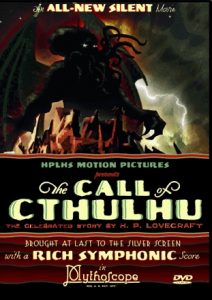 An organization devoted to the live-action role-playing game CTHULHU LIVES created two of the most faithful adaptations of H. P. Lovecraft’s work. In 2005, the H. P. Lovecraft Historical Society released THE CALL OF CTHULHU, a silent movie based on the story, originally published in WEIRD TALES in 1928, that introduced the author’s most famous creation, Cthulhu. Filmed by Andrew Leman and Sean Branney, with cinematography by David Robertson, THE CALL OF CTHULHU was an official selection at more than thirty international film festivals and a winner of numerous awards.
In 2011, the Society followed with an adaptation of Lovecraft’s THE WHISPERER IN DARKNESS, a masterful blending of horror and science fiction that originally ran in the August 1931 issue of WEIRD TALES. With Branney and Leman again collaborating with David Robertson, THE WHISPERER IN DARKNESS ran in selected theaters nationwide and was again screened at film festivals across the globe. Mirroring the style of classic horror films of the 1930s, such as DRACULA, FRANKENSTEIN, and KING KONG, this entertaining film features an “atmosphere of barely-controlled hysteria.”
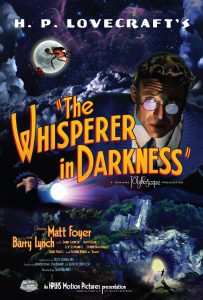 As part of its celebration of the 125th anniversary of H. P. Lovecraft’s birth and his relationship with WEIRD TALES, the leading supernatural fiction magazine of its time, PulpFest 2015 is very pleased to offer fully authorized showings of both THE CALL OF CTHULHU and THE WHISPERER IN DARKNESS. The films will screen Friday, August 14, and Saturday, August 15, beginning at 11:30 PM. Each will be paired with an episode from ROD SERLING’S NIGHT GALLERY that originally aired in 1971: “Cool Air” and “Professor Peabody’s Last Lecture.”
To thank the H. P. Lovecraft Historical Society for allowing us to exhibit their films, PulpFest has offered to help the organization with a couple of research projects.
In addition to her collaborations “The Curse of Yig,” “Medusa’s Coil,” and “The Mound,” the H. P. Lovecraft Historical Society is looking for copies of any pulp stories published by Zealia Brown Reed Bishop. She is thought to have had several stories published, probably in romantically inclined pulps, most likely credited to Zealia Reed or Zealia Bishop, depending on the year of publication.
Andrew Leman recently explored a trove of letters from Lovecraft to Bishop, in which he names several of her manuscripts he worked on. Some of these stories may have never been published, or they may have appeared under other titles. Zealia’s last name was Reed when she was writing these stories, and she didn’t marry Mr. Bishop until later in life. So if any of these stories were published, they probably appeared under the name Zealia Reed or Zealia Brown Reed. The stories are not weird tales or science fiction, but domestic or love fiction.
Additionally, the Society is seeking high-quality scans of any advertisements placed in WEIRD TALES for H. P. Lovecraft’s revisionist services. One ad is thought to have appeared in the August 1928 issue of “The Unique Magazine,” but others were probably published earlier.
An organization devoted to the live-action role-playing game Cthulhu Lives created one of the most faithful film adaptations of H. P. Lovecraft’s work. In 2005, the H. P. Lovecraft Historical Society released The Call of Cthulhu, a silent movie based on Lovecraft’s 1928 story. The one-sheet for The Call of Cthulhu, pictured above, is copyrighted 2005 by the H. P. Lovecraft Historical Society.
If you can help with either project, please contact Andrew Leman at leman@cthulhulives.org or Sean Branney at branney@cthulhulives.org. To view a trailer of The Call of Cthulhu, click here. To view a trailer of The Whisperer in Darkness, click here. The one-sheet for The Whisperer in Darkness, pictured above, is copyrighted 2011 by the H. P. Lovecraft Historical Society.
Saturday, August 14, 2015
The New Fictioneers—our Saturday afternoon programming began with one of our “New Fictioneers” readings. These featured contemporary writers reading from their recent works and fielding audience questions and comments. To learn more about PulpFest’s “New Fictioneers” readings, click here. Additionally, there were two presentations.
The Heirs of Weird Tales—as part of its celebration of the 125th anniversary of H. P. Lovecraft’s birth, PulpFest 2015 will salute WEIRD TALES, the rough-paper magazine that published many of the author’s most influential works. The first periodical largely devoted to the fantasy genre, WEIRD TALES also introduced readers to the sword-and-sorcery genre through Robert E. Howard’s stories of Kull, Solomon Kane, Bran Mak Morn, and Conan, and shared Clark Ashton Smith’s wonderfully evocative stories of Hyperboria, Averoigne, and Zothique. It gave us C. L. Moore’s “Schambleau” and Jirel stories, Henry S. Whitehead’s voodoo masterpiece, “Jumbee,” and many other classics of fantasy and horror.
Robert Weinberg has stated, “It was in WEIRD TALES . . . that traditions were broken . . . that unusual writing and poetry was featured . . . . It was a magazine where anything might find a home . . . . Most important, it was the policy and nature of the magazine that influenced the entire spectrum of fantasy and SF publishing.”
Even in today’s fast-moving society, WEIRD TALES is still inspiring authors, artists, and publishers. Join PulpFest on Saturday, August 15th, at 1:30 PM as we welcome a talented group of today’s fictioneers — the scribes and word-slingers who are creating the new pulp fiction — to discuss the writers and stories published by “The Unique Magazine,” the genres it helped to generate, and how WEIRD TALES has influenced contemporary writers. It’s called “The Heirs of WEIRD TALES” and promises to be the most fantastic “new pulp” panel we’ve ever assembled.
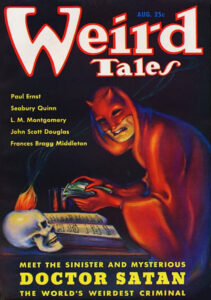 Ron Fortier, a professional writer for nearly three decades, will be moderating our “Heirs” panel. In 2007, Ron teamed up with illustrator Rob Davis to start Airship 27 Productions and build a home for new adventures featuring many of the pulp characters our community enjoys. Ron’s own creation, the undead avenger known as Brother Bones, would certainly have been at home with Paul Ernst’s Doctor Satan in the pages of “The Unique Magazine.”
Joining Ron will be “new pulp” authors Jim Beard, a Toledoan whose Sgt. Janus, Spirit-Breaker could certainly have matched wits with Seabury Quinn’s occult detective, Jules de Grandin; Jeff Fournier, author of new and exotic tales of Sinbad; John Hegenberger, author of the Lovecraft-inspired short story, “Howard’s Toe,” and the forthcoming Stan Wade private eye series; Rick Lai, whose character, The Revenant, was trained by Erik, the enigmatic Phantom of the Opera; Michael Panush, author of the Stein and Candle Detective Agency series concerning a pair of private detectives specializing in the paranormal, the supernatural, and the just plain weird (who certainly could have taken on Edmond Hamilton’s “Vampire Master”); and Frank Schildiner, whose latest novel, THE QUEST OF FRANKENSTEIN, has Frankenstein’s monster meet H. P. Lovecraft’s Herbert West: Reanimator.
Expect a fast-moving hour of Saturday afternoon listening pleasure! Be sure not to miss this powerhouse panel by registering for PulpFest 2015. And be sure to book a room! They’re going fast. If you are not from the Columbus area and want to attend PulpFest 2015, please book your room now and not later. Rooms near the Hyatt Regency are rapidly disappearing.
Readers first saw Paul Ernst’s Doctor Satan courtesy of Weird Tales premier cover artist Margaret Brundage. The character debuted in the August 1935 issue, pictured above. The issue also happens to be the first pulp ever bought by Chet Williamson, the guest of honor at PulpFest 2015.
“Doctor Satan. A man who took pride in his fiendishness! A man who robbed and killed, and broke the laws of man and God, not for gain, because he already had more than any one person could spend, but solely for thrills! A being jaded with the standard pleasures of the world, and turning to monstrous, sadistic acts to justify his existence and give him the sense of power he craved!”
It’s regrettable that he never faced off against Ron Fortier’s Brother Bones, whose “face, hidden forever behind an ivory white skull mask, is the entrance to madness for those unfortunate enough to behold it.”
 Pulp Macabre: The Art of Lee Brown Coye—in early May, Feral House, a small press with a taste for the outrageous, approached PulpFest with an offer that was hard to refuse. Author and collector Mike Hunchback put together a definitive survey of illustrator Lee Brown Coye’s later work and wanted to present a slideshow of the artist’s work at this year’s PulpFest. Since our convention was celebrating the 125th anniversary of author H. P. Lovecraft’s birth, we jumped at the chance to have Mike join our 2015 conference. After all, Coye, like Lovecraft, was strongly associated with “The Unique Magazine,” WEIRD TALES.
Born in Syracuse, New York, in 1907, Lee Brown Coye became very interested in drawing as a teenager and began studying art books on his own. In the late 1920s, woodcut illustrator Howard McCormick introduced him to scratch-board drawing. This became the artist’s favored medium.
Coye made his first pulp magazine appearance in the July 1930 issue of GOLDEN BOOK. However, it was not until the mid-forties – after illustrating August Derleth’s SLEEP NO MORE, an anthology of horror and ghost stories for Farrar & Rhinehart – that his work began to appear regularly in the rough-paper market. He was soon illustrating stories and painting covers for pulp magazines such as SHORT STORIES and WEIRD TALES. His work for the latter proved very popular, and he became a prolific contributor, sometimes appearing four or five times in a single issue. His drawings for the magazine included a running series of illustrations called “Weirdisms.” Coye pragmatically believed that, “I’d rather have my stuff in pulp magazines where people can see it than in a museum where they don’t.”
Writing in THE WEIRD TALES STORY, Robert Weinberg opined, “There was never an artist who came close to capturing horror and dread like Lee Brown Coye. He was master of the weird and grotesque illustration. Coye’s sketches had the shape of nightmares.”
More Derleth anthologies featuring Coye illustrations followed in the late forties: WHO KNOCKS? and THE NIGHT SIDE. The artist’s work continued to appear in WEIRD TALES until 1952. Beginning in 1962, following a ten-year hiatus from fantasy illustrating, Coye began producing horror and fantasy dust jackets for August Derleth’s Arkham House books. During this same period, his illustrations could be found in AMAZING STORIES, FANTASTIC STORIES OF IMAGINATION, and THE MAGAZINE OF FANTASY AND SCIENCE FICTION. In later years, he illustrated books and periodicals from other independent publishers, including several for Carcosa, a small press founded by Jim Groce, David Drake, and Karl Edward Wagner. According to the latter, Lee Brown Coye was “enormously talented and possessing the unsettling combination of a certain morbid genius with a whimsical sense of humor.” In the late seventies, Coye twice won the “World Fantasy Award for Best Artist.” He suffered a stroke, which left him partially paralyzed, in 1979 and died in September 1981, at the age of seventy-four.
 Now, thanks to editors Mike Hunchback and Caleb Braaten, some of Coye’s weirdest and most passionately ghoulish artwork is available again. PULP MACABRE, co-published in 2015 by Feral House and Sacred Bones Records, an alternative record company and publisher from Brooklyn, New York, showcases the art of Lee Brown Coye’s final and darkest era, a period when he was “king of the weird artists,” producing some of his strongest and most fearless work.
On Saturday afternoon, August 15th, at 2:30 PM, Mike Hunchback will discuss Coye’s life and work and share selected images from PULP MACABRE as well as fanzine covers, dust jackets, and photographs from his own collection that were not included in the book. Register now for PulpFest and be part of our salute to H. P. Lovecraft, WEIRD TALES, and the art of Lee Brown Coye.
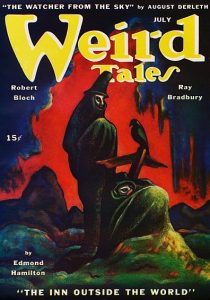
Soon after the August Derleth anthology Sleep No More appeared, the book’s illustrator, Lee Brown Coye, began a long relationship with Weird Tales. His first of ten covers for the magazine appeared in its July 1945 issue, our lead image. He also produced many interior illustrations for the magazine, including a series of pen-and-ink drawings that the artist “called “Weirdisms.” His work continued to appear in Weird Tales until 1952.
After growing up on a steady diet of horror and fantasy fiction from Arkham House Publishers and old pulp magazines, people such as Jim Groce, David Drake, and Karl Edward Wagner started their own small presses during the 1970s. Another was Stuart David Schiff, who, in 1973, began to publish Whispers, a magazine that “embraced classic horror pulp fiction as well as then-current Horror Culture. Under Schiff’s editorship, the poetry, short stories, essays, and various forms of artwork featured in the zine often reveled in the type of weird extremes found only in the grisliest pulps. Within a few issues, Whispers elevated the quality of fiction in fanzines, and other publishers had to follow suit.
The third issue of Schiff’s magazine was dedicated entirely to Lee Brown Coye. In Schiff’s featured essay, he wrote: “Lee’s pen conjures up spheres beyond normal perception and brings them to you with both subtlety and gut-wrenching directness.” Lee Brown Coye’s cover art for the issue – dated March 1974 – also serves as the cover art for Mike Hunchback’s and Caleb Braaten’s Pulp Macabre compilation.
Evening Presentations
 The 2015 Munsey Award—Stephen T. Miller has won the 2014 Munsey Award. Nominated by the pulp community, Steve was selected by a vote of all living Lamont, Munsey, and Rusty Award winners. The award is a fine art print of a painting by David Saunders, presented annually to someone who has worked to better the pulp community. Dan Zimmer of The Illustrated Press published the print.
New Jersey resident Steve Miller has helped index the magazines for years. Along with Michael Cook, he compiled Garland Publishing’s Mystery, Detective, and Espionage Fiction: A Checklist of Fiction in U.S. Pulp Magazines, 1915-1974, an exceptional resource for collectors of detective pulps as well as hero and adventure magazines. With Phil Stephensen-Payne and William G. Contento, Steve revised this classic index, issued on CD-ROM by Locus Press as Crime, Mystery and Gangster Fiction Magazine Index, 1915-2010. Also with Bill Contento, Steve compiled Science Fiction, Fantasy, and Weird Fiction Magazine Index, 1890-2008, a guide to more than 900 different magazines, again published on CD-ROM by Locus Press. Additionally, Steve has helped with a great deal of pulp-related research, sharing his knowledge and collection with researchers. Congratulations to our 2015 Munsey winner, Stephen T. Miller.
This year’s other nominees included Ron Fortier, Joel Frieman, Chris Kalb, William Lampkin, Laurie Powers, the late Chris Steinbrunner, Mike Taylor, George Vanderburgh, and Dan Zimmer. Congratulations to all nominees for this prestigious award, presented annually at PulpFest.
The Munsey Award is a limited edition of thirty-six numbered and signed prints, designed and painted by artist and pulp enthusiast David Saunders.
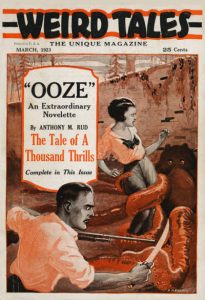 Weird Editing at “The Unique Magazine”—almost 125 years ago, on August 20, 1880, Howard Phillips Lovecraft was born in Providence, Rhode Island. According to the late Robert Bloch, author of PSYCHO, Lovecraft was “A precocious child; he learned to read when he was four and soon experimented with writing. Poor health kept him from college, and economic necessity eventually led him to neglect amateur journalism in favor of ghostwriting or revising others’ work for professional publication. Gradually he began to produce poetry and fiction of his own.” His “career as a professional writer was largely compressed into a span of about sixteen years. He remained virtually unknown except to the limited readership of pulp magazines such as WEIRD TALES in which his work appeared. It earned only a pitiful pittance to supplement the income from a meager inheritance, and he continued his anonymous chores for other writers.”
Bloch continues: “Today Lovecraft is established as a major American fantasy writer, frequently ranked as the equal of Poe. His work is in print here and abroad, and the mild-mannered, old-fashioned, conservative New England gentleman has become an acknowledged master of horror fiction.” What then should be made of this magazine that earned “The Copernicus of the horror story,” as author Fritz Leiber described Lovecraft, “a pitiful pittance to supplement the income from a meager inheritance?”
WEIRD TALES was the first periodical to be largely devoted to the fantasy genre. Premiering in early 1923, its publishers envisioned “The Unique Magazine” as a place for a writer to be given “free rein to express his innermost feelings in a manner befitting great literature.” It began to find its voice in late 1924, after Farnsworth Wright was named editor. In the years ahead, the pulp became known for fantasy and supernatural fiction, publishing the work of Lovecraft, Robert E. Howard, and Clark Ashton Smith. Other substantial writers included Bloch, E. Hoffmann Price, Carl Jacobi, Henry Kuttner, Frank Belknap Long, C. L. Moore, Seabury Quinn, Manly Wade Wellman, Henry S. Whitehead, and others. WEIRD TALES also became known for its artists: Hannes Bok, Margaret Brundage, J. Allen St. John, and Virgil Finlay all contributed tremendously to the fantasy art field through their work for “The Unique Magazine.”
In addition to publishing some of the best fantasy and supernatural fiction of the twentieth century, WEIRD TALES, like the Munsey magazines, also featured science fiction, offering tales of interplanetary expeditions, brain transference, death rays, lost races, parallel worlds, and more. Edmond Hamilton was its leading science fiction contributor. With stories about alien invasions, space police, and evolution gone wild, the author became known as “world-wrecker” Hamilton. Other notable science fiction authors in WEIRD TALES included Ray Cummings, Austin Hall, Otis Adelbert Kline, Moore, Donald Wandrei, and Jack Williamson. In his later years, H. P. Lovecraft spun his own style of science fiction in his tales of cosmic horror.
 The original run of WEIRD TALES began with its March 1923 number, with Edwin Baird as the editor, and ran through its September 1954 issue, for a total of 279 issues. During this period, it was perhaps the most important and influential fantasy magazine, providing an outlet for stories that probably would not have been published elsewhere. This was especially true during the Wright years when it published many of Lovecraft’s most influential works; introduced the sword-and-sorcery genre through Robert E. Howard’s stories of Kull, Solomon Kane, Bran Mak Morn, and Conan; shared Clark Ashton Smith’s wonderfully evocative stories of Hyperboria, Averoigne, and Zothique; and featured the early work of artists Hannes Bok, Margaret Brundage, and Virgil Finlay. As pulp scholar Robert Weinberg has written, “It was in WEIRD TALES . . . that traditions were broken . . . . that unusual writing and poetry was featured. The outrageous and the ordinary mingled side by side in the magazine . . . It was a magazine where anything might find a home.”
Although Wright did indeed publish some rather substantial stories during his editorship — including Lovecraft’s “The Call of Cthulhu,” “The Whisperer in Darkness,” and “The Haunter of the Dark;” Howard’s “The Tower of the Elephant,” “A Witch Shall Be Born,” “Pigeons from Hell,” and “Red Nails;” C. L. Moore’s “Schambleau” and Jirel stories; Clark Ashton Smith’s “A Rendezvous in Averoigne,” “The Vaults of Yoh-Vombis,” and “Genius Loci;” Henry S. Whitehead’s “Jumbee,” and many others — he was, at the same time, rejecting a great deal of fine work. H. P. Lovecraft was told thahttp://pulpcon.org/2015/03/the-films-of-h-p-lovecraft/t “At the Mountains of Madness” was “too long,” “not easily divisible into parts,” and “not convincing.” “The Shadow over Innsmouth” was rejected for similar reasons. Both have since become recognized as classics. In a letter addressed to Lee Alexander Stone in 1930, Lovecraft wrote: “Henry S. Whitehead . . . says that Wright uniformly rejects his best stories. Very like Wright — whose bland dumbness transcends my utmost limits of comprehension.” In a letter to Richard Searight, written in 1935, Lovecraft summarized his feelings about Wright by stating, “His capricious editorial policy does give me a large-sized cervical pain! He has consistently turned down my best work . . . on the ground of length, while at the same time taking far longer things (for the most part utter tripe) from others. It is clear to me that he does not like my work, no matter what he says to the contrary.”
Howard, Smith, and others experienced similar rejections. In a letter mailed to Wright about a year before his tragic suicide, Robert E. Howard stated, “WEIRD TALES owes me over eight hundred dollars for stories already published and supposed to be paid for on publication — enough to pay all my debts and get back on my feet again.” Some scholars have suggested that Wright’s sometimes difficult stance taken with his best writers may have contributed to the early deaths of Howard and Lovecraft and the premature end of Smith’s writing career.
As part of its celebration of the 125th anniversary of the birth of H. P. Lovecraft, PulpFest 2015 is proud to welcome Don Herron, editor of the scholarly landmark, THE DARK BARBARIAN, and winner of the 2006 Black Circle Award for lifetime achievement in Robert E. Howard studies; Morgan Holmes, longtime member of the Robert E. Howard United Press Association and a book review editor for THE DARK MAN; Professor Tom Krabacher of California State University, Sacramento and a member of the Pulp Era Amateur Press Association; 1979 Lamont Award winner and author of “The Wild Adventures of Doc Savage and Tarzan” Will Murray; and popular culture Professor Garyn G. Roberts, who was awarded the Munsey in 2013, for a presentation entitled “Weird Editing at ‘The Unique Magazine’.” Scheduled for Saturday evening, August 15th, at 7:55 PM, our panelists will discuss WEIRD TALES’ editorial policies, focusing particularly on the reign of Farnsworth Wright.
The first issue of Weird Tales, dated March 1923 and illustrated on the cover by R. R. Epperly, is best remembered for publishing Anthony M. Rud’s “Ooze,” a story about a giant amoeba. The issue also featured tales by Otis Adelbert Kline, Joel Townsley Rogers, R. T. M. Scott, and Harold Ward. Edwin Baird put together the issue, editing the magazine until the November 1924 issue, when Wright took the helm.
Hannes Bok created seven covers for Weird Tales. The last appeared on the March 1942 issue. Dorothy McIlwraith edited it, succeeding Farnsworth Wright after the March 1940 issue. McIlwraith would publish Ray Bradbury’s first professional solo story, “The Candle,” in the November 1942 issue. She also helped to launch the careers of author Fritz Leiber and fantasy artist Lee Brown Coye. Bok’s cover appears above and as our featured image.
 Almost two decades after its original demise, Weird Tales was revived in 1973-1974 for four issues, edited by Sam Moskowitz. The second issue, from fall 1973, featured cover art by Gary van der Steur, following Hannes Bok’s March 1940 cover. A paperback series lasting four more issues, edited by Lin Carter, appeared from 1981 to 1983. George H. Scithers, Darrell Schweitzer, and John Gregory Betancourt revived the magazine in 1988, and it has been published, more or less continuously, since then. In 2014, the 362nd issue was released. John Harlacher currently publishes it, with Marvin Kaye serving as editor. For more details, visit the magazine’s website at http://weirdtalesmagazine.com/.
The Thrilling Adventures of Rudolph Belarski—Rudolph Belarski grew up in the hardscrabble world of coal mines in Luzerne County, Pennsylvania. He finished sixth grade and entered the workforce with his classmates at the Pittston Mines, where he labored for ten years while subscribing to a correspondence art school to pursue his dream of becoming a celebrated illustrator.
In 1922, he moved to New York City to study at the Pratt Institute in Brooklyn, where his classmates included Walter Baumhofer, Frederick Blakeslee, and John Fleming Gould. In 1928, he entered the pulp industry through Dell Publications, doing interiors and covers for adventure pulps about World War I, such as WAR ACES, WAR BIRDS, WAR NOVELS, and WAR STORIES. In later years, he worked for Fiction House and the Munsey chain of pulp magazines, painting covers for ACES, AIR STORIES, ALL-AMERICAN FICTION, ARGOSY, DETECTIVE FICTION WEEKLY, DOUBLE DETECTIVE, RED STAR ADVENTURES, SILVER BUCK WESTERN, WINGS, and other rough-paper titles.
 By 1935 Rudolph Belarski was one of Ned Pines’ top artists at Standard Publications, where he painted covers for AIR WAR, THE AMERICAN EAGLE, ARMY NAVY FLYING STORIES, BLACK BOOK DETECTIVE, CAPTAIN FUTURE, DETECTIVE NOVEL MAGAZINE, EXCITING FOOTBALL, EXCITING SPORTS, GIANT DETECTIVE, G-MEN DETECTIVE, THE LONE EAGLE, MYSTERY BOOK MAGAZINE, THE PHANTOM DETECTIVE, POPULAR DETECTIVE, POPULAR WESTERN, RAF ACES, SKY FIGHTERS, STARTLING STORIES, THRILLING ADVENTURES, THRILLING DETECTIVE, THRILLING MYSTERY, THRILLING WONDER STORIES, WEST, and other pulps from the Thrilling Group.
After World War II, Rudolph Belarski became one of Ned Pines’ top paperback cover artists at Popular Library and a leading illustrator for men’s adventure magazines. He finished his career as a teacher at the world’s foremost correspondence art school, the Famous Artists School of Westport, Connecticut. On Saturday, August 15th, at 8:45 PM, please join pulp art historian David Saunders for an exploration of the life and work of pulp artist Rudolph Belarski at PulpFest 2015.
Born in 1954, David Saunders is a New York artist. Museums worldwide have collected his work, including the Museum of Modern Art, The Metropolitan Museum of Art, The Brooklyn Museum of Art, and the Hirschhorn Museum of Art in Washington, DC. He has taught art at colleges such as Yale, Oberlin, and the Kansas City Art Institute, as well as at art schools in France, Korea, Mexico, and Japan.
David’s father was the legendary illustrator, Norman Saunders. His mother, Ellene Politis Saunders, worked at Fawcett Publications as Chief Executive Editor for WOMAN’S DAY. In 1972, David became his father’s business secretary, which started a long project to catalog his father’s 7,000 published illustrations. He spent the next seventeen years gathering published examples of his father’s work from used bookshops and submitting each new entry to his father’s inspection. What began as a sentimental hobby for a father and son grew into an impressive archive of 20th-century American illustration. After his father’s death in 1989, he completed the archive himself. He interviewed his father’s surviving associates to record their oral histories. These transcripts broadened his view of the popular culture publishing industry and documented vital information about the lives of other artists. Some of this material has been published as biographical profiles in ILLUSTRATION MAGAZINE and several coffee-table art books on pulp artists.
David is probably the foremost scholar of American pulp illustrators. His free public website, Field Guide to Wild American Pulp Artists, includes over 300 biographical profiles of these popular-culture creators. David continues to research, document, and promote a greater appreciation of pulp artists. To learn more, visit davidsaunders.biz or normansaunders.com.
Rudolph Belarski’s cover for the Summer 1944 issue of Air War is one of many covers that the talented artist painted for Ned Pines’ “Thrilling Group” of pulp magazines. To learn more about the artist, visit David Saunders’ Field Guide to Wild American Pulp Artists, which includes more than 300 biographical profiles of American pulp artists. For a broader sampling of the artist’s work, pick up a copy of John Gunnison’s Belarski: Pulp Art Master, available through Adventure House.
Saturday Night at the Auction—PulpFest‘s Saturday night auction, featuring auctioneers John Gunnison and Joseph Saine, will immediately follow David Saunders’ presentation on Rudolph Belarski.
Thanks to Everyone!—year after year, there are countless individuals and organizations that help to make PulpFest an enjoyable experience for those who attend “Summer’s Great Pulp Con. The PulpFest organizing committee thanks the following people and organizations for their invaluable assistance in making PulpFest 2015 a tremendous success. We could not have done it without you:
Our front desk staff – Maura Childers, Sam Childers, Samantha Childers, Jack Cullers, and Sally Cullers; our panelists and presenters – Jason Scott Aiken, Jon Arfstrom, Jim Beard, Patrick Belk, Ron Fortier, Jeff Fournier, John Gunnison, John D. Haefele, John Hegenberger, Don Herron, Morgan Holmes, Ed Hulse, Mike Hunchback, Tony Isabella, Tim King, Tom Krabacher, Rick Lai, Chuck Loridans, Nathan Madison, Walker Martin, Will Murray, Michelle Nolan, Garyn G. Roberts, David Saunders, Frank Schildiner, Philip M. Sherman, Duane Spurlock, Anthony Tollin, J. Barry Traylor, Scott Urban, Chet Williamson, and John Wooley; our technical staff – Chuck and Juliette Welch; Lucy Denunzio, for help with the auction and Renee Thomas for the great PulpFest cakes; and our behind-the-scenes help – Dan Zimmer and the staff of the Hyatt Regency Columbus. Thanks also to the H. P. Lovecraft Historical Society for authorizing our showings of The Call of Cthulhu and The Whisperer in Darkness.
Many thanks to Ed Hulse, Greg Ketter, and J. Barry Traylor for helping to arrange the appearances of our special guests – Philip M. Sherman, nephew of Thrilling editor Leo Margulies, fantasy and Weird Tales artist Jon Armstrom, and author Chet Williamson.
The organizing committee would also like to thank the people who helped to create The Pulpster #24 – editor Bill Lampkin, assistant editor Peter Chomko, publisher Mike Chomko, plus contributors Sean Branney, Jason V. Brock, Ramsey Campbell, Tony Davis, W. Paul Ganley, Cody Goodfellow, John D. Haefele, Monte Herridge, Don Herron, Morgan Holmes, Derick Hussey, Tom Johnson, S. T. Joshi, Marvin Kaye, Tom Krabacher, the late Larry Latham, Nick Mamatas, Will Murray, Michelle Nolan, Fred Phillips, Tim Powers, W. H. Pugmire, Don Ramlow, Garyn G. Roberts, Jessica Amanda Salmonson, Darrell Schweitzer, J. Barry Traylor, Nicky Wheeler-Nicholson, and Chet Williamson, as well as the magazine’s advertisers – Airship 27, Altus Press, Black Coat Press, Doc Con 2015, Dick and Norma Enos, Rich Halegua Posters & Comic Art, Heartwood Auctions, Mike Hunter, Mike Chomko Books, Murania Press, Pegana Press, Prose ‘n Cons Mystery Magazine, PS Publishing, PULPDOM, The Pulp Factory, The Pulp. Net, Stark House Press, and the Windy City Pulp and Paper Convention.
Although the new PulpFest gaming track got off to a slow start, we plan to return it in 2016, albeit on a smaller scale. Many thanks to Rick Thomas for organizing our gaming events and to Bill Adcock, Keith Culbertson, Mark Herbert, Misty Long, Matt McCloud, Justin Ross, Byron Wingate, and Luke Woods for serving as game-masters during the track’s inaugural year.
Many thanks as well to the nominators and the Lamont Award, Munsey Award, and Rusty Hevelin Service Award winners who helped select this year’s Munsey winner, Stephen T. Miller. Congratulations to Steve and to all of the nominees for our 2015 award.
Again, we’d like to thank the following organizations for the books and similar items that were donated to PulpFest for distribution to our members: Chaosium, Inc., Engle Publishing and The Paper & Advertising Collectors’ Marketplace, Feral House, Gordon Van Gelder and The Magazine of Fantasy and Science Fiction, Paizo, Inc., Pelgrane Press, Tom Brown and Radio Archives, and Chet Williamson. And many thanks to the Windy City Pulp and Paper Convention for lending us their sound system. We’d also like to thank our website sponsors, Galaxy Press and PureCostumes.com.
Finally, thanks to Martin Grams, Tommy Hancock, Ed Hulse, Nathan Madison, Michael Neno, Rick Thomas, Scott Williams, and the many conventions, book and paper fairs, bookstores, comic and collectible shops, websites, magazines, newspapers, and other media outlets that helped to promote our show by distributing and displaying our advertising materials as well as the dealers, attending members and supporting members of PulpFest 2015. Your encouragement and support made our convention a success.
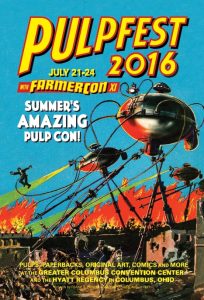 We hope to see you all back next summer along with a good many newcomers for PulpFest 2016, taking place in Columbus, Ohio, from July 21 through July 24. Details will be forthcoming in the months ahead. So please bookmark the PulpFest website. You’ll also find information on our Facebook page and on our Twitter account. In the months ahead, we’ll also be adding Instagram and Tumblr accounts.
If we’ve neglected anyone, please accept our apologies and our gratitude. Write to mike@pulpfest.com, and we will correct the oversight.
William Lampkin adapted our 2015 postcard from Matt Fox’s cover art for the November 1944 issue of Weird Tales and our 2016 postcard from Frank R. Paul’s cover art from the August 1927 issue of Amazing Stories, illustrating H. G. Wells’ “War of the Worlds.”
The Organizing Committee Grows—on this day (Monday, September 7, 2015), when we salute the American worker, PulpFest is pleased to welcome its newest “laborer,” William Lampkin, to its organizing committee.
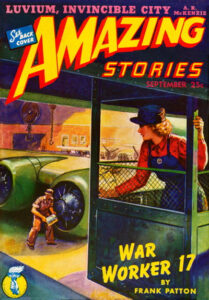 William Lampkin, or Bill, has read and collected pulp magazines since the 1970s. He became involved in pulp fandom in the early 1990s when he discovered other like-minded individuals on the then-new Internet.
In 1996, he founded what later became ThePulp.Net, a website devoted to the pulps. The five-page website, which originated on AOL as .Pulp, has grown over the past two decades to include blogs, articles, histories, bibliographies, and more. He also writes the Yellowed Perils blog.
Bill attended his first pulp show in Tampa in the late 1990s, Pulpcon 35 in 2006, was actively involved with Doc Con from 2004 to 2011, and is on a two-year string of PulpFest appearances. In 2008, he became designer of The Pulpster. Bill assumed the editorship in 2013 when founding editor Tony Davis stepped down after 20 years.
Bill has been designing promotional material and advertising for PulpFest for the past few years. He will serve on the PulpFest organizing committee as director of advertising, and will also continue designing and editing The Pulpster. Why mess with a great thing?
Robert Gibson Jones, an Ohio native, began working as a commercial artist for a Chicago advertising agency during the First World War. Nearly thirty years later, his first pulp magazine cover appeared on the January 1943 issue of Fantastic Adventures. According to pulp art scholar David Saunders, “He was soon painting many covers for this title as well as for Amazing Stories, Mammoth Adventure, Mammoth Detective, and Mammoth Western, all of which were produced in Chicago by the Ziff-Davis Publishing Company.” During the 1950s, Jones painted covers for Other Worlds Science Stories and Universe Science Fiction. His cover for the September 1943 issue of Amazing Stories is a wonderful depiction of women who took on many non-traditional roles and helped the war effort during World War II.
News and Reviews of PulpFest 2015—If you couldn’t make it to Columbus, Ohio, for PulpFest 2015, or want to relive the great times of this year’s convention, there are plenty of options online.
For your listening pleasure—a couple of websites offer audio recordings of PulpFestprogramming:
- ThePulp.Net has posted 14 audio recordings — totaling more than 10 hours — from PulpFest 2015programming. You can listen to the recordings on the web, or you can download them for free via the website’s Pulp Event Podcast on iTunes.
- Pulp Crazy posted three of the same programs, but also a New Pulp reading by Duane Spurlock.
Read all about it—a number of blogs have posts where PulpFest 2015 attendees recount their experiences at the convention:
- Chet Williamson: PulpFest 2015’s Guest of Honor, Chet Williamson, has posted a write-up of his talk, “Weird Tales & One Degree of H.P. Lovecraft,” on his website.
- EDitorial Comments: A report by Ed Hulse, editor of BLOOD ‘N’ THUNDER and publisher at Murania Press.
- Eventized: Photos by Michael Neno.
- Flight Log: A report by Ron Fortier of Airship27.
- Mystery*File: Reports or photos by Steve Lewis and Walker Martin.
- Tellers of Weird Tales: Three short reports by Terence Hanley.
- Up and Down on These Mean Streets: A report by Don Herron.
- Yellowed Perils: Three daily reports by Bill Lampkin.
You can find updated report lists at Bill Lampkin’s Yellowed Perils. This report was filed by Bill Lampkin to the PulpFest website on September 14, 2015.
Most of our promotional materials for PulpFest 2015 featured Matt Fox’s cover for the November 1944 issue of Weird Tales, one of about a dozen covers the artist painted for “the unique magazine.” Each year, PulpFest is packed with programming highlighting a range of topics.
To see what you’ve been missing, start planning right now to join the 45th convening of “Summer’s Great Pulp Con” in 2016. PulpFest 2016 will take place July 21-24 at the Hyatt Regency Columbus. Bookmark our website to keep informed about pulps and PulpFest.