
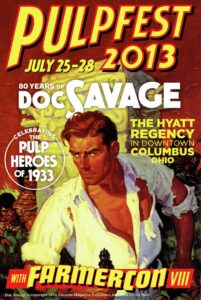
 In this post, we’ll explore PulpFest 2013. It took place at the Hyatt Regency Columbus in downtown Columbus, Ohio, from Thursday, July 25 through Sunday, July 28, 2013.
The convention’s themes were “The Pulp Heroes of 1933” and the centennial of Sax Rohmer’s Dr. Fu Manchu. As the convention announced on September 27, 2012:
Two major anniversaries will feature prominently in PulpFest’s 2013 programming. First and foremost, we are celebrating the hero pulp revolution that began 80 years ago in 1933, with the debuts of such popular figures as Doc Savage, The Spider, Nick Carter, Pete Rice, The Lone Eagle, The Phantom Detective, and G-8 and His Battle Aces. The success of Street & Smith’s Shadow pulp, launched two years earlier, spurred this revival of single-character magazines, a dime-novel-era phenomenon. The hero pulps revitalized an industry laid low by the Great Depression, and they dominated the rough-paper field for the rest of the decade. They remain the most avidly collected and frequently reprinted periodicals in the hobby.
We’ll also acknowledge the centennial of Sax Rohmer’s Dr. Fu Manchu, who made his American bow in a February 1913 issue of Collier’s magazine. In 1933, the initial cycle of short stories was published in hardcover as The Insidious Dr. Fu Manchu. Rohmer’s “Devil Doctor,” the first and greatest “Yellow Peril” villain, was widely imitated in American pop culture; rough-paper knockoffs included The Mysterious Wu Fang and Dr. Yen Sin, two short-lived pulps from Popular Publications.
After extensive advertising through other conventions, book fairs, bookstores, and print ads, our dealers set up in the Hyatt’s 15,800-square-foot ballroom, which could hold more than 100 eight-foot tables featuring pulp magazines and related materials, vintage paperbacks, digests, men’s adventure and true crime magazines, first edition hardcovers, series books, dime novels, original art, Big Little Books, Golden and Silver Age comic books, vintage films and radio programs, and other pop culture collectibles. Unfortunately, the list of dealers who exhibited at PulpFest 2013 is no longer available.
PulpFest 2013 Schedule of Events
PulpFest 2013 starts Thursday, July 25. The dealers’ room will be open only to registered sellers for setup from 4 PM to 11 PM. Ohio State’s Thompson Library will also offer a free lecture on the pulps at 5 PM. Early registration for all convention attendees will take place outside the dealers’ room from 6 PM to 8 PM. At 8 PM, a full slate of programming will begin.
Thursday, July 25
4:00 PM – 11:00 PM – Dealer Set-Up – the dealers’ room will be open only to dealers to assemble their displays
4:30 PM – Ohio State Lecture Series – Ed Hulse, the editor of Blood ‘n’ Thunder, examines “The Ancestors of Batman: Colorful Crime Fighters of Pulp Fiction” at Ohio State’s Thompson Library
6:00 PM – 8:00 PM – Early Registration – general members and dealers will be able to register for PulpFest
Evening Programming
8:00 PM – The Pulp Descendants of Fu Manchu – Rick Lai discusses the influence of Sax Rohmer’s devil doctor on the pulps with a look at villains such as Wu Fang, Shiwan Khan, the Blue Scorpion, and Robert E. Howard’s Skull Face and Erlik Khan
9:00 PM – Hollywood and the Hero Pulps – Blood ‘n’ Thunder editor Ed Hulse looks at The Spider’s Web, Columbia Pictures’ classic chapterplay, and Hollywood’s other attempts to bring the pulps to the silver screen
10:00 PM – The Spider’s Web – Chapters 1 – 5 of the 1938 Columbia Pictures movie serial starring Warren Hull as “The Master of Men” and Iris Meredith as his beloved, Nita Van Sloan
Friday, July 26
9:00 AM – 5 PM – Wheeling and Dealing – the dealers’ room will be open to all
1:00 PM – The New Fictioneers – William Patrick Maynard reads from his forthcoming novel, The Triumph of Fu Manchu
2:00 PM – The New Fictioneers – Van Allen Plexico has more than two dozen books under his belt. One of the leading figures of “New Pulp,” he will be reading from Lords of Fire and “River of Deceit” from Monster Aces
3:00 PM – The New Fictioneers – FarmerCon panelists Win Scott Eckert and John Small offer a variety pack of fiction including John’s tribute to Edgar Rice Burroughs and Philip José Farmer, “The Bright Heart of Eternity”
Evening Programming
7:25 PM – Welcome to PulpFest – Jack Cullers offers an official welcome
7:30 PM – The Mad Goblin, Escape from Loki, and His Apocalyptic Life – Art Sippo leads a discussion of Philip José Farmer’s contributions to the Doc Savage mythos. Panelists include Christopher Paul Carey, Win Scott Eckert, Rick Lai, and John Allen Small
8:30 PM – Doc Savage and the Pulp Heroes of 1933 – Nick Carr, Don Hutchison, Will Murray, and Garyn Roberts join Blood ‘n’ Thunder editor Ed Hulse to discuss eighty years of “The Great Pulp Heroes”
9:30 PM – Walter Baumhofer: King of the Pulps – pulp art historian David Saunders looks at the life and work of the artist who brought The Man of Bronze, The Master of Men, Pete Rice, and other pulp heroes to life
10:30 PM – The Spider’s Web – Chapters 6 – 10 of the 1938 Columbia Pictures serial in which The Spider battles The Octopus, a criminal mastermind bent on crippling the nation through a wave of terror
Saturday, July 27
9:00 AM – 5 PM – Wheeling and Dealing – the dealers’ room will be open to all
1:00 PM – The Future of New Pulp Fiction – moderator Ron Fortier is joined by five new writers inspired by the pulp fiction of yore – Jim Beard, Win Scott Eckert, Rick Lai, Frank Schildiner, and Art Sippo
2:00 PM – Doc and the King – Radio Archives’ Roger Price will be reading from Will Murray’s Skull Island, recently released as an audiobook. Both Will and Roger will be available for questions following the reading
3:00 PM – The New Fictioneers – Jim Beard, a columnist for the Toledo Free Press and a freelance writer, will read from Captain Action: Riddle of the Glowing Men, Monster Earth, and Sgt. Janus: Spirit-Breaker
Evening Programming
7:30 PM – PulpFest 2013 Business Meeting – all members are invited to ask questions and offer suggestions at this session
7:50 PM – 2013 Munsey Award Presentation – Matt Moring of Altus Press will present this year’s Munsey Award
8:00 PM – Fu Manchu and the Yellow Peril Pulps – Blood ‘n’ Thunder editor Ed Hulse is joined by Gene Christie, Win Scott Eckert, Nathan Madison, William Patrick Maynard, and Will Murray for a discussion of Sax Rohmer’s infamous creation and the character’s influence on the pulps and popular culture
9:00 PM – Hero Pulp Premiums and Promotions – Chris Kalb takes us back to a time when a dime not only bought a pulp magazine filled with thrills, but also a Spider Ring or a membership to Friends of the Phantom
9:30 PM – Saturday Night at the Auction – auctioneers John Gunnison and Joseph Saine complete the sale of pulp researcher Albert Tonik’s substantial collection, plus various lots from the convention’s regular consigners
11:30 PM – The Spider’s Web – Chapters 11 – 15 of the 1938 Columbia Pictures serial directed by James W. Horne and Ray Taylor in which The Spider unmasks the nefarious Octopus and wins the day for the good old USA
Sunday, July 28
9:00 AM – 2 PM – Wheeling and Dealing – the dealers’ room will be open to all
Evening Programming (Thursday):
The Ancestors of Batman—PulpFest‘s 2013 programming begins with an off-site presentation to which convention attendees are cordially invited. On Thursday, July 25th, in Room 150A-B at Ohio State University’s Thompson Library, PulpFest committee member and Blood ‘n’ Thunder editor and publisher Ed Hulse will deliver a lecture titled “The Ancestors of Batman: Colorful Crime Fighters of Pulp Fiction.”
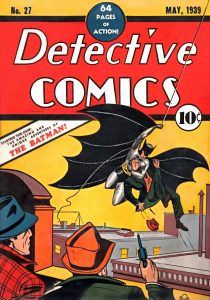 Ed’s presentation ties in with PulpFest‘s 80th-anniversary celebration of the 1933 hero-pulp explosion that gave us Doc Savage, The Spider, The Phantom Detective, and others. As he will point out, these characters directly influenced such later comic-book heroes as Batman – whose very first exploit was, in fact, plagiarized from a 1936 Shadow novel.
Batman was hardly the first colorful crime fighter to affect the pose of wealthy idler. The pulp magazines beat him to that characterization by a quarter century. Bruce Wayne simply joined a fraternity whose members already included Jimmie Dale, Lamont Cranston, Richard Wentworth, and Richard Curtis Van Loan, among others. But great wealth and social prominence were not the only traits these men shared, as Ed will point out.
The presentation will also include latter-day examples of hero-pulp concepts that became embedded in American popular culture. One example is 24‘s Jack Bauer, who shares with pulpdom’s Operator #5 the distinction of being a government agent working outside the system to combat terrorists seeking to inflict grave harm on the United States with apocalyptic weapons.
“The Ancestors of Batman” is scheduled to begin at 4:30 PM, is open to the public, and will set the tone for this year’s PulpFest, featuring many informative and entertaining programs.
The Pulps After Fu Manchu—Although Kaiser Wilhelm is believed to have coined the term “Yellow Peril,” Sax Rohmer profited most from the idea, largely through the villainous Dr. Fu Manchu. Little wonder that countless pulp writers, from Walter B. Gibson and Norvell W. Page to Robert E. Howard and George Worts, turned to the devil doctor to find inspiration for their lurid pulp tales.
Tall, thin with lizard-green eyes, yellow robe and black cap embroidered with coral bead, Fu Manchu was the very picture of warped genius. Such unusual potions as spiders, scorpions and plague-carrying tsetse flies were just part of Fu’s prescription to foreshorten the white race’s actuarial expectations. Master of super science and creative toxicology, he . . . was the Yellow Peril.
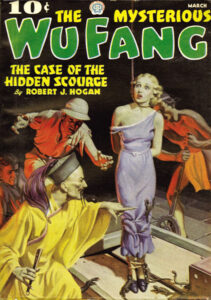 To kick off PulpFest’s celebration of the 100th anniversary of Sax Rohmer’s infamous creation, Rick Lai looks at “The Pulp Descendants of Fu Manchu,” beginning at 8 PM on Thursday, July 25, in the Fairfield Room on the second floor of the Hyatt Regency Columbus. Rick will discuss the influence of Sax Rohmer’s devil doctor on the pulps, highlighting villains such as Wu Fang, Shiwan Khan, The Blue Scorpion from Peter the Brazen, and Robert E. Howard’s Skullface and Erlik Khan.
Best known for his articles expanding on Philip José Farmer’s Wold Newton Universe concepts, recently collected by Altus Press as Rick Lai’s Secret Histories: Daring Adventurers, Rick Lai’s Secret Histories: Criminal Masterminds, Chronology of Shadows: A Timeline of The Shadow’s Exploits and The Revised Complete Chronology of Bronze, Rick Lai lives in New York. His short fiction has been collected in Shadows of the Opera (Wild Cat Books, 2011) and two upcoming Black Coat Press collections to be printed this year – Shadows of the Opera: Retribution in Blood and Sisters of the Shadows: The Cagliostro Curse.
From Pulp Page to Silver Screen—Blood ‘n’ Thunder editor Ed Hulse explores the pulp-to-movie connection in his PulpFest presentation “Hollywood and the Hero Pulps,” one of several pre-convention programs scheduled for Thursday, July 25, at 9 PM.
Motion-picture incarnations of pulp magazine protagonists date back to the medium’s earliest days. Moviegoers of the nickelodeon era —the pre-World War I years — were treated to cinematic adaptations of Short Stories’ Hamilton Cleek and The Popular Magazine’s Terrence O’Rourke, among others. Tom Mix became the industry’s top Western star thanks to his 1920 portrayal of Max Brand’s Whistlin’ Dan Barry. Master detective Nick Carter, who successfully made the transition from dime novel to pulp magazine, appeared on screens both in the U.S. and overseas in several sets of short subjects produced between 1908 and 1927.
With the rise of talkies and Hollywood’s emergence as the world’s filmmaking capital, pulp fiction became an even more frequent source of story material. Hundreds of movies released during the Thirties, Forties and Fifties — feature films and short subjects alike — were made from yarns originally printed in rough-paper periodicals.
As Blood ‘n’ Thunder readers know, Ed is the leading authority on pulp-related movies, having researched and written about them for decades. His PulpFest presentation will cover many, but focus on those adapted from hero pulps, with special emphasis on serials such as The Spider’s Web (1938), The Shadow (1940), and The Spider Returns (1941). He’ll present little-known, behind-the-scenes info gleaned in part from his own interviews with people who worked on these episodic epics, including Victor Jory (who played the serial Shadow) and Iris Meredith (who played Nita in The Spider’s Web). Ed will address the rumor that Columbia Pictures planned a G-8 and His Battle Aces serial for a 1939 release, and he’ll also report what little is known about the proposed Republic chapter plays featuring Doc Savage and Nick Carter.
This program, leading into the screening of Chapters One through Five of The Spider’s Web, promises a fascinating start to PulpFest’s 2013 hero-pulp tribute.
The Spider’s Web—Beginning at 10 PM on Thursday, July 25, PulpFest 2013 will present the fifteen-chapter Columbia Pictures movie serial, The Spider’s Web.
Released in 1938 and starring Warren Hull as Richard Wentworth, the “Master of Men,” and Iris Meredith as his beloved Nita Van Sloan, The Spider’s Web is now considered one of the greatest chapter plays ever filmed. PulpFest will show the serial in its entirety over three nights.
Columbia Pictures released its first cliffhanger serial in 1937. The Weiss brothers independently produced Jungle Menace and its immediate successors, The Mysterious Pilot (1937) and The Secret of Treasure Island (1938). Poverty Row denizens with roots in the motion-picture industry dating back to the early silent-movie days, their serials were competent but cheaply made and uninspiring. Columbia executive Irving Briskin surmised that to capture a significant share of the chapter-play market, the company would have to make serials in-house and invest them with more “production value” than the Weiss brothers could provide on their shoestring budgets.
Briskin began negotiating for screen rights to popular characters from other media. Soon, he secured The Spider from Popular Publications. He then assigned the property to newly hired producer Jack Fier, lured from Republic Pictures to Columbia, who would go on to turn out the industry’s finest serials and grade-B Westerns. Granted a generous budget (more than twice what the Weiss brothers spent on their chapter plays), Fier took on the daunting task of bringing one of pulpdom’s most popular heroes to the screen—and, by extension, establishing Columbia as a formidable competitor in episodic epics.
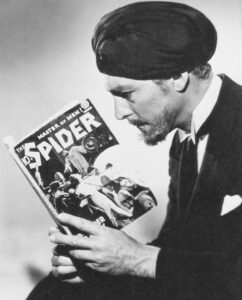 As serial historian Ed Hulse will explain in his PulpFest presentation on movie adaptations of hero pulps, Fier’s first chapter play went into production as The Spider — Master of Men. Thanks to careful writing (with editorial input from Norvell Page, chronicler of the Spider’s pulp-magazine adventures), this Columbia serial maintained an unusually high degree of fidelity to its source material. Jack Fier’s attention to detail and relatively liberal expenditure of money paid off, and after some last-minute tinkering (the result of Production Code administrators complaining to Columbia about the serial’s high body count), the newly retitled The Spider’s Web went into release in late October of 1938, eliciting mostly favorable reviews and generating more box-office revenue than the previous two Weiss serials combined.
Never commercially released on home video, The Spider’s Web has nonetheless been available for many years in “grey market” editions of varying quality. PulpFest has obtained the best version currently in circulation and will offer all 15 high-octane chapters to convention attendees in five-episode increments spread out over three nights.
To learn more about this great movie serial and its sequel, please visit The Spider Returns website. You’ll find a “serials” link in the site’s menu.
Evening Programming (Friday):
FarmerCon VIII at PulpFest—An annual gathering for fans of Grand Master of Science Fiction Philip José Farmer, FarmerCon returns for the third straight year to Columbus, Ohio, to commemorate the celebrated author, his fiction, and his pulp roots.
Once again, FarmerCon will have its own programming. On Friday, July 26, at 7:30 PM, our FarmerCon friends will turn their attention to the Grand Master’s Doc Savage-related work in a panel entitled “His Apocalyptic Life, Escape from Loki, and The Mad Goblin.”
The earliest of the three works, The Mad Goblin, was first published in 1970, paired with The Lord of the Trees as half of an Ace Double. Both novels were sequels to an earlier work, A Feast Unknown, that introduced Lord Grandrith, a thinly disguised Tarzan, and a “man of bronze” known as Doc Caliban. In Feast, Grandrith and Caliban learn that a powerful secret society known as The Nine has manipulated their lives. The two heroes go to war against their tormentors. The Mad Goblin tells the story from Doc Caliban’s point of view, while The Lord of the Trees presents Lord Grandrith’s version.
 Although he published over fifty novels and 100 short stories during his career, Philip José Farmer is best remembered for his Wold Newton Family. According to the author, the radiation from a meteorite that landed near the village of Wold Newton caused mutations in the villagers’ descendants, making them smarter, stronger, and more driven than most. Included among the offspring were Lord Greystoke, Sherlock Holmes, Sam Spade, Fu Manchu, and Dr. James Clarke Wildman, Jr., best known as Doc Savage. Much of Doc Savage: His Apocalyptic Life, first published by Doubleday in 1973, focuses on this idea.
Farmer’s final “work of bronze” was Escape from Loki, published by Bantam Books in 1991. Shot down behind enemy lines during World War I, sixteen-year-old Clark Savage, Jr. finds himself in a German baron’s notorious escape-proof prison. There, Doc and his future aides come together to match wits and derring-do against the sinister baron, whom Doc believes intends to wield a weapon of mass destruction that could end freedom and secure victory for the Kaiser.
Moderator Art Sippo, author of Sun Koh: Heir of Atlantis, a 2010 Pulp Factory Award nominee for Best Pulp Novel, and his panelists will dissect and analyze the Grand Master‘s contributions to the Doc Savage mythos. Joining Art will be Christopher Paul Carey, the co-author with Philip José Farmer of Gods of Opar: Tales of Lost Khokarsa, and the author of Exiles of Kho, a prelude to the Khokarsa series; Rick Lai, well known for his articles expanding on Farmer’s Wold Newton Universe concepts, recently collected into four volumes by Altus Press; Win Scott Eckert, the co-author with Philip José Farmer of The Evil in Pemberley House, and the author of its forthcoming sequel, The Scarlet Jaguar, featuring Doc Wildman’s daughter Pat; and John Allen Small, an award-winning journalist, columnist, and fiction writer whose work includes “The Bright Heart of Eternity,” a tribute to Edgar Rice Burroughs and Philip José Farmer, and “Into Time’s Abyss,” anthologized in The Worlds Of Philip José Farmer 2: Of Dust And Souls.
Meteor House will be premiering a new, expanded edition of Doc Savage: His Apocalyptic Life at PulpFest 2013. Featuring dust jacket art by Joe DeVito (pictured above) and essays by Win Scott Eckert, John Allen Small, Keith Howell, Rick Lai, Art Sippo, Christopher Paul Carey, and current Doc Savage writer Will Murray, it will be available as a deluxe hardcover. Altus Press will be publishing the softcover edition.
The Hero Pulp Explosion of 1933—Eighty years ago, after the astounding success of The Shadow Magazine, the pulp industry made a tremendous splash by releasing a wave of single-character magazines. The Phantom Detective, Nick Carter Magazine, Doc Savage Magazine, The Lone Eagle, G-8 and His Battle Aces, The Spider, and Pete Rice Magazine all debuted in 1933, despite the economic hardships of the Great Depression.
Street & Smith Publishing introduced The Shadow Magazine to readers in early 1931. With author Walter B. Gibson’s talents, the magazine proved an instant hit. Planned as a quarterly, this first “hero” pulp became a monthly after just two issues. A year later, The Shadow Magazine became a semi-monthly, appearing twice each month until early 1943.
By 1932, Street & Smith was planning other single-character pulps, hoping to emulate the high-flying Shadow Magazine. Other publishing houses also noticed the strong sales experienced by Gibson’s “Dark Avenger.” As Henry Steeger of Popular Publications stated: “At this point in pulp history, individual titles became very popular, so we decided to try out a few.” And so began what we now call “The Hero Pulp Explosion of 1933.”
On Friday, July 26, at 8:30 PM in the Fairfield Room of the Hyatt Regency Columbus, Ed Hulse, editor and publisher of Blood ‘n’ Thunder, and a panel of pulp historians will take a look at “Doc Savage and the Pulp Heroes of 1933.”
Joining Ed will be Nick Carr, one of the elders of the pulp community, who actually read The Spider and other pulps fresh off the newsstand, and has written countless articles about pulp heroes both known and little known; Don Hutchison, who also had the opportunity to buy pulps at a news agency and has likewise written many articles on the history of the pulps as well as the Stoker Award nominee, The Great Pulp Heroes (a “must-read” book for fans of the hero pulps); a child of the sixties when he first discovered “The Man of Bronze” and now today’s “Kenneth Robeson,” Will Murray, yet another author of numerous books and articles concerning the pulps; and Garyn Roberts, professor of English and popular culture studies and unabashed pulp fan and editor of some of the best collections from the pulps including The Compleat Adventures of the Moon Man, The Magical Mysteries of Don Diavolo, and other titles. This quartet of pulp experts will join Ed to discuss the causes and effects of the “Hero Pulp Explosion of 1933.”
Walter Baumhofer: King of the Pulps—Who was the “King of the Pulps?” Some say it was H. Bedford Jones, while others claim the title for Frederick Faust, better known as Max Brand. But to the young readers who devoured the pulp magazines and “delighted in his four-color depictions of action and adventure,” the one and only “King of the Pulps” was Walter M. Baumhofer.
 When an injury at age fourteen left him unable to do manual labor, Baumhofer began to study art intently. A scholarship let him attend the prestigious Pratt Institute, where he studied under Dean Cornwell and H. Winfield Scott. While still a student, he began his art career drawing pen-and-ink story illustrations for Adventure Magazine. By 1926, he was contributing covers to Clayton Publications and, soon thereafter, to Harold Hersey’s line of pulps. Street & Smith signed him to a contract in 1932 to paint a cover each week for their pulps. Around the same time, he was sought out by Popular Publications to provide cover art for their line of magazines, and so began his reign as the “King of the Pulps.”
Baumhofer worked in the pulp market for just over a decade, painting about 550 covers for a wide variety of titles, including Ace High, Adventure, Detective Tales, Dime Mystery Magazine, Doc Savage, Fire Fighters, Gangland Stories, The Spider, Spy Stories, Western Story Magazine, and others. He moved into the slick market and advertising art in the late thirties, contributing work to American Weekly, Collier’s, Cosmopolitan, Esquire, Redbook, Women’s Day, and other magazines. In later years, his paintings graced the covers of Argosy, Outdoor Life, and Sports Afield, and his portrait, landscape, and Western art were exhibited in fine art galleries nationwide.
At 9:30 PM on Friday, July 26, David Saunders will present a biographical profile of Walter Baumhofer’s life and the artist’s fascinating family history. He will exhibit never-before-seen visual documents from the personal world of this pulp art master. Walter was a close friend of the presenter’s father, Norman Saunders, and as such David was personally acquainted with the artist for over thirty years. Baumhofer was a sensationally colorful character, and David Saunders looks forward to sharing many amusing anecdotes and incidents that will help to promote a greater awareness of this legendary artist.
Afternoon Programming (Saturday):
Both Friday and Saturday afternoons were mostly set aside for “New Fictioneers” readings. These featured contemporary writers reading from their recent works and fielding audience questions and comments. To learn more about PulpFest’s “New Fictioneers” readings, click here.
On Saturday afternoon, a couple of other programs also took place.
The Future of “New Pulp”—At 1 PM on Saturday, July 27, writer, editor-in-chief of Airship 27, and two-time Pulp Factory Award winner, Ron Fortier, and five contemporary authors will gaze into their crystal balls to chart the road ahead for the new and exciting continuation of the pulp genre known as “New Pulp.” Joining Ron will be Jim Beard, Win Scott Eckert, Rick Lai, Frank Schildiner, and Dr. Art Sippo.
A native Toledoan, Jim Beard became a published fiction writer after selling a story to DC Comics in 2002. Since then, he’s written Star Wars and Ghostbusters comics, as well as several new pulp fiction works including Sgt. Janus, Spirit-Breaker and Captain Action: Riddle of the Glowing Men, the first pulp prose novel based on the classic 1960s action figure.
Another 2013 New Fictioneer, Win Scott Eckert, co-authored the Wold Newton novel The Evil in Pemberley House with Philip José Farmer. Win’s sequel, The Scarlet Jaguar, will debut at this year’s PulpFest. In addition to co-editing three Green Hornet anthologies for Moonstone Books, Win has written countless tales featuring Zorro, The Avenger, Honey West, The Phantom, Captain Midnight, The Scarlet Pimpernel, Sherlock Holmes, and many other genre fiction characters.
Rick Lai is a computer programmer best known for his articles based on Philip José Farmer’s Wold Newton concepts. Altus Press recently collected these into four volumes. His short stories have appeared regularly in the Tales of the Shadowmen anthologies published by Black Coat Press. In 2011, Wild Cat Books released Rick’s Shadows of the Opera, a novel about a 19th-century female vigilante.
A pulp fan since reading Philip José Farmer’s Tarzan Alive, Frank Schildiner is a New Jersey martial arts instructor. He has written Black Bat, Ravenwood, and Secret Agent X stories for Airship 27; Avenger yarns for Moonstone Books; tales of Thunder Jim Wade and Richard Knight for Pro Se Productions; and contributed to Black Coat Press’s Tales of the Shadowmen series.
An emergency room physician in St. Louis, Missouri, Dr. Art Sippo has written several articles and short stories grounded in the pulps. His first book, Sun Koh: Heir of Atlantis, was a 2010 Pulp Factory Award nominee for Best Pulp Novel. Art served in the United States Army for 36 years.
Doc Meets the King—Beginning with the premiere of Standard Magazines’ The Phantom Detective at the start of the year and Nick Carter Magazine and Doc Savage Magazine from Street & Smith in February, 1933 was the “year of the hero pulp.”
But 1933 was not just the year of the hero pulp. On March 2 of that same year, RKO Radio Pictures premiered “the eighth wonder of the world,” King Kong, at New York’s Radio City Music Hall and the Roxy. In just four days, the film earned nearly $90,000, a substantial sum in those dark Depression days.
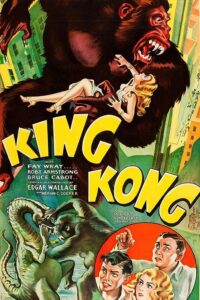 To celebrate the 80th anniversaries of “The Man of Bronze” and King Kong, Will Murray, author of The Wild Adventures of Doc Savage, paired the two characters in his novel, Skull Island. On Saturday, July 27th, at 2 PM, PulpFest 2013 will host a special New Fictioneers reading of Mr. Murray’s bestselling novel, read by Radio Archives reader Roger Price.
During his lengthy career as an entertainer, Roger has performed on television, radio, and the live stage. At one time or another, he has worked as a stand-up comic, hosted a late-night movie series as a character called “The Baron,” worked as a morning radio personality, hosted and emceed numerous live events, served as an entertainment news anchor, and even as a ring announcer for professional wrestling. Comic book and pop culture fans know Roger as the creator, director, and “voice” of Mid-Ohio-Con, one of the largest and longest-running conventions of its kind.
Through Radio Archives, Roger Price can be heard reading various short stories on Strange Detective Mysteries #1, Captain Satan #1, Captain Zero #1, and other audiobooks. Roger also works with a wide variety of clients as an announcer and voice actor, specializing in character/cartoon voices and dialects.
Following the reading, both Will Murray and Roger Price will be available for questions and conversation.
Evening Programming (Saturday):
The 2013 Munsey Award—Garyn G. Roberts has been named this year’s Munsey Award winner. Nominated by the general pulp community, Garyn was selected by a vote of all living Lamont, Munsey, and Rusty Award winners.
 Garyn has worked in higher education for many years, teaching English and popular culture studies. He is also an unabashed fan of the pulps. Garyn has written extensively about the pulps, both professionally and as a fan. He has edited or co-edited some of the best collections from the pulps, including A Cent a Story: The Best from Ten Detective Aces, More Tales of the Defective Detective in the Pulps, The Compleat Adventures of the Moon Man, The Magical Mysteries of Don Diavolo, and The Compleat Great Merlini Saga. His insightful essays in these books and elsewhere have deepened understanding of the pulps both inside and outside the pulp community. His anthology, The Prentice Hall Anthology of Science Fiction and Fantasy, a college-level textbook, is notable for its attention to pulp magazines. Additionally, Garyn has helped other researchers with various pulp-related projects and regularly attends pulp conventions, where he often serves as a presenter and panelist. Last year’s Munsey Award winner, Matt Moring, publisher of Altus Press, recently said about Garyn: “He’s been nothing but helpful and outgoing with anything I’ve ever asked of him.” That pretty much describes how Professor Roberts responds to all the requests the pulp community makes of him.
Other nominees for this year’s award included Charles Ardai, J. Randolph Cox, Stephen T. Miller, Laurie Powers, J. Barry Traylor, George Vanderburgh, Dan Zimmer, William G. Contento, Chris Kalb, Phil Stephensen-Payne, Celina Summers, and Howard Wright. John DeWalt also received votes.
The Munsey Award, named after the man who invented the pulp magazine, was created in 2009 by talented artist David Saunders. It is an art print, limited to 36 copies, published by Dan Zimmer of The Illustrated Press.
If you believe a person or organization deserves the 2014 Munsey Award, please let us know. Nominations must include a short paragraph or two explaining why you are nominating the person or organization. Send all nominations to PulpFest Marketing and Programming Director Mike Chomko. You can reach him by email at mike@pulpfest.com or by regular mail at 2217 W Fairview St, Allentown, PA 18104-6542.
On August 5, 2013, PulpFest received a lengthy thank-you note from Garyn Roberts. Click here for a pdf. Garyn’s note is followed by a comment from Walker Martin, dated August 15, 2013.
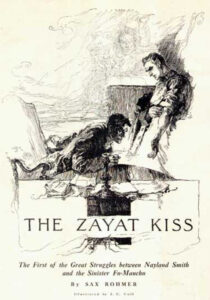 Dr. Fu Manchu & the Yellow Peril—One hundred years ago, Sax Rohmer’s Fu Manchu made his American debut in Collier’s, a five-cent weekly. “The Zayat Kiss” ran in the February 15, 1913 number. Nine more stories featuring Rohmer’s “devil doctor” would appear in Collier’s through June 28, 1913. In September that year, McBride released The Insidious Dr. Fu-Manchu, collecting all ten tales into novel form.
Although Sax Rohmer did not create the “yellow peril” genre of pulp fiction, his Fu Manchu stories would greatly influence the bloody pulps. From writers as diverse as Dashiell Hammett, Carroll John Daly, Walter B. Gibson, Norvell W. Page, Arthur J. Burks, Philip Nowlan, H. P. Lovecraft, and Robert E. Howard, pulpsters delivered many a story inspired by Rohmer’s evil genius. Even Robert J. Hogan’s flying spy, G-8, battled oriental evildoers in the author’s fantasy version of the First World War.
At 8 PM on Saturday, July 27, PulpFest will salute the American centennial of Dr. Fu Manchu with a panel exploring Sax Rohmer’s character and his influence on early-twentieth-century pulp fiction. Moderated by Blood ‘n’ Thunder editor and publisher, Ed Hulse, the panel will consist of pop culture experts Gene Christie, editor of three collections of Rohmer’s fiction and a leading authority on early American science fiction and fantasy; Win Scott Eckert, known for his work on literary crossovers and chronologies, including Marvel Comics’ Shang-Chi: Master of Kung Fu, a classic series concerning the son of Dr. Fu Manchu; Nathan Madison, author of Anti-Foreign Imagery in American Pulps and Comics, 1920-1960; William Patrick Maynard, authorized by the literary estate of Sax Rohmer to continue the Fu Manchu series; and Will Murray, author of the Wild Adventures of Doc Savage and one of the world’s leading authorities on the pulp era.
Hero Pulp Premiums and Promotions—How did pulp magazine publishers keep readers coming back month after month? Of course the best way was to publish excellent stories. Regardless of genre, the leading pulps attempted to do just that, issue after issue.
Another method that publishers employed to lure dimes on a regular basis from buyers with thin wallets was to create a club and offer premiums. For a few cents or by clipping coupons from a favorite pulp magazine, a devoted fan could become a member in good standing of the Doc Savage Club, one of the Friends of the Phantom, or Adventure Magazine’s Camp-Fire Club. Rings, pins, and other items were also available, such as the Spider Pencil, a celluloid mechanical pencil with a rubber eraser bearing The Spider seal, produced in very limited quantity during 1941-42.
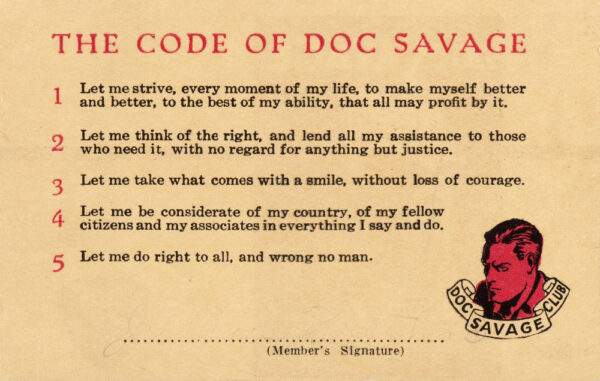
On Saturday, July 27, at 9 PM, please join PulpFest website designer Chris Kalb in the Fairfield Room located on the second floor of the Hyatt Regency Columbus as he takes us back to a time when a few cents not only bought a pulp magazine filled with thrills, but also an Operator #5 ring, a G-8 Battle Aces Club pin, or a membership in the Green Lama Club. Chris will present “Hero Pulp Premiums and Promotions,” an event you cannot afford to miss. It won’t cost you a dime more than your convention membership.
For more pulp premiums, visit Pulpster editor Bill Lampkin’s The Pulp.Net website and search for “premiums.” Bill has photographs of rings, membership cards, pins, and other items on his highly informative website.
Tonik Auction Continues—One of PulpFest’s many highlights is its Saturday night auction. Organized by J. Barry Traylor and a gaggle of enthusiastic volunteers, the auction is always the final programming event of summer’s great pulp con. Any registered convention member may submit items for auction as long as they meet PulpFest’s guidelines.
PulpFest is proud that this year’s auction will include 115 lots of approximately 250 books from collector and scholar Al Tonik’s huge library of hardcovers, paperbacks, pulps, dime novels, comic books, fanzines, and reference books. At its 2012 convention, PulpFest sold about seventy percent of the Tonik collection, with more than $15,000 in bids on a wide range of items. The remaining lots are hard-to-find reference books and author biographies. Over many years, Albert Tonik was a leading scholar of pulp history. The winner of the 1994 Lamont Award, Al researched aspects of pulp history previously covered sketchily and loved sharing his knowledge with our community.
In addition to the Tonik material, PulpFest will accept about 100 lots from registered PulpFest 2013 members. However, because of the substantial number of Tonik lots, we may limit the number of lots each consignee can offer.
PulpFest‘s annual Saturday night auction will start at approximately 9:30 PM on July 27, following the conclusion of Chris Kalb’s presentation, “Hero Pulp Premiums and Promotions. “Remember to bring your convention badge. We’ll use your badge number when buying and/or selling during the auction. Our auctioneers will be Adventure House‘s John Gunnison and Joseph Saine, a full-time proprietor of an antique toy shop and licensed auctioneer from northwest Ohio.
Many Thanks for Your Help
Year after year, countless individuals and organizations help make PulpFest an enjoyable experience for those who choose to attend “Summer’s Great Pulp Con.” The PulpFest Organizing Committee thanks the following people and organizations for their invaluable assistance in making PulpFest 2013 a wonderful weekend. We could not have done it without you:
Our all-volunteer front desk staff: Maura Childers, Sam Childers, Aaron Cullers, Jack Cullers, Sally Cullers, Samantha Cullers, and Tess Massey; our panelists, presenters, and auctioneers: Jim Beard, Christopher Paul Carey, Nick Carr, Gene Christie, Win Scott Eckert, Ron Fortier, John Gunnison, Ed Hulse, Don Hutchison, Chris Kalb, Rick Lai, Nathan Madison, William Patrick Maynard, Matt Moring, Will Murray, Van Allen Plexico, Roger Price, Garyn Roberts, Joseph Saine, David Saunders, Frank Schildiner, Art Sippo, and John Allen Small; our behind-the-scenes help: Mike Chomko, Mike Croteau of FarmerCon, Ohio State’s Eric Johnson, Chris Kalb, Lohr McKinstry, Rick and Renee Thomas, Barry Traylor, Chuck Welch, Dan Zimmer, and the staff of the Hyatt Regency Columbus.
The Organizing Committee would also like to thank the people who helped to create The Pulpster #22: editor and designer Bill Lampkin and proofreader Peter Chomko, plus contributors Michael Chomko, Tony Davis, Monte Herridge, Tom Johnson, John Locke, Nathan Vernon Madison, William Patrick Maynard, Vella Munn, Will Murray, Laurie Powers, William Preston, David Rajchel, George Vanderburgh; the magazine’s sponsors: Baen Books, The Comic Book Shop in Spokane, Washington, Doug Frizzle, Richard Halegua, Heartwood Auctions, Larry Latham and Lovecraft is Missing, Murania Press, Pro Se Productions, The Pulp Factory, Radio Archives (who also provided the door prizes for PulpFest 2013), Stark House Press, Alfred R. Taylor, Titan Books, and Weird Tales.
Many thanks as well to the nominators and the Lamont Award, Munsey Award, and Rusty Hevelin Service Award winners who helped select this year’s Munsey winner, Garyn G. Roberts. Congratulations to Garyn and to all of the nominees for our 2013 awards.
Again, we’d like to thank the following organizations for the books and similar items that were donated to PulpFest for distribution to our members: John Huckans and Book Source Magazine, Engle Publishing and The Paper & Advertising Collectors’ Marketplace, the Estate of Rusty Hevelin, Gordon Van Gelder and The Magazine of Fantasy & Science Fiction, Tom Brown and Radio Archives, Greg Shepard and Stark House Press, and Charles F. Millhouse and Stormgate Publishing.
Finally, thanks to all of the conventions, book and paper fairs, bookstores, comic and collectible shops, websites, magazines, newspapers, and other media outlets that helped to promote our show as well as the dealers, attending members, and supporting members of PulpFest 2013. Your encouragement and support made our convention a success. We hope to see you all back next summer along with a good many newcomers for PulpFest 2014. Details will follow in the coming months. Please subscribe to our PulpFest email list through the small gray box found along the right side of our home page. You’ll also find information on our Facebook page and our Twitter account.
Meet Chuck Welch
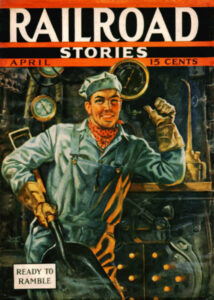 On this day when we salute the American worker, PulpFest is pleased to welcome its newest “laborer,” Chuck Welch, to its organizing committee. A Wisconsin resident, Chuck began attending pulp cons in the late nineties. After starting a family, he rejoined PulpFest several years back and has been a devoted attendee ever since. Here’s what Chuck has to say about himself:
Although some may believe he is old enough to have purchased pulps off the newsstand, Chuck Welch is a mere whippersnapper. As one of the original Internet “Fans of Bronze,” Chuck started attending the summer pulp convention in the late 1990s. After meeting his future wife at one of those conventions, Chuck took some time off to start a family. At Bill Mann’s behest, he returned to attend PulpFest.
As is his wont, Chuck immediately started volunteering and making suggestions to Jack, Barry, Ed, and Mike. Fed up with his puppy-dog eyes, the fearsome foursome asked Chuck to join the team. Recently moved and having foisted off his old businesses, Chuck accepted. His goal for PulpFest 2014 is to not have any other members call for his head.
Chuck lives in La Crosse, Wisconsin, with his wife and daughter. Though the youngest Welch has access to three complete collections of Doc Savage novels, she hasn’t yet found her parents’ love for the character. A generalist at heart, Chuck won’t claim an expert’s knowledge in any area of pulps or pulp collecting. However, he brings technical expertise in social media, new and dinosaur journalism, and organization.
Please welcome Chuck as one of the planners of PulpFest, “The Summer’s Great Pulp Con!”
Chris Kalb adapted our lead image from Walter Baumhofer’s cover art for the March 1933 issue of Doc Savage Magazine. Our featured image is excerpted from Baumhofer’s original cover painting.
Bob Kane created the cover for Detective Comics #27, dated May 1939, marking Batman’s first appearance.
Jerome Rozen’s menacing cover art adorned the March 1936 issue of Popular Publications’ The Mysterious Wu Fang, the final issue of the pulp’s short run.
In a publicity photo, Kenneth Duncan as Ram Singh reads an issue of The Spider for the 1938 Columbia Pictures movie serial, The Spider’s Web.
Joe DeVito painted the cover art for the Meteor House edition of Philip José Farmer’s Doc Savage: His Apocalyptic Life, published in 2013.
Walter M. Baumhofer contributed the front cover art to the August 15, 1935 Adventure, pictured above. It was published by Popular Publications.
The film poster for the RKO Pictures 1933 release, King Kong, is by an unknown artist.
Joseph Clement Coll’s illustration for the first Fu Manchu story published in the United States, “The Zayat Kiss.” The picture originally appeared in the February 15, 1913 issue of Collier’s. The image is courtesy of The Page of Fu Manchu, an ongoing effort by scholars and readers worldwide to create a definitive Sax Rohmer bibliography, reference, and archive.
The Doc Savage Club card, Street & Smith, c. 1930s, was one of the premiums you could get by clipping coupons from your pulp magazine, accompanied by payment of a dime or some other token amount.
Emmett Watson contributed the cover for the April 1937 issue of Railroad Stories, published by the Frank A. Munsey Company.