 As part of its celebration of “Hardboiled Dicks, Dangerous Dames, and a Few Psychos,” PulpFest will honor the 100th anniversary of the birth of Robert Bloch, author of PSYCHO.
The convention is pleased to announce that the Narada Radio Company will bring its Pulp-Pourri Theatre to next summer’s PulpFest. The group will be dramatizing Bloch’s “Return to the Sabbath,” a short story that originally appeared in the July 1938 WEIRD TALES.
Based in Corpus Christi, Pulp-Pourri Theatre is an all-new audio drama anthology series with roots in vintage pulp fiction, but it presents its stories in a modern way. Pete Lutz is the company’s producer and director. You can sample the troupe’s work online or via iTunes.
Additionally, PulpFest is planning to have presentations on DIME DETECTIVE, the villains of THE SHADOW MAGAZINE, “The Dangerous Dames of Kenneth Robeson,” Hollywood detective Dan Turner, Señorita Scorpion and the Domino Lady, Philip José Farmer, and much more.
We’ll keep you informed about all of these exciting topics through our website and social media. Please bookmark PulpFest.com and visit at least once a week. We’ll be offering a new post every Monday morning around 9 AM Eastern time. You can also keep up with us on Facebook or by following us on Twitter.
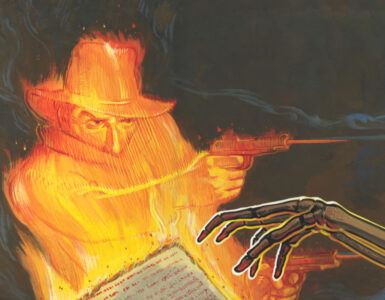
Our featured image was excerpted from Gloria Stoll’s cover art for the July 1945 issue of Popular Publications’ Detective Tales. The artist will be the Guest of Honor at PulpFest 2017.
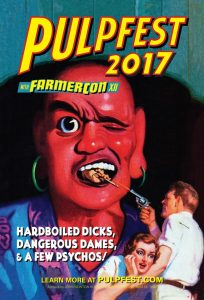
Designed by PulpFest’s advertising director, William Lampkin, our PulpFest 2017 postcard features artist John Newton Howitt’s work. His painting originally appeared as the cover of the April 15, 1934 issue of Popular Publications’ Dime Detective Magazine.
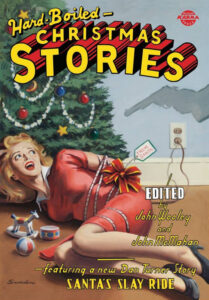 Season’s Greetings from PulpFest—from July 27 – 30, 2017, PulpFest will celebrate the “Hardboiled Dicks, Dangerous Dames, and a Few Psychos” found in the great pulp magazines.
In such rough-paper periodicals as BLACK MASK and DIME DETECTIVE MAGAZINE, the hardboiled detective genre took shape and flourished.
Continuing to inspire authors and readers across the globe, the hardboiled dick and dangerous dame had to be, as Raymond Chandler suggested, “the best man (or woman) in his (or her) world and a good enough man (or woman) for any world.”
John Wooley and John McMahan echoed Chandler in their introduction to HARD-BOILED CHRISTMAS STORIES:
“… the classic hard-boiled detectives knew well how the world worked, that it was too often an ugly, unfair and brutal place that buried gentle virtues and kind gestures under spadefuls of smothering darkness … They understood that they were trying to make a decent living in an often indecent business, but it was more than that. Deep down, they wanted to help humanity, wanted to restore compassion and kindness to the world – wanted, say, for themselves and others to be able to enjoy Christmas like a kid.”
We hope you’ll join us from July 27-30 at the newly and beautifully renovated DoubleTree by Hilton Hotel Pittsburgh – Cranberry in Mars, Pennsylvania for PulpFest 2017.
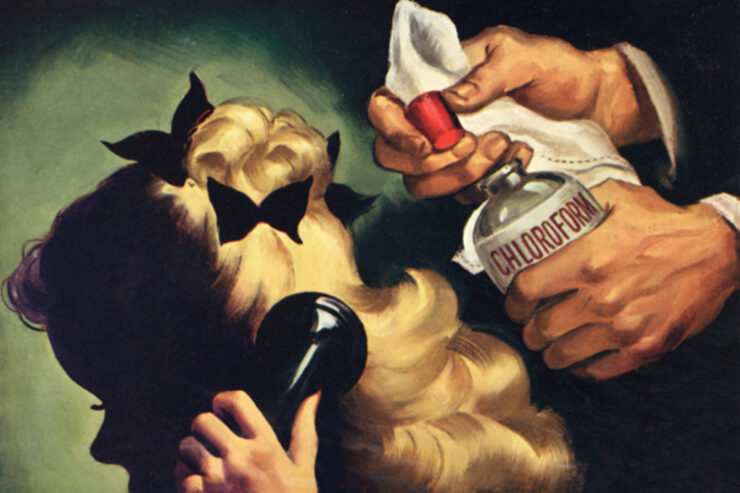
And hopefully, a knight errant of the hardboiled school will be around to help the poor woman in our featured image to enjoy her holidays. It doesn’t look too good for her.
Our featured image is David Saunders’ cover for Hard-Boiled Christmas Stories, an anthology of ten yuletide homicide tales edited by John Wooley and John McMahan and published in 2014 by Reverse Karma Press. It’s highly recommended.
Coming Soon to Pittsburgh—PulpFest is known for its great programming, and the line-up that we’re planning for our 2017 convention is shaping up to be one of our best.
The focus of this year’s convention will be hard-boiled dicks, dangerous dames, and a few psychos. We’ll be exploring DIME DETECTIVE MAGAZINE — one of the pulps where the hard-boiled detective story began to take shape — and Robert Leslie Bellem’s tough-guy detective, Dan Turner; Pat Savage, The Domino Lady, and other dangerous dames of the pulps; and some of the mad scientists, crazed hunchbacks, and foul cultists who decimated American cities on a monthly basis in the rough-paper magazines. We’ll also be saluting the hundredth anniversary of Robert Bloch’s birth. Even the author of PSYCHO was once a baby.
To give you an idea of what you’ll encounter from July 27 through July 30 at the DoubleTree by Hilton Hotel Pittsburgh – Cranberry in Mars, Pennsylvania, just north of Pittsburgh, below is the planned schedule for PulpFest 2017.
Preliminary Schedule for PulpFest 2017
Thursday, July 27, 2017
Dealers’ Room
4:00 PM – 11:00 PM — Dealers’ Room Set-Up
6:00 PM – 9:00 PM — Dealers’ Room Open for Early-Bird Shopping (free with your stay at the DoubleTree)
Programming
9:00 – 9:10 PM — Robert Bloch’s PSYCHO: SANITARIUM — A Reading by Chet Williamson
9:10 – 9:50 PM — The Dangerous Dames of Kenneth Robeson: Pat Savage, Nellie Gray and Rosabel Newton (Chuck Welch)
9:50 – 10:00 PM — Philip José Farmer’s Most Dangerous Dame — Win Scott Eckert Reads from THE SCARLET JAGUAR
10:00 – 10:40 PM — Compliments of the Domino Lady (Michelle Nolan)
10:40 – 10:50 PM— Scarlet Adventuress — The Domino Lady — A Reading by Ron Fortier
10:50 – 11:00 PM — Intermission
11:00 – 11:30 PM — Pulp-Pourri Theatre Presents “The Return of Mr. Fye”
Friday, July 28, 2017
Dealers’ Room
9:00 AM – 10:00 AM — Early Registration and Dealers’ Room Set-Up
10:00 AM – 4:45 PM — Dealers’ Room Open to All
Programming
12:45 – 4:30 PM — New Fictioneers Readings — (author readings by Jim Beard, John Bruening, Peter McGarvey, Heidi Ruby Miller, and Don Shakers)
6:55 – 7:00 PM — Welcome to PulpFest 2017 (Convention Chairman Jack Cullers)
7:00 – 7:20 PM — The Psychos of Philip José Farmer — The Nine (Win Scott Eckert, Frank Schildiner, and Art Sippo)
7:20 – 7:30 PM — The Psychos of Philip José Farmer — Win Scott Eckert Reads from THE MONSTER ON HOLD
7:30 – 7:50 PM — Philip José Farmer and Robert Bloch (Mike Croteau of Meteor House)
7:50 – 8:30 PM — 100 Years with the Author of Psycho: Robert Bloch (Garyn Roberts)
8:30 – 9:10 PM — Somewhere a Roscoe (John Wooley)
9:10 – 9:20 PM — Pulp-Pourri Theatre Presents Robert Leslie Bellem, a Dan Turner Reading
9:20 – 9:50 PM — Hardboiled and Dangerous: The Many Characters of Erle Stanley Gardner (Jeffrey Marks)
9:50 – 10:30 PM — Hardboiled Dicks: A Look at DIME DETECTIVE MAGAZINE (Matt Moring)
10:30 – 10:40 PM — Philip José Farmer’s Most Dangerous Dame — Win Scott Eckert Reads from THE SCARLET JAGUAR
10:10 – 10:50 PM — The Dangerous Dames of Maxwell Grant: Myra Reldon, Margo Lane, and Carrie Cashin (Anthony Tollin)
10:50 – 11:00 PM — Intermission
11:00 – 11:30 PM — Pulp-Pourri Theatre Presents “Return to the Sabbath,” a WEIRD Audio Play by Robert Bloch
Saturday, July 29, 2017
Dealers’ Room
10:00 AM – 4:45 PM — Dealers’ Room Open to All
3:00 – 4:15 PM — Auction Viewing at the DoubleTree
Programming
12:30 – 2:00 PM — New Fictioneers Readings — (author readings by Win Scott Eckert and Frank Schildiner)
2:15 – 3:15 PM — Six Writers of New Pulp (moderator Ron Fortier, with Fred Adams, Jr., John Bruening, Wayne Carey, Michael Maynard, and Charles Millhouse)
3:20 – 4:00 PM — A Few Psychos: The Villains of The Shadow
5:00 – 6:50 PM — PulpFest 2017 Group Meal at Ember & Vine in the DoubleTree (Volunteer Coordinator Sally Cullers)
7:00 – 7:20 PM — PulpFest 2017 Business Meeting (meet the convention organizers)
7:20 – 7:30 PM — 2017 Munsey Award Presentation (presented by Laurie Powers)
7:30 – 8:10 PM — Guest of Honor Gloria Stoll Karn with David Saunders
8:10 – 8:20 PM — The Wild Adventures of Pat Savage by Will Murray — A Reading by Pulp-Pourri Theatre
8:20 – 8:50 PM — Hard-Boiled at 100: The Don Everhard Stories of Gordon Young (Tom Krabacher & Walker Martin)
8:50 – 9:10 PM — Intermission (Auction Viewing)
9:15 – 12:15 AM — Saturday Night at the Auction (John Gunnison and Joseph Saines, Auctioneers)
Sunday, July 30, 2017
Dealer’s Room
9:00 AM – 2:00 PM — Dealers’ Room Open to All (many dealers will be packing up; buying opportunities may be limited)
All PulpFest members are welcome to attend our afternoon and evening programming. All programming events will be in the Hemlock and Hickory Rooms at the DoubleTree
PulpFest 2017 Dealers—although PulpFest is well known for its excellent programming, it is also lauded for its very substantial dealers’ room. Beginning on Thursday, July 27, the DoubleTree by Hilton Hotel Pittsburgh – Cranberry — just north of Pennsylvania’s “Steel City” — will be home to thousands of collectible pulp magazines and digests, vintage paperbacks, first edition hardcovers and series books, original art, B-movies and serials, collectible comic books, and more. And remember, members staying at the DoubleTree can enjoy free early-bird shopping on Thursday evening from 6 to 9 PM. For those staying elsewhere, early-bird shopping privileges will cost $30 more.
In addition to Thursday’s early-bird hours, the PulpFest dealers’ room will be open from 10 AM to 4:45 PM on July 28 & 29 and from 9 AM to 2 PM on Sunday, July 30. Note that buying and selling opportunities on Sunday may be limited as dealers pack up for their trip home.
Who will be selling at PulpFest 2016?
Adventure House (John Gunnison), Adventures in Bronze (Will Murray), Age of Aces (Chris & David Kalb), Airship 27 Productions (Ron Fortier & Rob Davis),
Jim & Walter Albert, All American Comics and Collectibles (Gene Carpenter), Mark Alvarado, Battered Silicon Dispatch Box (George Vanderburgh), Bethlehem Art Gallery (Robert & Loretta Gould), The Bronze Gazette (Chuck Welch), Nick Certo, Chaska Books (Jonathan Sweet), Creepy Classics (Ron Adams), Jack Cullers, Curious Bookshop (Ray Walsh), L. W. Currey, Darkstar Books (Gary Diedriech), Dearly Departed Books (Scott & Linda Edwards), Keith Dilbone, Dreamhaven Books (Greg Ketter), Doug Ellis & Deb Fulton, Flinch! Books (Jim Beard & John Bruening), Bob Flowers, Harold & Honey Forman, Garcia Publishing Services (Robert Garcia), Larry “Doc” & Jasper Grubb, Mark Halegua, Rick Hall, Scott Hartshorn, John Hauser, Heartwood Auctions (Richard Meli & Emma Sloan), Paul Herman, Heroes & Games (Doug Sims & Mark Carbonaro), Mark Hickman, John Knott, Bookseller, Dave Kurzman, Ed Lancaster, Dave LePlae, Bill Mann, Laurie Mann, Walker Martin, William Patrick & Michael Maynard, Meteor House, Mike Chomko Books (Mike & Peter Chomko), Ted Miller, Murania Press (Ed Hulse), Narada Radio Theatre, Pete Lutz, Director, Phil Nelson, Jerry Ohlinger’s Movie Materials (Barbara Fister-Liltz & Bill Hunt), Shaun Perkins, Craig Poole, Pulp Era Booksellers (Curt Phillips), Rantings of a Wandering Mind (Joab Stieglitz), Garyn & Virginia Roberts, Joseph Saine, Sanctum Books (Anthony Tollin), Skeptic Collectibles (Tom Skemp), Bill Thinnes, Tim’s Books (Tim Paxton), Barry Traylor, Sheila Vanderbeek, Jon Wehler, David White, Chet Williamson, Dave Willoughby, Derek Woywood, and Ygor’s Books (Cathy & Larry Hallock).
Plan to attend PulpFest’s 2017 celebration of pulp fiction and pulp art. Join us July 27 – 30 outside of Pittsburgh, Pennsylvania as we explore the “hardboiled dicks, dangerous dames, and a few psychos” of the pulps.

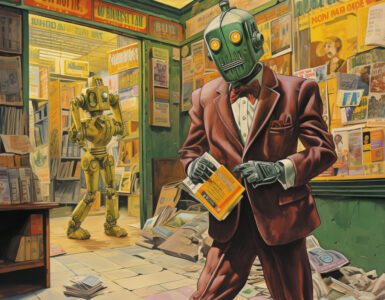
Bill Lampkin adapted our featured image from a photograph of a Manhattan newsstand, circa 1935.
Highlights from The Pulpster—our award-winning program book returns with a hardboiled and dangerous 26th issue at PulpFest 2017. As usual, it’s packed with interesting articles about pulp magazines.
Number 26 will feature articles that tie into two of this summer’s pulp convention themes: dangerous dames and psychos.
Authors and pulp historians Ron Goulart and Bill Pronzini each write about those dangerous dames. Goulart’s piece looks at the few female detectives found in the pulps, while Pronzini examines the women authors whose fiction appeared in detective pulps.
As for the psycho angle, how about author Robert Bloch? He’s best known today for writing the 1959 novel on which Alfred Hitchcock based his classic movie, PSYCHO. But before that, Bloch got his professional writing start in the pulp magazines. His first sale was made to WEIRD TALES, naturally. Professor Garyn Roberts profiles Bloch and looks at the novel PSYCHO.
Tony Davis, editor emeritus of THE PULPSTER, writes about horror author and poet Mary Elizabeth Counselman, whom he corresponded with during the late 1970s and early ’80s. Her story, “The Three Marked Pennies,” was one of the three most popular in all of Weird Tales history.
In addition to articles about the pulps and their creators, THE PULPSTER will also feature an article by Curt Phillips offering tips on preserving your collection of the aging pulpwood magazines, and articles on DETECTIVE FICTION WEEKLY.
Rounding out the issue are columns by editor Lampkin, publisher Michael Chomko, and “Final Chapters,” in which editor emeritus Davis remembers pulp community members who have recently passed away.
A longstanding tradition cherished by attendees of summer pulp cons, THE PULPSTER #26 will be released at PulpFest 2017. Every PulpFest member, including supporting members, will receive a complimentary copy of THE PULPSTER.
Norman Saunders painted the cover art for the 2017 Pulpster, based on the July 1949 Black Mask issue. The painting appears courtesy of his son, pulp art historian David Saunders. A limited edition poster of the painting is available in the “gift shop” at the Norman Saunders website, normansaunders.com.
Thursday, July 27, 2017
Robert Bloch’s Psycho: Sanitarium—to the fans of pulp and genre fiction, Robert Bloch is known as the author of the classic, “Yours Truly, Jack the Ripper,” the Lefty Feep stories for FANTASTIC ADVENTURES, his Lovecraft-inspired tales such as “The Shambler from the Stars” and “The Shadow from the Steeple,” and “That Hell-Bound Train,” a short story for which he received a Hugo Award in 1959. Mr. Bloch also served as a Pulpcon guest of honor in 1983.
To the world at large, Robert Bloch is best known as the author of PSYCHO, the novel that became the basis for Alfred Hitchcock’s classic film of the same name. To celebrate the 100th anniversary of Mr. Bloch’s birth, PulpFest has asked author Chet Williamson to read from his novel, PSYCHO: SANITARIUM.
“The original PSYCHO novel by Robert Bloch was published in 1959 and became an instant hit, leading to the smash movie only a year later. It brought Norman Bates’s terrifying story into the public consciousness, where it still remains (as proven by the success of the TV series BATES MOTEL). It took Bloch twenty-three years to write another PSYCHO novel, revealing that Norman had been in a mental institution the entire time. In that sequel, Norman quickly escapes the sanitarium and goes on a killing spree in Hollywood.
But what happened in that asylum during those two decades? Until now, no one has known.”
 Chet Williamson’s parents took him to see Alfred Hitchcock’s PSYCHO when he was twelve, and he has been a reader and disciple of Bloch ever since. Chet’s stories have appeared in THE NEW YORKER, PLAYBOY, and many other magazines and anthologies. A collection of his stories received the International Horror Guild Award. He has been nominated twice for the World Fantasy Award and the Mystery Writers of America’s Edgar Award, and six times for the Horror Writers of America’s Stoker Award. A professional writer and actor, he has narrated more than thirty audiobooks.”
On Thursday, July 27, at 9:00 PM, Chet Williamson will read from his novel, PSYCHO: SANITARIUM at PulpFest 2017. It’s part of our salute to Robert Bloch’s life and work.
The quotes used in this post come from the dust jacket of Psycho: Sanitarium, published in 2016 by Thomas Dunne Books, an imprint of St. Martin’s Press. Ervin Serrano designed the jacket.
The Dangerous Dames of Kenneth Robeson—over the years, PulpFest has honored pulp fiction and pulp art by highlighting the many ways they have inspired writers, artists, film directors, software developers, game designers, and other creators. Indeed, the hardboiled dicks, dangerous dames, and a few psychos of the pulps that we’ll be celebrating in 2017 have had a profound effect on popular culture.
Today, we’re turning our attention to the dangerous dames of the pulps, the hardboiled ladies who helped pave the way for modern-day gumshoes like Sue Grafton’s Kinsey Millhone, Marcia Muller’s Sharon McCone, and Sara Paretsky’s V. I. Warshawski. Collectively, these authors and their characters have helped the hardboiled school of detective fiction writing evolve in new directions.
Female pulp characters such as Cleve Adams’s Violet McDade and Nevada Alvarado, Lester Dent’s Pat Savage, Paul Ernst’s Nellie Gray and Rosabel Newton, John Russell Fearn’s Golden Amazon, Walter Gibson’s Myra Reldon and Margo Lane, Robert E. Howard’s Bêlit, the “Queen of the Black Coast,” C. L. Moore’s Jirel of Joiry, Norvell Page’s Nita Van Sloan, Les Savage’s Senorita Scorpion, Theodore Tinsley’s Carrie Cashin, Gene Francis Webb’s Grace Culver, and the pseudonymously written Domino Lady and Sheena, Queen of the Jungle, all depicted women in roles often reserved for men. Generally, they performed as well as or better than their male counterparts. These dangerous dames helped remove women from the drawing rooms of Carolyn Wells and Agatha Christie, the love and western romance pulps, and into the mean streets of “a world gone wrong.”
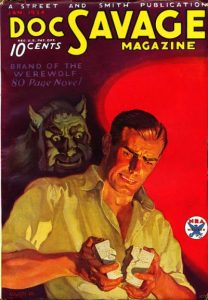 The most loved woman character of the pulps is Lester Dent’s Pat Savage. As Doc Hermes writes in Pat Savage, Woman of Bronze, “I’ve never seen a pulp fan who didn’t like Patricia Savage, and many think she is aces.”
Introduced in “Brand of the Werewolf” — originally published in the January 1934 issue of DOC SAVAGE MAGAZINE — Pat Savage would appear in 37 adventures of the Man of Bronze. In “I Died Yesterday,” her final pulp appearance (published in the January 1948 number of the Street & Smith pulp), she is the story’s first-person narrator. As Terence Towles Canote has written on A SHROUD OF THOUGHTS:
“She was in many ways the perfect, female counterpart to her cousin. Pat was spectacularly beautiful, yet very much her own woman. She could fight as well as any man, deadly with her six shooter and skilled in boxing, fencing, and jujitsu. She could fly a plane, pick locks, pick pockets, speak Mayan and German (although she was not very good at the latter), knew Morse code, and was a very convincing actress. She also had an undying love of adventure, which she shared with her cousin (even if Doc would never admit it). Over the course of her adventures Pat emerges as a fully realised character, perhaps more fully realised than any female character from the pulps save Nita Van Sloan from THE SPIDER. This could very well be the reason she still has more than her fair share of fans to this day.”
Please join PulpFest 2017 on Friday, July 28, at 9:10 PM as the convention’s technical director, Chuck Welch, examines The Dangerous Dames of Kenneth Robeson. In addition to Pat Savage, Chuck will discuss Paul Ernst’s Nellie Gray and Rosabel Newton, two strong female characters in Street & Smith’s THE AVENGER, a hero pulp introduced in 1939.
As one of the original Internet Fans of Bronze, Chuck Welch started attending Pulpcon in the late 1990s. After meeting his future wife at one of these conventions, Chuck took some time off to start a family. At Bill Mann’s request, he returned to attend PulpFest. Chuck is the convention’s technology director and webmaster. When the Internet began to take off, Chuck began Flearun, a Doc Savage group now at Facebook. He is also the creator of the Hidalgo Trading Company — perhaps the closest anyone has come to presenting an online Doc fanzine — and the publisher of the Doc Savage fan magazine THE BRONZE GAZETTE.
Doc Savage and his assistants travel to British Columbia to visit his uncle, Alex Savage, and cousin, Patricia Savage, in “The Brand of the Werewolf,” originally published in Doc Savage Magazine for January 1934, with cover art by Walter M. Baumhofer. When they reach the cabin of Doc’s relatives, they discover that Alex Savage has been murdered. From the start, Pat is ready for adventure, hoping to find her father’s killers. She remained “ready for adventure” in nearly forty tales of Lester Dent’s Man of Bronze.
Philip José Farmer’s Most Dangerous Dame—during his life, Philip José Farmer maintained that his book DOC SAVAGE: HIS APOCALYPTIC LIFE was a biography of a real person named Doctor James Clarke Wildman. Pat Wildman is the daughter of Doc Wildman, “the world-renowned adventurer and crimefighter of the 1930s and 40s.”
 Introduced in the Wold Newton novel, THE EVIL IN PEMBERLEY HOUSE — which Eckert coauthored with Philip José Farmer — Patricia’s adventures continue in THE SCARLET JAGUAR, written solely by Win Scott Eckert.
The winner of the 2014 New Pulp Award for best novella, Eckert’s story tells of a young girl whose father has been kidnapped by the Scarlet Jaguar. Pat, following in her father’s footsteps of righting wrongs and assisting those in need, agrees to help the girl. Now, it’s a race against time, deep in the wilds of the Central American jungle, as Pat Wildman and her crew search for the girl’s father and confront the Scarlet Jaguar’s strange power to eliminate enemies from afar.
Join Win Scott Eckert of FarmerCon on Thursday, July 27, at 9:50 PM for a short reading from THE SCARLET JAGUAR. To learn more about Philip José Farmer, please visit The Official Philip José Farmer Web Page. It’s the Brobdingnagian collection of all things Farmerian!
Eckert is the editor of and contributor to MYTHS FOR THE MODERN AGE: PHILIP JOSÉ FARMER’S WOLD NEWTON UNIVERSE. He has coedited three Green Hornet anthologies for Moonstone Books. His short tales have appeared in many character-themed anthologies from various publishers. Eckert’s critically acclaimed, encyclopedic CROSSOVERS: A SECRET CHRONOLOGY OF THE WORLD 1 & 2, was released by Black Coat Press in 2010. His forthcoming works include: the third Pat Wildman adventure; a new novel of one of the preeminent pulp heroes of the ’40s, The Avenger; and the unfinished fourth novel in Farmer’s Secrets of the Nine series. You can find Win Scott Eckert online at winscotteckert.com.
Win Scott Eckert’s The Scarlet Jaguar was released in 2016 by Meteor House, featuring cover art by Mark Sparacio. A Boca Raton resident, Mark is a Professor of Fine Arts at Digital Media Arts College in Florida. He has also worked as a comic book illustrator for Marvel, DC, and other companies.
Compliments of The Domino Lady—in the violence-riddled cities of the pulp era, the police were either unable or unwilling to deal with the criminal element. Strong-willed, often well-to-do citizens were left to take matters into their own hands. Over time, these characters became known as the pulp heroes. The Shadow, Doc Savage, The Spider, The Green Lama, The Avenger, The Black Bat, and others. These heroic vigilantes were helped by hand-picked agents, including several female assistants.
The Shadow had Myra Reldon and Margo Lane; Nita Van Sloan worked with The Spider; although disgruntled, Doc Savage accepted help from his cousin Pat; and The Avenger was capably helped by Nellie Grey and Rosabel Newton. And then there’s The Domino Lady…
The only female pulp hero to be featured in her own series, The Domino Lady appeared in six stories credited to Lars Anderson. Published in 1936, five of her tales ran in SAUCY ROMANTIC ADVENTURES. The character’s final tale appeared in MYSTERY ADVENTURE MAGAZINE.
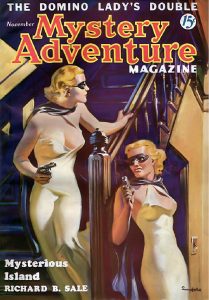 The Domino Lady is really debutante Ellen Patrick. Following the murder of her father—an honest and tireless district attorney—Ellen decides to fight evil in society. Wearing a small mask and a tight, revealing evening gown, she becomes The Domino Lady. Armed with an automatic pistol and a knockout drug, she robs her victims, donating the bulk of the loot to charity and leaving her calling card.
In his introduction to Vanguard Publications’ DOMINO LADY: THE COMPLETE COLLECTION, Bernard Drew writes:
“You’re in for a treat as you read these half-dozen Domino Lady escapades, for that’s the best way to describe them. Escapades. They involve no investigation, no probing, no crime solving. Ellen has already zeroed in on the bad guy by the story’s start. The main plot element, in fact, is the shapely heroine wrangling her way into a social situation, making light conversation, swiping something or other of value from someone who deserves to lose it and dropping a calling card which reads ‘The Domino Lady’s Compliments.’”
Over the last few decades, various small and independent presses have published new adventures of The Domino Lady. Moonstone Books has released several books and comics featuring the character. Airship 27 has issued two anthologies collecting new Domino Lady stories. Perhaps the strangest versions are the erotic comic book tales written and drawn by the late Ron Wilber.
At 10 PM on Thursday, July 27, please join Michelle Nolan in the PulpFest 2017 programming room for “Compliments of The Domino Lady,” a brief discussion of what The Domino Lady means in pulp history and how the character paved the way for dozens of costumed heroines in the comics of the Golden Age and beyond. It’s all part of the convention’s celebration of the dangerous dames of the pulps.
A mainstream journalist for more than fifty years, Michelle Nolan has also covered the history of genre fiction in pulps, comics, books and films in more than 1,000 magazine, newspaper and book articles. She is the author of the definitive LOVE ON THE RACKS: A HISTORY OF AMERICAN ROMANCE COMICS and BALL TALES: A STUDY IN AMERICAN SPORTS FICTION. In 2014, Michelle received an Inkpot Award from Comic-Con International: San Diego.
Although the first costumed pulp heroine appeared in just six stories in rare and obscure mid-1930s pulps, The Domino Lady commanded three covers, including the November 1936 issue of Mystery Adventure Magazine. Norman Saunders, one of the pulp era’s leading artists and illustrators, painted all three Domino Lady covers.
Over a five-decade career, Saunders completed more than 2,500 commercial art assignments, including more than 1,000 covers for 85 different pulp titles. In addition to his pulp work, Norman Saunders illustrated for national advertisers, slick magazines, paperbacks, men’s adventure magazines, calendars, comic books, trading cards, and more. He died in 1989 at 82.
The Domino Lady: Scarlet Adventuress—this year, PulpFest is saluting the dangerous dames of the pulps: characters such as Myra Reldon and Margo Lane, Nita Van Sloan, and Ellen Patrick, and the best of them all, The Domino Lady, created by Lars Anderson for SAUCY ROMANTIC ADVENTURES and MYSTERY ADVENTURE MAGAZINE.
Following the murder of her father — an honest and tireless district attorney — debutante Ellen Patrick declares war on crime. Armed with an automatic pistol and a knockout drug, wearing a small mask and revealing evening wear, she tackles the underworld, leaving them with her calling card: “The Domino Lady’s Compliments.”
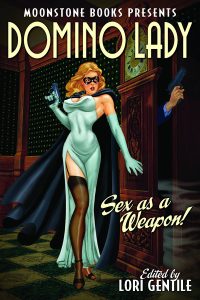 On Friday, July 28, at 10:40 PM, please join PulpFest 2017 as we welcome author, editor, and publisher Ron Fortier to read from “The Claws of the Cat,” a short story featuring one of the world’s first female masked crime fighters, The Domino Lady. Ron’s story originally appeared in DOMINO LADY: SEX AS A WEAPON, published in 2009 by Moonstone Books. Edited by Lori Gentile, the anthology featured nine new stories by some of the best writers of new pulp fiction.
Ron Fortier has been a professional writer for over four decades. In 2007, Ron teamed up with illustrator Rob Davis to found Airship 27 Productions and publish new adventures featuring long-moribund pulp characters such as the Green Lama, the Masked Rider, Secret Agent X, and Fortier’s own version of Captain Hazzard. Airship’s books have inspired contemporary writers and artists to create new adventures featuring many characters long remembered by the pulp community. They have also served as entry points for new people to get involved in the world of pulps. In 2009, Ron helped develop the Pulp Factory Awards, launched to support and encourage new pulp fiction and art. Ron’s own prose creation, Brother Bones, was recently optioned as a motion picture by Franklin-Husser Entertainment, an independent film production company based in Seattle.
Published in several different editions by Moonstone Books, Domino Lady: Sex as a Weapon! features cover art by Jeff Butler, an American illustrator and comic book artist. With Mike Baron, Butler created The Badger for Capital Comics. Later, he worked for TSR, the publisher of Dungeons and Dragons. He left the firm to help Ron Fortier bring The Green Hornet back to comics. Butler has also worked in the video game industry.
Pulp-Pourri Theatre Presents “The Adventures of Mr. Fye”—live theatre returns to this year’s PulpFest. On Thursday evening, July 27, at 11 PM, PulpFest welcomes the Narada Radio Company and their PULP-POURRI THEATRE to this summer’s convention. Based in Corpus Christi, PULP-POURRI THEATRE is an audio drama anthology series rooted in vintage pulp fiction, but presented in a modern way. Pete Lutz is the company’s producer-director. You can sample their work online or via iTunes.
“The Adventures of Mr. Fye” introduces a new hero inspired by the single-character hero pulps.
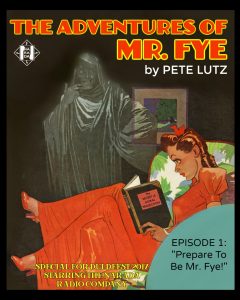 In her final moments of life, an ancient Chinese mystic passes on her powers to an unsuspecting police detective named “Jinx” Duncan. After a series of strange events, Jinx realizes that his life has been forever altered. He works to control his new powers and use them to help the innocent and battle crime. To do so, he becomes Mister Fye (say it with a New York accent and you’ll get the meaning).
According to Narada’s Pete Lutz, “PULP-POURRI THEATRE embraces the thrilling world of pulp fiction from the last century. We present audio dramas with a few modern touches, such as full sound design. We bring you the most exciting stories from the finest pulp writers. We also throw in an occasional new story from a guest playwright.”
The PulpFest 2017 cast of Narada Radio Company’s PULP-POURRI THEATRE will be Austin and Barbi Beach, Ross Bernhardt, Randy Coull, Derek, Keane, and Pete Lutz, and Greg and Rhiannon McAfee. Please join them at PulpFest 2017 from Thursday evening, July 27, through Sunday afternoon, July 30, at the DoubleTree by Hilton Hotel Pittsburgh – Cranberry, just nineteen miles north of the exciting city of Pittsburgh.
Start making your plans now to celebrate the “hardboiled dicks, dangerous dames, and a few psychos” at PulpFest 2017. Don’t miss your chance to meet “Mr. Fye” at the “pop culture center of the universe.”
The Narada Radio Company and their Pulp-Pourri Theatre will perform Pete Lutz’s original audioplay, The Adventures of Mr. Fye, at 11 PM on Thursday, July 27, at PulpFest 2017. The company will also be performing a Dan Turner Spicy Detective reading, a Pat Savage reading, and more at the convention. Watch for more details.
Pete Lutz designed The Adventures of Mr. Fye poster, based on a Robert O. Reid cover for the March 23, 1940 issue of Collier’s. The magazine was probably the number two general-interest magazine in America during the thirties, forties, and fifties, behind The Saturday Evening Post. Collier’s ceased publication in 1957.
Friday, July 28, 2017
The New Fictioneers—Friday afternoon programming was completely set aside for “New Fictioneers” readings. These featured contemporary writers reading from their recent works and fielding audience questions and comments. To learn more about PulpFest’s “New Fictioneers” readings, click here.
The Psychos of Philip José Farmer: The Nine—since 2011, PulpFest has hosted FarmerCon, a convention that began in Peoria, Illinois, Philip José Farmer’s hometown. Originally a gathering of Farmer fans, figuratively and literally in Farmer’s backyard, FarmerCon offered presentations, dinners, and even picnics at the author’s house. After Phil and Bette Farmer passed away in 2009, the organizers decided to associate FarmerCon with PulpFest, providing Farmer fans with a variety of programming and a room full of pulp and book dealers to enjoy.
On Friday, July 28 at 7 PM, please join PulpFest as we hand over our programming stage to our FarmerCon XII members and “The Psychos of Philip José Farmer — The Nine.” Win Scott Eckert, who edited the anthology MYTHS FOR THE MODERN AGE: PHILIP JOSÉ FARMER’S WOLD NEWTON UNIVERSE and collaborated with Phil on THE EVIL IN PEMBERLEY HOUSE, the novel that introduced adventuress Patricia Wildman, will moderate the panel. Joining him will be Frank Schildiner — author of THE QUEST OF FRANKENSTEIN, THE TRIUMPH OF FRANKENSTEIN, and other works — and Dr. Art Sippo, author of SUN KOH: HEIR OF ATLANTIS and host of the ArtsReviews podcast.
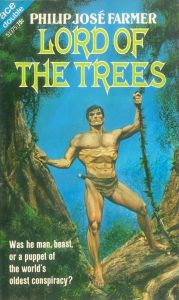 As this year’s PulpFest will be focusing on the “hardboiled dicks, dangerous dames, and a few psychos” of the pulps, our FarmerCon friends have decided to turn their attention toward Philip José Farmer’s novels of the Nine: A FEAST UNKNOWN, LORD OF THE TREES, and THE MAD GOBLIN. Win Scott Eckert is currently working on the fourth book in the series — a Doc Caliban novel entitled THE MONSTER ON HOLD — which is based on a chapter and high-level outline written by Farmer and published in the program book of the 1983 World Fantasy Convention. The series recounts the ongoing battle between the ape-man, Lord Grandrith, and the man of bronze, Doc Caliban, as they oppose the Nine, a secret cabal of immortals bent on amassing power and manipulating world events.
With both Art Sippo and Win Scott Eckert contributing introductions or afterwords to the Titan Books editions of Philip José Farmer’s books, expect a thought-provoking, in-depth look at the Nine and the two men who seek to defeat them. It’s all part of PulpFest 2017 and FarmerCon XII at the DoubleTree by Hilton Hotel Pittsburgh – Cranberry, just north of Pennsylvania’s “Steel City” of Pittsburgh. We hope you’ll attend. You’ll have a maddening time, especially if you stay at the DoubleTree! We look forward to seeing you July 27–30.
Philip José Farmer’s Lord of the Trees was originally released in 1970 by Ace Books as part of its double-paperback line. The other half featured The Mad Goblin. Gray Morrow, a comic and paperback artist who also illustrated many science-fiction magazines, created both covers. He was nominated for the Hugo Award for Best Professional Artist in 1966, 1967, and 1968.
The Monster on Hold—in 2017, FarmerCon is mixing things up a bit. They’ve asked Win Scott Eckert to perform a short reading from THE MONSTER ON HOLD. He’ll delve into the chapter Philip José Farmer offered at the 1983 World Fantasy Convention.
The fourth volume in “The Secrets of the Nine” series, THE MONSTER ON HOLD — forthcoming from Meteor House — is based on a chapter, notes, and text found in Farmer’s “Magic Filing Cabinet,” and a high-level outline written by the late author and published in the program book of the 1983 World Fantasy Convention.
Started in the volume A FEAST UNKNOWN and continued in LORD OF THE TREES and THE MAD GOBLIN, “The Secrets of the Nine” recounts the ongoing battle of the ape-man, Lord Grandrith, and the man of bronze, Doc Caliban, against the Nine, a secret cabal of immortals bent on amassing power and manipulating the course of world events.
Alternately called THE UNSPEAKABLE THRESHOLD and DOWN TO EARTH’S CENTRE, THE MONSTER ON HOLD evokes the sense of mystery and horror that the bronze-hued superman, Doc Caliban, feels when faced with a descent deep into a subterranean complex to confront an unfathomable evil. Philip José Farmer used all three titles at various times while working on his fourth Nine book. However, THE MONSTER ON HOLD was the latest title, and the one under which he announced the book in 1983. Thus, it is only fitting that this Doc Caliban adventure will finally appear under the title best known to Farmer’s legions of fans.
Win Scott Eckert is the coauthor with Philip José Farmer of the Wold Newton novel, THE EVIL IN PEMBERLEY HOUSE. It concerns Patricia Wildman, the daughter of pulp hero Doc Wildman, the bronze champion of justice. Her adventures continue in Eckert’s sequel, THE SCARLET JAGUAR, which won the 2014 New Pulp Award for best novella.
Eckert is the editor of and contributor to MYTHS FOR THE MODERN AGE: PHILIP JOSÉ FARMER’S WOLD NEWTON UNIVERSE. He has coedited three Green Hornet anthologies for Moonstone Books. His short tales have appeared in many character-themed anthologies from various publishers. Eckert’s critically acclaimed, encyclopedic CROSSOVERS: A SECRET CHRONOLOGY OF THE WORLD 1 & 2, was released by Black Coat Press in 2010. His forthcoming works include: the third Pat Wildman adventure; a new novel of one of the preeminent pulp heroes of the ’40s, The Avenger; and the unfinished fourth novel in Farmer’s Secrets of the Nine series. You can find Win Scott Eckert online at winscotteckert.com.
 Philip José Farmer and Robert Bloch—born on April 5, 1917, Robert Bloch is best remembered for his novel PSYCHO, which became the basis for Alfred Hitchcock’s classic film of the same name. The author of more than 200 stories, nearly thirty novels, and many non-fiction articles, screenplays, and teleplays, Bloch began his career in the pulp magazines celebrated each summer at PulpFest.
Please join us on Friday, July 28, at 7:30 PM as FarmerCon founder Michael Croteau, creator of Philip José Farmer’s Official Home Page and the publisher at Meteor House, explores Robert Bloch’s relationship with Grand Master of Science Fiction Philip José Farmer. In addition to being accomplished writers, both men frequently attended various science fiction and fantasy conventions. They formed a lasting friendship at the 1952 World Science Fiction Convention in Chicago.
Bloch—well known for his tongue-in-cheek sense of humor—often served as the toastmaster at convention banquets. At the 31st World Science Fiction Convention, held in 1973 in Toronto, Ontario, Bloch quipped:
“Then of course we have Philip José Farmer, one of the greatest innovators in our field, who stripped away much of the prudery and phony taboos. More than twenty years ago Philip José Farmer dared to do what no one had ever done before. He wrote ‘The Lovers,’ a story in which a man had sexual relations with an insect. You might call it science fiction’s first case of buggery.” Greeted by groans from his audience, Bloch continued, “You hear that, Phil? That’s how the public is. Last year they give you a Hugo; this year they boo your name.”
Using photographs and other materials from the Farmer estate, Michael will regale PulpFest attendees with tales of the friendship between these two science fiction and fantasy writers.
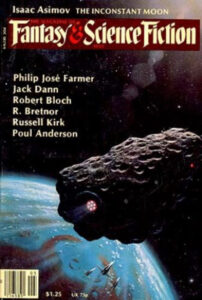
Farmer and Bloch not only crossed paths at science fiction conventions but also occasionally appeared together in books and magazines. Although he rarely submitted a truly “weird tale,” Farmer’s “The Freshman,” originally published in the May 1979 issue of The Magazine of Fantasy & Science Fiction, owes a substantial debt to H. P. Lovecraft, who mentored Robert Bloch. That same issue also includes Bloch’s short story, “Freak Show.” It follows a traveling sideshow that unexpectedly appears at the Goober City Fairgrounds. David Hardy contributed the issue’s cover.
Robert Bloch, Renaissance Man of the Fantastic—this year marks the 100th anniversary of Robert Bloch’s birth. The author of more than 200 stories, nearly thirty novels, and many nonfiction articles, screenplays, and teleplays, Bloch began his career in the pulp magazines celebrated each summer at PulpFest.
 During a long and productive career, Robert Bloch received a Hugo Award, the World Fantasy Life Achievement Award, the World Science Fiction Convention Special Lifetime Career Award, the Bram Stoker Award, and the World Horror Convention Grand Master Award. He also served as president of the Mystery Writers of America in 1970-71, and was the first Guest of Honor at a World Science Fiction Convention outside the United States. He was the Guest of Honor at the first Bouchercon and the first World Fantasy Convention, and, with Hugh B. Cave, the Guests of Honor at Pulpcon 12.
When asked what he considered to be the highlights of his career, Robert Bloch replied: “My first sales—of a short story, of a novel …the sale of PSYCHO to films and its subsequent success. But the most satisfying and memorable moments have come with the conventions where I was invited to appear as guest of honor, the winning of various awards … the continuing interest of fans …”
Following Bloch’s death in 1994, the late Frank Robinson wrote:
“He was a journeyman writer and entertainer, and had more experience in various writing forms—from political speeches to advertising to short stories, novels, articles, teleplays, and film scripts—than probably any other genre writer. But all of his stories, all of his movies, and all of his teleplays didn’t account for the feelings of affection that both fans and writers felt for him … Robert Bloch was a man without malice. Almost everyone who met him sensed that, and almost everybody who met him loved him for it. It was impossible not to.”
Beginning at 7:50 PM on Friday, July 28, PulpFest 2017 will honor Robert Bloch. Join Professor Garyn G. Roberts for “100 Years with the Author of PSYCHO,” an illustrated survey of Robert Bloch’s life and times. This presentation will showcase landmark events in the life of this “writer’s writer” and share little-known details about this master of the pulpwoods and other popular media. Though he never met the author in person, Professor Roberts maintained a prolific, ongoing correspondence with Bloch until the writer’s passing in 1994.
In Garyn’s words:
“The story of our relationship via the mail means a great deal to me. Though we never met in person, Mr. Bloch and I kept up a voracious correspondence to the point that I think I can call him a ‘friend.’ In the last months of his life, Mr. Bloch approached me and said he wanted to send me some unique materials I could incorporate into a book about him. I was tremendously honored that he chose me for this privilege, based on my previous biographical publications. He sent photos from Hollywood, unpublished writings, answers to interview questions, and more, including an introduction for the book. He also cleared all the rights for me to reprint these. I am convinced that no twentieth-century writer was more loved than Robert Bloch. Though underappreciated in his time, many of us still love him. More than a very talented writer, Robert Bloch was a good man and a dear friend.”
 Garyn G. Roberts, Ph.D., is a college and university professor. He holds multiple literary and teaching awards. Roberts was born in northern Wisconsin, 100 miles north of Plainfield, where serial killer Ed Gein’s atrocities occurred. When Gein’s activities were discovered in late 1957, Roberts’ father was hunting. To this day, Roberts’ mother recounts how frightened she was at home alone in the Wisconsin woods—a 23-year- old newlywed—when the news from Plainfield broke. Robert Bloch’s classic novel, PSYCHO, was inspired by the Ed Gein murders.
PulpFest 2017 will take place from Thursday evening, July 27, through Sunday afternoon, July 30, at the DoubleTree by Hilton Hotel Pittsburgh – Cranberry, just 19 miles north of Pittsburgh.
Start planning now to celebrate the 100th anniversary of PSYCHO author Robert Bloch’s birth at PulpFest 2017, the “pop culture center of the universe.”
Two of Robert Bloch’s major pulp markets were Weird Tales and the Ziff-Davis magazines, including Amazing Stories and Fantastic Adventures.
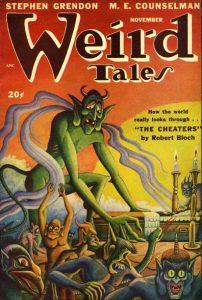
Between 1935 and 1952, Bloch published nearly seventy stories in “The Unique Magazine,” including “The Cheaters” in the November 1947 issue. It featured cover art by Matt Fox. A cartoonist, illustrator, comic book and advertising artist, watercolorist, painter, and graphic artist, with lithographs, woodcuts, and etchings to his credit, Fox painted eleven covers for Weird Tales and also contributed interior illustrations to the magazine. He also worked for Marvel Comics during the 1950s.
After Robert Bloch published “The Man Who Collected Poe” in the October 1951 issue of Famous Fantastic Mysteries, he was asked to complete Poe’s unfinished story, “The Lighthouse.” Published in the January 1953 issue of Fantastic—with cover art by Robert Frankenberg—Bloch was extremely proud that very few people could tell where Poe left off and where he began.
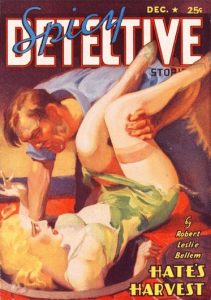 Somewhere a Roscoe—“From the window that opened onto the roof-top sun deck a roscoe sneezed: Ka-Chow! Chowpf! and a red-hot hornet creased its stinger across my dome; bashed me to dreamland.”
That’s Robert Leslie Bellem, writing as Hollywood gumshoe Dan Turner. The story is “Lake of the Left-Hand Moon,” originally published in the December 1943 issue of HOLLYWOOD DETECTIVE.
Born in Philadelphia and trained as a newspaper reporter, Bellem began writing for the pulps in 1928.
“I was thumbing through a magazine one day. I stumbled on an illustration to a story … It depicted two or three native South Seas island gals—clad in no more than the law allowed—surrounding one rather embarrassed-looking beachcomber. I squinted at the daub and got a definite inward reaction. I sat down at my typewriter and batted off ‘Eden Island,’ a sex yarn. It was the first sex farce I’d ever written. I sent it to PEP. They bought it and yelled for more of the same. That’s four years ago—now I sell about five or six sex farces a month, and hardly get time to write anything else!”
In 1934, Harry Donenfeld’s Culture Publications introduced SPICY DETECTIVE STORIES. Edited by Frank Armer, the former publisher of PEP, Bellem joined from day one, penning the adventures of Dan Turner, a “six feet plus and one hundred ninety pounds of wisecracking, .38 toting, whisky-swilling, womanizing private eye.” The character would go on to fight, shoot, and kiss his way through a “good two hundred tales,” published in SPICY and SPEED DETECTIVE STORIES, as well as HOLLYWOOD DETECTIVE STORIES.
A prolific writer, Robert Leslie Bellem “knocked out hundreds of other stories, at one stretch selling about a million words of fiction per year.”
He wrote a variety of fiction including adventure, detective, western, mystery, weird, and, of course, the sex farces. During the 1930s, Bellem regularly appeared in the Trojan/Culture pulps SPICY DETECTIVE, SPICY MYSTERY, SPICY-ADVENTURE and PRIVATE DETECTIVE (and their later incarnations as the SPEED titles) both under his own name and a stable of pen names. On more than one occasion, an entire pulp issue consisted of works by Bellem under several names. Bellem also published fiction in REAL DETECTIVE STORIES, DETECTIVE FICTION WEEKLY, THRILLING DETECTIVE, MAMMOTH DETECTIVE, THE GHOST, THRILLING SPY STORIES, SUPER DETECTIVE, and POPULAR DETECTIVE, to name a few.
As the pulp market contracted and died, Bellem turned to the television industry, scripting for DICK TRACY, PERRY MASON, THE ADVENTURES OF SUPERMAN, VOYAGE TO THE BOTTOM OF THE SEA, 77 SUNSET STRIP, CAPTAIN MIDNIGHT, THE F.B.I., BROKEN ARROW, WANTED: DEAD OR ALIVE, DEATH VALLEY DAYS, THE MILLIONAIRE, and others.
Join PulpFest 2017 on Thursday, July 27, at 8:30 PM as we welcome author, editor, and publisher John Wooley for a look at Robert Leslie Bellem and Dan Turner. Immediately following John’s talk, members of the Pulp-Pourri Theatre will perform a reading from one of Bellem’s entertaining tales of “Hollywood, U.S.A.’s number one gumshoe.”
One of the first books John Wooley sold was a collection of Dan Turner stories. He has since written, co-written, or edited over three dozen books, including HOMICIDE HIGHBALL: THE LOST DAN TURNER MOVIE SCRIPT, which spotlights the alternative screenplay for the Dan Turner made-for-TV movie. John has also written comic books, trading cards, and thousands of magazine and newspaper stories, most of them in conjunction with his work as the music and horror-movie writer for the TULSA WORLD, a position he held from 1983 through 2006. Winner of the Lamont Award in 2006, Wooley is co-owner, with John McMahan, of the pulp-related Reverse Karma Press. In 2015, John was inducted into the Oklahoma Historians’ Hall of Fame.
Beyond the outrageous writing of Robert Leslie Bellem and his peers at Culture Publications, the Spicy line of pulp magazines is also remembered for the pulp art of the talented H. J. Ward and others. Ward contributed the cover illustration for the December 1937 number of Spicy Detective Stories. The artist began working in the pulp industry in 1931, selling freelance pulp covers to many different publishers, including Munsey, Dell, and Popular. However, the majority of his work was published by Culture/Trojan. Ward became the publisher’s top artist.
Many thanks to Tom Roberts of Black Dog Books for his highly informative afterword to Corpse on Ice, quoted in this article.
Hardboiled and Dangerous—when the magazine BLACK MASK is discussed, author Dashiell Hammett often comes up. But the creator of Sam Spade and The Continental Op was far from the most prolific contributor to the greatest of the hard-boiled detective magazines. That honor would go to Erle Stanley Gardner, best known for creating Perry Mason. Gardner would appear in THE BLACK MASK over one hundred times.
A practicing lawyer interested in a better income, Erle Stanley Gardner forced “himself to churn out four thousand words a night. It took two years, but he made his first sale to the pulps. It wouldn’t be the last.” During his fifty-year writing career, Gardner published close to twenty million words of fiction and created “no less than 49 unique detectives and adventurers who made two or more appearances in book or magazine form …”
According to Bill Pronzini’s introduction to THE DANGER ZONE AND OTHER STORIES—published by Crippen & Landru in 2004—Gardner published 128 novels between 1933 and 1970. Eighty-two of these feature Perry Mason, while Bertha Cool and Donald Lam appear in 29 book-length adventures. Crusading district attorney Doug Selby appears in nine novels, while the remaining eight feature other characters.
“All of Gardner’s other series characters … were created for the magazine markets, both pulp-paper and slick-paper, and appear only in novelettes and short stories. Several hundred of these yarns saw print from the 1920s into the 1950s, the preponderance in a ten-year span from 1926 to 1936 when Gardner lived up to his billing as “King of the Woodpulps” by producing and selling an average of one million words of fiction annually. ARGOSY, BLACK MASK, and DETECTIVE FICTION WEEKLY were his favorite pulp markets, printing nearly 200 stories among them. Series tales and one-shots also ran regularly in DIME DETECTIVE, CLUES, STREET & SMITH’S DETECTIVE STORY, TOP-NOTCH, BLACK ACES, ALL DETECTIVE, SHORT STORIES, and a host of others…
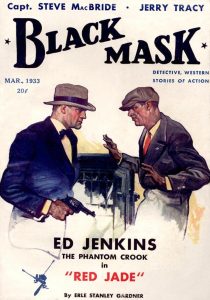 Foremost among his amazing array of short-fiction creations are Ed Jenkins, the Phantom Crook, an outlaw and ‘famous lone wolf’ who lives by his wits and solves crimes unjustly pinned on him by the police, many of which have San Francisco Chinatown settings; and Lester Leith, debonair man-about-town, whose ‘chain lightning mind’ allows him to both outfox criminals and outmaneuver his butler, Scuttle, an undercover police spy. Jenkins appears in 72 novelettes published in BLACK MASK between 1925 and 1943 … Leith can be found in 65 novelettes in DETECTIVE FICTION WEEKLY from 1929 to 1943…”
Other oft-published series characters created by Erle Stanley Gardner include Bob Zane of the “Whispering Sands” tales; Sidney Zoom, master of disguises; Señor Lobo, Mexican soldier of fortune; the Patent Leather Kid; Paul Pry, who steals from crooks; Bob Larkin, an adventurer armed with a billiard cue; attorney Ken Corning; gunslinger Black Barr; and Speed Dash, the Human Fly.
At 9 PM on Friday, July 28, PulpFest 2017 welcomes Jeffrey Marks to discuss Gardner’s four types of pulp characters: the western miner, the non-Perry lawyers, the traditional pulp loners, and the author’s happy-go-lucky criminals. Marks is a long-time mystery fan and freelance writer. His works include WHO WAS THAT LADY, a biography of mystery writer Craig Rice, ATOMIC RENAISSANCE: WOMEN MYSTERY WRITERS OF THE 1940S/1950s, and PULP ICONS: ERLE STANLEY GARDNER AND HIS PULP MAGAZINE CHARACTERS. His latest work is a biography of mystery author and critic Anthony Boucher entitled ANTHONY BOUCHER. It has been nominated for an Agatha and, fittingly, won an Anthony Award.
Jeffrey’s work has won several awards, including the Barnes and Noble Prize. It has also been nominated for an Edgar Award, three Agathas, two Macavity Awards, and three Anthony Awards. Today, he writes from his home in Cincinnati, which he shares with his partner and two dogs.
Please join us from July 27 through July 30 at the DoubleTree by Hilton Hotel Pittsburgh – Cranberry — just north of Pennsylvania’s “Steel City” — for PulpFest 2017 as we celebrate the hardboiled dicks, dangerous dames, and a few psychos of the pulps.
First introduced to Black Mask readers with the story “The Shrieking Skeleton,” published in the December 15, 1923 number under the pseudonym Charles Green, Erle Stanley Gardner quickly became a reader favorite. Soon thereafter, he introduced his first series character, Bob Larkin. But it was with the January 1925 number that Gardner truly hit paydirt, introducing Ed Jenkins in “Beyond the Law.” By the end of 1926, Jenkins was earning the cover spot, including the March 1933 issue, which featured artwork by J. W. Schlaikjer. Erle Stanley Gardner’s Phantom Crook would appear in 72 novelettes published in Black Mask between 1925 and 1943.
A Look at Dime Detective Magazine—Matt Moring—the publisher of Altus Press and its fine line of pulp reprint and history volumes—turns an eye toward DIME DETECTIVE MAGAZINE on Saturday, July 29, at 9:40 PM. It’s all part of the celebration of hardboiled dicks, dangerous dames, and a few psychos at PulpFest 2017.
Although the earliest pulps were general fiction magazines, the rough-paper rags eventually specialized. Pulps featuring aviation and war stories, fantasy and the supernatural, love and romance, the railroad, science fiction, sports, and other genres emerged. Titles also appeared devoted to prison yarns, firefighters, and even engineering stories. However, one of the longest-lasting and most popular categories was the detective field. In fact, the first pulp magazine successfully dedicated to a single fiction genre was Street & Smith’s DETECTIVE STORY MAGAZINE.
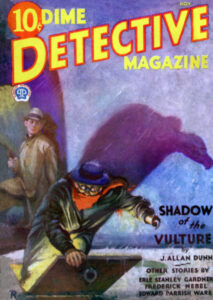 DETECTIVE STORY was a trailblazer as a specialty magazine. However, it did little to further the development of the detective or crime story. That task would be left to its highly prized successors: BLACK MASK—the pulp where the hardboiled detective story began to take shape—and DIME DETECTIVE MAGAZINE—where the tough-guy detective became extremely popular. Call them what you will—flatfoots, gumshoes, dime detectives, or private eyes—these hardboiled dicks transformed the traditional mystery story into the tough-guy-and-gal crime fiction that remains popular today.
Most critics cite BLACK MASK MAGAZINE as the fertile ground where hardboiled detective fiction gathered its form. From 1923 through 1931, it reigned supreme as the genre’s home. Then, in 1931, Henry Steeger and Harold Goldsmith of Popular Publications introduced DIME DETECTIVE MAGAZINE. Costing a nickel less than BLACK MASK, it appealed to cash-strapped Great Depression consumers. As Stefan Dziemianowicz wrote in his introduction to HARD-BOILED DETECTIVES (1992):
As added inducement, it was able to lure BLACK MASK regulars like Gardner, Nebel, Chandler, Norbert Davis, and Frederick C. Davis into its pages by paying them the princely sum of four cents per word—one cent more than BLACK MASK and quadruple the going pulp fiction rate. DIME DETECTIVE made only two stipulations to its authors: there were to be no novel serializations, and the characters they created could not appear in competing magazines. The result was a looser and more varied magazine than BLACK MASK.
Before long, DIME DETECTIVE became the best-selling title in the mystery-detective genre and the most popular magazine in its publisher’s line of pulp magazines. By the summer of 1933, it appeared twice monthly, a schedule it maintained through June 1935. It became one of Popular’s longest-lived titles, running for 274 issues—largely monthly—through its August 1953 number.
Running for twenty years, Popular Publications’ DIME DETECTIVE MAGAZINE published thousands of high-quality hard-boiled stories by hundreds of authors, eventually becoming the most respected detective pulp magazine behind BLACK MASK. However, DIME DETECTIVE excelled at introducing long-running series characters, something BLACK MASK normally didn’t do. These series characters run the gamut of quirky detectives, completely unique and offbeat: the types of investigators that had never been seen before (and rarely repeated with such skill since).
Matt Moring—who wrote the words above—is the publisher at Altus Press. Reprinting pulp fiction from a wide variety of pulp genres, including hero, detective, jungle, the French Foreign Legion, and more, Matt has quickly become one of the leading publishers in the pulp world. He has also published numerous historical works on the pulps, including biographies, indices, and examinations of single-character magazines. Together with Will Murray, Matt revived the Doc Savage series, publishing brand new stories after a long absence. The Altus Press website is also an excellent reference source, featuring links to The Pulp Superhero Index and The ECHOES Index. Matt won our Munsey Award in 2012.
In addition to employing some of the pulp industry’s leading authors, Dime Detective Magazine also employed its leading artists. William Reusswig, who painted the first 37 covers for Dime Detective, including the first issue, dated November 1931, was a freelance artist who sold covers to Ace-High, Action Novels, Adventure, All-Fiction, Argosy, Complete Detective, Detective Book, Detective Tales, Dime Detective, The Frontier, Short Stories, War Aces, War Birds, War Stories, West, Western Story, and Wild West Weekly. He also worked for the slicks and men’s adventure magazines.
 The Dangerous Dames of Maxwell Grant—Maxwell Grant was a pen name used by the authors of The Shadow pulp magazine stories. Street & Smith, the publishers of THE SHADOW MAGAZINE, asked Walter B. Gibson, the writer they originally hired to chronicle the Shadow’s adventures, to create a pen name so that numerous authors could be used to write the stories without confusing the readers. Gibson adopted the pen name Maxwell Grant, taking the name from two magic dealers he knew, Maxwell Holden and U. F. Grant.
Four authors besides Gibson used the Maxwell Grant pseudonym over the years. Theodore Tinsley wrote 27 Shadow stories between 1936 and 1943; Lester Dent wrote one story, “The Golden Vulture,” published in 1938; Bruce Elliott wrote fifteen Shadow stories between 1946 and 1948; and Dennis Lynds wrote nine Shadow paperback novels between 1964 and 1967.
Although most hardboiled pulp fiction featured male protagonists, some very dangerous dames also made it into the rough paper magazines. These hardboiled ladies helped pave the way for modern-day gumshoes such as Sue Grafton’s Kinsey Millhone, Marcia Muller’s Sharon McCone, and Sara Paretsky’s V. I. Warshawski. As part of our celebration of the pulp’s “hardboiled dicks, dangerous dames, and a few psychos,” please join PulpFest 2017 on Thursday evening, July 27, at 10:30 PM as Anthony Tollin explores “The Dangerous Dames of Maxwell Grant.”
Although Margo Lane is, by and large, the best known of these three characters, she is probably the least dangerous of Grant’s dames. In DEADLY EXCITEMENTS, the late Robert Sampson remarked, “. . . she was a feather-headed nitwit, a flighty pest who lacked any sense of personal danger … The Shadow treated her rather humorously, as if she were a kitten full of catnip. She caused more trouble than she was worth.”
The character was originally created in 1937 for Mutual Broadcasting System’s version of The Shadow. A friend and companion to Lamont Cranston, Margo spies for his alter ego, The Shadow. She first appeared in print in The Shadow newspaper strips. In 1941, Walter B. Gibson included her in her first pulp novel, “The Thunder King.”
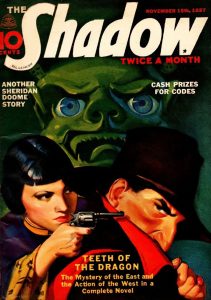
Myra Reldon was the first female agent to work for The Shadow. Born in Shanghai, she spent many years in Asia learning Chinese languages and customs. This led her to become an undercover agent for the U. S. Department of Justice, where she disguised herself as “Ming Dwan” and investigated Chinese matters. The Shadow met her while working on a case in San Francisco’s Chinatown. He was impressed with her talents and brought her into his organization. Myra first appeared in the 1937 story, “The Teeth of the Dragon.”
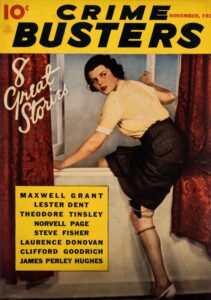 Although he used his real name for the Carrie Cashinstories, Theodore Tinsley was the writer who, after Walter Gibson, hid behind the Maxwell Grant house name. Attractive as sin, hard-boiled as hell, and one of the first hardboiled lady dicks of the pulps, Carrie Cashin appeared in over three dozen action-packed, fast-paced stories. The series began in the November 1937 issue of Street & Smith’s CRIME BUSTERS. It continued after the magazine became MYSTERY MAGAZINE in 1939, until her final appearance in November 1942, in one of the pulp’s last issues.
Anthony Tollin, publisher, writer, and researcher, is best known for his reprints of Doc Savage, The Shadow, The Spider, and other pulp heroes, issued through the Sanctum Books imprint. Sanctum’s books are not only entertaining and informative; they also help new readers discover the pulps.
Tony was also the co-author—with Walter Gibson—of THE SHADOW SCRAPBOOK, and helped assemble and introduce many recorded collections of pulp-related radio programs during his association with Radio Spirits. He also worked on several comic book interpretations of the great pulp heroes and worked as a colorist for many years, primarily for DC Comics. In 2011, Anthony received the Munsey Award for his many contributions to the pulp community.
Myra Reldon, one of the dangerous dames created by the authors who hid behind the Maxwell Grant pseudonym, first appeared in the November 15, 1937 issue of The Shadow, published by Street & Smith and featuring cover art by George Rozen.
Although he used his own name for the Carrie Cashin stories, Theodore Tinsley also used the Grant pseudonym, writing 27 of The Shadow’s pulp adventures. His most dangerous dame, Ms. Cashin, was featured in 39 issues of Crime Busters and Mystery Magazine. Carrie appeared on the first cover of the pulp magazine, dated November 1937, in a staged photograph. Crime Busters was an anthology book, featuring the adventures of Lester Dent’s Click Rush, Walter B. Gibson’s Norgil the Magician, Frank Gruber’s Jim Strong, Norvell Page’s The Death Angel, and other characters.
Pulp-Pourri Theatre Presents “Return to the Sabbath”—PulpFest will celebrate the 100th anniversary of Robert Bloch’s birth at this year’s convention. The author of more than 200 stories, nearly thirty novels, and many nonfiction articles, screenplays, and teleplays, Bloch began his professional writing career in the pulp magazines celebrated each summer at PulpFest.
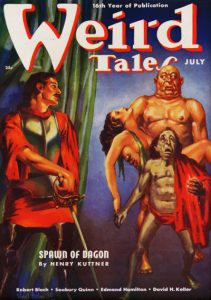 Bloch discovered the pulp magazines in 1927, courtesy of his Aunt Lil. As he wrote in his autobiography, ONCE AROUND THE BLOCH: “And it was thus that I was introduced to a magazine which changed my life, my very first copy of WEIRD TALES…”
Through that magazine, Robert Bloch began corresponding with H. P. Lovecraft. At the urging of “The Old Gentleman”—as Lovecraft called himself—Bloch began to write fiction. Before long, the young man was a published author:
“But in July, 1934, less than a month after graduating from high school, I received a letter of acceptance for my story … I had suddenly and almost miraculously become a professional writer, a contributor for the very magazine which published the work of my favorite author and present pen pal…”
Robert Bloch’s early fiction was strongly influenced by Lovecraft and his “Cthulhu Mythos.” Bloch even made Lovecraft a central character in “The Shambler from the Stars,” published in the September 1935 WEIRD TALES. He also created two of the often cited texts of the Mythos, Ludwig Prinn’s DE VERMIS MYSTERIIS and Comte d’Erlette’s CULTES DES GOULES.
Following Lovecraft’s death in 1937, Bloch continued writing for WEIRD TALES. He became one of the magazine’s most popular authors, appearing in its pages nearly seventy times. Perhaps his best-known tale for “The Unique Magazine” is “Yours Truly, Jack the Ripper,” published in the July 1943 number.
Whereas Lovecraft’s later work took on science fiction overtones, Bloch’s WEIRD TALES fiction was mostly grounded in horror and the supernatural. For instance, from 1936 through 1938, several of the author’s stories—“Fane of the Black Pharaoh,” “The Eyes of the Mummy,” “Beetles,” and others—were likely inspired by the 1932 Boris Karloff film THE MUMMY. Others explored such horror motifs as voodoo, wax museums, and black magic. Robert Bloch’s “Return to the Sabbath,” originally published in WEIRD TALES for July 1938, exemplifies the latter.
Originally published under Bloch’s Tarleton Fiske pseudonym, “Return to the Sabbath” was published when the author was twenty-one. Narrated in the first person by a Hollywood public relations man, it’s the story of a European actor brought to the United States to star in a satanic horror film. But the actor—who had dabbled in devil worship himself —disappears after he learns that a former colleague has been murdered in Paris by cultists. Bloch’s story was later adapted and filmed for television as “The Sign of Satan.” It aired on THE ALFRED HITCHCOCK HOUR in 1964.
On Friday, July 28, at 11 PM, PulpFest 2017 welcomes the Narada Radio Company and their PULP-POURRI THEATRE to this summer’s convention. The group will be dramatizing Robert Bloch’s “Return to the Sabbath” in the old radio-play format. Based in Corpus Christi, PULP-POURRI THEATRE is an audio drama anthology series with roots in vintage pulp fiction. However, it presents its stories in modern ways. Pete Lutz is the company’s producer-director. You can sample their work online or via iTunes.
According to Narada’s Pete Lutz:
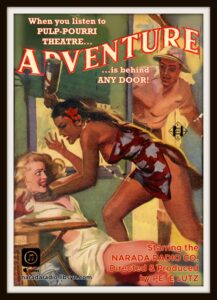 My life’s dream has been to create “radio” plays and be an actor in them. I was looking at copies of pulp magazine covers and followed a link to scans of pulp stories. I started reading them and immediately began to mentally dramatize them for audio. My wife came up with the name PULP-POURRI THEATRE. I feel this hints at the wide variety of pulp genres available. The possibilities are endless. There are thousands of pulp-fiction stories available. Action becomes dialogue. Narration becomes action. Once the last voice is “in the can”, I start production. Voices get cobbled together first, and then I add music and sound effects. Then I listen to it a half-dozen times to make sure I haven’t overlooked anything.
PULP-POURRI THEATRE embraces the thrilling world of pulp fiction from the last century. We present audio dramas with a few modern touches, such as full sound design. We bring you the most exciting stories from the finest pulp writers. We also throw in an occasional new story from a guest playwright.
The PulpFest 2017 cast of Narada Radio Company’s PULP-POURRI THEATRE will be Austin and Barbi Beach, Ross Bernhardt, Randy Coull, Derek, Keane, and Pete Lutz, and Greg and Rhiannon McAfee. Please join them at PulpFest 2017 from Thursday evening, July 27, through Sunday afternoon, July 30, at the DoubleTree by Hilton Hotel Pittsburgh – Cranberry, just nineteen miles north of the exciting city of Pittsburgh.
Start making plans now to celebrate the 100th anniversary of the birth of PSYCHO author Robert Bloch at PulpFest 2017, the “pop culture center of the universe.”
Robert Bloch’s “Return to the Sabbath” originally ran in the July 1938 issue of Weird Tales, featuring front-cover art by the great pulp and fantasy artist Virgil Finlay. The artist got his start during the Great Depression when he sent unsolicited illustrations to his favorite pulp magazine, Weird Tales. In addition to “The Unique Magazine,” he also contributed interior illustrations and covers to Amazing Stories, Astounding Stories, Captain Future, Famous Fantastic Mysteries, Fantastic Adventures, Fantastic Novels, Galaxy, Strange Stories, Super Science Stories, Thrilling Wonder Stories, Worlds of Tomorrow, and other pulps and digests. Even today, Finlay remains one of the most highly regarded and collected artists in science fiction and fantasy.
Pete Lutz, the producer-director for the Narada Radio Company, used the August 1942 cover of Spicy Adventure Stories as the basis for his Pulp-Pourri Theatre advertisement. The artist is H. J. Ward, who painted many covers for the Spicy line of pulp magazines. For a great overview of this artist’s career, we suggest you track down a copy of David Saunders’ book H. J. Ward, published by The Illustrated Press in 2010.
Saturday, July 29, 2017
The New Fictioneers—Saturday afternoon programming was largely set aside for “New Fictioneers” readings. These featured contemporary writers reading from their recent works and fielding audience questions and comments. To learn more about PulpFest’s “New Fictioneers” readings, click here.
Six Writers of New Pulp—one of PulpFest‘s hallmarks has been its willingness to seek out and try new ideas. This was clear in its 2009 decision to present readings by “The New Fictioneers,” contemporary authors whose fiction is inspired by a love of the pulps. Since then, several other conventions have added a “New Pulp” track to their programming schedules.
PulpFest‘s dedication to new ideas and “New Pulp” continues with its annual panel moderated by Ron Fortier, a professional writer for over forty-five years. In 2007, Ron teamed up with illustrator Rob Davis to start Airship 27 Productions and built a home for new adventures featuring many of the pulp characters our community still remembers. Ron’s own creation, the undead avenger known as Brother Bones, would certainly have been at home with Paul Ernst’s Doctor Satan in the pages of WEIRD TALES and Norvell Page’s The Spider. Ron has also penned the adventures of pulp heroes Captain Hazzard and the Domino Lady, as well as pop culture icons The Green Hornet and The Phantom.
On Saturday, July 28, Ron will be joined by five practitioners of contemporary pulp fiction for PulpFest‘s 2017 new pulp panel. The six authors will discuss their writing experiences and why — of all the genres out there — they gravitated to pulp fiction.
Fred Adams, Jr. is a western Pennsylvania native who has enjoyed a lifelong love affair with horror, fantasy, and science fiction literature and films. He holds a Ph.D. in American Literature from Duquesne University and recently retired from teaching in the English Department of Penn State University. He has published over fifty short stories in amateur and professional magazines, as well as hundreds of news features as a staff writer and sportswriter for newspapers. For Airship 27, Fred has written HITWOLF, SIX-GUN TERROR, and most recently, DEAD MAN’S MELODY.
 John C. Bruening has been writing professionally for more than thirty years, first as a newspaper reporter and magazine editor and later as a marketing copywriter. For as long as he can remember, he has been a fan of comics, pulps, adventure fiction, vintage movies and serials, old-time radio, and any other form of heroic storytelling. His 2016 debut novel, THE MIDNIGHT GUARDIAN: HOUR OF DARKNESS, has been called “a Republic serial set to prose” and “the creative construct of a first-rate storyteller.” His most recent published work is “The Warrior and the Stone,” a short story appearing in RESTLESS: AN ANTHOLOGY OF MUMMY HORROR, a 2017 release from Flinch! Books, where he is a publishing partner with Jim Beard. John is currently working on the next adventure of The Midnight Guardian. He lives near Cleveland, Ohio.
A lifelong fan of science fiction and pulp fiction, Wayne Carey grew up reading Edgar Rice Burroughs, H. G. Wells, Isaac Asimov, H. Rider Haggard, and all the great masters. His reading guided him toward a career in science, with degrees in biology and education, and gave him an early desire to write. A love of classic and noir films also influences his writing. He is the author of THE NANON FACTOR, a young adult contemporary science fiction thriller that blends a murder mystery with cutting-edge technology. His work has also appeared in a variety of anthologies such as LEGENDS OF NEW PULP FICTION. He and his wife live in the wilds of Central Pennsylvania with their three children, who provide much of his inspiration.
Born to a father who was both a writer and a pulp enthusiast, Michael Maynard has been a pulp fan his whole life. His favorites include Dashiell Hammett, Sax Rohmer, John Buchan, and H. G. Wells. His favorite medium, however, is the cinema. Some of Michael’s favorite movies include such classics as THE MALTESE FALCON, DOUBLE INDEMNITY, and CASABLANCA. Michael’s first work of fiction was published in 2016: a short story that he wrote with his father. It was featured in the Airship 27 anthology, THE TOWERS OF METROPOLIS. He intends to continue writing for the foreseeable future.
Charles Milhouse has been publishing independently since 1999, but really didn’t get into pulp until 2010. That’s when he started working on Captain Hawklin. He has written four books in the series and is currently outlining a fifth volume. He has published fourteen books, including the recently concluded, five-volume TALON’S EPIC. Charles is influenced by writers such as William F. Nolan and Frank Herbert. He is a professional chef, but writing is his passion. To learn more about Charles’ writing, please visit the Stormgate Press website.
Our new pulp panel will take place at 2:15 PM on Saturday, July 28, in the PulpFest programming room at the DoubleTree by Hilton Hotel Pittsburgh – Cranberry. Watch for the PulpFest PANELS banner outside the entrance to our programming room. PulpFest 2017 — the destination for fans and collectors of vintage popular fiction, art and related materials — will begin on Thursday, July 27, and run through Sunday, July 30.
If you’re wondering about the term “fictioneer,” most dictionaries trace its origin to the early 1900s. However, it was relatively common in magazines between 1910 and 1920 and appears in works dating back to the mid-nineteenth century. To learn more about this term, click here.
Our featured image is Thomas Gianni’s cover art for John C. Bruening’s The Midnight Guardian: Hour of Darkness, published by Flinch! Books in 2016.
 The Villains of The Shadow—with over 300 novels, decades of radio adventures, and multiple movie appearances, The Shadow has faced down more evil than any other pulp hero. Robbers! Killers! Thieves! Con men! And … Psychos? Join Tim King on Saturday, July 29, at 3:20 PM for an afternoon of “Psycho Bingo” as he showcases a few of The Knight of Darkness’s psychotic nemeses.
A hero is defined by his villains. Voodoo Master? Sure. Benedict Stark, The Prince of Evil? Of course. Shiwan Khan? Inevitably. But The Shadow’s pulp adventures feature many, many other high-quality psychos.
Tim will use forensic psychology in a fast-paced look back at some of the more dastardly, manipulative, sociopathic antagonists of The Dark Avenger. How are psychopathic villains different than others? Are their actions predictable or preventable? How does The Shadow deal with evil, remorseless psychotic villains? If you love The Shadow, and you want to sneak a peek into his secret archives and get inside the methods and motives of his adversaries, then this is the talk for you!
Tim King is a career Intelligence Officer with training and experience in forensic psychology—the application of psychology to the criminal justice system. He presented at PulpFest 2015, and contributed an essay to Anthony Tollin’s Sanctum SHADOW reprint #103 entitled, “Spycraft and The Shadow.” He is not a psychologist or medical doctor, but he is adamant that The Shadow’s greatest female Agent was Myra Reldon, not what’s-her- name.
When George Rozen left Street & Smith in 1938, Graves Gladney took over as The Shadow’s cover artist. Gladney painted 70 Shadow covers through 1941, including our featured image from the September 15, 1939 issue of The Shadow, illustrating Walter B. Gibson’s “The Golden Master.” Although he freelanced, Gladney sold most of his cover paintings to Street & Smith, contributing covers for Astounding, The Avenger, Clues, Crime Busters, Mystery, Sport Story, Unknown, and most notably The Shadow.
The 2017 Munsey Award—Phil Stephensen-Payne won the 2017 Munsey Award. Nominated by the general pulp community, Phil was selected by a vote of all living Lamont, Munsey, and Rusty Award winners. The award is a fine art print of a David Saunders painting, published by Dan Zimmer, presented annually to an individual or institution that has bettered the pulp community. Laurie Powers, the recipient of the 2016 Munsey Award, presented the award. Walker Martin accepted it, as Phil, a retiree in the United Kingdom, could not attend PulpFest 2017.
Phil Stephensen-Payne is a prolific bibliographer and pulp researcher based in the United Kingdom. For many years, he has been compiling extremely useful “working bibliographies” (often in collaboration with the late Gordon Benson, Jr.) of speculative fiction writers, many of whom got their start writing for the pulps. These bibliographies, numbering about sixty, are among the best reference resources available today in science fiction and fantasy. Additionally, his Galactic Central website includes an online checklist of all known fiction magazines, attempting to include the cover of every such magazine ever published. It also indexes bibliographies, pulps, science fiction magazines, and other genre magazines. Stephensen-Payne is also a significant contributor and host to the FictionMags Index — principally edited by William G. Contento — and co-author (with Stephen T. Miller and William G. Contento) of the CRIME, MYSTERY, AND GANGSTER FICTION MAGAZINE INDEX, originally released on CD-ROM by Locus Press in 2011.
The other nominees for the 2017 Munsey Award included Mike Ashley, John Betancourt, Camille Cazedessus, William Contento, Ron Fortier, Joel Frieman, Ron Hanna, Richard Harvey, Chris Kalb, Rick Lai, William Lampkin, Phil Stephensen-Payne, Michael Uslan, George Vanderburgh, Chuck Welch, Howard Wright, and Dan Zimmer.
The Munsey Award, named after the man who invented the pulp magazine, was created in 2009 by talented artist David Saunders. It is an art print, limited to 36 copies, published by Dan Zimmer of The Illustrated Press. The Rusty Award utilizes the same print.
If you believe a person or organization deserves the 2015 Munsey Award, please let us know. Nominations must include a short paragraph or two explaining why you are nominating the person or organization. Send all nominations to PulpFest Marketing and Programming Director Mike Chomko. You can reach him by email at mike@pulpfest.com or by regular mail at 2217 W Fairview St, Allentown, PA 18104-6542.
 Guest of Honor—with 2017 marking the year PulpFest celebrates the hardboiled dicks, dangerous dames, and psychos of the pulps, we’re very pleased to welcome pulp artist Gloria Stoll Karn as our Guest of Honor. In a field dominated by men, it was highly unusual for a woman to be painting covers for pulp magazines. But at age seventeen, Gloria Stoll began contributing black-and-white interior illustrations to pulp magazines. In a few years, the young artist was painting covers. How’s that for a dangerous dame?
PulpFest is very pleased to welcome as its 2017 Guest of Honor, one of the few surviving contributors to the pulp magazine industry, Gloria Stoll Karn. Pulp art historian David Saunders — winner of our 2016 Lamont Award — will be joining Ms. Stoll Karn to discuss her freelance career in the pulps and much more on Saturday evening, July 29, from 7:30 to 8:10 at the DoubleTree by Hilton Hotel Pittsburgh – Cranberry — just north of Pennsylvania’s “Steel City.”
We look forward to seeing you at the “pop culture center of the universe” from July 27 through July 30 at the beautiful DoubleTree by Hilton in Mars, Pennsylvania. Please join Gloria Stoll Karn — that “dangerous dame of pulp art” — and PulpFest for our celebration of the hardboiled dicks, dangerous dames, and psychos of the pulps.
Pictured above is one of several covers that Gloria Stoll (Karn) painted for Popular Publications’ Black Mask pulp. The issue is dated March 1945.
The Don Everhard Stories of Gordon Young—tradition holds that the hardboiled school of detective fiction began with the publication of Carroll John Daly’s “Three Gun Terry” in the May 15, 1923 issue of THE BLACK MASK. Dashiell Hammett’s first Continental Op story followed a few months later. The magazine’s editor, Joseph T. Shaw, would later nurture the genre to maturity. BLACK MASK would become synonymous with the hard-boiled detective story.
Or so the story goes. Few, if any, literary genres come into being at a single time and place; rather, they draw their basic elements from earlier literary forms. The detective story is no exception. A key precursor to the hardboiled school appears in Gordon Young’s “Don Everhard” stories.
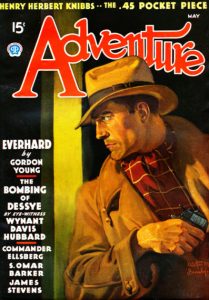 Now all but forgotten, Young’s stories appeared in ADVENTURE and SHORT STORIES, spread over a quarter century. The first appeared in 1917, a full six years before Daley’s tale. It anticipated many basic elements of the hardboiled school, including character types, plot structure, narrative voice, the treatment of violence, and skepticism toward traditional social institutions. All would become common in BLACK MASK in the decade that followed.
During his life, Gordon Ray Young was a cowboy, marine, sailor, marksman, reporter, occasional poet, sport fisherman, bibliophile, and literary critic. More importantly, he was a storyteller, author of some of the finest adventure fiction to grace the pages of American pulp magazines in the first half of the twentieth century. Appearing regularly in titles such as ADVENTURE, BLUE BOOK, ARGOSY, ROMANCE, and SHORT STORIES, his fiction spanned genres as diverse as westerns, crime stories, South Seas adventure, international intrigue, historical fiction, and humor. His tales also made the jump to the silver screen, as Hollywood adapted five of his stories for film.
Young was born in rural Ray County, Missouri, on September 7, 1886, and inherited from his father a sense of independence and a taste for wandering. At fifteen, he was working as a cowboy in eastern Colorado. In 1908—at the age of 22—he enlisted in the United States Marines. He served both in the Philippines and aboard ship. After mustering out of the Corps, Young pursued a career in journalism, working on newspapers in both San Francisco and Stockton, California, before taking a position with the LOS ANGELES TIMES. He served as the paper’s literary editor for more than a decade.
His freelance writing career began with the sale of a minor short story to THE CAVALIER in 1913 and took off in 1917, when he began selling to Arthur Sullivant Hoffman’s ADVENTURE. By 1920, Gordon Young was an established member of that select group of writers, including Arthur Friel, Talbot Mundy, Hugh Pendexter, and W. C. Tuttle, who regularly filled ADVENTURE’‘s pages during the magazine’s glory years in the teens and twenties. After his novels began appearing in hardcover, his reputation spread beyond pulp magazines and reached book reviewers.
Young showed great diversity in his writing, producing a wide variety of story types. South Seas stories, for example, were common in the teens and twenties, while westerns came to dominate his later career. His longest-running character, however, was the hard-boiled professional gambler, Don Everhard. Young created him in his first sale to ADVENTURE in 1917—“A Royal Flush of Hearts”—and he appeared in more than thirty short stories and novels over Young’s career.
In 1948, Gordon Young died of heart failure in his home in Los Angeles, California, at the age of 62.
On Saturday, July 29, PulpFest 2017 continues its celebration of hardboiled dicks, dangerous dames, and a few psychos. Please join us at 8:10 PM as Tom Krabacher and John Wooley discuss “The Most Dangerous Man in America,” Gordon Young’s Don Everhard: “Hard-Boiled at 100.”
Tom Krabacher is a professor at California State University, Sacramento, and a member of the Pulp Era Amateur Press Association. He has previously presented at PulpFest, serving on and moderating panels on WEIRD TALES, the Cthulhu Mythos, and John Campbell’s classic fantasy magazine, UNKNOWN. Tom has also published articles on the pulps and their history in BLOOD ‘N’ THUNDER, THE PULPSTER, and elsewhere.
John Wooley—who will also be presenting on Dan Turner and SPICY DETECTIVE at PulpFest 2017—has written, co-written, or edited over three dozen books. He has also authored comic books, trading cards, and thousands of magazine and newspaper stories. Winner of the Lamont Award in 2006, Wooley is a co-owner of the pulp-related Reverse Karma Press with John McMahan. In 2015, John was inducted into the Oklahoma Historians’ Hall of Fame.
 For fans of Gordon Young, Adventure magazine, or Don Everhard, the author’s travel trunk has been consigned to our 2017 auction.
Here’s your chance to own a piece of pulp history! The trunk is rather worn, but still bears the author’s name. He used it while traveling to Europe with his family in 1927.
Years ago, Young’s granddaughter and her mother attended an Ohio Pulpcon. They had a wonderful experience at the convention, meeting the people who were keeping the pulps alive for posterity. The Young family would like to find a good home for the trunk with people who will appreciate it the most. Please be aware that the trunk is currently in Northern California. The winning bidder will be responsible for shipping the trunk to its destination. These costs are in addition to the winning bid.
The PulpFest 2017 auction is scheduled for Saturday evening, July 29.
Don Everhard was pictured twice on the cover of Adventure magazine. The first time was in V. E. Pyles’ cover for the December 15, 1928 issue of Adventure, illustrating Gordon Young’s novella, “Don Everhard.” Our lead image is Walter M. Baumhofer’s version of Don Everhard, featured on the May 1936 number.
According to Jess Nevins, Don Everhard was a “professional gambler and amateur justice-dealer … he keeps getting involved in helping others or, more often, settling accounts … He’s a cold man, always calm (even when under fire), always rational, invulnerable to the wiles of women, and extremely experienced in the ways of criminals and violence. He has a reputation for being very violent, ‘the most famous gunman in the country,’ and of having ‘killed more men than any other fellow in America—and is proud of it.’ … He kills in self-defense or when the target is guilty and deserving of execution.”
The Wild Adventures of Pat Savage—Will Murray discovered Doc Savage in 1969 when he picked up the Bantam Books edition of DUST OF DEATH. Within a few short years, he began contributing to Doc Savage fanzines, starting with THE DOC SAVAGE READER. Soon thereafter, he began placing articles in other fanzines, including ECHOES, THE PULP COLLECTOR, and PULP VAULT, writing about Doc and other pulp characters and the magazines in which they appeared. Today, nearly fifty years later, Will is one of the most respected authorities on the pulp magazine, having authored countless articles and books, including THE DUENDE HISTORY OF THE SHADOW MAGAZINE and WORDSLINGERS: AN EPITAPH FOR THE WESTERN.
In addition to his many non-fiction works on the pulps, Murray wrote about forty Destroyer action-adventure novels. He has also written twenty Doc Savage novels and two Tarzan novels. He also serves as the literary agent for the Lester Dent estate and co-edits Sanctum Books’ highly regarded pulp reprints.
In 2016, Murray decided to give many fans what they wanted and penned a solo Pat Savage novel — SIX SCARLET SCORPIONS. Well, almost solo, as Monk Mayfair joins Pat on her adventure:
“When a man so anemic that he could be a vampire’s victim comes to Patricia Savage for rescue, the impetuous girl can’t say no. Excitement is her meat and danger her dessert.
“Accompanied by Doc Savage aide, Monk Mayfair, Pat finds herself in the worst danger of her life. Wanted for murder, hounded by the minions of a weird mystery figure calling himself Chief Standing Scorpion, narrowly evading the hordes of the Vinegarroon tribe, the bronze-skinned golden girl battles her way to a sinister secret cached in an ancient ruin.
“From the oilfields of Oklahoma to the forbidding Ozark Mountains, the trail of scorpionic doom winds. Will Pat Savage’s first great adventure also be her last?”
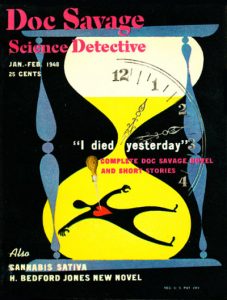 Of course, for longtime fans of the Man of Bronze, SIX SCARLET SCORPIONS is actually the second Pat Savage novel. In “I Died Yesterday,” her final pulp appearance — published in the January/February 1948 issue of DOC SAVAGE SCIENCE DETECTIVE — she is the first-person narrator of the story. Monk teams up with Pat to work on the case.
Members of the Narada Radio Company and their PULP-POURRI THEATRE will perform a reading from Will Murray’s SIX SCARLET SCORPIONS, the first book in THE ALL-NEW WILD ADVENTURES OF PAT SAVAGE series, published by Adventures in Bronze in association with Altus Press. Based in Corpus Christi, PULP-POURRI THEATRE is an audio drama anthology series with roots in vintage pulp fiction, but presenting stories in a modern fashion. Pete Lutz is the company’s producer-director. You can sample their work online or via iTunes.
“The Wild Adventures of Pat Savage by Will Murray,” a reading by PULP-POURRI THEATRE, will take place on Saturday, July 29, at 8:50 PM in the PulpFest 2017 programming area at the DoubleTree by Hilton Hotel Pittsburgh – Cranberry — just north of Pennsylvania’s “Steel City.”
Walter Swenson painted eleven Doc Savage covers from January 1947 through September 1948. The January/February 1948 number is a good example of his cover art. Swenson also contributed four 1948 covers to Shadow Mystery, and some interior illustrations by the artist appear in issues of John W. Campbell’s Astounding Science Fiction published around the same time. Nothing else is known about the artist.
Saturday Night at the Auction—PulpFest‘s Saturday night auction, featuring auctioneers John Gunnison and Joseph Saine, will follow the Narada Radio Theatre’s reading from Will Murray’s “The Wild Adventures of Pat Savage.”
 Thanks for Your Help—year after year, there are countless individuals and organizations that help to make PulpFest an enjoyable experience for those who attend “Summer’s Great Pulp Con. The PulpFest organizing committee thanks the following people and organizations for their invaluable assistance in making PulpFest 2017 a success. We could not have done it without you:
Our front desk staff – Maura Childers, Jack Cullers, and Sally Cullers; Lucy Denunzio, Bill Thinnes, and J. Welch, for help with the auction; our panelists and presenters – Fred Adams, Jr., Jim Beard, John Bruening, Wayne Carey, Mike Croteau, Win Scott Eckert, Ron Fortier, John Gunnison, Pete Lutz and the other members of the Narada Radio Company — Austin Beach, Barbi Beach, Keane Lutz, Derek Lutz, Cora Devoir, and Edward Champion — Tom Krabacher, Peter McGarvey, Jeffrey Marks, Walker Martin, Michael Maynard, Heidi Ruby Miller, Jason Jack Miller, Charles Millhouse, Matt Moring, Will Murray, Michelle Nolan, Garyn G. Roberts, Joseph Saine, David Saunders, Frank Schildiner, Art Sippo, Joab Stieglitz, Gloria Stoll Karn, J. Welch, and Chet Williamson; our technical staff – Chuck and J. Welch; and our behind-the-scenes help – Dan Zimmer and Allyssa Tudor and the terrific staff of the DoubleTree by Hilton Pittsburgh — Cranberry.
Many thanks to J. Barry Traylor for helping to arrange the appearance of author Chet Williamson. Likewise, thanks to Barry, Jack Cullers, Chuck and J. Welch, and Mike Chomko for all the hours spent assembling this year’s auction.
The organizing committee would also like to thank the people who helped to create THE PULPSTER #26 – editor Bill Lampkin, assistant editor Peter Chomko, publisher Mike Chomko, Schuerholz Printing, plus contributors Tony Davis, Douglas Draa, Ron Goulart, Monte Herridge, Walker Martin, Curt Phillips, Bill Pronzini, and Garyn G. Roberts. We’d also like to thank the magazine’s advertisers – AbeBooks, Bear Manor Media, Black Hood Press, Fedogan & Bremer, Freeman’s Auctions, Girasol Collectables, Heartwood Auctions, Larque Press, Mike Chomko Books, New Texture, Pulp Factory Awards, Stark House Press, SleuthFest, ThePulp.Net, and the Windy City Pulp and Paper Convention.
Many thanks as well to the nominators and the Lamont Award, Munsey Award, and Rusty Hevelin Service Award winners who helped select this year’s Munsey winner, Phil Stephensen-Payne. Congratulations to Phil and to all of the nominees for our 2017 award. Thank you to 2016 Munsey winner Laurie Powers for presenting this year’s award, and to Walker Martin for accepting it in Phil’s absence.
Again, we’d like to thank the following organizations for the books and similar items that were donated to PulpFest for distribution to our members: Chaosium, Inc., John L. Coker, III, Gordon Van Gelder and THE MAGAZINE OF FANTASY & SCIENCE FICTION, Larque Press, Lohr McKinstry, Wyatt Doyle and Robert Deis of New Texture, and the family of pulp author Gordon Young. We also thank Pittsburgh’s Caliban Book Shop for offering a discount to our members who visited their store during the convention, and the Windy City Pulp and Paper Convention and Charley Schuerholz for loaning the convention their sound systems. Thanks as well to our website sponsors: AbeBooks.com, Essayscribes, College Homework Help, SmartWritingService.com, and DoMyEssay.net.
Thanks also go to AbeBooks, Meteor House Press, and the members of the PulpFest organizing committee for sponsoring this year’s hospitality suite at the DoubleTree.
Finally, thanks to Ron Adams and Monster Bash, Jim Beard, Joe Collucio, Keith Culbertson, Doug Ellis, Harold Forman, Henry Franke and the Burroughs Bibliophiles, Martin Grams, Tommy Hancock, Nathan Madison, Todd McDevitt and New Dimension Comics, Rick Thomas, Ray Walsh and Curious Book Shop, and the many conventions, book and paper fairs, bookstores, comic and collectible shops, websites, magazines, newspapers, and other media outlets that helped to promote our show by distributing and displaying our advertising materials.
Special thanks must be extended to Jennifer Baron — who wrote a great little piece about PulpFest for NextPittsburgh, Christopher Bowser of Geek’s Guide to Pittsburgh, Sara Holzer and Mike Robertson from VisitPittsburgh, David Saunders for all of his help identifying cover artists, Mary Thomas of the PITTSBURGH POST-GAZETTE for her piece on our guest of honor Gloria Stoll Karn, and Katie Yakovleva of AbeBooks.
Thank you as well to the dealers, attending members, and supporting members of PulpFest 2017. Your encouragement and support made our convention a success. We hope to see you all back next summer, along with many newcomers, for PulpFest 2018. We will celebrate the 100th anniversary of the end of World War I and the centennial of a certain Grand Master of Science Fiction named Philip José Farmer.
So please bookmark the PulpFest website, like our Facebook page, and follow our Twitter feed. Wherever you look for PulpFest on the web, we’ll keep you informed of our plans.
If we’ve neglected anyone, please accept our apology and our gratitude. Write to mike@pulpfest.com, and we will correct the oversight.
Your PulpFest organizing committee — Mike Chomko, Jack Cullers, Sally Cullers, Bill Lampkin, Barry Traylor, and Chuck Welch
Designed by PulpFest’s advertising director, William Lampkin, our PulpFest 2017 welcome banner — sponsored by AbeBooks.com — features the work of artist John Newton Howitt. His painting originally appeared as the cover of the April 15, 1934 issue of Popular Publications’ Dime Detective Magazine.
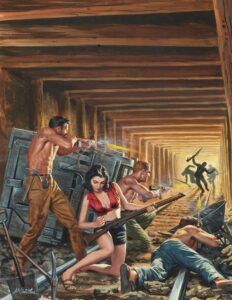 Happy Labor Day from PulpFest—On this day, as we honor America’s laborers, PulpFest is pleased to announce that the organizing committee has secured a contract to return to the beautiful DoubleTree by Hilton Hotel Pittsburgh – Cranberry in 2018.
In his PulpFest 2017 report, Murania Press publisher Ed Hulse wrote: “And what a venue. I’ve been attending conventions of various kinds for exactly 50 years now but have rarely set foot in a hotel more perfectly suited than the DoubleTree for the event it hosted.” Walker Martin echoed Ed’s sentiments in the report he wrote for Steve Lewis’ Mystery*File: “In my opinion, after attending almost all the pulp conventions since 1972, this is the best hotel that we have ever had for our shows.”
Conveniently located where three major roadways intersect, the DoubleTree offers ample free parking, free Wi-Fi for guests, and two free breakfast coupons per day to PulpFest members who stay at the host hotel during the convention. Its Ember & Vine open-air restaurant is also very popular. The room rate will be $129 per night.
PulpFest 2018 will take place over the last weekend in July, beginning on Thursday evening, July 26, and running through Sunday, July 29. We’ll keep you posted on our homepage. So please stay tuned by visiting our website at least once a week. You can also get information through our Facebook page or catch us on Twitter.
PulpFest 2018 will salute the war pulps of the early 20th century as part of the centennial of Armistice Day, which marked the end of World War I. Our image is Mort Künstler’s original cover art for the January 1963 issue of Male. One of about 160 magazines designed to appeal to veterans returning from World War II and, later, soldiers shipped off to fight in Korea and Vietnam, Male debuted with its June 1950 number. It ran for over 300 issues, lasting into 1981.
Reviews and Recordings of PulpFest 2017—our convention wrapped up six weeks ago. If you couldn’t attend, that’s unfortunate. You missed over three days of pulp presentations, pulp deals, and plenty of pulp talk among true fans. But all is not lost.
You can catch a glimpse of the 2017 PulpFest through the post-convention reports, photos, and podcasts available online.
 Read All About It—Check out what these folks had to say about this year’s AMAZING summer pulp convention in their reports:
- Airship27: by Ron Fortier
- File 770: by Mike Glyer
- The Leader’s Report: by Lewis Forro
- Murania Press: by Ed Hulse
- Mystery*File: by Walker Martin
- Pulp Flakes: by Sai Shankar
- Yellowed Perils: by Bill Lampkin
Tuning in
If you’re not in the dealers’ room during the day, you may be attending a New Pulp reading or a FarmerCon panel discussion. In the evenings, you may be at one of the pulp panels.
Re-live — or listen to for the first time — a selection of the PulpFest 2017 programming:
- Art’s Reviews: Art Sippo’s podcast features a selection of New Pulp readings and FamerCon discussions.
- ThePulp.Net’s Pulp Event Podcast: Bill Lampkin has posted seven recordings, almost four hours, from the pulp-focused programming.
After you’ve read the reports and listened to the recordings, start planning to attend 2018’s PulpFest to experience it firsthand. It will take place over the last weekend in July, beginning on Thursday evening, July 26, and running through Sunday, July 29.
Our lead image is a photograph of PulpFest 2017 Guest of Honor, Gloria Stoll-Karn, a talented artist who contributed covers to the pulp market during the mid-to-late 1940s. The post was written by William Lampkin.
Happy Birthday, Gloria Stoll Karn (November 18, 2017)—PulpFest was very proud to welcome pulp artist Gloria Stoll Karn as our 2017 Guest of Honor. A Pittsburgh resident, the artist is one of the very few individuals alive today who worked in the pulp magazine industry. Today is her 94th birthday.
In a field dominated by men, it was highly unusual for a woman to be painting covers for pulp magazines. But at age seventeen, Gloria Stoll began contributing black-and-white interior illustrations to pulp magazines. In a few years, the young artist was painting covers.
Rafael DeSoto inspired Gloria to become a commercial artist and introduced her to Popular Publications. The two lived in the same apartment building in New York City.
 A graduate of New York’s High School of Music and Art, Gloria Stoll began her career doing black-and-white interior illustrations for Popular. This evolved into painting covers for the publisher’s line of women’s pulps. She contributed covers to Popular’s ALL-STORY LOVE, LOVE BOOK, LOVE NOVELS, LOVE SHORT STORIES, NEW LOVE, RANGELAND ROMANCES, ROMANCE, and ROMANCE WESTERN, as well as Standard Publications’ THRILLING LOVE.
Beginning in late 1943, Stoll also began painting covers for Popular’s mystery and detective pulps. Her work was featured on BLACK MASK, DETECTIVE TALES, DIME MYSTERY MAGAZINE, and NEW DETECTIVE. She also did interior illustrations for ARGOSY magazine. The artist continued working in the pulp field until 1949.
In Ms. Stoll Karn’s own words:
“Pulp artists were required to come up with ideas for the magazine covers which reflected the general flavor of the stories within. Moving on to painting covers for mystery and detective magazines involved a radical conceptual switch. It was a surprise when I came up with gruesome ideas and concluded that, within the human psyche, there is a shadow side of which we are often unaware. I am grateful that my work struck a balance which uncovered the dark side within, along with the light side depicting the joys of romance.”
Gloria’s pulp artist career ended abruptly when she married Fred Karn in 1948. The couple moved to Pittsburgh, Pennsylvania, where they raised three children. In the 1950s, Stoll Karn began teaching art classes. Her work has been exhibited at the Carnegie Museum of Art, the Brooklyn Museum’s National Print Annual, and the Pittsburgh Watercolor Society’s International Exhibition. Her work is in the permanent collections of Yale University, the Carnegie Museum of Art, Westinghouse Corporation, the Speed Art Museum, the Brooklyn Museum of Art, and the Pittsburgh Department of Education. She is listed in WHO’S WHO IN AMERICAN ART. Her current work is abstract and draws on her life experiences.
PulpFest wishes Gloria a very happy birthday.
Our image is Gloria Stoll’s cover for the June 1944 issue of Popular Publications’ All-Story Love. Painted during the Second World War, it was one of several covers Gloria created that featured members of the United States military.