During its early years, PulpFest gave over its programming area to writers of “new pulp fiction.” The convention called these its “New Fictioneer” Readings. Here’s how these were described:
 They were called scribes, word slingers, hacks, and penny-a-worders. But perhaps the most favored term, especially among the men and women who labored for the bloody pulps, was fictioneer — a fiction writer, especially a prolific creator of commercial or pulp fiction.
If you’re wondering about the term “fictioneer,” most dictionaries trace its origin to the early 1920s. However, it was relatively common in magazines between 1910 and 1920 and has appeared in works dating back to the mid-nineteenth century.
H. Bedford-Jones used it in a series of articles called “The Graduate Fictioneer,” originally published by Author & Journalist in the early 1930s. In 1932, a group of Wisconsin writers got together and called themselves “The Milwaukee Fictioneers.” At various times, Robert Bloch, Fredric Brown, August Derleth, Ralph Milne Farley, Lawrence Keating, Ray Palmer and Stanley Weinbaum were members of this group. Later that decade, Popular Publications started Fictioneers, Inc., a pulp line that paid its authors half the going market rate of a penny a word.
E. Hoffmann Price, soldier-of-fortune and prolific pulp author, used the term in his memoirs from the pulp years, Book of the Dead — Friends of Yesteryear: Fictioneers & Others (Arkham House, 2001). The most recent use of the word was probably in John Locke’s non-fiction anthology Pulp Fictioneers: Adventures in the Storytelling Business (Adventure House, 2004). Many thanks to John for helping explain the term’s origins.
Join PulpFest as we celebrate today’s fictioneers — the authors writing the new pulp fiction.
Over the years, the following contemporary authors performed “New Fictioneer” Readings at the convention. They are in alphabetical order, with the years of their readings noted in parentheses.
Fred Adams, Jr. (2016)
Jason Scott Aiken (2015)
Roger Alford (2018, 2019)
Ralph Angelo (2014)
Jim Beard (2013, 2014, 2017, 2018)
Matt Betz (2019)
John C. Bruening (2017, 2018, 2019)
Christopher Paul Carey (2012, 2013, 2014, 2016, 2018, 2019, 2021)
Wayne Carey (2018, 2019, 2021)
Jeremiah Dylan Cook (2019)
Bill Craig (2011)
Win Scott Eckert (2011, 2012, 2013, 2016, 2017, 2018, 2019)
Dick Enos (2014)
Ron Fortier (2009, 2012)
Mike Glagola (2009)
J. L. Gribble (2019)
John Hegenberger (2015, 2016)
Sara Light-Waller (2018, 2019)
Craig McDonald (2019, 2021)
Peter McGarvey (2017, 2018)
William Patrick Maynard (2009, 2012, 2019, 2021)
Heidi Ruby Miller (2017, 2019)
Van Allen Plexico (2013)
Gary Rabuzzi (2018)
Wayne Reinagel (2011)
Shelby Rhodes (2009)
Christopher Ryan (2021)
Don Sakers (2017)
Frank Schildiner (2014, 2017, 2018)
Darrell Schweitzer (2021)
E. C. Skowronski (2019)
John Small (2013)
Duane Spurlock (2011, 2016)
Joab Stieglitz (2019)
Sara Tantlinger (2019)
K. W. Taylor (2019)
Scott H. Urban (2015)
G. Warlock Vance (2009)
David Walker (2010)
J. Manfred Weischel (2021)
Albert Wendland (2019)
Evan Witmer (2021)
K. Ceres Wright (2019)
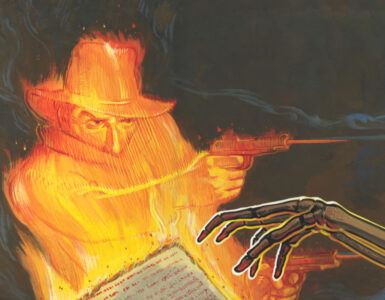
William Lampkin designed PulpFest’s “New Fictioneer Readings” banner. It adapted Hannes Bok’s cover art for the November 1941 issue of Weird Tales, depicting a skeleton writing at a podium.
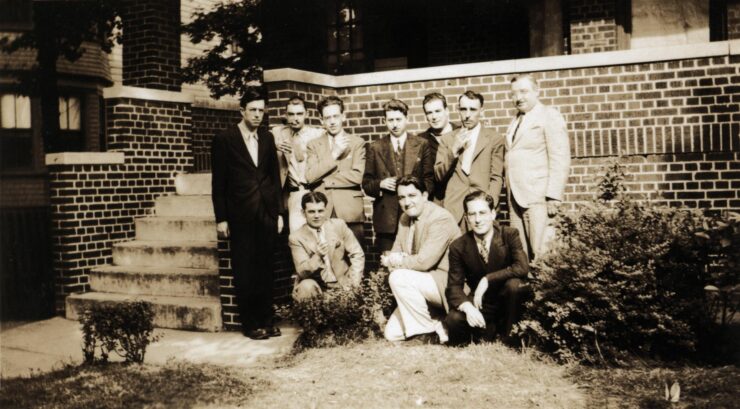
Our featured image, courtesy of Doug Ellis, is from his Black Gate article, “The Great Pulp Gathering.” It shows the “fictioneers” listed below, gathered outside Mort Weisinger’s home in June 1937. When the photograph was taken, Weisinger was editing Thrilling Wonder Stories.
Top row, left to right: Jack Williamson, L. Sprague de Camp, John D. Clark, Frank Belknap Long, Mort Weisinger, Edmond Hamilton, and Otis Adelbert Kline. Bottom row, left to right: Otto Binder, Manly Wade Wellman, and Julius Schwartz.