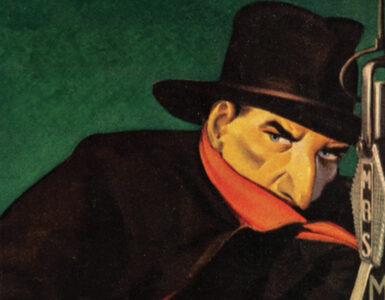
 Below is a play-by-play of PulpFest 2013’s creation, told through many of the posts that originally appeared on the convention’s home page during 2012 and 2013. We’ve left out posts that pertain to “housekeeping chores,” such as registration, Munsey Award nominations, and so on.
The posts begin in September 2012, soon after the organizing committee started planning, arranging, and promoting the 2013 convention — which fans later called the “best pulp con of them all!”
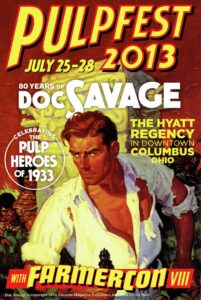
Chris Kalb adapted our lead image from Walter Baumhofer’s cover art for the March 1933 issue of Doc Savage Magazine.
PulpFest 2013 Plans Are Underway
Sept. 27, 2012 – The PulpFest committee is delighted to announce that our 2013 convention will once again be held at the Hyatt Regency hotel in downtown Columbus, Ohio. Our 2013 confab will take place from Thursday, July 25 through Sunday, July 28. It will boast the same combination of product and programming that has made PulpFest the must-attend annual event for fans, scholars, and collectors of pulp fiction.
Two very important anniversaries will figure prominently in PulpFest’s 2013 programming. First and foremost, we are celebrating the hero pulp revolution that began 80 years ago in 1933, with the debuts of such popular figures as Doc Savage, The Spider, Nick Carter, Pete Rice, The Lone Eagle, The Phantom Detective, and G-8 and His Battle Aces. The success of Street & Smith’s Shadow pulp, launched two years earlier, spurred this revival of single-character magazines, a dime-novel-era phenomenon. The hero pulps revitalized an industry laid low by the Great Depression, and they dominated the rough-paper field for the rest of the decade. They remain the most avidly collected and frequently reprinted periodicals in the hobby.
We’ll also acknowledge the centennial of Sax Rohmer’s Dr. Fu Manchu, who made his American bow in a February 1913 issue of Collier’s Magazine. In 1933, the initial cycle of short stories was published in hardcover as The Insidious Dr. Fu Manchu. Rohmer’s “Devil Doctor,” the first and greatest “Yellow Peril” villain, was widely imitated in American pop culture; rough-paper knockoffs included The Mysterious Wu Fang and Dr. Yen Sin, two short-lived pulps from Popular Publications.
With so many possibilities for panels and presentations, the PulpFest committee once again plans to offer a full night of programming on Thursday, before the convention’s “official” opening on Friday, so attendees are urged to make early arrival a part of their PulpFest travel plans.
Although the 2013 convention is still ten months away, you can rest assured that the committee is already hard at work on planning and promotion. Ideas for panels and presentations have already been proposed and, as always, we remain open to programming suggestions and volunteer presenters. Most importantly, though, we wanted to let you know that our venue is confirmed. So start saving for the next PulpFest right away and check back periodically for updates.
Happy Holidays from PulpFest
Dec. 22, 2012 – Here’s wishing everyone the happiest of holiday seasons. As we near 2013 and the eightieth anniversary of the “hero pulp explosion,” when characters such as Doc Savage, G-8, The Spider, and The Phantom Detective were introduced to the reading public, let’s hope there’s a copy of your favorite pulp magazine tucked into Santa’s sack to help tide you over until April 12th, when the Windy City Pulp and Paper Convention will begin in the Chicago area.
After you’ve finished celebrating the winter holidays, please stop back at the PulpFest website as we gear up for next “Summer’s Great Pulp Con.” Better still, sign up for our email updates by filling in the little gray box titled “E-Mail List” right here on our home page. And while you’re at it, why not “like” our Facebook page as more than 500 others have done. You can also follow PulpFest on Twitter.
Celebrating the Pulp Heroes of 1933
Jan. 23, 2013 – Eighty years ago, following the great success of The Shadow, the pulp industry exploded with eight new single-character magazines. The Phantom Detective, Doc Savage, Nick Carter, The Lone Eagle, G-8 and His Battle Aces, The Spider, and Pete Rice all debuted in their own magazines in the glorious year of 1933. Join PulpFest on Thursday, July 25, for our celebration of “The Pulp Heroes of 1933.”
Enter the Phantom
 Jan. 29, 2013 – In 1933, Franklin Delano Roosevelt was inaugurated as the 32nd president of the United States of America, proclaiming that “We have nothing to fear but fear itself.” Adolph Hitler was named the Chancellor of Germany, amid promises of a parliamentary democracy. San Francisco broke ground on the Golden Gate Bridge. King Kong premiered in New York City, and the hero pulp revolution began.
The tremendous success of Street & Smith’s The Shadow Magazine prompted the return of the single-character periodical. The first of these hero pulps was The Phantom Detective. Launched by Ned Pines’ Thrilling Group, the Phantom was the alter ego of man-about-town Richard Curtis Van Loan. A veteran of the First World War, this moneyed playboy had grown bored with life. A family friend recommended he “try his hand at solving a mysterious crime which had stumped the police.” His initial success led Van Loan to dedicate his life and fortune to combat crime, making the Phantom “a name known and admired by the police of every nation.”
The first issue of The Phantom Detective was dated February 1933. The Summer 1953 issue would be its final number. The Phantom Detective was the longest-lived hero pulp, lasting just over twenty years.
Bertram Glover contributed the cover art for the February 1933 issue of The Phantom Detective, the first of several hero pulps Standard Magazines/Better Publications published.
Kenneth Robeson Coming to PulpFest
Feb. 2, 2013 – Following the astounding success of their first single-character pulp, The Shadow Magazine, Street & Smith set out to duplicate its good fortune in the adventure magazine market. Working with the company’s business manager, Henry W. Ralston, editor John Nanovic spent a year developing a scientist-adventurer who would travel the globe, right wrongs, and punish evildoers. In late 1932, Lester Dent, a former telegraph operator turned pulp writer, joined them. Soon thereafter, Doc Savage, the world’s first superhero, was born.
 Doc Savage Magazine premiered early the next year with its first issue dated March 1933. The lead novel, “The Man of Bronze,” introduced Clark Savage, Jr. to a disheartened country thirsting for heroes. Amidst the dark days of the Great Depression, the magazine was an immediate success.
Although the first tale of Doc Savage and his five trouble-busting assistants was credited to Kenneth Roberts, a name belonging to a former journalist and author of historical novels, later novels in the series were proclaimed the work of Kenneth Robeson, a house name that hid the identity of Dent as well as Laurence Donovan, Ryerson Johnson, William Bogart, and other writers.
PulpFest is pleased to announce that Will Murray, the current “Kenneth Robeson,” will present at the 2013 convention for fans of pulp magazines and pulp fiction. The author of a dozen Doc Savage novels for Bantam Books and Altus Press, Will hopes to be Kenneth Robeson for a long time to come.
Murray discovered Doc Savage in 1969, when he bought a copy of Bantam Books’ Dust of Death. Before long, he began collecting the original pulp magazine and writing articles about the Man of Bronze for fanzines. This modest beginning led to Murray becoming one of the leading experts on Doc Savage and the pulps, the literary agent for the estate of Doc co-creator Lester Dent, a scriptwriter for The Adventures of Doc Savage program for National Public Radio, and the latest “Kenneth Robeson.”
Murray penned seven Doc novels for Bantam Books back in 1991-93. Twenty years later, he’s doing it again for Altus Press with the Wild Adventures of Doc Savage series. For the eightieth anniversary of “The Man of Bronze,” Will teamed Doc with another legend who first appeared in 1933 — King Kong — in the novel Skull Island.
Walter M. Baumhofer painted the front cover art for the March 1933 issue of Doc Savage Magazine, published by Street & Smith.
The World’s Greatest Detective
 Feb. 18, 2013 – Nick Carter, created by John Russell Coryell, debuted in 1886 in Street & Smith’s New York Weekly. Five years later, Frederic Dey and other writers took over, penning over a thousand stories featuring the “Little Giant.” The character was so popular that when Detective Story Magazine began in 1915, Street & Smith claimed “Nicholas Carter” was its editor.
By 1933, interest in the old Nick Carter stories was beginning to wane. It was the era of the hardboiled detective, with characters such as Dashiell Hammett’s Continental Op and Sam Spade, Carroll John Daly’s Race Williams and Vee Brown, and Frederick Nebel’s “Tough Dick” Donahue and Jack Cardigan tearing up the pages of rough-paper magazines like Black Mask and Dime Detective.
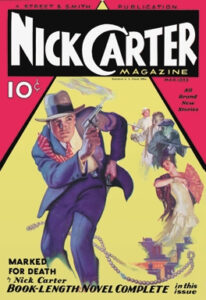
It was also the time of the pulp hero. With The Shadow Magazine flying off America’s newsstands, Street & Smith decided to expand the single character field with magazines featuring adventure and detective heroes. For the latter, it was decided to create a hardboiled version of the “Little Giant” of the dime novels, and Nick Carter Magazine was born. Dated March 1933, the new pulp would sport a cover by Jerome Rozen and lead with the novel “Marked for Death,” by author Richard Wormser (writing as “Nick Carter”). Nick Carter Magazine would run through June 1936.
Jerome Rozen contributed the cover art for the first issue of Nick Carter Magazine, dated March 1933. Thanks to Sanctum Books for the great cover scan.
The World’s First Superhero
There was death afoot in the darkness. It crept furtively along a steel girder. Hundreds of feet below yawned glass-and-brick-walled cracks – New York streets. Down there, late workers scurried homeward. Most of them carried umbrellas and did not glance upward.
Feb. 19, 2013 – Eighty years ago, the words above helped convince readers to buy Doc Savage Magazine when it appeared on newsstands in mid-February 1933. Sporting a front cover painted by the “King of the Pulps,” Walter M. Baumhofer, and published by Street & Smith, the new rough paper magazine promised “a thrilling saga of a scrappy outfit hunting a treasure and being hunted in turn.”
“The Man of Bronze,” credited to Kenneth Roberts, was by Lester Dent, a writer who broke into the pulp market in 1929 with an aviation yarn published by Top-Notch Magazine. In the ensuing years, he had sold about three dozen stories to a variety of magazines including Air Stories, Detective-Dragnet Magazine, Scotland Yard, Sky Riders, War Birds, and Western Trails.
Impressed by Dent’s ability to combine an “extravagant plot, scenes and action with comparatively high credibility and reasonableness of motivation,” the author was invited to the offices of Street & Smith to join business manager Henry W. Ralston and The Shadow Magazine editor John L. Nanovic in a brainstorming session to flesh out a new adventure series they were planning.
Although Doc Savage Magazine wasn’t the first hero pulp to debut in 1933, it would become the most popular single-character magazine launched that year, trailing only The Shadow in total issues published. The character would go on to inspire not only original pulp readers, but also fans of the Bantam paperback reprints that appeared from 1964 through 1990. Likewise, today’s readers, who enjoy the original pulp tales collected by Sanctum Books, and Will Murray’s new adventures of the Man of Bronze, published by Altus Press.
Join PulpFest 2013 over the last weekend of July to celebrate eighty years of Doc Savage and the pulp heroes of 1933.
Spring Training for PulpFest
Feb. 23, 2013 – With spring comes baseball, pulp cons, and paperback shows.
Leading off is the 34th annual Los Angeles Vintage Paperback Show. This one-day show will feature appearances by over forty writers, including James Blaylock, Dennis Etchison, William F. Nolan, and Harry Turtledove, all happy to sign your books. It will take place on Sunday, April 7th, at the Valley Inn and Conference Center in Mission Hills, California.
 The Windy City Pulp and Paper Convention is on deck. Now in its 13th year, this Chicago-area event will celebrate ninety years of science-fiction and fantasy magazines with salutes to Weird Tales and the “Scientific Fiction Number” of Hugo Gernsback’s Science and Invention. The convention will be held at the Westin Lombard Yorktown Center from April 12 – 14.
The three-spot features the South’s leading “pulp culture” convention, PulpArk. A writers’ conference and pulp convention, it focuses on the methodology of pulp fiction, storytelling involving “action, adventure, larger-than-life heroes and villains, and a strong focus on both plot and characterization.” Featuring guest appearances by Joe Devito, Martin Powell, and Paul Bishop, PulpArk will take place April 26 – 28 at the Holiday Inn Springdale Hotel and Convention Center in Springdale, Arkansas.
Batting clean-up on May 11 is Canada’s premier pulp event, the 17th annual Fantastic Pulps Show & Sale at the Lillian H. Smith branch of the Toronto Public Library in Toronto, Ontario.
Penciled in to follow on May 17 – 19 is the 2013 Edgar Rice Burroughs Chain of Friendship (ECOF) Gathering, hosted by the Chicago Muckers, the regional chapter of the Burroughs Bibliophiles. It will be held at the Quality Inn in Morris, Illinois, and feature artist Mike Hoffman as its guest of honor.
Cinevent 45 is slotted in at number six and will take place over Memorial Day weekend, May 24 – 27. In addition to 170 tables of movie-related collectibles such as posters, lobby cards, press kits, DVDs, and 16 mm films, Cinevent features an extensive schedule of classic sound and silent films and one of the country’s largest live auctions of vintage posters. It will be held at the Ramada Plaza Hotel and Conference Center in Columbus, Ohio.
Robert E. Howard Days is installed as the number seven hitter on June 7 – 8 at the Robert E. Howard House & Museum in Cross Plains, Texas. This annual gathering of fans of Two-Gun Bob is presented by Project Pride of Cross Plains and sponsored by the Robert E. Howard Foundation, with help from the members of the Robert E. Howard United Press Association. Tim Truman, artist and writer for Dark Horse Comics, will be guest of honor.
In the 8-hole later this spring is Classicon 43, one of the first pulp and paperback shows ever established. Featuring 35 tables and thousands of collectible pulp magazines, paperbacks, vintage comic books, original artwork, and more, it is held twice a year in Lansing, Michigan. For further information, write to the Curious Book Shop at 304 East Grand River Avenue, East Lansing, Michigan 48823, or by email at cbsmail@curiousbooks.com.
At the bottom of the line-up is the best pulp event of all, the summertime destination for fans and collectors of vintage popular fiction and related materials, PulpFest 2013. Join us from July 25 – 28 at the Hyatt Regency Columbus for summer’s great pulp con. This year, we’ll celebrate Doc Savage and the pulp heroes of 1933, and the centennial of the villainous Dr. Fu Manchu.
This year’s Windy City Pulp and Paper Convention will salute ninety years of science fiction and fantasy magazines, including the August 1923 issue of Hugo Gernsback’s Science and Invention magazine, its “Scientific Fiction Number,” which featured front cover art by Howard V. Brown.
The Birth of Dr. Fu-Manchu
Imagine a person, tall, lean, and feline, high-shouldered, with a brow like Shakespeare and a face like Satan, a close-shaven skull, and long, magnetic eyes of the true cat-green. Invest him with all the cruel cunning of an entire Eastern race, accumulated in one giant intellect, with all the resources of science past and present. Imagine that awful being, and you have a mental picture of Dr. Fu-Manchu, the yellow peril incarnate in one man.
 March 2, 2013 – One hundred years ago, the words above were published in the February 15, 1913 issue of Collier’s. “The Zayat Kiss” was by Arthur Henry Sarsfield Ward, better known as Sax Rohmer, and introduced American readers to Dr. Fu-Manchu. Although Rohmer did not create the “yellow peril” story, his tales of “the devil doctor” were certainly the most influential in that genre.
During his life, Sax Rohmer penned four accounts concerning his creation of Dr. Fu-Manchu. Supposedly inspired by a “Mr. King,” a wealthy man of mystery said to control all the Chinese gambling, drug traffic, and Tongs of London, Rohmer claimed that Fu-Manchu arose from a chance encounter that he had one night in the Limehouse district of the city. In “How Fu Manchu Was Born,” published in the September 29, 1957 issue of This Week, he wrote:
I saw a tall and very dignified man alight, Chinese, but different from any Chinese I had ever met. He wore a long, black topcoat and a queer astrakhan cap. He strode into the house. He was followed by an Arab girl, or she may have been an Egyptian.
The chauffeur closed the car door, jumped to his seat, and backed out the way he had come in. The headlights faded in the mist … and Dr. Fu Manchu was born!
Join PulpFest in July as we celebrate the centennial of Sax Rohmer’s enduring literary icon, Dr. Fu Manchu, and the 130th anniversary of Rohmer’s birth on
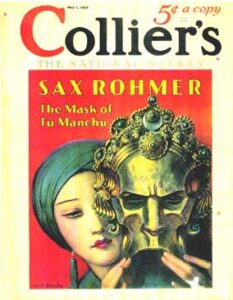
W. T. Benda’s masterful cover for the May 7, 1932 issue of Collier’s appears above, courtesy of The Page of Fu Manchu. It illustrates the author’s novel, “The Mask of Fun Manchu.”
The Pulp Heroes Take to the Air
May 27, 2013 – Americans in 1933 had “nothing to fear but fear itself,” and the pulp heroes introduced that year were proving the country’s new president absolutely correct. During that harrowing year, The Phantom Detective, Nick Carter, and Doc Savage had met and defeated “The Emperor of Death,” “Maniacs of Science,” “The Red Skull,” and other adversaries. As the year wore on and the Great Depression savaged other genres, the new hero pulps surged ahead, their magazines disappearing from America’s newsstands. The publishers noticed.
After Fiction House introduced Air Stories in the summer of 1927, aviation fiction became a standard part of the industry. With the launch of War Birds in early 1928, Dell Publishing added war to the mix. Riding the tide of “air-mindedness” inspired by Charles Lindbergh’s heroic flight, both magazines proved instant hits. Similar titles were rushed to the stands.
Following the stock market crash of 1929, “the vision that aviation would lead mankind to a higher level of civilization … came plummeting down to earth,” taking much of the air pulp market with it. However, the genre was far from dead.
In 1932, a trio of air-war magazines was born – Popular Publications’ Dare-Devil Aces and Battle Birds, and the Standard’s Sky Fighters. Their pages filled with the exploits of flying aces of the First World War, these pulps were “especially sought after by boys raised on the courageous exploits of fathers and uncles who had served in the Great War, boys who kept themselves busy building model planes constructed of balsa wood.” Little wonder that the next pulp heroes to be introduced in 1933 would take to the air.
 Borrowing one of the nicknames given to Lindbergh following his nonstop flight from New York to Paris, Standard Magazines was first to the stands with The Lone Eagle. Relating the heroic adventures of Air Intelligence Agent John Masters, “the world’s greatest Sky Fighter,” as proclaimed on the magazine’s cover, the pulp debuted in the late summer of 1933.
“Masters showed a natural affinity for a stuttering machine-gun and as his natural proficiency increased, he built up a dark and terrible reputation about his name. He became the “Lone Eagle” of the skies … He showed an indomitable courage and a dynamic driving power, in pushing to a successful conclusion his secret missions. Many men feared him, many hated him–an occasional one loved him.”
Those words, written by F. E. Rechnitzer, appeared in “No Man’s Air,” the lead novel for the first issue of the new hero pulp. A former World War I Allied pilot and prisoner-of-war, Rechnitzer is believed to have written many of The Lone Eagle’s adventures under the “Lt. Scott Morgan” house name. Robert Sidney Bowen probably contributed most of the later novels. In all, 75 tales of “the world’s greatest Sky Fighter” appeared through the spring of 1943 when the magazine would fly off into the sunset as The American Eagle.
One month after the debut of Standard’s air hero, Popular Publications premiered G-8 and His Battle Aces, featuring Robert J. Hogan at the controls. An air cadet at the end of the First World War, Hogan turned to writing after losing employment as an airplane salesman. Although he also wrote sports and western fiction, Hogan was a regular for the air pulps, scoring big with his Smoke Wade and Red Falcon stories.
In the summer of 1933, Henry Steeger, co-founder of Popular Publications, asked Hogan to create a book-length air character patterned after The Shadow and Doc Savage, pitting “a super protagonist and his loyal side men against heinous forces of power and evil.”
“We have decided to make you a special agent of the spy system of America. A special independent system…. No one will take command over you. You may choose any assistants you wish. You may take matters entirely in your own hands. You will answer to no one but us, and that will be at your discretion. Your first job will be to stop this deadly plan of the fiend, Krueger…”
Determined “to avoid similarity and dullness with a healthy injection of fantasy,” Hogan created diabolical masterminds to match wits with his flying spy:
Herr Doktor Kreuger, a fiendish, thick-lensed gnome whose outsized brain conceived surgically altered man-beasts and mammoth bird monsters, deadly rays and flying swords … Chu Lung, an oriental mercenary scientist with a retinue of padding hatchet men, and the huge Herr Stahlmaske, crazed and scarred in a fiery crash, who wore a bullet-shaped steel mask and commanded an underworld corps of disfigured brutes equipped with razored gloves. There were others with secret formulas from the ancient tombs of Egypt, voodoo priests and flying zombies from Haiti, cobra charmers and poison-dart mystics from India and Africa, and even a tribe of defrosted Vikings from northern glaciers (Sidney H. Bragg, “G-8, Flying Spy of the Pulps.” Xenophile #11).
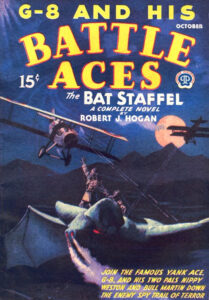 Debuting in “The Bat Staffel,” in the October 1933 number of G-8 and His Battle Aces, Hogan’s hero would appear in 110 adventures, battling “The Skeleton Patrol,” “Staffel of the Floating Heads,” “The Black Aces of Doom,” “Squadron of the Flying Dead,” “Skeletons of the Black Cross,” “Hordes of the Wingless Death,” and other hideous horrors of the hated Hun. The final issue of the Popular Publication was dated June 1944.
To learn more about these and the other great pulp heroes of 1933, register now for PulpFest 2013, running from Thursday, July 25th through Sunday, July 28th.
Illustrating this section are Eugene Franzden’s cover for The Lone Eagle, dated September 1933, and Frederick Blakeslee’s cover for the October 1933 issue of G-8 and His Battle Aces.
Bill Maynard Presents Fu Manchu
May 30, 2013 – They were called scribes, word slingers, hacks, and penny-a-worders. But perhaps the most favored term, especially among the men and women who labored for the bloody pulps, was fictioneer or, more specifically, a fiction writer, particularly a prolific creator of commercial or pulp fiction. Join PulpFest as we celebrate today’s fictioneers — the authors writing the new pulp fiction— the New Fictioneers!
Our special guest, William Patrick Maynard, will get things rolling at 1 p.m. on Friday, July 26, in the Fairfield Room located on the second floor of the Hyatt Regency Columbus. Authorized by the estate of Sax Rohmer to continue the Fu Manchu series, Maynard’s debut novel, The Terror of Fu Manchu, was published in 2009 by Black Coat Press. A sequel, The Destiny of Fu Manchu, followed in 2012. Bill is currently working on The Triumph of Fu Manchu, his third novel concerning Rohmer’s fabulous devil doctor. Bill hopes to “continue to tell new stories of these classic characters for many years to come and, hopefully, somewhere in the Great Beyond, Sax Rohmer is happy to see his characters alive and well after a century.”
As a child growing up in Cleveland, Ohio, Bill Maynard discovered Fu Manchu through Marvel Comics’ Master of Kung Fu. Later, he learned of the Pyramid paperback reprints of Sax Rohmer’s fiction classic and developed a passion for the series and the character.
A past nominee of a Pulp Factory Award for Best Pulp Novel and a Rondo Award for Best Genre Article in a Periodical, Bill has published articles in Blood ‘n’ Thunder, The Cimmerian, The Pulpster, and Windy City Pulp Stories, among others. He also pens a weekly pulp fiction column for The Black Gate. His short fiction has appeared in The Ruby Files (Airship 27), Gaslight Grotesque (EDGE Publishing), and Tales of the Shadowmen: Grand Guignol (Black Coat Press). He has also contributed essays to Serial Squadron’s remastered Drums of Fu Manchu DVD and to the Sax Rohmer collection, The Voice of Kali, published by Black Dog Books. His forthcoming works include The Occult Case Book of Shankar Hardwicke and a hardboiled detective novel.
Wold Newton Fictioneers
June 3, 2013 – Longtime Farmerphile Win Scott Eckert is a familiar face at summer’s great pulp con. Since FarmerCon joined with PulpFest in 2011, Win has appeared on several panels, signed books, and regaled audiences as part of the convention’s popular New Fictioneers presentations. For his reading this year, Win has decided to share center stage with his good friend and fellow Philip José Farmer devotee, John Allen Small.
John grew up wanting to be a writer, and so he did. A journalist and columnist who has earned nearly 200 awards from the Society of Professional Journalists, the National Newspaper Association, and other professional organizations, John hails from Oklahoma. He has also written fiction for The Avenger: Roaring Heart Of The Crucible (2013), The Green Hornet: Still At Large (2012), The Worlds Of Philip José Farmer 2: Of Dust And Souls (2011), and other works; authored two collections of his own; and contributed to the new hardcover edition of Farmer’s Doc Savage: His Apocalyptic Life and the forthcoming Tales Of The Wold Newton Universe. At PulpFest, John will be reading “The Bright Heart of Eternity,” a tribute to Edgar Rice Burroughs and Philip José Farmer, and the opening scene from his Avenger story, “Ghost of Thunder Isle.”
 A three-time New Fictioneer, Colorado’s Win Scott Eckert returns to the Fairfield Room stage with two new works. He’ll read from The Scarlet Jaguar, his limited-edition novella to be released by Meteor House at PulpFest 2013/FarmerCon VIII in celebration of Doc Savage’s eightieth anniversary. Featuring Patricia Wildman, daughter of a certain bronze champion of justice, The Scarlet Jaguar is the sequel to the Eckert/Farmer collaboration, The Evil in Pemberley House (2009).
Win also plans to offer an excerpt from A Girl and Her Cat, the first new “Honey West” novel in over forty years. In this exciting work forthcoming from Moonstone Books, co-written by Matthew Baugh, Honey teams up with former cat burglar-turned-bodyguard Thomas Hewitt Edward Cat, better known as “T.H.E Cat.”
In addition to the works mentioned above, Win Scott Eckert edited and contributed to Myths for the Modern Age: Philip José Farmer’s Wold Newton Universe (MonkeyBrain Books), a 2007 Locus Awards finalist. He has co-edited three Green Hornet anthologies for Moonstone Books; the third, The Green Hornet: Still at Large, recently won the 2013 PulpArk Award for best anthology. His tales of The Green Hornet, Zorro, The Avenger, The Phantom, The Scarlet Pimpernel, Captain Midnight, and Sherlock Holmes can be found in various character-themed anthologies from Moonstone, as well as anthologies such as Tales of the Wold Newton Universe (Titan Books) and Tales of the Shadowmen (Black Coat Press). His critically acclaimed Crossovers: A Secret Chronology of the World was released by Black Coat Press in 2010. Find Win online at www.winscotteckert.com.
Mark Sparacio’s contributed the cover art for Win Scott Eckert’s forthcoming The Scarlet Jaguar, published by Meteor House and debuting at PulpFest 2013/FarmerCon VIII.
The Future of “New Pulp”
June 5, 2013 – At 1 PM on Saturday, July 27, writer, editor-in-chief of Airship 27, and two-time Pulp Factory Award winner, Ron Fortier, and five contemporary authors will gaze into their crystal balls to chart the road ahead for the new and exciting continuation of the pulp genre known as “New Pulp.” Joining Ron will be Jim Beard, Win Scott Eckert, Rick Lai, Frank Schildiner, and Dr. Art Sippo.
A native Toledoan, Jim Beard became a published fiction writer after selling a story to DC Comics in 2002. Since then, he’s written Star Wars and Ghostbusters comics, as well as several works of new pulp fiction including Sgt. Janus, Spirit-Breaker and Captain Action: Riddle of the Glowing Men, the first pulp prose novel based on the classic 1960s action figure.
One of our 2013 New Fictioneers, Win Scott Eckert, co-authored the Wold Newton novel The Evil in Pemberley House with Philip José Farmer. Win’s sequel, The Scarlet Jaguar, will debut at this year’s PulpFest. In addition to co-editing three Green Hornet anthologies for Moonstone Books, Win has written countless tales featuring Zorro, The Avenger, Honey West, The Phantom, Captain Midnight, The Scarlet Pimpernel, Sherlock Holmes, and many other genre fiction characters.
Rick Lai is a computer programmer best known for his articles based on Philip José Farmer’s Wold Newton concepts. Altus Press recently collected these into four volumes. His short stories have appeared regularly in the Tales of the Shadowmen anthologies published by Black Coat Press. In 2011, Wild Cat Books released Rick’s Shadows of the Opera, a novel about a 19th-century female vigilante.
A pulp fan since reading Philip José Farmer’s Tarzan Alive, Frank Schildiner is a New Jersey martial arts instructor. He has written Black Bat, Ravenwood, and Secret Agent X stories for Airship 27; Avenger yarns for Moonstone Books; tales of Thunder Jim Wade and Richard Knight for Pro Se Productions; and contributed to Black Coat Press’s Tales of the Shadowmen series.
An emergency room physician in St. Louis, Missouri, Dr. Art Sippo has written several articles and short stories grounded in the pulps. His first book, Sun Koh: Heir of Atlantis, was a 2010 Pulp Factory Award nominee for Best Pulp Novel. Art served in the United States Army for 36 years.
The Beard . . . . New Fictioneer!
June 7, 2013 – Jim Beard’s father introduced him to comic books, passing on a love for the medium and the pulp characters that preceded it. After decades of reading, collecting, and dissecting comics, Jim became a published writer when he sold a story to DC Comics in 2002. Since then, he’s written comic stories for Dark Horse’s Star Wars and IDW’s Ghostbusters and contributed articles and essays to several volumes of comic book history.
A native of Toledo, Ohio, where he is a regular columnist for the Toledo Free Press, Jim broke into the world of “New Pulp” in 2012 when Airship 27 published Sgt. Janus, Spirit-Breaker, a collection of ghost stories featuring an occult detective, and Captain Action: Riddle of the Glowing Men, the first prose novel based on the 1960s action figure. Jim provides regular content for marvel.com, the official Marvel Comics website, and has new and forthcoming comic and prose work from Bluewater, TwoMorrows, Airship 27, and Pro Se Productions.
Join “The Beard” on Saturday, July 27 at 3 PM when Jim will be reading from Sgt. Janus, Spirit-Breaker, Captain Action: Riddle of the Glowing Men, and “The Parade of Moments,” a story published in Monster Earth, a shared-world anthology of giant monster tales. And to learn more about this exciting new writer, please visit The Beard: The Jim Beard Fan Page.
Doc Meets the King
June 9, 2013 – Beginning with the premiere of Standard Magazines’ The Phantom Detective at the start of the year and Nick Carter Magazine and Doc Savage Magazine from Street & Smith in February, 1933 was the “year of the hero pulp.”
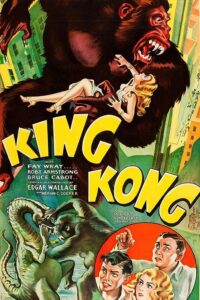 But 1933 was not just the year of the hero pulp. On March 2 of that same year, RKO Radio Pictures premiered “the eighth wonder of the world,” King Kong, at New York’s Radio City Music Hall and the Roxy. In just four days, the film earned nearly $90,000, a substantial sum in those dark Depression days.
To celebrate the 80th anniversaries of “The Man of Bronze” and King Kong, Will Murray, author of The Wild Adventures of Doc Savage, paired the two characters in his novel, Skull Island. On Saturday, July 27th, at 2 PM, PulpFest 2013 will host a special New Fictioneers reading of Mr. Murray’s bestselling novel, read by Radio Archives reader Roger Price.
During his lengthy career as an entertainer, Roger has performed on television, radio, and the live stage. At one time or another, he has worked as a stand-up comic, hosted a late-night movie series as a character called “The Baron,” worked as a morning radio personality, hosted and emceed numerous live events, served as an entertainment news anchor, and even as a ring announcer for professional wrestling. Comic book and pop culture fans know Roger as the creator, director, and “voice” of Mid-Ohio-Con, one of the largest and longest-running conventions of its kind.
Through Radio Archives, Roger Price can be heard reading various short stories on Strange Detective Mysteries #1, Captain Satan #1, Captain Zero #1, and other audiobooks. Roger also works with a wide variety of clients as an announcer and voice actor, specializing in character/cartoon voices and dialects.
Following the reading, both Will Murray and Roger Price will be available for questions and conversation.
A poster for the RKO Pictures 1933 release, King Kong. The artist is not known.
Master of Men!
June 12, 2013 – Popular Publications got its start in late 1930 when Henry Steeger and Harold Goldsmith released their first four titles – Battle Aces, Detective Action Stories, Gang World, and Western Rangers. A year later, they were joined by two more – Underworld Romances and the magazine that helped send the company to the top of the pulp chain, Dime Detective Magazine.
In spring and summer 1933, Henry Steeger planned additional releases. Two targeted the western and love genres, while the others were aimed at the single-character market. “At this point in pulp history, individual titles became very popular, so we decided to try out a few …”
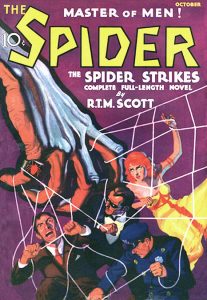 Popular Publications debuted its four new titles in September 1933 – Star Western and Lovers Magazine; its air-war hero pulp, G-8 and His Battle Aces; and the company’s answer to the phenomenally popular Street & Smith character pulp, The Shadow Magazine. It was called The Spider.
R. T. M. Scott’s “The Spider Strikes” led off the first issue of The Spider, cover dated October 1933. A mystery novelist well known for his character Secret Service Smith, Scott would only write the first two novels of the magazine’s long run. He would, however, introduce many of the trappings that would endear the pulp’s characters to readers.
With its third issue, the magazine turned The Spider over to Norvell W. Page, a newspaperman turned pulp writer. Hidden behind the name Grant Stockbridge, Page would contribute 91 tales of the “Master of Men” – more than three-quarters of the magazine’s 118-issue run – writing with “heart, feeling and emotion.”
As the late Michael Avallone wrote in the June 1981 issue of Mike Shayne Mystery Magazine.
Richard Wentworth, playboy millionaire by day and caped crusader by night … Master of disguise, superbly conditioned body, keen, alert brain and altogether hair-trigger personality when the United States and the world were threatened by master villains, Yellow Perils, horrible hordes, devastating plagues, and killing, chilling terrorism. Wentworth, who became the cragged, grotesque Spider who left his vermillion trademark on the dead foreheads of The Enemy.
Started as a knock-off of the first single-character pulp, The Spider would eventually join Doc Savage, G-8 and His Battle Aces, Jim Hatfield (in Texas Rangers), The Phantom Detective and The Shadow, the magazine that inspired them all, as one of the longest-lived of the hero pulps, thanks largely to the white-hot prose of Norvell Page.
PulpFest 2013 salutes eighty years of The Spider and “The Pulp Heroes of 1933″ from July 25– 28 in Columbus, Ohio.
Walter Baumhofer painted the cover to The Spider: Master of Men! for October 1933, pictured above.
The Ancestors of Batman
June 14, 2013 – PulpFest‘s programming begins with an off-site presentation to which convention attendees are cordially invited. On Thursday, July 25th, in Room 150A-B at Ohio State University’s Thompson Library, PulpFest committee member and Blood ‘n’ Thunder editor and publisher Ed Hulse will deliver a lecture titled “The Ancestors of Batman: Colorful Crime Fighters of Pulp Fiction.”
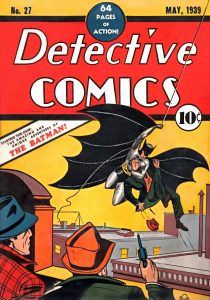 Ed’s presentation ties in with PulpFest‘s 80th-anniversary celebration of the 1933 hero-pulp explosion that gave us Doc Savage, The Spider, The Phantom Detective, and others. As he will point out, these characters directly influenced such later comic-book heroes as Batman – whose very first exploit was, in fact, plagiarized from a 1936 Shadow novel.
Batman was hardly the first colorful crime fighter to affect the pose of wealthy idler. The pulp magazines beat him to that characterization by a quarter century. Bruce Wayne simply joined a fraternity whose members already included Jimmie Dale, Lamont Cranston, Richard Wentworth, and Richard Curtis Van Loan, to name just a few. But great wealth and social prominence were not the only traits these men shared, as Ed will point out.
The presentation will also include latter-day examples of hero-pulp concepts that became embedded in American popular culture. One example is 24‘s Jack Bauer, who shares with pulpdom’s Operator #5 the distinction of being a government agent working outside the system to combat terrorists seeking to inflict grave harm on the United States with apocalyptic weapons.
“The Ancestors of Batman” is scheduled to begin at 4:30 PM, is open to the public, and will set the tone for the many informative and entertaining programs scheduled for this year’s PulpFest.
Pictured above is Detective Comics #27, dated May 1939, with cover art by Bob Kane.
Buying & Selling at PulpFest 2013
June 16, 2013 – Every great pulp con is centered around its dealers’ room, and this year, PulpFest will be hosting about fifty sellers of pulp magazines and related materials, vintage paperbacks, digests, men’s adventure and true crime magazines, first edition hardcovers, series books, dime novels, original art, Big Little Books, Golden and Silver Age comic books, vintage films and radio programs, and other pop culture collectibles. Over 100 tables of material will be available.
The PulpFest dealers’ room will be in the Regency Ballroom, a 15,800-square-foot gathering space with wide aisles and spacious work areas for our sellers. Located on the third floor of the Hyatt Regency Columbus, the ballroom can accommodate up to 1600 people at any given moment.
The PulpFest dealers’ room will be open to all registered attendees from 9 AM to 5 PM on July 26 and 27, and from 9 AM until 2 PM on Sunday, July 28.
The 2013 Munsey Award Nominees
June 16, 2013 – The PulpFest Organizing Committee is pleased to announce that thirteen individuals were nominated by their peers for the 2013 Munsey Award. This year, no one was nominated for the elite Rusty Hevelin Service Award.
The following nominees will be forwarded to a committee of all living Lamont, Munsey, and Rusty Award winners, who will select the recipient of the 2013 Munsey Award.
These individuals include Charles Ardai, William G. Contento, Randy Cox, Chris Kalb, Steve Miller, Laurie Powers, Garyn Roberts, Phil Stephensen-Payne, Celina Summers, J. Barry Traylor, George Vanderburgh, Howard Wright, and Dan Zimmer.
The recipient of the 2013 Munsey Award, a limited edition print designed by artist and pulp enthusiast David Saunders, will be announced on July 27 as part of the Saturday evening programming, open to all PulpFest 2013 registrants.
The Pulps After Fu Manchu
Tall, thin with lizard-green eyes, yellow robe and black cap embroidered with coral bead, Fu Manchu was the very picture of warped genius. Such unusual potions as spiders, scorpions and plague-carrying tsetse flies were just part of Fu’s prescription to foreshorten the white race’s actuarial expectations. Master of super science and creative toxicology, he . . . was the Yellow Peril.
June 17, 2013 – Although Kaiser Wilhelm is believed to have coined the term “Yellow Peril,” Sax Rohmer profited most from the idea, largely through the villainous Dr. Fu Manchu. Little wonder that countless pulp writers, from Walter B. Gibson and Norvell W. Page to Robert E. Howard and George Worts, turned to the devil doctor to find inspiration for their lurid pulp tales.
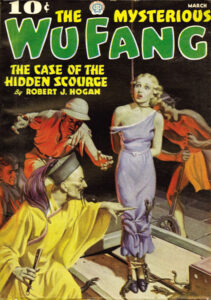 To begin PulpFest‘s celebration of the 100th anniversary of Sax Rohmer’s infamous creation, Rick Lai looks at “The Pulp Descendants of Fu Manchu,” beginning at 8 PM on Thursday, July 25, in the Fairfield Room located on the second floor of the Hyatt Regency Columbus. Rick will discuss the influence of Sax Rohmer’s devil doctor on the pulps with a look at villains such as Wu Fang, Shiwan Khan, The Blue Scorpion from Peter the Brazen, and Robert E. Howard’s Skullface and Erlik Khan.
Best known for his articles expanding on Philip José Farmer’s Wold Newton Universe concepts, recently collected by Altus Press as Rick Lai’s Secret Histories: Daring Adventurers, Rick Lai’s Secret Histories: Criminal Masterminds, Chronology of Shadows: A Timeline of The Shadow’s Exploits and The Revised Complete Chronology of Bronze, Rick Lai lives in New York. His short fiction has been collected in Shadows of the Opera (Wild Cat Books, 2011) and two upcoming Black Coat Press collections to be printed this year – Shadows of the Opera: Retribution in Blood and Sisters of the Shadows: The Cagliostro Curse.
Pictured above is Jerome Rozen’s menacing cover art for the March 1936 issue of Popular Publications’ The Mysterious Wu Fang.
From Pulp Page to Silver Screen
June 19, 2013 – Blood ‘n’ Thunder editor Ed Hulse explores the pulp-to-movie connection in his PulpFest presentation “Hollywood and the Hero Pulps,” one of several pre-convention programs scheduled for Thursday, July 25, at 9 PM.
Motion-picture incarnations of pulp magazine protagonists date back to the medium’s earliest days. Moviegoers of the nickelodeon era —the pre-World War I years — were treated to cinematic adaptations of Short Stories’ Hamilton Cleek and The Popular Magazine’s Terrence O’Rourke, among others. Tom Mix became the industry’s top Western star thanks to his 1920 portrayal of Max Brand’s Whistlin’ Dan Barry. Master detective Nick Carter, who successfully made the transition from dime novel to pulp magazine, appeared on screens both in the U.S. and overseas in several sets of short subjects produced between 1908 and 1927.
With the rise of talkies and Hollywood’s emergence as the world’s filmmaking capital, pulp fiction became an even more frequent source of story material. Hundreds of movies released during the Thirties, Forties and Fifties — feature films and short subjects alike — were made from yarns originally printed in rough-paper periodicals.
 As Blood ‘n’ Thunder readers know, Ed is the leading authority on pulp-related movies, having researched and written about them for decades. His PulpFest presentation will cover many, but focus on those adapted from hero pulps, with special emphasis on serials such as The Spider’s Web (1938), The Shadow (1940), and The Spider Returns (1941). He’ll present little-known, behind-the-scenes info gleaned in part from his own interviews with people who worked on these episodic epics, including Victor Jory (who played the serial Shadow) and Iris Meredith (who played Nita in The Spider’s Web). Ed will address the rumor that Columbia Pictures planned a G-8 and His Battle Aces serial for a 1939 release, and he’ll also report what little is known about the proposed Republic chapter plays featuring Doc Savage and Nick Carter.
This program, leading into the screening of Chapters One through Five of The Spider’s Web, promises to get PulpFest’s 2013 hero-pulp tribute off to a fascinating start.
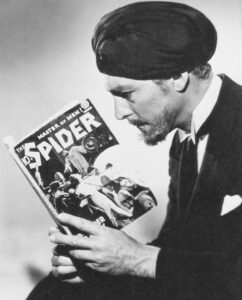
Kenneth Duncan as Ram Singh reads an issue of The Spider in this publicity photo for the 1938 Columbia Pictures movie serial, The Spider’s Web.
The Spider’s Web
June 21, 2013 – Beginning at 10 PM on Thursday, July 25, PulpFest 2013 will present the fifteen-chapter Columbia Pictures movie serial, The Spider’s Web.
Released in 1938 and starring Warren Hull as Richard Wentworth, the “Master of Men,” and Iris Meredith as his beloved Nita Van Sloan, The Spider’s Web is now considered one of the greatest chapter plays ever filmed. PulpFest will show the serial in its entirety over three nights.
Columbia Pictures released its first cliffhanger serial in 1937. Jungle Menace and its immediate successors, The Mysterious Pilot (1937) and The Secret of Treasure Island (1938), were independently produced by the Weiss brothers, Poverty Row denizens with roots in the motion-picture industry going back to the early silent-movie days. Their serials were competent but cheaply made and uninspiring. Columbia executive Irving Briskin surmised that to capture a significant share of the chapter-play market, the company would have to make serials in-house and invest them with more “production value” than the Weiss brothers could provide on their shoestring budgets.
Briskin began negotiating for screen rights to popular characters from other media. Soon, he secured The Spider from Popular Publications. He then assigned the property to newly hired producer Jack Fier, lured to Columbia from Republic Pictures, then turning out the industry’s finest serials and grade-B Westerns. Granted a generous budget (more than twice what the Weiss brothers spent on their chapter plays), Fier took on the daunting task of bringing one of pulpdom’s most popular heroes to the screen—and, by extension, establishing Columbia as a formidable competitor in the arena of episodic epics.
As serial historian Ed Hulse will explain in his PulpFest presentation on movie adaptations of hero pulps, Fier’s first chapter play went into production as The Spider — Master of Men. Thanks to careful writing (with editorial input from Norvell Page, chronicler of the Spider’s pulp-magazine adventures), this Columbia serial maintained an unusually high degree of fidelity to its source material. Jack Fier’s attention to detail and relatively liberal expenditure of money paid off, and after some last-minute tinkering (the result of Production Code administrators complaining to Columbia about the serial’s high body count), the newly retitled The Spider’s Web went into release in late October of 1938, eliciting mostly favorable reviews and generating more box-office revenue than the previous two Weiss serials combined.
Never commercially released on home video, The Spider’s Web has nonetheless been available for many years in “grey market” editions of varying quality. PulpFest has obtained the best version currently in circulation and will offer all 15 high-octane chapters to convention attendees in five-episode increments spread out over three nights.
To learn more about this great movie serial and its sequel, please visit The Spider Returns website. You’ll find a link to the “serials” section in the site’s menu.
The Sheriff of Buzzard Gap
June 23, 2013 – When the powers at Street & Smith saw what a gold mine they had in The Shadow Magazine, they began planning a raft of companion titles, selecting four top pulp genres as their themes: adventure, detective, aviation, and western. The publisher covered the first two by releasing Doc Savage Magazine and Nick Carter Magazine early in 1933. Their aviation title, Bill Barnes, Air Adventurer, was held back until the beginning of the next year. But as soon as circulation figures showed the new single-character titles were winners, Street & Smith launched its western hero pulp, Pete Rice Magazine. Its first issue was dated November 1933.
Street & Smith Publications, Inc., the oldest and foremost fiction-publishing house in America, take pleasure in presenting this first issue of Pete Rice Magazine to their discriminating readers. It is not “just another magazine,” but a publication which has been a long time in developing, and one which is aimed at the new, modern trend of public taste.
In this magazine you will feel the real pulse of the great West as it actually exists. The scenes and action will be familiar to all those who know of the West, and will be instructive to those who do not. The characters will live and breathe through these pages as no others have, and they will give you more entertainment than you have ever deemed possible from fiction before.
 “Pistol Pete” Rice was the sheriff of Buzzard Gap, Arizona, a clean-living, non-swearing, alcohol-avoiding paragon of frontier virtues and terror to outlaws who still lived with his mother. He was backed by two trusty deputies: 300-pound giant William Alamo Butler, better known as “Teeny,” and the town’s combination barber and medico, Lawrence Michael Hicks, colloquially known as “Misery.” Pete rode a sorrel horse named Sonny and was sometimes accompanied by a dog called Vulcan.
This hard-riding trio operated in the never-never land of the “Pulp West,” a vague, undated era in the magazine’s early issues. As the series progressed, the stories took on the quaint qualities of a 1930s Hollywood western film, where the sheriff and his posse would start out in an automobile and switch to horseback when the terrain got too rocky for rubber. In one story, Pistol Pete hopped a plane to Chicago to get his man. Unfortunately, by trying to have the West both ways, the magazine had a short lifespan. It folded in 1936 after just 32 issues.
Ben Conlon wrote all the Pete Rice novels as Austin Gridley. Afterward, Conlon took the series to Wild West Weekly, where Pete encountered other Street & Smith buckaroos such as Sonny Tabor. Eventually, Pete’s creator was replaced by other writers hidden by the Gridley house name. The series finally petered out in 1939 after some fifty adventures — not counting a short-lived radio program. Fans best remember Pete Rice Magazine because it shared cover artists with Doc Savage. Walter M. Baumhofer painted the cover art for both series until Robert G. Harris took them off his hands in time for Pete Rice‘s finale.
Although Pete Rice Magazine ran for less than three years, it paved the way for other western character pulps, beginning with Ranger Publications’ The Masked Rider Western Magazine in spring 1934 and, later that same year, Popular Publications’ Mavericks. The longest-lived western pulp hero, Jim Hatfield, would debut in the October 1936 issue of Texas Rangers. Standard Publications’ “Lone Wolf” hero would ride the range for 206 issues, heading into the sunset with its February 1958 number. Among the hero pulps, only The Shadow Magazine appeared more often.
Pistol Pete was the last of the pulp heroes of 1933 — seven in all. From July 25 – 28, join PulpFest in Columbus, Ohio, as we celebrate these characters who had “nothing to fear but fear itself” during those dark days of the Great Depression when the great pulp heroes were born.
The great Walter M. Baumhofer contributed the cover art for the first issue of Pete Rice Magazine, pictured above.
The Black Bat – The Forgotten Hero?
June 24, 2013 – An eighth single-character pulp debuted in 1933. Black Bat Detective Mysteries began with its October 1933 number, and ran for six issues, ending in the spring of 1934. The magazine’s lead novels featured a character called The Black Bat (not to be confused with The Black Bat that later appeared in Standard’s Black Book Detective Magazine.
Created by Murray Leinster, The Black Bat, whose real name was never revealed, was an omniscient amateur detective who worked closely with the police. The character was more of a defective detective than a pulp hero. Although Black Bat Detective Mysteries was technically a single-character magazine, it more closely resembled a detective pulp. Published by a small outfit out of New York City, Berryman Press, and given its limited run, the magazine had little impact on the pulp market.
Philip José Farmer’s Doc Savage
June 25, 2013 – Since 2011, PulpFest has hosted FarmerCon, a convention within a convention. FarmerCon began in Peoria, Illinois, the hometown of Grand Master of Science Fiction Philip José Farmer. Originally a gathering of Farmer fans figuratively, and literally, right outside Phil’s back door, FarmerCon offered presentations, dinners, and even picnics at the author’s house.
After Phil and Bette Farmer passed away in 2009, the organizers decided to take FarmerCon on the road to broaden its horizons. By holding the convention alongside events like PulpFest, Farmer fans get a variety of programming and a room full of pulp and book dealers to enjoy. This year, PulpFest is pleased to welcome FarmerCon once again to the Hyatt Regency Columbus for its 8th convention.
As it has every year since 2011, FarmerCon will provide some of PulpFest’s evening programming. On Friday, July 26, at 7:30 PM, our FarmerCon friends turn their attention toward the Grand Master‘s work related to Doc Savage with a panel entitled His Apocalyptic Life, Escape from Loki, and The Mad Goblin.
The earliest of the three works, The Mad Goblin, was first published in 1970, paired with The Lord of the Trees as half of an Ace Double. Both novels were sequels to an earlier work, A Feast Unknown, that introduced Lord Grandrith, a thinly disguised Tarzan, and a “man of bronze” known as Doc Caliban. In Feast, Grandrith and Caliban learn that a powerful secret society known as The Nine has manipulated their lives. The two heroes go to war against their tormentors. The Mad Goblin tells the story from Doc Caliban’s point of view, while The Lord of the Trees presents Lord Grandrith’s version.
 Although he published over fifty novels and 100 short stories during his career, Philip José Farmer is best remembered for his Wold Newton Family. According to the author, the radiation from a meteorite that landed near the village of Wold Newton caused mutations in the villagers’ descendants, making them smarter, stronger, and more driven than most. Included among the offspring were Lord Greystoke, Sherlock Holmes, Sam Spade, Fu Manchu, and Dr. James Clarke Wildman, Jr., best known as Doc Savage. Much of Doc Savage: His Apocalyptic Life, first published by Doubleday in 1973, focuses on this idea.
Farmer’s final “work of bronze” was Escape from Loki, published by Bantam Books in 1991. Shot down behind enemy lines during World War I, sixteen-year-old Clark Savage, Jr. finds himself in a German baron’s notorious escape-proof prison. There, Doc and his future aides come together to match wits and derring-do against the sinister baron, whom Doc believes intends to wield a weapon of mass destruction that could mean the end of freedom and victory for the Kaiser.
Moderator Art Sippo, author of Sun Koh: Heir of Atlantis, a 2010 Pulp Factory Award nominee for Best Pulp Novel, and his panelists will dissect and analyze the Grand Master‘s contributions to the Doc Savage mythos. Joining Art will be Christopher Paul Carey, the co-author with Philip José Farmer of Gods of Opar: Tales of Lost Khokarsa, and the author of Exiles of Kho, a prelude to the Khokarsa series; Rick Lai, well known for his articles expanding on Farmer’s Wold Newton Universe concepts, recently collected into four volumes by Altus Press; Win Scott Eckert, the co-author with Philip José Farmer of The Evil in Pemberley House, and the author of its forthcoming sequel, The Scarlet Jaguar, featuring Doc Wildman’s daughter Pat; and John Allen Small, an award-winning journalist, columnist, and fiction writer whose work includes “The Bright Heart of Eternity,” a tribute to Edgar Rice Burroughs and Philip José Farmer, and “Into Time’s Abyss,” anthologized in The Worlds Of Philip José Farmer 2: Of Dust And Souls.
Meteor House will be premiering a new, expanded edition of Doc Savage: His Apocalyptic Life at PulpFest 2013. Featuring dust jacket art by Joe DeVito (pictured above) and essays by Win Scott Eckert, John Allen Small, Keith Howell, Rick Lai, Art Sippo, Christopher Paul Carey, and current Doc Savage writer Will Murray, it will be available as a deluxe hardcover. Altus Press will be publishing the softcover edition. It will be available at PulpFest through Mike Chomko, Books.
Doc Savage & the Pulp Heroes of 1933
June 28, 2013 – Eighty years ago, following the astounding success of The Shadow Magazine, the pulp industry created a tremendous splash in publishing by releasing a wave of single-character magazines. The Phantom Detective, Nick Carter Magazine, Doc Savage Magazine, The Lone Eagle, G-8 and His Battle Aces, The Spider, and Pete Rice Magazine all debuted in 1933, despite the economic hardships of the Great Depression.
Street & Smith Publishing introduced The Shadow Magazine to readers in early 1931. With author Walter B. Gibson’s talents, the magazine proved an instant hit. Planned as a quarterly, this first “hero” pulp became a monthly after just two issues. A year later, The Shadow Magazine became a semi-monthly, appearing twice each month until early 1943.
By 1932, Street & Smith was planning other single-character pulps, hoping to emulate the high-flying Shadow Magazine. Other publishing houses also noticed the strong sales experienced by Gibson’s “Dark Avenger.” As Henry Steeger of Popular Publications stated: “At this point in pulp history, individual titles became very popular, so we decided to try out a few.” And so began what we now call, “The Hero Pulp Explosion of 1933.”
On Friday, July 26, at 8:30 PM in the Fairfield Room of the Hyatt Regency Columbus, Ed Hulse, editor and publisher of Blood ‘n’ Thunder, and a panel of pulp historians will take a look at “Doc Savage and the Pulp Heroes of 1933.”
Joining Ed will be Nick Carr, one of the elders of the pulp community, who actually read The Spider and other pulps fresh off the newsstand, and has written countless articles about pulp heroes both known and little known; Don Hutchison, who also had the opportunity to buy pulps at a news agency and has likewise written many articles on the history of the pulps as well as the Stoker Award nominee, The Great Pulp Heroes (a “must-read” book for fans of the hero pulps); a child of the sixties when he first discovered “The Man of Bronze” and now today’s “Kenneth Robeson,” Will Murray, yet another author of numerous books and articles concerning the pulps; and Garyn Roberts, professor of English and popular culture studies and unabashed pulp fan and editor of some of the best collections from the pulps including The Compleat Adventures of the Moon Man, The Magical Mysteries of Don Diavolo, and other titles. This quartet of pulp experts will join Ed to discuss the causes and effects of the “Hero Pulp Explosion of 1933.”
Walter Baumhofer: King of the Pulps
July 1, 2013 – Who was the “King of the Pulps?” Some say it was H. Bedford Jones, while others claim the title for Frederick Faust, better known as Max Brand. But to the young readers who devoured the pulp magazines and “delighted in his four-color depictions of action and adventure,” the one and only “King of the Pulps” was Walter M. Baumhofer.
 When an injury at age fourteen left him unable to do manual labor, Baumhofer began to study art intently. A scholarship let him attend the prestigious Pratt Institute, where he studied under Dean Cornwell and H. Winfield Scott. While still a student, he began his art career drawing pen-and-ink story illustrations for Adventure Magazine. By 1926, he was contributing covers to Clayton Publications and, soon thereafter, to Harold Hersey’s line of pulps. Street & Smith signed him to a contract in 1932 to paint a cover each week for their pulps. Around the same time, he was sought out by Popular Publications to provide cover art for their line of magazines, and so began his reign as the “King of the Pulps.”
Baumhofer worked in the pulp market for just over a decade, painting about 550 covers for a wide variety of titles, including Ace High, Adventure, Detective Tales, Dime Mystery Magazine, Doc Savage, Fire Fighters, Gangland Stories, The Spider, Spy Stories, Western Story Magazine, and others. He moved into the slick market and advertising art in the late thirties, contributing work to American Weekly, Collier’s, Cosmopolitan, Esquire, Redbook, Women’s Day, and other magazines. In later years, his paintings graced the covers of Argosy, Outdoor Life, and Sports Afield, and his portrait, landscape, and Western art were exhibited in fine art galleries nationwide.
At 9:30 PM on Friday, July 26, David Saunders will present a biographical profile of Walter Baumhofer’s life and the artist’s fascinating family history. He will exhibit never-before-seen visual documents from the personal world of this pulp art master. Walter was a close friend of the presenter’s father, Norman Saunders, and as such David was personally acquainted with the artist for over thirty years. Baumhofer was a sensationally colorful character, and David Saunders looks forward to sharing many amusing anecdotes and incidents that will help to promote a greater awareness of this legendary artist.
Walter M. Baumhofer contributed the front cover art to the August 15, 1935 Adventure, pictured above.
Dr. Fu Manchu & the Yellow Peril
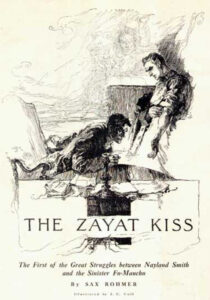 July 6, 2013 – One hundred years ago, Sax Rohmer’s Fu Manchu made his American debut in Collier’s, a five-cent weekly. “The Zayat Kiss” ran in the February 15, 1913 number. Nine more stories featuring Rohmer’s “devil doctor” would appear in Collier’s through June 28, 1913. In September of that year, McBride would release The Insidious Dr. Fu-Manchu, collecting all ten tales into novel form.
Although Sax Rohmer did not create the “yellow peril” genre of pulp fiction, his Fu Manchu stories would greatly influence the bloody pulps. From writers as diverse as Dashiell Hammett, Carroll John Daly, Walter B. Gibson, Norvell W. Page, Arthur J. Burks, Philip Nowlan, H. P. Lovecraft, and Robert E. Howard, pulpsters delivered many a story inspired by Rohmer’s evil genius. Even Robert J. Hogan’s flying spy, G-8, battled oriental evildoers in the author’s fantasy version of the First World War.
At 8 PM on Saturday, July 27, PulpFest will salute the American centennial of Dr. Fu Manchu with a panel exploring Sax Rohmer’s character and his influence on early-twentieth-century pulp fiction. Moderated by Blood ‘n’ Thunder editor and publisher, Ed Hulse, the panel will consist of pop culture experts Gene Christie, editor of three collections of Rohmer’s fiction and a leading authority on early American science fiction and fantasy; Win Scott Eckert, known for his work on literary crossovers and chronologies, including Marvel Comics’ Shang-Chi: Master of Kung Fu, a classic series concerning the son of Dr. Fu Manchu; Nathan Madison, author of Anti-Foreign Imagery in American Pulps and Comics, 1920-1960; William Patrick Maynard, authorized by the literary estate of Sax Rohmer to continue the Fu Manchu series; and Will Murray, author of the Wild Adventures of Doc Savage and one of the world’s leading authorities on the pulp era.
Pictured above is Joseph Clement Coll’s illustration for the first Fu Manchu story published in the United, “The Zayat’s Kiss.” The picture originally appeared in the February 15, 1913 issue of Collier’s. The image is courtesy of The Page of Fu Manchu, an ongoing effort by scholars and readers around the world to create a definitive Sax Rohmer bibliography, reference and archive.
Hero Pulp Premiums and Promotions
July 9, 2013 – How did pulp magazine publishers keep readers coming back month after month? Of course the best way was to publish excellent stories. Regardless of genre, the leading pulps attempted to do just that, issue after issue.
Another method that publishers employed to lure dimes on a regular basis from buyers with thin wallets was to create a club and offer premiums. For a few cents or by clipping coupons from a favorite pulp magazine, a devoted fan could become a member in good standing of the Doc Savage Club, one of the Friends of the Phantom, or Adventure Magazine’s Camp-Fire Club. Rings, pins, and other items were also available, such as the Spider Pencil, a celluloid mechanical pencil with a rubber eraser bearing The Spider seal, produced in very limited quantity during 1941-42.
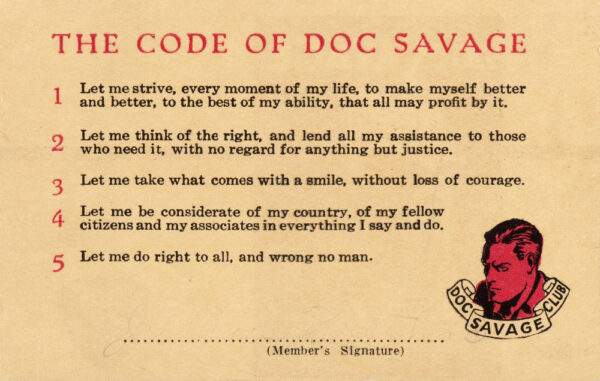
On Saturday, July 27, at 9 PM, please join PulpFest website designer Chris Kalb in the Fairfield Room located on the second floor of the Hyatt Regency Columbus as he takes us back to a time when a few cents not only bought a pulp magazine filled with thrills, but also an Operator #5 ring, a G-8 Battle Aces Club pin, or a membership in the Green Lama Club. Chris will present “Hero Pulp Premiums and Promotions,” an event you cannot afford to miss. It won’t cost you a dime more than your convention membership.
For more pulp premiums, visit Pulpster editor Bill Lampkin’s The Pulp.Net website and search for “premiums.” Bill has photographs of rings, membership cards, pins, and other items on his highly informative website.
Picture above is the Doc Savage Club card, Street & Smith, c. 1930s.
Tonik Auction Continues!
July 12, 2013 – One of the many highlights of PulpFest is its Saturday night auction. Organized by J. Barry Traylor and a gaggle of enthusiastic volunteers, the auction is always the final programming event of summer’s great pulp con. Any registered convention member may submit items for auction as long as they meet PulpFest’s guidelines.
PulpFest is very proud that this year’s auction will include 115 lots made up of approximately 250 books from collector and scholar Al Tonik’s huge library of hardcovers, paperbacks, pulps, dime novels, comic books, fanzines, and reference books. At its 2012 convention, PulpFest sold about seventy percent of the Tonik collection, with more than $15,000 in bids on a wide range of items. The remaining lots are hard-to-find reference books and author biographies. Over many years, Albert Tonik was a leading scholar of pulp history. The winner of the 1994 Lamont Award, Al researched aspects of pulp history previously covered sketchily and loved sharing his knowledge with our community.
In addition to the Tonik material, PulpFest will accept about 100 lots from registered PulpFest 2013 members. However, because of the substantial number of Tonik lots, we may limit the number of lots each consignee can offer.
PulpFest‘s annual Saturday night auction will start at approximately 9:30 PM on July 27, following the conclusion of Chris Kalb’s presentation, “Hero Pulp Premiums and Promotions. “Remember to bring your convention badge. Your badge number will be used when buying and/or selling during the auction. Our auctioneers will be Adventure House‘s John Gunnison and Joseph Saine, a full-time proprietor of an antique toy shop and licensed auctioneer from northwest Ohio.
New Fictioneer Van Allen Plexico
July 14, 2013 – Van Allen Plexico is the award-winning and Amazon.com bestselling author of ten novels and nearly two dozen short stories and novellas, as well as five non-fiction books. His works have included everything from Sherlock Holmes to space opera to 1930s air ace combat to Marvel’s Avengers. However, he is best known for his ongoing superhero pulp novel series, Sentinels.
A three-time nominee for Pulp Writer of the Year at PulpArk and a founding editor of the All Pulp news site, he has been published by Airship 27, Pro Se Productions, White Rocket Books, Permuted Press, Red Bud Studios, Maple Street Press, and Rittenhouse Archives, among others. He also hosts the weekly pop culture and New Pulp discussion show, The White Rocket Podcast. In his spare time, Van is an Assistant Professor of History and Political Science at Southwestern Illinois College. You can find links to all of his stuff at www.plexico.net.
Join New Fictioneer Van Allen Plexico on Friday, July 26, at 2 PM in the Hyatt Regency’s Fairfield Room where he will be reading “River of Deceit,” from the anthology Monster Aces, and a selection from Lords of Fire, the first novel in a new military science fiction/space opera series entitled The Shattering.
One Week Left to Go!
July 18, 2013 – PulpFest 2013 starts Thursday, July 25. The dealers’ room will be open only to registered sellers to set up their displays from 4 PM to 11 PM. Ohio State’s Thompson Library will also offer a free lecture on the pulps at 5 PM. Early registration for all convention attendees will take place outside the dealers’ room from 6 PM to 8 PM. Beginning at 8 PM, a full slate of programming will get underway.
Thursday, July 25
4:00 PM – 11:00 PM – Dealer Set-Up – the dealers’ room will be open only to dealers to assemble their displays
4:30 PM – Ohio State Lecture Series – Ed Hulse, the editor of Blood ‘n’ Thunder, examines “The Ancestors of Batman: Colorful Crime Fighters of Pulp Fiction” at Ohio State’s Thompson Library
6:00 PM – 8:00 PM – Early Registration – general members and dealers will be able to register for PulpFest
Evening Programming
8:00 PM – The Pulp Descendents of Fu Manchu – Rick Lai discusses the influence of Sax Rohmer’s devil doctor on the pulps with a look at villains such as Wu Fang, Shiwan Khan, the Blue Scorpion, and Robert E. Howard’s Skull Face and Erlik Khan
9:00 PM – Hollywood and the Hero Pulps – Blood ‘n’ Thunder editor Ed Hulse looks at The Spider’s Web, Columbia Pictures’ classic chapterplay, and Hollywood’s other attempts to bring the pulps to the silver screen
10:00 PM – The Spider’s Web – Chapters 1 – 5 of the 1938 Columbia Pictures movie serial starring Warren Hull as “The Master of Men” and Iris Meredith as his beloved, Nita Van Sloan
Friday, July 26
9:00 AM – 5 PM – Wheeling and Dealing – the dealers’ room will be open to all
1:00 PM – The New Fictioneers – William Patrick Maynard reads from his forthcoming novel, The Triumph of Fu Manchu
2:00 PM – The New Fictioneers – Van Allen Plexico has more than two dozen books under his belt. One of the leading figures of “New Pulp,” he will be reading from Lords of Fire and “River of Deceit” from Monster Aces
3:00 PM – The New Fictioneers – FarmerCon panelists Win Scott Eckert and John Small offer a variety pack of fiction including John’s tribute to Edgar Rice Burroughs and Philip José Farmer, “The Bright Heart of Eternity”
Evening Programming
7:25 PM – Welcome to PulpFest – Jack Cullers offers an official welcome
7:30 PM – The Mad Goblin, Escape from Loki, and His Apocalyptic Life – Art Sippo leads a discussion of Philip José Farmer’s contributions to the Doc Savage mythos. Panelists include Christopher Paul Carey, Win Scott Eckert, Rick Lai, and John Allen Small
8:30 PM – Doc Savage and the Pulp Heroes of 1933 – Nick Carr, Don Hutchison, Will Murray, and Garyn Roberts join Blood ‘n’ Thunder editor Ed Hulse to discuss eighty years of “The Great Pulp Heroes”
9:30 PM – Walter Baumhofer: King of the Pulps – pulp art historian David Saunders looks at the life and work of the artist who brought The Man of Bronze, The Master of Men, Pete Rice, and other pulp heroes to life
10:30 PM – The Spider’s Web – Chapters 6 – 10 of the 1938 Columbia Pictures serial in which The Spider battles The Octopus, a criminal mastermind bent on crippling the nation through a wave of terror
Saturday, July 27
9:00 AM – 5 PM – Wheeling and Dealing – the dealers’ room will be open to all
1:00 PM – The Future of New Pulp Fiction – moderator Ron Fortier is joined by five new writers inspired by the pulp fiction of yore – Jim Beard, Win Scott Eckert, Rick Lai, Frank Schildiner, and Art Sippo
2:00 PM – Doc and the King – Radio Archives’ Roger Price will be reading from Will Murray’s Skull Island, recently released as an audiobook. Both Will and Roger will be available for questions following the reading
3:00 PM – The New Fictioneers – Jim Beard, a columnist for the Toledo Free Press and a freelance writer, will read from Captain Action: Riddle of the Glowing Men, Monster Earth, and Sgt. Janus: Spirit-Breaker
Evening Programming
7:30 PM – PulpFest 2013 Business Meeting – all members are invited to ask questions and offer suggestions at this session
7:50 PM – 2013 Munsey Award Presentation – Matt Moring of Altus Press will present this year’s Munsey Award
8:00 PM – Fu Manchu and the Yellow Peril Pulps – Blood ‘n’ Thunder editor Ed Hulse is joined by Gene Christie, Win Scott Eckert, Nathan Madison, William Patrick Maynard, and Will Murray for a discussion of Sax Rohmer’s infamous creation and the character’s influence on the pulps and popular culture
9:00 PM – Hero Pulp Premiums and Promotions – Chris Kalb takes us back to a time when a dime not only bought a pulp magazine filled with thrills, but also a Spider Ring or a membership to Friends of the Phantom
9:30 PM – Saturday Night at the Auction – auctioneers John Gunnison and Joseph Saine complete the sale of pulp researcher Albert Tonik’s substantial collection, plus various lots from the convention’s regular consigners
11:30 PM – The Spider’s Web – Chapters 11 – 15 of the 1938 Columbia Pictures serial directed by James W. Horne and Ray Taylor in which The Spider unmasks the nefarious Octopus and wins the day for the good old USA
Sunday, July 28
9:00 AM – 2 PM – Wheeling and Dealing – the dealers’ room will be open to all
The Great Pulp Heroes
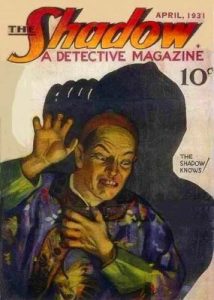 July 23, 2013 – The first pulp dedicated to a single character was The Shadow: A Detective Magazine, its initial issue dated April 1931. Following its astounding success, the leading pulp magazine publishers launched seven new titles in 1933 — The Phantom Detective, Nick Carter, Doc Savage, The Lone Eagle, G-8 and His Battle Aces, The Spider, and Pete Rice Magazine — what we now call the “hero pulp explosion of 1933.” These eight titles would, by and large, serve as the foundation for more than fifty titles released over nearly two decades. Although most of the single-character magazines that followed that initial burst of 1933 had relatively short lives, they helped to keep afloat an industry that was dying.
Stories of Sheena, Queen of the Jungle, published by Fiction House in the spring of 1951, was the last single-character magazine to reach the reading public. Within a few years of Sheena’s sole appearance in her own rough-paper title, the entire pulp magazine industry would be gone, the victim of changing public tastes. But for many of us who love the pulps, the hero titles introduced us to pulp collecting and helped keep alive the memory of the great pulp era.
From July 25 – 28, please join PulpFest 2013 at the Hyatt Regency in downtown Columbus, Ohio as we celebrate “80 Years of Doc Savage and the Hero Pulp Explosion of 1933.” You’ll find additional details by scrolling through this post.
Modest Stein was the cover artist for the April 1931 issue of The Shadow, A Detective Magazine. Street & Smith had previously used the artwork as the cover of the October 1, 1919 issue of The Thrill Book.
Why PulpFest?
by Walker Martin
July 23, 2013 – Readers and Collectors! We are down to the final minutes now. It’s time to separate the non-collectors from the collectors. Yes, it’s that time of year again. Pulpfest 2013 begins this Thursday, July 25, and continues through Sunday, July 28 in Columbus, Ohio. The complete details are at pulpcon.com.
Will you be one of the millions of poor souls that do NOT attend PulpFest? Or will you be among the elite of old magazine collectors, those that DO attend? I’m talking about the 400 or so pulp, digest, paperback, book, and original art collectors who will be swarming to the pulp collecting center of the universe. In April it was Chicago for Windy City, and now in July, it is Columbus, Ohio.
I’ve heard all the reasons for not attending this pulp convention, and there is no acceptable excuse! Illness? Hell, I knew a collector who attended knowing he had a terminal illness and would be dead in a few months. I once attended with a busted back, wrapped up like a mummy, not able to sit down for the entire convention. Every 40 minutes I had to stop the car and get out to stretch and walk around. For awhile I was almost positive that I wasn’t going to make it and I started stopping near hotels in case I had to give up and just lay in a bed for a couple weeks.
But the thought of my collection kept me going. The visions of more SF magazines, more detective and adventure pulps, more westerns. The artwork, the original cover paintings, the interior illustrations. The stacks of digest magazines, the vintage paperbacks. The friends and old pals that I enjoyed talking to and seeing once again. Some of the best friendships in my life are now stretching beyond the 40-year mark. I just had lunch with a collector that I’ve know since 1970 and we talked about books for 3 hours straight. How could I not attend the pulp convention? When I returned home, I took 4 weeks off from work to recuperate from my back problems. Let’s face it, our collections are more important than some job that just pays the bills.
Speaking of money, I’ve heard the excuse about not having the cash to attend the convention. I never let this stop me. Sometimes I borrowed the money from the bank or the credit union. I even borrowed money from my wife. You know you have to be desperate to ask for help from a non-collector! I’ve used my credit cards, pension money, money set aside for bills. I mean we are talking about a serious addiction here!
To be a serious book or old magazine collector, is a calling of the highest order. You are not just some wage slave like the other millions of non-collectors. No, you are a Collector with a capital C. You don’t just eat, work, watch TV, and sleep. And then repeat it day after day like most poor bastards. YOU READ! You Collect valuable and rare artifacts.
In this era of electronic gadgets, you actually collect non-electronic books and pulps. I mean how cool is that? No computer geek can stand up to that. E-books look pitiful next to a beautiful real, hard-copy book. You can’t collect E-books like pulps. A stack of pulps is a thing of beauty. The smell, the look, the feel. And they are worth money!
I’ve tried many addictions and they can’t compare to collecting books and pulps. Drugs, alcohol, gambling, all can destroy your health and finances. I won’t even get into sex. Sexual habits can ruin you just like any addiction or at the very least, you will find yourself married to a non-collector!
So there is still time to say to hell with your job and personal responsibilities. Your family can do without you for a few days. Your book addiction needs to be fed. Your Collection must be extended and made larger. You need more books!
PulpFest awaits …
From July 24 – 27, 2013 are several reports about traveling to PulpFest 2013 and what awaits you day-by-day. It culminates in the following report:
And the Winner Is . . .
 July 27, 2013 – Garyn G. Roberts has been named the winner of the 2013 Munsey Award. Nominated by the general pulp community, Garyn was selected by a vote of all living Lamont, Munsey, and Rusty Award winners. The award is a fine art print by Dan Zimmer of a painting by David Saunders, presented annually to someone who has worked for the betterment of the pulp community.
Garyn has worked in higher education for many years, teaching English and popular culture studies. He is also an unabashed fan of the pulps. Garyn has written extensively about the pulps, both professionally and as a fan. He has edited or co-edited some of the best collections from the pulps, including A Cent a Story: The Best from Ten Detective Aces, More Tales of the Defective Detective in the Pulps, The Compleat Adventures of the Moon Man, The Magical Mysteries of Don Diavolo, and The Compleat Great Merlini Saga. His insightful essays in these books and elsewhere have deepened understanding of the pulps both inside and outside the pulp community. His anthology, The Prentice Hall Anthology of Science Fiction and Fantasy, a college-level textbook, is notable for its attention to pulp magazines. Additionally, Garyn has helped other researchers with various pulp-related projects and regularly attends pulp conventions, where he often serves as a presenter and panelist. Last year’s Munsey Award winner, Matt Moring, publisher of Altus Press, recently said about Garyn: “He’s been nothing but helpful and outgoing with anything I’ve ever asked of him.” That pretty much describes how Professor Roberts responds to all the requests the pulp community makes of him.
Other nominees for this year’s award included Charles Ardai, J. Randolph Cox, Stephen T. Miller, Laurie Powers, J. Barry Traylor, George Vanderburgh, Dan Zimmer, William G. Contento, Chris Kalb, Phil Stephensen-Payne, Celina Summers, and Howard Wright. John DeWalt also received votes.
Many Thanks
Aug. 1, 2013 – Year after year, countless individuals and organizations help make PulpFest an enjoyable experience for those who choose to attend “Summer’s Great Pulp Con.” The PulpFest Organizing Committee thanks the following people and organizations for their invaluable assistance in making PulpFest 2013 a wonderful weekend. We could not have done it without you:
Our all-volunteer front desk staff: Maura Childers, Sam Childers, Aaron Cullers, Jack Cullers, Sally Cullers, Samantha Cullers, and Tess Massey; our panelists, presenters, and auctioneers: Jim Beard, Christopher Paul Carey, Nick Carr, Gene Christie, Win Scott Eckert, Ron Fortier, John Gunnison, Ed Hulse, Don Hutchison, Chris Kalb, Rick Lai, Nathan Madison, William Patrick Maynard, Matt Moring, Will Murray, Van Allen Plexico, Roger Price, Garyn Roberts, Joseph Saine, David Saunders, Frank Schildiner, Art Sippo, and John Allen Small; our behind-the-scenes help: Mike Chomko, Mike Croteau of FarmerCon, Ohio State’s Eric Johnson, Chris Kalb, Lohr McKinstry, Rick and Renee Thomas, Barry Traylor, Chuck Welch, Dan Zimmer, and the staff of the Hyatt Regency Columbus.
The Organizing Committee would also like to thank the people who helped to create The Pulpster #22: editor and designer Bill Lampkin and proofreader Peter Chomko, plus contributors Michael Chomko, Tony Davis, Monte Herridge, Tom Johnson, John Locke, Nathan Vernon Madison, William Patrick Maynard, Vella Munn, Will Murray, Laurie Powers, William Preston, David Rajchel, George Vanderburgh; the magazine’s sponsors: Baen Books, The Comic Book Shop in Spokane, Washington, Doug Frizzle, Richard Halegua, Heartwood Auctions, Larry Latham and Lovecraft is Missing, Murania Press, Pro Se Productions, The Pulp Factory, Radio Archives (who also provided the door prizes for PulpFest 2013), Stark House Press, Alfred R. Taylor, Titan Books, and Weird Tales.
Many thanks as well to the nominators and the Lamont Award, Munsey Award, and Rusty Hevelin Service Award winners who helped select this year’s Munsey winner, Garyn G. Roberts. Congratulations to Garyn and to all of the nominees for our 2013 awards.
Again, we’d like to thank the following organizations for the books and similar items that were donated to PulpFest for distribution to our members: John Huckans and Book Source Magazine, Engle Publishing and The Paper & Advertising Collectors’ Marketplace, the Estate of Rusty Hevelin, Gordon Van Gelder and The Magazine of Fantasy & Science Fiction, Tom Brown and Radio Archives, Greg Shepard and Stark House Press, and Charles F. Millhouse and Stormgate Publishing.
Finally, thanks to all of the conventions, book and paper fairs, bookstores, comic and collectible shops, websites, magazines, newspapers, and other media outlets that helped to promote our show as well as the dealers, attending members, and supporting members of PulpFest 2013. Your encouragement and support made our convention a success. We hope to see you all back next summer along with a good many newcomers for PulpFest 2014. Details will follow in the coming months. Please subscribe to our PulpFest email list through the small gray box found along the right side of our home page. You’ll also find information on our Facebook page and our Twitter account.
If you’d like to volunteer for PulpFest 2014, please email Mike Chomko at mike@pulpfest.com, or Jack Cullers at jack@pulpfest.com.
Comments
Keep on going! PulpFest was great, and IS great. It is the only time I get to meet folks of like interests, as well as a convention where I feel I could take my family and feel safe about them. Maybe it’s just that right now a lot of people are low on funds–I was, with the economy. But don’t give up! I loved PulpFest and want it to continue! (Greg Gick, Aug. 7, 2013)
Hi. I’ve gone to the last 16 pulp cons and wouldn’t miss them for the world. After reading about your trials and tribulations at this last con, I felt a little down that you might cut it out or merge with another. There really is a great bunch of pulp fans and very knowledgeable in the field of pulps. Fight the good fight and keep it going! (Steve DeNunzio, Aug. 8, 2013)
I thought this year’s PulpFest was the best ever, as did my buddies who attended! We had a blast. Keep it going! (Mike, Aug. 12, 2013)
Munsey Award Update
,Garyn Roberts, our 2013 Munsey Award recipientsent us a letter concerning the award he received at this year’s PulpFest. We’d like to share it with you as it clearly demonstrates why Professor Roberts was very deserving of his Munsey. Way to go, Garyn! You’re the best!
August 5, 2013
Dear Friends:
Thank you for naming me the 2013 Munsey Award recipient. The honor of being this year’s representative means a great deal to me. There are so many others worthy of this award—for research, writing and publication, presentations, service and promotion of pulp magazine history, preservation, scholarship and fandom. To be associated with our extended group of visionaries and friends, for more than three decades personally, means so much and is an ongoing honor in itself—because of the people and close friends committed to this very important part of American and world literature and culture.
I have read Walter Gibson’s Shadow, Edgar Rice Burroughs, Robert E, Howard and Ray Bradbury since youth. My mother had given me paperback copies of Bradbury’s The Martian Chronicles and Long After Midnight in the early seventies. I have collected and read Big Little Books, comic books, and newspaper strips since I was six or seven in the mid-sixties. My dad told me that, in the 1930s and ‘40s, his cousin Fred used to hide pulp magazines in the barn of the family farm in northeastern Illinois—probably some with semi-provocative covers like Spicys and Saucys and Detectives and Weird Tales and so on.
Years later in graduate school, somewhere during the fall of 1981, my new-found friend and classmate Gary Hoppenstand provided me with my first Fu Manchu story—the yellow Pyramid paperback of The Insidious Fu Manchu, my first Arkham House volume—Carl Jacobi’s Revelations in Black, and my first pulp—a 1940s Weird Tales (with an uncharacteristically and unintentionally dreadful cover—no, I mean the art stunk, the same cover which misspelled Fredric Brown’s name on the cover); Brown’s story there is the really great “Come and Go Mad.” (I still have all three, and now, many dozen Rohmer hardcovers, an 85 percent complete Arkham House collection including multiple copies of some volumes, and a couple hundred Weird Tales.) More importantly, Gary has been a lifelong friend ever since. Today, together we continue writing projects; back then, we published the first volume of Frederick C. Davis’s Moon Man stories under the Purple Prose Press imprint (Bob Sampson, Nick Carr, Will Murray and Bob Weinberg joined us on that project; Don Hutchison was scheduled for the second volume; we donated some the meager profits from that endeavor—by and large we lost money—to Manly Wade Wellman’s end-of-life care), and wrote of defective detectives for Ray Browne’s Bowling Green Popular Press. We later got to meet Fred Davis’s son (Rick Davis) and granddaughter (the talented and beautiful Karen Cunningham)—I number them as good friends, too. We published a volume of dime novel reprints featuring female detectives, and I edited a little volume entitled A Cent A Story! The Best from Ten Detective Aces for the Popular Press at this time as well.
Somewhere around 1982-3, I met someone else. The best student I would ever have in a university class—and many thousands of students later still the best, though I love them all for different reasons—was Robert “Bob” Craig from the greater Cleveland area. I’d have been about 23 when Bob was 18 or 19. After 27 or 28 years, Bob found me again at PulpFest. For three or four years now, Bob and I have been back in touch, meeting at PulpFest, and planning a book project together (on the pulps) soon. One day in class some thirty years ago, Bob scared the hell out of me in my Fantasy and Science Fiction class at BGSU. I had a beautiful lecture prepared on Robert E. Howard, and as I made this presentation, Bob very politely and respectively added specific details to my lecture. Decades later, no one has scared me so badly in the classroom. Bob is scary bright. He is an even nicer person. Soon, Gary got Bob published in Echoes—this article might have been about the pulp-like Ahern novels including The Takers or about The Destroyer novels by Sapir and Murphy.
From Bowling Green in the first half of the 1980s, Gary and I increasingly strayed in quest of books and pulps. Soon we were in Ann Arbor and Dayton. Richard Clear ran The Dragon’s Lair in Dayton (exactly 124 miles south on Hwy 75 from BG), and he had the original “Pulp Vault”—literally a bank vault with a thick heavy metal door and spinning tumbler lock. White paper copies of the rarest, most wonderful pulps lived in this vault. In the meantime, back at BGSU, Bob Craig had completed a set of Bantam Doc Savage paperbacks to date—save one. Bob was missing Bantam #50, The Devil on the Moon. Gary and I bought Bob the issue—only it was the original pulp. I think we paid $15 for a nice copy from Dragon’s Lair. But in those days, at my first PulpCon auction at the University of Dayton, a really nice copy of “Zemba,” a 1930s Shadow pulp novel, went for $12.
At Bowling Green, I used to order pulps and pulp reprints and pulp related publications from Robert and Phyllis Weinberg’s catalogs. In those days we ordered by phone, and it got to a point where—whether Bob or Phyllis answered in Chicago—we knew each other’s voices so well that we did not have to introduce ourselves to each other.
One day, about 1984 or ‘85, Gary and I drove northwest of Ann Arbor another hour and arrived in East Lansing at Ray Walsh’s Curious Bookshop. The summer of 1985 saw us working in East Lansing for Michigan State, cataloguing Fantasy and Science Fiction fanzines donated by P. Schuyler Miller and others. Lots of ERB and REH. (Two strangely titled fanzines I remember were Amoeboid Scunge and The Four Door Grape. We used a hot-burning Apple IIE and lots of note cards.) There was one strange photo of a young Ray Bradbury, who later became my good friend, but . . . .
The summer of 1985 also saw the debut of two wonderful movies: Goonies and Return to Oz. Gary and I visited Curious Books almost daily that summer—especially when we had a little money to spend. I got a really nice copy of Arkham House’s Tales of Science and Sorcery by Clark Ashton Smith from Ray that summer. Still have it and a couple other copies of the book. Oh, that was also the summer that Ray sold me Clark Ashton Smith’s first book (of poetry)—corrected in fountain pen by the author—The Star Treader (1912). That one is locked away in a special place in my collection.
Ray Walsh has been my dear friend ever since. (Unlike Bradbury, Mr. Walsh has yet to be found in any embarrassing photos!) Working part-time in Ray’s shop in 1988 I met his new employee, Virginia, a reddish-brown haired art major; well you know . . . . Virginia and I were married July 31, 1994 in Madison. One winter about 1990 or ‘91, I spent my tax refund on part of an Arkham House collection Ray had on consignment. I think the seller was from Minnesota. But, that is ahead of the story.
May 10, 1986 I completed five years of graduate school and went through commencement at BGSU. After one last summer at my parents’ home in northern Wisconsin, I became an Assistant Professor at Mankato State University in Minnesota. More very important friends appeared.
During the fall of 1986, I journeyed northeast of Mankato about an hour and fifteen minutes to the Twin Cities. My little red Pontiac Sunbird (two-door, hatchback, four-on-the-floor) was filled with fourteen boxes of books to sell and/or trade—in the boxes were multiple copies of what for me were duplicate British Clark Ashton Smith paperbacks and much more. Eventually I walked into this really beautiful store called “DreamHaven” and met a guy named “Greg.” Greg Ketterer has been my good friend ever since.
A few months later, I discovered that Jack and Helen Deveny lived in Edina, a nice, semi-rural suburb of the cities. I visited them often after Friday morning classes at the university. I had corresponded with Jack and had bought pulps from his catalogs for several years. But I cannot tell you how important Jack and Helen were in my life. My friend, Tony Davis, printed a short essay/tribute I wrote about Jack and Helen in The Pulpster about five years ago. I was so happy that Tony let me provide happy personal memories of Jack and Helen. Thanks, Tony.
During the spring of 1987, I had an offer of an interview for a professorial position at Michigan State University. I got a job offer and Mankato countered. I loved Mankato and I have often wondered what would have happened had I not headed east for the big city lights of a Big Ten school. But Ray Walsh and then later Jay, Mark, Christian, Bob, Virginia and so many others would meet me there.
I mention this transition of career and life to set up another pulp remembrance. Michigan State flew me from the Twin Cities (Hubert H. Humphrey airport) to Detroit for my interview. At the time, my old buddy Gary Hoppenstand was teaching in Toledo; he came north to Detroit to meet me. I got off the plane briefcase in hand, and we went to Gary’s car as if to complete some sinister espionage transaction straight from the pulps. Gary brought out his briefcase and we simultaneously opened our cases on the hood of his car. Gary handed me pulps and books, and I handed Gary pulps and books. It was all unscripted. The shady transaction was complete.
There are so many others stories and friends before, in between and after.
I started at Michigan State University fall of 1987; Gary started at MSU exactly a year later in 1988—the place where, back during the summer of 1985, we cataloged fanzines for the Russel B. Nye Special Collections section of the MSU libraries—and where we haunted Curious Books. In 1994, I moved 175 miles northwest to Northwestern Michigan College in Traverse City.
A few years later I started work on what would be an award-winning volume of Fantasy and Science Fiction—not because of me, but because of the content of the volume and the vision of my Senior Editor, Ms. Carrie Brandon. (In 1995 I was a Mystery Writers Finalist for the Edgar Allan Poe Award for Dick Tracy and American Culture: Morality and Mythology, Text and Context—McFarland.) Again, pulp fiction was the mainstay of the F and SF project. Late in life, the great pulp artist Edd Cartier (Shadow and Unknown artist) actually provided an original pulp painting for color reproduction in the book. The book, a college and university textbook and, yet, popular anthology, is still in print: The Prentice Hall Anthology of Science Fiction and Fantasy (Pearson Education). Bob Weinberg and Forry Ackerman helped with that one. And my friend, Carrie? She is the granddaughter of the prolific pulp Western writer, C. W. Harrison. She has become a member of the Roberts family. Carrie toured us through the Louisa May Alcott House outside of Boston during the spring of 2012. It was a trip of a lifetime for my youngest, Morgan, then eleven years old. Before and after, Morgan had and has read the vast majority of what Alcott wrote—memoirs, romances, social melodramas, Civil War hospital accounts, bodice-rippers, supernatural stories, as well as all the Little Women type books.
It was about ten years ago (in the early days of the twenty-first century) when I first met Dr. George Vanderburgh. I was participating in a National American Culture/Popular Culture Association meeting in Toronto. Virginia and our children were with me. Another shady pulp deal was in the offing. George drove to the conference hotel to sell me three hardcover volumes—a complete set of reprints of Seabury Quinn’s Jules de Grandin stories. The whole experience was unbelievable. The volumes were and are extraordinary, and George was a really neat man who quickly became a very dear friend. Dr. George brought me on to his publishing company and has included me in several publishing projects ever since. Bob Weinberg, Rodney Shroeder, and Randy Vanderbeek were and are part of George’s team, too. I got to edit and introduce a range of pulp reprints for George under The Lost Treasures from the Pulps heading. We completed (along with Gary) Frederick C. Davis’s Moon Man saga, and we got Rick Davis and Karen Cunningham on board for that one, too. George had me edit Clayton Rawson volumes, including some very rare Don Diavlo and related pulp stories; volumes of G.T. Fleming-Roberts (no direct relation to me) Green Ghost stories; Park Avenue Hunt Club stories; and more. George’s books are massive and definitive, and we all need them. I hope George, our friends and I will be releasing some new projects soon. There are some great ones in the wings.
A couple of years ago my friend, Steve Haffner, had me write a lengthy introduction to the first of two large volumes of Henry Kuttner weird-menace stories. I got to share the cover bylines on that great book with Kuttner, and the recently passed Richard Matheson. A couple of months ago, I published essays on Kuttner and Robert Bloch in a book for Salem Press. Two or three more essays on my late friend, Ray Bradbury, are due in a book from Salem later this year.
Rick Hall and I are contributing essays to Matt Moring’s Altus Press reprint volumes of James B. Hendryx novels and stories. I have some neat stories to share about Hendryx, probably my favorite adventure writer. Hendryx and I, at different times, both spent lots of years in the greater Traverse City, Michigan area. More introductions for volumes of Giesy and Smith Semi Dual stories are upcoming for Altus Press. Thanks, Matt, for the opportunities.
Mark Hickman is letting me write an essay for the second collection of his father’s (Lynn’s) historic Pulp Era prozines. If you do not have the first collection of Lynn and Mark’s book, you need to get it. Here’s a preview: in part, I am going to talk about how Lynn’s excellent life and work is carried on in his son, my dear friend, Mark.
Ed Hulse has published my work before, too. What an honor for me to be in Blood ‘n’ Thunder. Ed, I promise you something new soon. Ed and Murania Press have recently released The Blood ‘n’ Thunder Guide to Pulp Fiction. This study is an instant cornerstone of any pulp scholarship. If you haven’t already done so, add Ed’s book and Nathan Vernon Madison’s Anti-Foreign Imagery in American Pulps and Comic Books (McFarland, 2013) to your personal library as soon as possible.
There is another friend of more than three decades I need to mention here—one of the genuine gentlemen of the pulp community. Albert “Al” Tonik has provided sincere friendship, excellent research and camaraderie all that time, and I am so very glad that I was able to get a few of the pieces from his research library through the PulpFest auctions of 2012 and ‘13.
I haven’t even mentioned the legendary Doug Ellis (and Deb Fulton) and John (and Maureen) Gunnison, Mike (and Dianne) Chomko, Jack (and Sally) Cullers and their family, and Barry Traylor, Neil and Leigh Mechem, Martin (and Michelle) Grams, Jr., and Francis “Mike” Nevins.
Tom Roberts (friend and family, but not blood relation), John Locke (excellent researcher), Gene Christie (excellent researcher), Bill Mann (Bill, I have enjoyed some G-8 stories through the years, but hadn’t considered myself an Aviation pulp guy until your books—thanks for some really wonderful research and scholarship), Chris Kalb (looking forward to part two of your pulp premiums next summer), Anthony Tollin (master of The Shadow), Laurie Powers (I am so glad to get to know you, Laurie), Walker Martin (we need to collect your blogs and writing in one volume—you are very good, and funny), Phil Nelson and Holly, and Dave Schmidt and Zoey and their family.
What lifelong friends you all are. You have made my life much more than it would have been without you. There are so many others—I am sorry I have not listed you all here. May be that there will be more stories of all of you soon—all good, I promise.
Maybe I am naïve. Yet it seems to me that, the Pulp community, as it has expanded, is comprised of people who work together; petty jealousies and squabbles do not exist. The sincere mutual support for collectors, researchers, writers, publishers, newcomers and others is extraordinary. I think the old pulpmasters of days gone by would approve of what today’s Pulp community has done for their collective legacy.
All this is to say “Thank You” for naming me the 2013 recipient of the Munsey Award. I have been honored beyond words to be associated with the Pulp community for thirty plus years. The image on that Munsey, by my very good friend, David Saunders, is better up close than I could have ever imagined—I was always afraid to ever consider that I might one day have this image as an award. I am still in awe and humbled, but mostly you need to hear my sincere “thank you,” and know my love for you, my friends—no, my extended family. I bet there are pulps in Heaven, and I bet Bob Sampson and Jack Deveny are already cataloging them there.
Garyn G. Roberts, Chippewa Falls, Wisconsin
Chuck Welch, webmaster of the Hidalgo Trading Company site, snapped the above photo of Garyn offering his Munsey acceptance speech on July 27, 2013. If you’d like to hear Garyn’s address, Jason Aiken has posted a recording of it on his Pulp Crazy website.
Comments
Comment by Walker Martin — Aug. 15, 2013
Thanks for writing this extremely interesting letter, Garyn. It brings back alot of memories.
There are two things I used to do before attending Pulpcon in Dayton, Ohio. First I would visit The Dragon’s Lair owned by Richard Clear. I also remember the big bank vault that he stored pulps in. Not only did Richard Clear sell me pulps but I bought some pulp art from him including four big illustrations by Norman Saunders.
The second thing I’d do would be to visit Bonnett’s Bookstore. Once a year, he would bring pulps up from his basement for Pulpcon. In fact at an early Pulpcon, Bonnett was the unofficial guest of honor and gave a talk on his pulp writing days when he even managed to crack BLACK MASK.
I also miss Jack Deveny and his wife, Helen. Every Christmas he would send Christmas greetings with a pulp cover on the card. I once loaned him a box of pulps that had Christmas covers and he used the images for many holidays.
Bob Sampson! For 25 years we carried on an extensive correspondence about pulps. I still have his letters, a couple hundred of them. And Ray Walsh! I was wondering recently why I don’t find as many pulps at his table like I used to. And then I realized the answer was because I had bought so many from Ray in earlier years. Ray’s been attending the pulp conventions since the first or second one. We started off as young collectors in our twenties or thirties(I was 30 at the first Pulpcon in 1972) and now we have turned into grizzled veterans.
Well, at least I have, though lately I seem to be fading and crumbling like an old pulp magazine. Just as long as I don’t start shedding like a pulp!
I could go on and on about some of the collectors you mention, guys like Bob Weinberg, who I’ve known since the 1960′s. So thanks for the great letter and congratulations again.
Comment by J. Barry Traylor — Aug. 15, 2013
Garyn, I wish I was as erudite as you. Suffice to say I can’t think of anyone that deserved The Munsey more than you. Not only are you a really nice guy and a person I am proud to know, but a darn good writer to boot.
Meet Chuck Welch
On this day when we salute the American worker, PulpFest is pleased to welcome its newest “laborer,” Chuck Welch, to its organizing committee. A Wisconsin resident, Chuck began attending pulp cons in the late nineties. After starting a family, he rejoined PulpFest several years back and has been a devoted attendee ever since. Here’s what Chuck has to say about himself:
Although some may believe he is old enough to have purchased pulps off the newsstand, Chuck Welch is a mere whippersnapper. As one of the original Internet “Fans of Bronze,” Chuck started attending the summer pulp convention in the late 1990s. After meeting his future wife at one of those conventions, Chuck took some time off to start a family. At Bill Mann’s behest, he returned to attend PulpFest.
As is his wont, Chuck immediately started volunteering and making suggestions to Jack, Barry, Ed, and Mike. Fed up with his puppy-dog eyes, the fearsome foursome asked Chuck if he’d like to join the team. Recently moved and having foisted off his old businesses, Chuck accepted. His goal for PulpFest 2014 is to not have any other members call for his head.
Chuck lives in La Crosse, Wisconsin, with his wife and daughter. Though the youngest Welch has access to three complete collections of Doc Savage novels, she hasn’t yet found her parents’ love for the character. A generalist at heart, Chuck won’t claim an expert’s knowledge in any area of pulps or pulp collecting. However, he brings technical expertise in social media, new and dinosaur journalism, and organization.
Please welcome Chuck as one of the planners of PulpFest, “The Summer’s Great Pulp Con!”