 Although Walter B. Gibson is rightfully given the lion’s share of credit for creating The Shadow and launching the hero-pulp explosion of the 1930s, there were two men who worked with him behind the scenes. One of was Henry W. Ralston who, at the time of the magazine’s creation, had no official title. However, he largely ran the show at Street & Smith. The other was a young editor who had recently graduated from Notre Dame University. He was named John Leonard Nanovic.
Born on October 7, 1906 in Slovakia, Nanovic emigrated to the United States with his mother and siblings in 1911. His father had arrived a few years earlier, settling in Palmerton, a company town of the New Jersey Zinc Company, nestled in the mountains of eastern Pennsylvania.
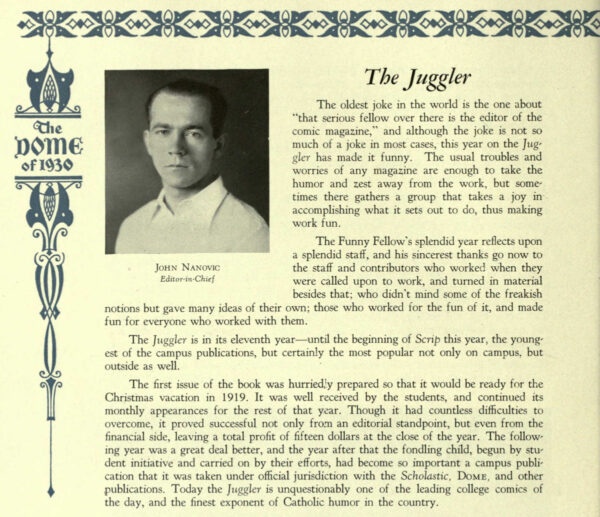
From an early age, John Nanovic showed an interest in writing and publishing. During high school, he produced a magazine called The Street Cleaner, and began reporting the local news from Palmerton for The Morning Call. During his junior year of high school, he became the editor of The Palmerton Press, a weekly local newspaper founded in 1918. After four years, he left to major in English at the University of Notre Dame. In his senior year of college, he served as the editor of The Juggler, the university’s humor magazine.
Although he had been offered positions at several magazines, including Cosmopolitan and Judge, things were looking pretty grim for Nanovic following the stock market crash of 1929. But a freelance submission to Street & Smith’s Sport Story Magazine circa 1930 – 31 led to an offer of employment from the publisher. Offered $25 a week to helm a new magazine, College Stories, Nanovic leapt at the chance.
Taking up for the discontinued pulp Excitement, the new magazine was introduced at the wrong time. With the economy in the doldrums, early 1931 was hardly a period when most young Americans were looking forward to four carefree years of college life. College Stories ran for ten issues and was canceled after its February 1932 number.
Around the same time that Street & Smith was launching their new magazine on campus life and college sports, it was debuting another title, envisioned as a one-shot. Nanovic was asked to work with a young writer named Walter B. Gibson and finish off the first issue of The Shadow: A Detective Magazine. Meant to establish a trademark on the title character, the new Street & Smith pulp instead sold out the print runs of its first and second issues.
With its October 1931 issue, The Shadow: A Detective Monthly was an established magazine with John L. Nanovic at the helm. Working with Gibson and Street & Smith business manager Henry W. Ralston, Nanovic helped to create the first single character or hero pulp, reviving a fiction format that had disappeared following the demise of the dime novels and story papers. A few years later, Ralston and Nanovic, working with author Lester Dent, repeated their success with Doc Savage Magazine.
“We discussed the plots with Ralston, and then Les or Walt gave me a 20-page outline. And then when I okayed that, that was the story. If there were any changes, we made them in the outline …. Now, 80 to 85% of the stories were original with the authors. Only about 15% of them were really Ralston’s and my ideas. And even with those, 90% of the work was the writer’s. Which it was supposed to be …. We gave him the idea, and worked with him. But they wrote the stories …. All we were looking for in Shadow, Doc, etc., were good stories.”
Ralston and Nanovic would attempt to repeat their success with other writers on magazines such as The Avenger, Nick Carter Detective Magazine, The Skipper, and The Whisperer, but never again scored a hit.
 John Nanovic left Street & Smith in 1943, accepting a very good severance package. Having worked for the publisher for twelve years, he entered the advertising and public relations fields. He died in Lansdale, Pennsylvania in early 2001, at the age of 93.
Visit the PulpFest YouTube Channel for our John Nanovic video, produced by award-winning author and journalist Craig McDonald.
And while you’re there, please be sure to subscribe.
Kenneth Grant is a writer and popular culture enthusiast who began writing for our website in early 2022. He particularly enjoys the hero pulps and has written about pulp villains, Ron Hill’s documentary, We Are Doc Savage, Talking Pulp with Craig McDonald, and more. We hope you enjoy his work.
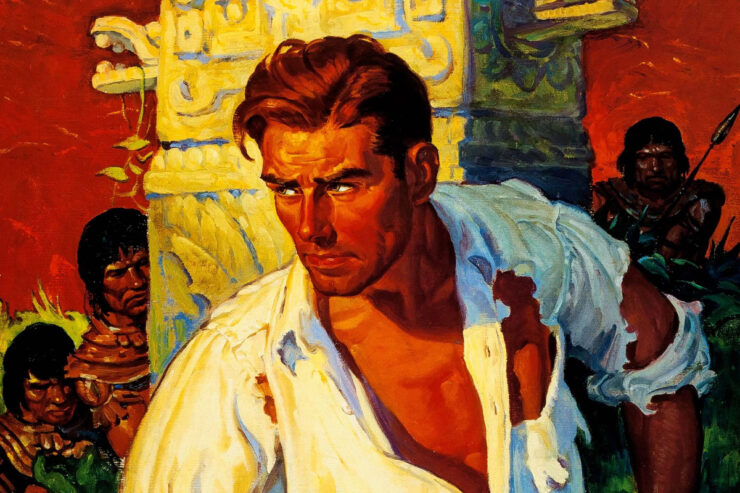
Our featured image is excerpted from Walter M. Baumhofer’s original cover painting for the October 1933 issue of Doc Savage Magazine, illustrating the Lester Dent novel, “The Man of Bronze.”
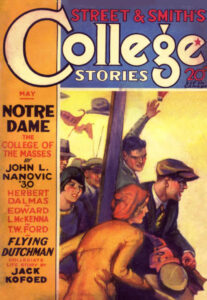
Our lead image is Delos Palmer’s cover for the May 1931 number of College Stories, the first issue of the pulp magazine. Edited by John Nanovice, the lead article was the editor’s own work, “Notre Dame — College of the Masses.”
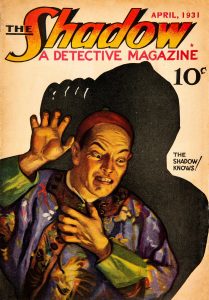
When Street & Smith launched The Shadow: A Detective Magazine on March 6, 1931, they were hedging their bets. Envisioned as a one-shot or a quarterly at best, they handed off the magazine to a new editor, working with a relatively unknown writer. Not only that, but Modest Stein’s cover art for the April 1931 issue had been used before. It originally ran as the cover for the October 1, 1919 issue of The Thrill Book, illustrating H. Bedford-Jones’ lead novelette, “Mr. Shen of Shensi.”
Modest Stein would later create at least forty-one new covers for The Shadow during the magazine’s later years.
We owe many thanks to the late Sam Moskowitz (Pulp Vault #7), Will Murray (Master of Mystery: The Rise of The Shadow), and Albert Tonik (The Pulp Collector #2) for their work on John L. Nanovic over the years. Also, Nanovic’s own essay, “I Never Called Him Bill,” in the Dover Press collection, The Crime Oracle and The Teeth of the Dragon.