 In early May, Feral House, a small press with a taste for the outrageous, approached PulpFest with an offer that was hard to refuse. Author and collector Mike Hunchback had put together a definitive survey of the later work of illustrator Lee Brown Coye and wanted to present a slideshow of the artist’s work at this year’s PulpFest. Since our convention was celebrating the 125th anniversary of author H. P. Lovecraft’s birth, we jumped at the chance to have Mike be part of our 2015 conference. After all, Coye, like Lovecraft, was strongly associated with “The Unique Magazine,” WEIRD TALES.
Born in Syracuse, New York, in 1907, Lee Brown Coye became very interested in drawing as a teenager and began studying art books on his own. In the late 1920s, woodcut illustrator Howard McCormick introduced him to scratch-board drawing. This became the artist’s favored medium.
Coye made his first pulp magazine appearance in the July 1930 issue of GOLDEN BOOK. However, it was not until the mid-forties – after illustrating August Derleth’s SLEEP NO MORE, an anthology of horror and ghost stories for Farrar & Rhinehart – that his work began to appear regularly in the rough-paper market. He was soon illustrating stories and painting covers for pulp magazines such as SHORT STORIES and WEIRD TALES. His work for the latter proved very popular, and he became a prolific contributor, sometimes appearing four or five times in a single issue. His drawings for the magazine included a running series of illustrations called “Weirdisms.” Coye pragmatically believed that, “I’d rather have my stuff in pulp magazines where people can see it than in a museum where they don’t.”
Writing in THE WEIRD TALES STORY, Robert Weinberg opined, “There was never an artist who came close to capturing horror and dread like Lee Brown Coye. He was master of the weird and grotesque illustration. Coye’s sketches had the shape of nightmares.”
More Derleth anthologies featuring Coye illustrations followed in the late forties: WHO KNOCKS? and THE NIGHT SIDE. The artist’s work continued to appear in WEIRD TALES until 1952. Beginning in 1962, following a ten-year hiatus from fantasy illustrating, Coye began producing horror and fantasy dust jackets for August Derleth’s Arkham House books. During this same period, his illustrations could be found in AMAZING STORIES, FANTASTIC STORIES OF IMAGINATION, and THE MAGAZINE OF FANTASY AND SCIENCE FICTION. In later years, he illustrated books and periodicals from other independent publishers, including several for Carcosa, a small press founded by Jim Groce, David Drake, and Karl Edward Wagner. According to the latter, Lee Brown Coye was “enormously talented and possessing the unsettling combination of a certain morbid genius with a whimsical sense of humor.” In the late seventies, Coye twice won the “World Fantasy Award for Best Artist.” He suffered a stroke, which left him partially paralyzed, in 1979 and died in September 1981, at the age of seventy-four.
 Now, thanks to editors Mike Hunchback and Caleb Braaten, some of Coye’s weirdest and most passionately ghoulish artwork is available again. PULP MACABRE, co-published in 2015 by Feral House and Sacred Bones Records, an alternative record company and publisher from Brooklyn, New York, showcases the art of Lee Brown Coye’s final and darkest era, a period when he was “king of the weird artists,” producing some of his strongest and most fearless work.
On Saturday afternoon, August 15th, at 2:30 PM, Mike Hunchback will discuss Coye’s life and work and share selected images from PULP MACABRE as well as fanzine covers, dust jackets, and photographs from his own collection that were not included in the book. Register now for PulpFest and be part of our salute to H. P. Lovecraft, WEIRD TALES, and the art of Lee Brown Coye.
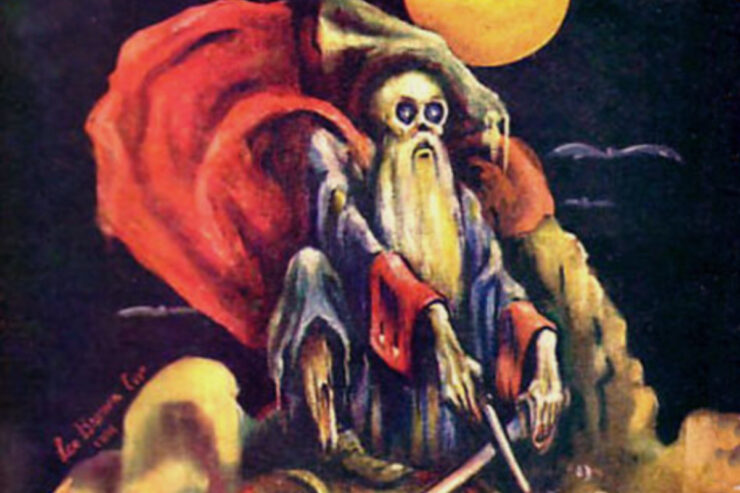
Our featured image was excerpted from Lee Brown Coye cover for Short Stories for March 25, 1945. A few years later, Dorothy McIlwraith, who edited both magazines, reused Coye’s art for the cover of the September 1951 issue of Weird Tales.
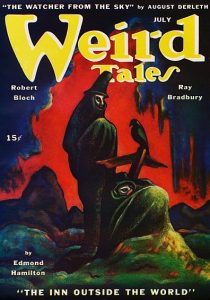
Soon after the August Derleth anthology Sleep No More appeared, the book’s illustrator, Lee Brown Coye, began a long relationship with Weird Tales. His first of ten covers for the magazine appeared in its July 1945 issue, our lead image. He also produced many interior illustrations for the magazine, including a series of pen-and-ink drawings that the artist “called “Weirdisms.” His work continued to appear in Weird Tales until 1952.
After growing up on a steady diet of horror and fantasy fiction from Arkham House Publishers and old pulp magazines, people such as Jim Groce, David Drake, and Karl Edward Wagner started their own small presses during the 1970s. Another was Stuart David Schiff, who, in 1973, began to publish Whispers, a magazine that “embraced classic horror pulp fiction as well as then-current Horror Culture. Under Schiff’s editorship, the poetry, short stories, essays, and various forms of artwork featured in the zine often reveled in the type of weird extremes found only in the grisliest pulps. Within a few issues, Whispers elevated the quality of fiction in fanzines, and other publishers had to follow suit.
The third issue of Schiff’s magazine was dedicated entirely to Lee Brown Coye. In Schiff’s featured essay, he wrote: “Lee’s pen conjures up spheres beyond normal perception and brings them to you with both subtlety and gut-wrenching directness.” Lee Brown Coye’s cover art for the issue – dated March 1974 – also serves as the cover art for Mike Hunchback’s and Caleb Braaten’s Pulp Macabre compilation.