
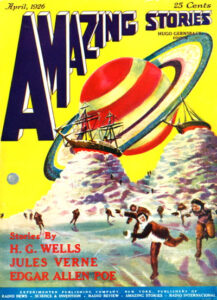
 PulpFest 2026 will celebrate the centennials of Amazing Stories and Ghost Stories, plus a great deal more at this year’s convention. Hugo Gernsback’s groundbreaking science fiction pulp and Bernarr Macfadden’s purportedly “true” magazine concerning the spirit world both debuted one hundred years ago.
It was hard to miss that first issue of Amazing Stories on the newsstand back in March 1926. Larger than the typical pulp magazine, with three-dimensional block letters trailing across its masthead and a bright yellow backdrop framing an alien landscape, the magazine certainly stood out on the sales rack.
The first continuing magazine specializing in what Hugo Gernsback labeled “scientifiction,” more than 600 issues of Amazing Stories were published through early 2021. Although no print issues have appeared since the Winter number of that year, Amazing Stories continues to publish stories online.
As Munsey Award-winning author and editor Mike Ashley noted in our seven-part series on the magazine’s history, Amazing Stories has had both high points and low points during the last century. The mid to late 1950s – when Paul Fairman was editing Amazing – was one of the magazine’s lowest periods. As Ashley wrote:
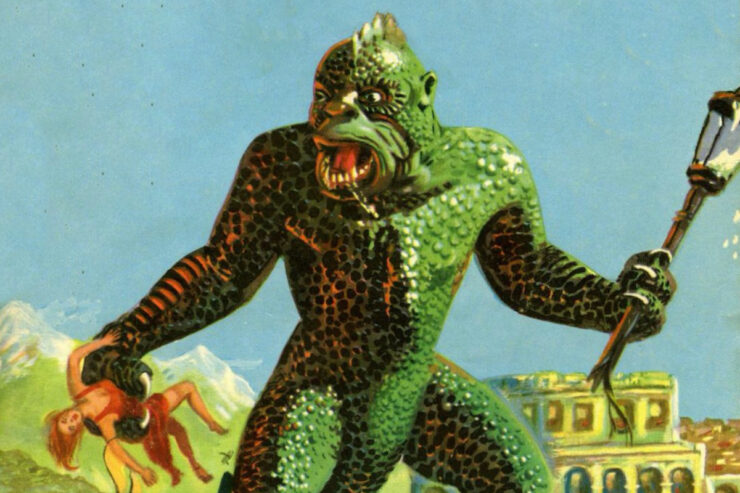
Little of merit survives from the Fairman years. The 1950s were the days of science-fiction B-movies, and Fairman seemed to equate sf too closely with the archetypal monster movie or alien invasion. Indeed, the movie industry inspired another companion magazine, Amazing Stories Science Fiction Novel, which attempted to bridge the gap between paperbacks and magazines. It saw only one issue – in June 1957 – which consisted of a novelization by Henry Slesar of the Columbia film 20 Million Miles to Earth.
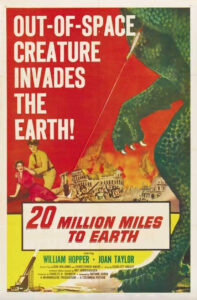 At 11:10 pm on Thursday, July 30, PulpFest 2026 will show Columbia Pictures’ 1957 science fiction thriller, 20 Million Miles to Earth. Directed by Nathan Juran, an Oscar-winning art director, this late-fifties monster movie features a giant reptilian creature from Venus, rampaging through the streets of Rome. The creature is slain after climbing to the top of the Roman Colosseum.
Produced by Charles H. Schneer, 20 Million Miles to Earth was largely a vehicle meant to spotlight the late Ray Harryhausen’s special effects. Starring William Hopper and Joan Taylor, the true star of the film is Harryhausen’s excellent stop-motion animation work. Produced during a time without CGI, Harryhausen’s effects are simply Amazing!
Before our showing of the Ray Harryhausen classic, authors, filmmakers, and podcasters L. S. Goozdich and Nathanael Hummel of Veritas Entertainment will be sharing three short films with PulpFest.
Incredibly passionate about telling great stories that are filled with heart and action, Luke and Nathanael will be presenting Hell at My Heels, a western about a man forced to kill, who goes on the run while being tracked by a deadly bounty hunter; East Germany Assignment, an action/adventure film tinged with horror about a team of CIA operatives who infiltrate East Germany to investigate rumors of a man terrorizing the countryside; and The Black Veil, a horror/noir film about a private eye, investigating a series of murders, who begins to crumble under the pressure of outside forces as the line between reality and insanity begins to blur.
After the films, Luke and Nathanael will be fielding questions and comments from the audience. You can connect with Luke on Instagram @LS_Author or YouTube at LS Author. You can follow Nathanael on Instagram @Piedmonticus.
Our PulpFest 2026 film program continues on Friday, July 31, at 11:10 pm with a showing of Robert Wise’s The Haunting. Starring Claire Bloom, Julie Harris, Richard Johnson, and Russ Tamblyn, The Haunting was released in 1963 by MGM. The film was adapted by screenwriter Nelson Gidding from Shirley Jackson’s 1959 novel, The Haunting of Hill House, considered one of the finest horror novels of the late 20th century.
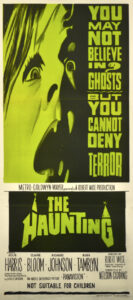 Filmed in the United Kingdom at the MGM-British Studios near London, The Haunting depicts the experiences of a small group of people invited by a paranormal investigator to investigate a purportedly haunted house. Considered one of the most effective horror films of the twentieth century, The Haunting is PulpFest’s tribute to the centennial of Bernarr Macfadden’s Ghost Stories.
Filled with first-person encounters with the supernatural, Ghost Stories also featured fictional yarns, including classics by Algernon Blackwood, Robert W. Chambers, Nathaniel Hawthorne, Oscar Wilde, and others, as well as contemporary tales by Hugh B. Cave, Jack D’Arcy, Nictzin Dyalhis, Paul Ernst, Walter B. Gibson, Robert E. Howard, Frank Belknap Long, Victor Rousseau, and other pulpsters.
PulpFest 2026 begins on July 30 and runs through August 2 at the DoubleTree by Hilton Hotel Pittsburgh – Cranberry in Mars, Pennsylvania. In addition to honoring the centennials of Amazing Stories and Ghost Stories, we’ll also be celebrating the sesquicentennial of writer Jack London’s birth, the centennial of the birth of artist Robert Kennedy Abbett, and more at this year’s convention.
The general public is welcome to attend our programming free of charge. To learn more about our presentations, please click the 2026 Schedule link found on our website.
For those who also want to enjoy our dealers’ room, you can join PulpFest by clicking the register link found on our website. And don’t forget to book a room at the DoubleTree. They’re going fast!
Remember, in addition to your membership in PulpFest 2026, you’ll also be a member of Doc Con 2026, FarmerCon XXI, and The Shadow Con 2026. That’s four conventions for one price! You can’t beat that deal.
If you’re interested in selling at PulpFest, all of our wall and foyer tables have been reserved. A few island tables are remaining for $110 per table. Please click the “register” link on our website to learn how to join the convention as a dealer.
Our featured image is excerpted from Ed Valigursky’s cover for the Amazing Stories Science Fiction Novel. Released in June 1957, the one-shot magazine featured an adaptation of Nathan Juran’s science-fiction thriller, 20 Million Miles to Earth, written by Henry Slesar.
Our lead image is the April 1926 issue of Amazing Stories, the first continuing science fiction magazine. Published by Hugo Gernsback, it featured cover art by Frank R. Paul, considered the “grandfather of science-fiction art.” An Austrian-born artist and draftsman, Paul was a mainstay for Gernsback throughout his career as a publisher.
One of the film posters used to publicize the 1957 Columbia Pictures science fiction thriller, 20 Million Miles to Earth. The artist is not known. It’s followed by a poster publicizing Robert Wise’s 1963 horror classic, The Haunting.
Here’s the official trailer for the Ray Harryhausen classic, 20 Million Miles to Earth.
You can also find an original trailer for The Haunting by clicking here. While you’re visiting YouTube, please be sure to subscribe to the PulpFest YouTube Channel.