 Now that PulpFest is entering its second decade as “the summertime destination for fans of pulp magazines and popular culture,” we thought we’d, once again, address the question: “What’s this PulpFest all about?”
PulpFest is named for pulp magazines — fiction periodicals named after the cheap pulp paper on which they were printed. Frank A. Munsey pioneered the format in 1896 with THE ARGOSY. Stories like Edgar Rice Burroughs’ “Tarzan and the Apes” and Max Brand’s “Destry Rides Again” really got things moving.
The pulps started to flourish following the introduction of specialized magazines such as DETECTIVE STORY and LOVE STORY. Publishing legends BLACK MASK, WEIRD TALES and AMAZING STORIES debuted during the 1920s. The early thirties introduced the hero pulps, while science fiction exploded as the world went to war in 1939.
By the early fifties, the pulps had largely disappeared. Although displaced by paperback books, comics, radio, television, movies, and more, these rough-paper periodicals profoundly shaped popular culture worldwide. They inspired everything from STAR WARS and JURASSIC PARK to Batman and Spider-Man. The fiction and art of the pulps reverberated through comic books, movies, paperbacks, television, and even anime and role-playing games.
PulpFest 2019 will focus on the many ways pulp fiction and pulp art have inspired and continue to inspire creators. We’re calling next year’s theme, “Children of the Pulps and Other Stories,” an examination of the pervasive influence of pulp magazines on contemporary pop culture. We’ll have plenty of great programming that tells those stories.
Beyond our programming, the PulpFest dealers’ room will feature tens of thousands of pulp magazines, vintage paperbacks, digests, genre books, original art, first edition hardcovers, series books, reference books, men’s adventure and true crime magazines, dime novels and story papers, Big Little Books, B-Movies, serials and related paper collectibles, old-time radio shows, and collectible comic books and newspaper adventure strips.
The convention will take place from Thursday evening, August 15, through Sunday afternoon, August 18, at the DoubleTree by Hilton Hotel Pittsburgh – Cranberry, just 19 miles north of Pittsburgh. If you need lodging, you can book a room directly through the PulpFest website.
Start planning now to join PulpFest 2019 at the “pop culture center of the universe.” You can register through our website.
To learn more about pulps and PulpFest, click here.
Published by the Frank A. Munsey Company, the October 1912 issue of The All-Story featured Edgar Rice Burroughs’ novel “Tarzan of the Apes,” published in its entirety. Clinton Pettee painted the magazine’s front cover.
Burroughs’ Tarzan is probably the most famous character to emerge from the pulps. Others include Zorro, Conan the Barbarian, Dr. Kildare, The Shadow, Buck Rogers, Sam Spade, Doc Savage, and Cthulhu. Come to PulpFest 2019 and learn how the pulps continue to inspire the world’s pop culture creators.
Children of the Pulps and Other Stories
PulpFest is the summertime destination for fans and collectors of popular culture both old and new. It honors the pulps by highlighting the many ways these throwaway magazines have inspired writers, artists, film directors, game designers, and other creators over the years.
Our 2019 convention will focus on the many ways pulp fiction and pulp art have inspired and continue to inspire creators. We’re calling this year’s theme “Children of the Pulps and Other Stories,” an examination of the pervasive influence of pulp magazines on contemporary pop culture. Our planned schedule appears below.
We’ll also have a spacious dealers’ room. It will feature tens of thousands of pulp magazines, vintage paperbacks, digests, genre books, original art, first edition hardcovers, series books, reference books, men’s adventure and true crime magazines, dime novels and story papers, Big Little Books, B-Movies, serials and related paper collectibles, old-time radio shows, and collectible comic books and newspaper adventure strips.
Please join PulpFest 2019 as we celebrate mystery, adventure, science fiction, and more. We’ll be back at the DoubleTree by Hilton Hotel Pittsburgh – Cranberry, just north of Pennsylvania’s “Steel City” in Mars, PA. If you need lodging, you can book a room directly through the PulpFest website.
If you enjoy genre writers such as J. K. Rowling, Lee Child, Michael Connelly, John Scalzi, or Stephen King, you’ll love PulpFest!
PulpFest 2019 Schedule
Thursday, August 15, 2019
 Dealers’ Room
3:00 PM – 10:00 PM — Dealers’ Room Set-Up
4:00 PM – 8:00 PM — Member Registration and Early-Bird Shopping
Evening Programming
8:15 – 9:00 PM — Bob Davis — Grandfather of Science Fiction (Gene Christie)
9:05 – 9:50 PM — A Century of Zorro — (Rich Harvey)
9:55 – 10:40 PM — Hollywood Pulp — From Pulp Page to the Silver Screen (Ed Hulse)
10:45 – 11:30 PM — Two Sought Adventure — Eighty Years of Fritz Leiber’s Fafhrd & the Gray Mouser (Jason Aiken & Morgan Holmes)
11:40 – 1:00 AM — Fu Manchu Film Festival (William Patrick Maynard)
Friday, August 16, 2019
Dealers’ Room
9:00 AM – 10:00 AM — Early Registration and Dealers’ Room Set-Up
10:00 AM – 4:45 PM — Dealers’ Room Open to All
Afternoon Programming
Author Readings
11:00 – 12:20 AM — Raw Dog Screaming Press Rapid-Fire Read & Sweet Sixteen Celebration(Publisher Jennifer Barnes)
12:30 – 1:05 PM — Wayne Carey, author of Quatermain: The New Adventures
1:10 – 1:45 PM — Craig McDonald, author of The Hector Lassiter Series
1:50 – 2:25 PM — Joab Stieglitz, author of The Utgarda Series
2:30 – 3:05 PM — Christopher Paul Carey, The Wild Adventures of Edgar Rice Burroughs Series and The Khokarsa Series author, will be moderating our “Enter the Edgar Rice Burroughs Universe” at this time
3:10 – 3:50 PM — William Patrick Maynard, authorized author of Fu Manchu
Other Programming
1:30 – 2:30 PM — Author Signings — John Locke, Will Murray, and Chet Williamson will be available for signings at our main entrance
2:30 – 3:05 PM — Enter the Edgar Rice Burroughs Universe (featuring Matt Betts, Win Scott Eckert, and Heidi Ruby Miller, with Christopher Paul Carey)
2:30 – 4:30 PM — The Art of Edgar Rice Burroughs (sponsored by The Burroughs Bibliophiles)
4:00 – 4:40 PM — Fu Manchu Film Festival Encore (William Patrick Maynard)
Evening Programming
6:55 – 7:00 PM — Welcome to PulpFest (Convention Chairman Jack Cullers)
7:05 – 7:50 PM — ARGOSY, ADVENTURE and BLUE BOOK — The Men’s Adventure Pulps (Bob Deis & Wyatt Doyle)
7:55 – 8:40 PM — The Game’s Afoot: Sherlock Holmes and the Pulps (George Vanderburgh & Garyn Roberts)
8:45 – 9:30 PM — The Secret Life of Women Pulp Artists (David Saunders)
9:35 – 10:25 PM — Dashiell Hammett and the Detective Story (John Wooley with John Gunnison)
10:25 – 11:10 PM — The Key of Imagination: THE TWILIGHT ZONE and the Pulps (Nicholas Parisi)
11:15 – 12:45 AM — Charles Beaumont: The Short Life of Twilight Zone’s Magic Man (A film by Jason V. Brock)
Saturday, August 17, 2019
Dealers’ Room
10:00 AM – 4:45 PM — Dealers’ Room Open to All
Afternoon Programming
Author Readings
10:00 – 10:50 AM — Popular Fiction from Seton Hill (introduced by Heidi Ruby Miller)
11:00 – 12:20 AM — Dog Star Books Rapid-Fire Read & Sweet Sixteen Celebration (Publisher John Edward Lawson)
12:30 – 1:05 PM — Flinch Fest, featuring John Bruening, author of The Midnight Guardian Series
1:10 – 1:45 PM — Roger Alford, author of The Black Spectre Series
1:50 – 2:25 PM — Sara Light-Waller, author of ANCHOR and LANDSCAPE OF DARKNESS
2:30 – 3:05 PM — Win Scott Eckert, author of HUNT THE AVENGER and many other works
Other Programming
1:30 – 2:30 PM — Author Signings — Win Scott Eckert, Nicholas Parisi, and John Wooley will be available for signings at our main entrance
2:30 – 4:30 PM — The Art of Edgar Rice Burroughs (sponsored by The Burroughs Bibliophiles)
3:15 – 4:30 PM — Contemporary Pulp: Writing Genre Fiction (John Bruening, Christopher Paul Carey, Win Scott Eckert, Craig McDonald, and Will Murray, with William Patrick Maynard)
4:15 – 4:45 PM — Auction Preview
 Evening Programming
5:00 – 6:45 PM — PulpFest 2019 Group Meal
7:00 – 7:30 PM — PulpFest Annual Business Meeting (meet the convention organizers)
7:30 – 7:40 PM — Munsey Award Presentation (presented by William Lampkin)
7:45 – 8:25 PM — FarmerCon XIV: Farmer of the Pulps: A Harvest of Influences (featuring Jason Aiken, Christopher Paul Carey, Win Scott Eckert, and Garyn G. Roberts, with Paul Spiteri)
8:30 – 9:30 PM — Born Writing: The Unparalleled Career of Arthur J. Burks (John Locke)
9:30 – 9:45 PM — Last Minute Auction Viewing
9:45 – 12:00 AM — Saturday Night Auction
12:00 – 1:00 AM — Fu Manchu Film Festival Encore (William Patrick Maynard)
Sunday, August 18, 2019
Dealers’ Room
9:00 AM – 2:00 PM — Dealers’ Room Open to All (many dealers will be packing up; buying opportunities may be limited)
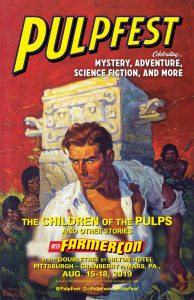
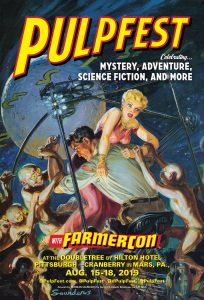
Bill Lampkin adapted Walter Baumhofer’s cover for the March 1933 issue of Doc Savage Magazine, illustrating Lester Dent’s “The Man of Bronze,” as our main postcard image to promote PulpFest 2019. Bill also adapted Norman Saunders’ cover for the August 1950 number of Famous Fantastic Mysteries, illustrating H. G. Wells’ “The Time Machine.”
PulpFest 2019 Dealers—although PulpFest is well known for its excellent programming, it is also lauded for its very substantial dealers’ room. Beginning on Thursday, August 15, the DoubleTree by Hilton Hotel Pittsburgh – Cranberry — just north of Pennsylvania’s “Steel City” — will be home to Adventure House (John & Maureen Gunnison), Adventures in Bronze (Will Murray), Age of Aces (Chris & David Kalb), Jim & Walter Albert, All American Comics and Collectibles (Gene Carpenter), Mark Alvarado, Battered Silicon Dispatch Box (George Vanderburgh), Belt Publishing (Martha Bane), Bold Venture Press (Rich Harvey & Audrey Parente),Brad Braddock, Brenner’s Collectable Books (Michael Brenner), Brick Pickle Media (Jonathan Sweet), the Burroughs Bibliophiles (Henry G. Franke III & Gary Buckingham), Christopher Paul Carey, Nick Certo, Jack Cullers, Curious Bookshop (Ray Walsh), Dearly Departed Books (Scott & Linda Edwards), Win Scott Eckert, Doug Ellis & Deb Fulton, Fenham Publishing (Jim Dyer), First Fandom Experience (David & Daniel Ritter), Flinch! Books (John Bruening), Bob & James Flowers, R. David & Lisa Fulchur, Heartwood Auctions (Richard Meli & Janet Gee), Paul Herman, Heroes & Games (Mike Carbanaro), Heroineburgh, Mark Hickman, Bill Lampkin, Kurt McCoy, John McMahan, Peter Macuga, Bill Mann, Walker Martin, William Patrick Maynard, Meteor House, Mike Chomko Books, Murania Press (Ed Hulse), Phil Nelson, New Dimentions Comics (Todd McDevitt), New Texture (Bob Deis & Wyatt Doyle), Nicholas Parisi, Curt Phillips, Craig Poole, Laurie Powers, R & B Enterprises (Robin and Brandon Faulkner), Raw Dog Screaming Press (Jennifer Barnes & John Lawson), Redfield Arts Audio (Mark Renfield & Jenifer Rouse), Garyn & Virginia Roberts, Christopher Ryan, Joseph Saine, Donald E. Simpson, Steven Spilger, Joab Stieglitz, Tim’s Books (Tim Paxton), Sheila Vanderbeek, Todd Warren, Jon Wehler, Well-Stacked Books (Chris Maffei), Mark Wheatley, Chet Williamson, World of Strange (Ben & Tracy Eller), Marvin Wynn, and Ygor’s Books (Cathy & Larry Hallock).
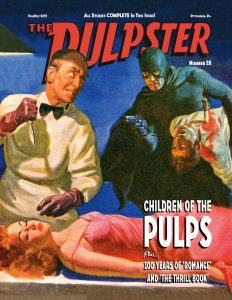 Highlights from The Pulpster—our award-winning program book returns with a Pow! and a Smash! Echoing the “Children of the Pulps” portion of this year’s PulpFest theme, THE PULPSTER #28 looks at how characters and fiction writers from pulpwood paper magazines influenced later characters, television, movies, and more.
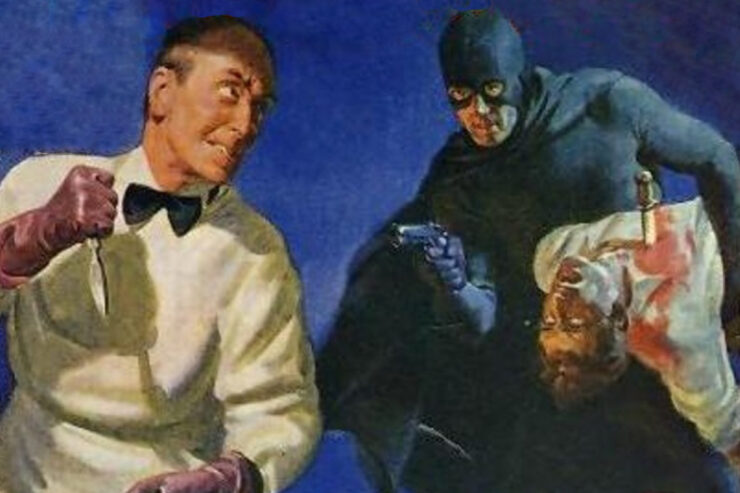
Fronting the magazine is art by Rudolph Belarski from the cover of the September 1939 BLACK BOOK DETECTIVE magazine. It illustrates one way the pulps influenced the creation of the superhero in comics, with a decidedly Batman-looking Black Bat. That leads into the first of our cover stories.
Will Murray recalls how he and Anthony Tollin pieced together how the creators of Batman lifted elements from THE SHADOW MAGAZINE for their Dark Knight. Will also writes about Johnston McCulley, whom he calls the grandfather of the superhero. Meanwhile, D. Kepler looks at how McCulley’s most famous character — Zorro — on the 100th anniversary of his debut, has been portrayed on screens around the world.
Scott Tracy Griffin surveys how Edgar Rice Burroughs’ Tarzan begat generations of jungle men, women, and children in popular culture.
Three articles examine the pulp magazines’ influence on movies and television: Aaron H. Oliver writes about the 1960s western/spy TV series THE WILD WILD WEST; Jess Terrell looks at the original STAR WARS trilogy; and Sara Light-Waller details how Japanese anime (animated) and tokusatsu (live-action special effects film) drew from the pulps.
THE PULPSTER also celebrates the 100th anniversaries of two pulp magazines: THE THRILL BOOK and ROMANCE. Richard Bleiler looks at the ambitious oddity that was THE THRILL BOOK, while Doug Ellis writes about how ROMANCE struggled for a year with its name and its place in the adventure field.
Then editor emeritus of THE PULPSTER, Tony Davis, writes about Bertrand Sinclair and his nearly 50-year career in the pulps. THE PULPSTER also reprints a letter from fictioneer G. T. Fleming-Roberts, in which he reflects on Sherlock Holmes’s influence on his career.
Of course, this issue includes the regular departments: “Final Chapters,” by Davis, which notes those in the pulp community who have passed away in the last year; and columns by publisher Michael Chomko and editor Bill Lampkin. And we would be remiss not to note assistant editor Peter Chomko’s help with this issue.
A longstanding tradition cherished by attendees of the summer pulp con, THE PULPSTER will be released at PulpFest 2019. Every PulpFest member — including supporting members — will receive a complimentary copy of THE PULPSTER #28.
Bill Lampkin adapted Rudolph Belarski’s cover for Better Publications’ September 1939 Black Book Detective for The Pulpster #28 and our featured image.
Thursday, August 15, 2019
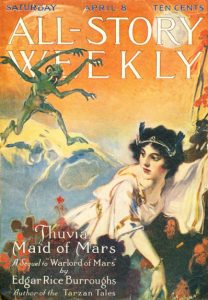 Bob Davis, Grandfather of Science Fiction—born in Nebraska on March 23, 1869, Robert Hobart Davis has been called the greatest editor of the pulp era. Trained in the newspaper industry, Davis became the managing editor of Frank A. Munsey’s NEW YORK SUNDAY NEWS in the early 1900s. He soon shifted to fiction editor for MUNSEY’S MAGAZINE. As Munsey added more magazines to his stable, he turned them over to Davis. THE ALL-STORY MAGAZINE, THE CAVALIER, RAILROAD MAN’S MAGAZINE, THE SCRAP BOOK, and others were edited by Bob Davis.
Sam Hellman — a Davis protégé — knew of no other editor who had “graduated more writers from pulp to prominent pay.” Pulp historian John Locke also noted that, “More than sixty authors — many of them well-known — dedicated their books to Bob Davis.”
Bob Davis was the literary godfather to “Edgar Rice Burroughs, Zane Grey, Edison Marshall, Mary Roberts Rinehart, Octavus Roy Cohen, Max Brand, Fannie Hurst, Israel Zangwill, Dorothy Canfield Fisher, Sophie Kerr, Frank L. Packard, Montague Glass, Arthur Somers Roche, Faith Baldwin, James Oliver Curwood, Rex Beach, Louis Joseph Vance, Charles Van Loan, and Ben Ames Williams,” according to Richard Cary. He also signed O. Henry to a long-term contract — giving Munsey first look at the author’s works — and acquired the rights to Joseph Conrad’s last major work, “Victory.”
Science fiction and fantasy also owe a great deal to Robert H. Davis. He was a major force in their development in the early twentieth century. Using Edgar Rice Burroughs’s scientific romances as a template, Davis inspired a style of fiction for the Munsey stable of magazines. He called this style the “different” story. The Munsey editor discovered or cultivated the talents of Ray Cummings, George Allan England, Philip M. Fisher, Homer Eon Flint, J. U. Giesy, Austin Hall, Murray Leinster, A. Merritt, Todd Robbins, Victor Rousseau, Garrett P. Serviss, Perley Poore Sheehan, Francis Stevens, and Charles B. Stilson. Robert H. Davis can very well be thought of as “The Grandfather of Science Fiction.”
Join PulpFest 2019 on Thursday evening, August 15, as we welcome Gene Christie for a look at the life of Bob Davis and his importance to the development of science fiction and fantasy. A longtime pulp collector and scholar, Gene has edited over a dozen anthologies for various publishers. THE CRIME MAGNET: THE ADVENTURES OF MAJOR BERNARD DE TREVILLE, THE MAN WHO FOUND ZERO: EARLY SCIENCE FICTION AND WEIRD FANTASY FROM THE BLACK CAT, THE PEOPLE OF THE PIT AND OTHER EARLY HORRORS FROM THE MUNSEY PULPS, THE SPACE ANNIHILATOR: EARLY SCIENCE FICTION FROM THE ARGOSY, and THE THING FROM — OUTSIDE are just a few of Gene’s books.
Although he cultivated a school of writers to create “pseudoscientific” or “different” stories for the Munsey chain of magazines, Robert H. Davis also turned to Edgar Rice Burroughs for many such works. One was “Thuvia, Maid of Mars.” It was serialized in three parts, beginning with the April 8, 1916 issue of All-Story Weekly, with cover art by P. J. Monahan.
 A Century of Zorro—in the early 1800s, California was still under Spanish rule. The peaceful indigenous people were victimized by the corrupt military commanders. One man rose to stand against injustice and the abuse of power. One man stirred the hearts of Californians and gave them the spirit to resist tyranny. That man was the masked avenger known as Zorro!
On Thursday night, August 15, publisher, author, and 2019 Munsey Award nominee Rich Harvey of Bold Venture Press presents “A Century of Zorro,” marking not only the centennial of the legendary pulp character, but also the publication of the first matched set of every original Zorro novel and short story in six attractive volumes from Bold Venture Press.
Pulp writer Johnston McCulley created Zorro. In the original stories, Zorro has a price on his head, but is too skilled and cunning for the authorities to capture. Zorro is the secret identity of Don Diego de la Vega, the only son of Don Alejandro de la Vega, a wealthy landowner. He adopted his secret identity after learning California had fallen under the thrall of a ruthless dictator. Diego conceals his identity by posing as a cowardly fop.
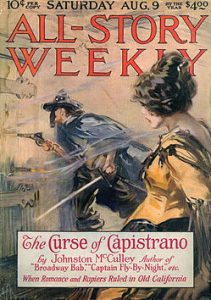
Zorro was introduced in McCulley’s novel, “The Curse of Capistrano,” when it was serialized in ALL-STORY WEEKLY in 1919. The success of its 1920 film adaptation, THE MARK OF ZORRO, starring Douglas Fairbanks, convinced his creator to author further adventures. Over the next forty years, McCulley penned five Zorro novels and nearly 60 short stories featuring the masked avenger. The stories appeared in ARGOSY, WEST, and other magazines. In book form, “The Curse of Capistrano” was retitled THE MARK OF ZORRO and sold more than 50 million copies. McCulley’s numerous follow-ups never matched that success. Most were never collected in book form until Bold Venture Press’ definitive editions.
Zorro appeared in over 40 film and television adaptations, including Walt Disney’s 1950s TV series starring Guy Williams. The character has appeared in numerous literary pastiches as well as radio, comic books, newspaper strips, and stage plays.
 As one of the earliest examples of a fictional masked avenger with a double identity, Zorro inspired several similar characters in pulp magazines and other media. McCulley’s hero is a precursor of the superheroes of American comic books, with Batman drawing particularly close parallels to the character. As such, today’s superheroes are very much “Children of the Pulps.” Join Bold Venture Press founder Rich Harvey on PulpFest‘s opening night to celebrate “A Century of Zorro.”
Written by William Patrick Maynard.
Zorro debuted in “The Curse of Capistrano,” a five-part serial that ran in Munsey’s All-Story Weekly, starting with the August 9, 1919 issue and featuring cover art by P. J. Monahan. A native of Des Moines, Iowa, Monahan moved to Brooklyn in 1907. He became one of New York’s most prolific artists for the first three decades of the twentieth century, creating advertisements, movie posters, commissioned art, and, most of all, pulp magazine illustrations and covers.
Along with Bob Fujitani, Bob Correa and Alberto Giolitti, the late pulp artist Everett Raymond Kinstler created the interior pencils and inks for the Zorro stories featured in Dell’s Four Color Comics series. Kinstler drew issues 497— featuring “The Sword of Zorro,” with the cover painted by an unknown artist — 538, and 574. Born in 1942, Kinstler worked as a freelance artist in the pulp, slick, comic book, and paperback industries before turning to portraiture in the 1950s.
 Hollywood Pulp: From Pulp Page to the Silver Screen—join PulpFest 2019 on Thursday, August 15, as pulp and film expert Ed Hulse explores some of the movies adapted from rough-paper fiction.
The motion-picture industry was still in its infancy when producers began licensing stories from pulp magazines for adaptation to celluloid. As early as 1912—when movies were still novelties, screened primarily in storefront nickelodeons—recurring characters from the pulps appeared in short-subject series. That year the Edison Company enjoyed great success with THE CHRONICLES OF CLEEK. These monthly one-reel installments starred Ben Wilson as Thomas A. Hanshew’s “Man of Forty Faces,” a character that appeared regularly in the pulp SHORT STORIES.
Edison’s Cleek series was typical film fare of the day. During the silent movie era, a one-reel short yielded 12 to 15 minutes of screen time—just enough to tell a perfunctory story that might take 5,000 to 10,000 words in prose. Nickelodeons ran “programs” that grouped four or five such films together. They changed their programs three to five times per week.
With filmmakers under constant pressure to satisfy thrill-hungry viewers, a huge market emerged for adaptable yarns. Producers obtained stories from pulps and slicks alike. The two magazines most frequently tapped for material during the pre-1920 period were THE SATURDAY EVENING POST and THE ALL-STORY or ALL-STORY WEEKLY. During this period, many top pulp writers saw their rough-paper fiction immortalized on celluloid. This august group included Max Brand, Edgar Rice Burroughs, George Allan England, Zane Grey, James B. Hendryx, Johnston McCulley, Frank L. Packard, Mary Roberts Rinehart, and Perley Poore Sheehan, among others.
By 1920, the motion-picture industry had mushroomed. Lavish downtown “picture palaces” replaced the seedy nickelodeons, and practically every small town in the country boasted its own movie theater. Production, initially based on the East Coast, gravitated to Hollywood. Wall Street began investing in the most profitable studios. Weekly attendance soared to 40 million people and would continue to grow throughout the Roaring Twenties. Melodramas were second only to comedies as the most popular and profitable screen subjects. This meant that westerns, thrillers, and detective stories were in constant demand. Writers specializing in these genres could usually find a producer to license their pulp yarns if they looked hard (or had aggressive literary agents).
The demand for pulp fiction lessened somewhat as “talking pictures” took over the movie business in the late twenties. As the Great Depression began to affect American consumers, Hollywood was hard hit. To compete for the dimes and quarters that bought tickets, the studios increasingly adapted famous stage plays and mainstream novels. These stories relied on dialogue rather than the melodramatic action found in rough-paper magazines. The Thirties still saw many pulp-based films, but they were increasingly low-budget “B” pictures or serials from Poverty Row studios.
Prominent pulp characters brought to the silver screen were Tarzan, Zorro, Buck Rogers, Sam Spade, The Shadow, The Spider, Doc Savage, Conan the Barbarian, and John Carter of Mars, to name just a few. But many others are not easily recognizable to today’s aficionados. Ed will identify many of these in his presentation, accompanied by a selection of rare stills and posters from the films.
A journalist for nearly forty years, Ed Hulse has written or edited many books about vintage motion pictures and their stars, as well as numerous books about pulp fiction. He was the editor and publisher of BLOOD ‘N’ THUNDER, the award-winning journal devoted to the study of adventure, mystery, and melodrama of the late 19th and early 20th centuries.
Written by Emile C. Tepperman IV.
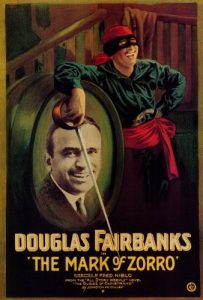
The Mark of Zorro — a 1920 silent — is the first of three adaptations of Johnston McCulley’s novel, “The Curse of Capistrano.” Starring Douglas Fairbanks as the title character and his alter ego, The Mark of Zorro was the first film to be released by United Artists, the company formed by Fairbanks, Mary Pickford, Charlie Chaplin, and D. W. Griffith. The film’s advertising prominently mentioned All-Story Weekly, its pulp source. Our presentation, “Hollywood Pulp — From Pulp Page to the Silver Screen,” will include behind-the-scenes information on the making of this historic film.
 Two Sought Adventure: Eighty Years of Fritz Leiber’s Fafhrd & the Gray Mouser—Fafhrd and the Gray Mouser first met in the story, “Ill Met in Lankhmar,” published in the April 1970 issue of THE MAGAZINE OF FANTASY AND SCIENCE FICTION. Fritz Leiber’s story won both the 1970 Nebula and 1971 Hugo awards in the novella category. However, Leiber’s friend, Harry Otto Fischer, had created the characters decades earlier, describing them in a 1934 letter to the author.
After further correspondence with his friend, Fritz Leiber began working on a novella, finishing it in early 1936. Farnsworth Wright of WEIRD TALES rejected it as too full of “stylistic novelties.” Following several revisions, the author showed his manuscript to H. P. Lovecraft, who wrote:
“There will shortly be circulated among the gang … a remarkable unpublished novelette by young Leiber — “Adept’s Gambit,” rejected by Wright and now under revision according to my suggestions. It is a brilliant piece of fantastic imagination — with suggestions of Cabell, Beckford, Dunsany, and even Two-Gun Bob — and ought to see publication some day.”
Although the first tale of Fafhrd and the Gray Mouser would not be published until 1947 in NIGHT’S BLACK AGENTS, pulp readers would meet the characters in the August 1939 UNKNOWN. Beginning with “Two Sought Adventure,” the Street & Smith pulp would publish five of Leiber’s tales of the two adventurers. In later years, the stories would be featured in COSMOS SCIENCE FICTION AND FANTASY MAGAZINE, DRAGON, THE MAGAZINE OF FANTASY AND SCIENCE FICTION, OTHER WORLDS, SUSPENSE MAGAZINE, WHISPERS, and, most importantly, FANTASTIC and Donald Wollheim’s Ace Books.
“Two comrades to the death and black comedians for all eternity, lusty, brawling, wine-bibbing, imaginative, romantic, earthy, thievish, sardonic, humorous, forever seeking adventure across the wide world, fated forever to encounter the most deadly of enemies, the most fell of foes, the most delectable of girls, and the most dire of sorcerers and supernatural beasts and other personages.”
Join PulpFest 2019 on Thursday, August 15, as we welcome fantasy and horror writer Jason Scott Aiken and sword and sorcery expert Morgan Holmes, for “Two Sought Adventure — Eighty Years of Fritz Leiber’s Fafhrd & the Gray Mouser.” Dr. Holmes is the former official editor of the Robert E. Howard United Press Association and was nominated for a Hugo Award in 2016 as Best Fan Writer.
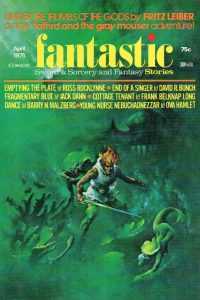
Although the Fafhrd and the Gray Mouser series began in the pulp Unknown, Cele Goldsmith of Fantastic took a gamble and commissioned Fritz Leiber to write a new series of Fafhrd and the Gray Mouser stories. The first of these stories was “Lean Times in Lankhmar,” published in the November 1959 issue. Fantastic eventually ran eleven tales featuring Leiber’s two comrades, concluding with “Under the Thumbs of the Gods,” published in the April 1975 number, with front cover art by Stephen E. Fabian.
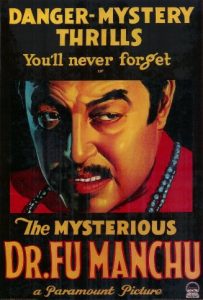 Fu Manchu Film Festival—there are a number of Holy Grails that every collector seeks. Some say the quest is more important than the treasure. This is probably because few such treasures are ever discovered. For fans of Sax Rohmer’s Fu Manchu series, one of the most obscure relics is a 1952 pilot film shot for NBC for a FU MANCHU television series starring John Carradine as the Devil Doctor. The pilot was never broadcast. A still has never been published in books or magazines. Many fans dismissed the pilot as nothing more than a rumor — an idea that was never actually filmed.
They were wrong.
William Cameron Menzies, the legendary Hollywood production designer, directed the highly stylized pilot film. It is a surprisingly faithful adaptation of the 1912 Sax Rohmer story that started it all — “The Zayat Kiss.” Cedric Hardwicke plays Nayland Smith, the driven British colonial official obsessed with capturing the elusive criminal mastermind, Dr. Fu Manchu. John Carradine — appropriately menacing as a silhouetted figure behind a screen intoning his commands in an educated hiss far removed from the province of yellowface performances — is the most faithful Fu Manchu ever to grace the big or small screen.
Born out of imperialist Britain’s fear of a Yellow Peril emerging from the East, Rohmer ingeniously imbued his fictional villain with greater intelligence and integrity than his Western protagonists. Rohmer’s initial description of the character in “The Zayat Kiss” is unforgettable and one he would strive to re-create over the years without ever falling into direct imitation:
“Imagine a person, tall, lean, and feline, high-shouldered, with a brow like Shakespeare and a face like Satan, a close-shaven skull, and long, magnetic eyes of the true-cat green. Invest him with all the cruel cunning of an entire Eastern race, accumulated in one giant intellect, with all the resources of science past and present, with all the resources, if you will, of a wealthy government — which, however, already has denied all knowledge of his existence. Imagine that awful being, and you have a mental picture of Dr. Fu-Manchu, the yellow peril incarnate in one man.”
Dr. Fu-Manchu does not even appear in the story, yet his presence pervades the atmosphere and hysteria of “The Zayat Kiss.” Set in a mad world of conspiracy theories, bizarre assassinations, and death traps, Rohmer’s story was bound to be a smashing success when it debuted in print in October 1912. All of the ingredients were there to build a winning formula.
Thursday night, August 15, PulpFest 2019 will offer the first of three public screenings of a complete and pristine print of Carradine’s legendary lost classic. Also featured will be such rarities as the silent FU MANCHU serials made by Stoll Productions in the 1920s. Alongside the lost NBC pilot, these silent chapters are the most faithful adaptations of Sax Rohmer’s works ever attempted. Two encore presentations of the lost pilot will be held on Friday afternoon, August 16, and Saturday night, August 17. The silent rarities screened with it during the encore presentations will be unique to each screening. This will allow repeat attendees to maximize their enjoyment. For copyright reasons, you cannot make, distribute, or sell copies at these free public exhibitions, which are open to any attendee of PulpFest 2019.
Join the licensed continuation author of the Fu Manchu thrillers, William Patrick Maynard, for these three very special screenings at PulpFest 2019. You’ll see John Carradine as Fu Manchu for the first time in 67 years and then enjoy the equally rare treat of seeing Fu Manchu serial chapters made nearly a century ago. You’ll bask in shimmering location footage genuinely shot on the streets and alleyways of London — including Limehouse — as it looked when Sax Rohmer and Fu Manchu were on everyone’s breath.
Written by William Patrick Maynard.
The Mysterious Dr. Fu Manchu — directed by Rowland V. Lee and starring Warner Oland in the title role — was released by Paramount Pictures in 1929. The first talking Fu Manchu movie, it was based on Sax Rohmer’s novel, The Mystery of Dr. Fu Manchu. Set during the Boxer Rebellion in China, Dr. Fu Manchu’s wife and child are killed by foreigners. Enraged, he vows to take his revenge on the British army officers he holds responsible for the killings. The poster advertising the film — one of several — was created by an unknown artist.
Friday, August 16, 2019
The New Fictioneers—much of Friday afternoon’s programming was set aside for “New Fictioneers” readings. These featured contemporary writers reading from their recent works and fielding audience questions and comments. To learn more about PulpFest’s “New Fictioneers” readings, click here.
 Author Signings—more than 30 fiction writers will attend PulpFest 2019. Most will read from their work or participate in panels on writing and pulp fiction. The convention will host nine readings by contemporary genre fiction authors as part of its long-running New Fictioneers series. You can read about our New Fictioneers readings by clicking the link above.
The convention will also host the Raw Dog Screaming Press Rapid-Fire Read & Sweet Sixteen Celebration on Friday and the Dog Star Books Rapid-Fire Read on Saturday. Additionally, PulpFest 2019 will showcase Popular Fiction from Seton Hill prior to the Dog Star event. Join Dog Star Books founder and author Heidi Ruby Miller and three writers from Seton Hill University’s Writing Popular Fiction Master’s Program on Saturday morning, August 17, in the convention’s programming hall.
One highlight of Saturday’s programming line-up will be a panel on “Contemporary Pulp: Writing Genre Fiction.” Fu Manchu continuation author William Patrick Maynard will be joined by Midnight Guardian creator John Bruening; Christopher Paul Carey, Director of Publishing at Edgar Rice Burroughs, Inc.; Philip José Farmer collaborator Win Scott Eckert; Edgar-nominated author Craig McDonald, creator of the Hector Lassiter historical crime series; and Will Murray, author of “The All-New Wild Adventures of Doc Savage and Tarzan.”
PulpFest 2019 will also host two formal author signing sessions outside the entrance to our dealers’ room. The signings will take place from 1:30 to 2:30 PM on both Friday and Saturday afternoons. Our writer guests will also have copies of their recent books available for sale.
Friday afternoon’s signings will feature pulp historian and Lamont Award recipient John Locke; pulp’s indefatigable Renaissance man, Lamont Award recipient, and official continuation author of Doc Savage, Tarzan, and The Spider, Will Murray; as well as renowned horror, science fiction, and suspense author and PulpFest 2015 guest of honor, Chet Williamson.
Saturday afternoon’s signings will feature the author of ROD SERLING: HIS LIFE, WORK, AND IMAGINATION, Nicholas Parisi; critically acclaimed pop culture historian and Lamont Award recipient John Wooley; and 2019 Munsey Award nominee, Win Scott Eckert, who will be signing copies of his new novel, HUNT THE AVENGER.
Written by William Patrick Maynard.
Rod Serling: His Life, Work, and Imagination is a 2018 biography, videography, and critical analysis of television and film writer Rod Serling, written by Nicholas Parisi, and featuring a foreword by his daughter, Anne Serling.
 Heroines of Science Fiction and Fantasy—it goes without saying that we consider Sara Light-Waller a “Heroine of Science Fiction and Fantasy.” Sara is one of more than thirty writers attending PulpFest 2019. An avid reader of pulp science fiction, Sara writes and illustrates her fiction in the manner of the Golden Age science fiction from the 1930s and 40s. She is the author of ANCHOR: A STRANGE TALE OF TIME and LANDSCAPE OF DARKNESS. Both are published by Sara’s Lucina Press and are available through Amazon.
In 2018, we asked Sara if she’d be interested in writing posts about the first issues of SCIENCE WONDER STORIES and AIR WONDER STORIES. She quickly agreed and offered to write a third post about a subject dear to her heart: the women who helped to develop the science fiction genre. Of course we agreed.
Sara Light-Waller will be one of our “New Fictioneers” readers on Saturday, August 17, at PulpFest 2019.
Heidi Ruby Miller is our other “Heroine of Science Fiction and Fantasy.”
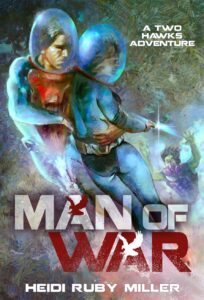
With degrees in Anthropology, Geography, Foreign Languages, and Writing, Heidi knew early that penning fast-paced, exotic adventures would be her life. One of the founders of Dog Star Books — the science fiction adventure imprint of Raw Dog Screaming Press — Heidi is the author of the AMBASADORA series and the Meteor House bestseller, MAN OF WAR. She also teaches creative writing at Seton Hill University, where she graduated from their renowned Writing Popular Fiction Graduate Program. Between writing and teaching, Heidi travels the world with her husband, writer Jason Jack Miller.
Earlier this year, Heidi appeared in a documentary produced by WQED Pittsburgh concerning pulp artist Gloria Stoll Karn. It’s part of a documentary entitled VISIBLE that aired on WQED, the nation’s first community-supported television station.
Heidi has also penned an article called “New Pulp” for the July 2019 issue of THE WRITER. Based on a class she taught in Seton Hill University’s Writing Popular Fiction MFA program, it concerns the resurgence of this popular fiction genre. The issue is currently available through bookstores and finer newsstands.
A resident of Pittsburgh, Heidi will be part of the Dog Star Books portion of the Raw Dog Screaming Press Rapid-Fire Read and Sweet Sixteen Celebration on Saturday, August 17. She’ll also host our “Popular Fiction from Seton Hill” presentation preceding the Dog Star Celebration on Saturday.
Be sure you have the opportunity to meet these two contemporary “Heroines of Science Fiction and Fantasy” by registering for PulpFest 2019 today.
Pictured above is Heidi Ruby Miller’s novel, Man of War. Published by Meteor House in 2017, it features cover art by Mark Wheatley.
Enter the Edgar Rice Burroughs Universe—a century before the term “crossover” became a buzzword in popular culture, Edgar Rice Burroughs created the first expansive, fully cohesive literary universe. Coexisting in this vast cosmos was a pantheon of immortal heroes and heroines. In Burroughs’ eighty-plus novels, their epic adventures transported them to strange and exotic worlds, the lost civilizations of Earth, and even to realms beyond the farthest star. Now the Edgar Rice Burroughs Universe expands in an all-new series of canonical novels written by today’s talented authors!
Join Edgar Rice Burroughs, Inc. Director of Publishing Christopher Paul Carey for an exclusive first glimpse at the recently announced Edgar Rice Burroughs Universe series. The series represents the first time ERB, Inc., has declared official canon beyond the classic tales of wonder and imagination penned by Mr. Burroughs.
Christopher will discuss the secrets of the newly expanding universe. He will be joined by several critically acclaimed authors who will be writing for the series. These include Matt Betts — who will be writing CARSON OF VENUS: THE EDGE OF ALL WORLDS — and Win Scott Eckert — who will be writing TARZAN: BATTLE FOR PELLUCIDAR. Heidi Ruby Miller — author of AMBASADORA: MARKED BY LIGHT and MAN OF WAR: A TWO HAWKS ADVENTURE — will also be on hand with a special exclusive announcement.
The “Enter the Edgar Rice Burroughs Universe” PulpFest panel will take place on Friday, August 16, beginning at 2:30 PM.
Written by Emile C. Tepperman IV.
 The Art of Edgar Rice Burroughs—the late Ray Bradbury called Edgar Rice Burroughs “the most influential writer, bar none,” of the twentieth century. In TARZAN: THE CENTENNIAL CELEBRATION, Tracy Scott Griffin labels Burroughs’ Tarzan as “one of the greatest literary achievements in history,” placing the character alongside “King Arthur, Robin Hood, and Superman in worldwide popularity.”
As part of our focus on the many ways pulp fiction and pulp art have inspired and continue to inspire creators, PulpFest 2019 will host an exhibition dedicated to artwork inspired by Edgar Rice Burroughs. The exhibition will feature original art for books, newspaper strips, comic books, graphic albums, and fan magazines, created by major illustrators such as Bob Abbett, Richard Hescox, Joe Jusko, and Richard Powers. Other prominent professional and fan artists will also be featured in the show.
A follow-up to last year’s rare gallery showing of original art by acclaimed writer-illustrator Mark Wheatley, here is your chance to view works featured in some of the most prominent archive editions and books featuring Burroughs’ work. With support from The Burroughs Bibliophiles—the nonprofit literary society devoted to Burroughs and his works—this year’s PulpFest art show promises a unique way to experience the creative worlds of Edgar Rice Burroughs.
Join PulpFest 2019 on Friday, August 16, and Saturday, August 17, for this special art exhibition that examines Edgar Rice Burroughs’ pervasive influence on popular culture. “The Art of Edgar Rice Burroughs” will be open for viewing from 2:30 to 4:30 PM on both days.
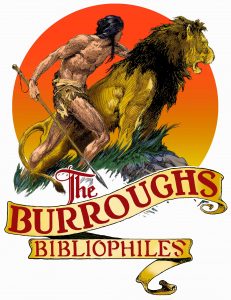
Founded in September 1960, The Burroughs Bibliophiles is a worldwide organization of aficionados who share a love for the works and characters of American author Edgar Rice Burroughs, the celebrated creator of Tarzan. The group’s membership list includes bestselling authors, artists, scientists, teachers, and academicians, as well as readers who simply love a good story well told. Their logo is based on J. Allen St. John’s dust jacket art for Tarzan and the Golden Lion, published by A.C. McClurg & Co. in 1923.
 The Men’s Adventure Pulps: Argosy, Adventure, and Blue Book—ARGOSY, ADVENTURE, BLUE BOOK … when it comes to pulps, these three magazines were the “aristocrats.”
THE ARGOSY was the first pulp magazine, having been converted to an all-fiction magazine with its October 1896 issue. Two months later, publisher Frank Munsey began to print it on wood-pulp paper. The rough-paper fiction magazine — or pulp — was born.
When THE ARGOSY celebrated its 25th anniversary in 1907, its circulation had reached a half million copies. Given its success, THE ARGOSY was bound to attract imitators. Street & Smith, longtime publisher of dime novels and story papers, was first to meet the call. It debuted THE POPULAR MAGAZINE in late 1903. Munsey countered in 1904 with its second pulp, THE ALL-STORY. One year later, the Story-Press Corporation introduced THE MONTHLY STORY MAGAZINE. Not long thereafter, it became THE MONTHLY STORY BLUE BOOK MAGAZINE. In late 1910, the Ridgway Company introduced the pulp known as ADVENTURE.
These five periodicals — along with SHORT STORIES — led the pulp magazine industry for decades, publishing some of the field’s best writers: H. Bedford-Jones, Max Brand, Edgar Rice Burroughs, Agatha Christie, Zane Grey, H. Rider Haggard, James B. Hendryx, Harold Lamb, A. Merritt, Clarence Mulford, Talbot Mundy, E. Phillips Oppenheim, Sax Rohmer, Rafael Sabatini, Edgar Wallace, and others. They also introduced the world to Tarzan, Zorro, Barsoom, Hopalong Cassidy, Captain Blood, and Pellucidar.
The stresses of World War II — the loss of writers and artists to the war effort, paper shortages, declining readership, changing tastes — generated a slow but steady metamorphosis of the “aristocrats.” ARGOSY was the first to change.
In 1943, ARGOSY was converted to a bedsheet, semi-slick magazine. Although fiction stories by top pulp writers remained a mainstay, true war stories became more common, along with other true or fact-based stories. In the early fifties, ADVENTURE and BLUE BOOK followed suit.
 As the pulp industry contracted during the 1950s, men’s adventure magazines began to take off. The successful transformations of ARGOSY, ADVENTURE, and BLUEBOOK (renamed in 1952) led to a significant increase in men’s adventure magazine titles. Although many were short-lived, more than 150 men’s adventure magazines were launched during the decade, thanks to the three “aristocrats.”
Join PulpFest 2019 on Friday, August 16, as we welcome Bob Deis and Wyatt Doyle for “ARGOSY, ADVENTURE and BLUE BOOK — Men’s Adventure Pulps,” a look at how these “pulp giants” became men’s adventure magazines.
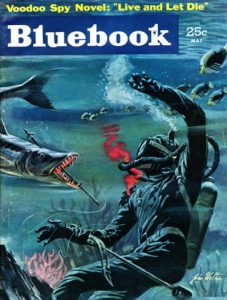
Bob Deis has worked as a teacher, artist, musician, logger, magazine writer, and a state government bureaucrat. By accident, he fell into a lengthy career as a political consultant. Now retired, Bob spends much of his time collecting, writing, and publishing books about the men’s adventure magazines, including the November 1957 issue of Adventure, featuring cover art by Mort Künstler (as Emmett Kaye), and the May 1954 issue of Bluebook, featuring cover art by John Walter.
In 2009, Bob created the popular website MensPulpMags.com about the genre. Several years later, he became friends with another fan of the men’s adventure genre, writer and publisher Wyatt Doyle, co-founder of the New Texture imprint.
Together, Bob and Wyatt co-edit and publish the Men’s Adventure Library series, which collects classic stories and artwork from the men’s adventure magazines. Their books include Weasels Ripped My Flesh!, He-Men, Bag Men, & Nymphos, Cryptozoology Anthology, A Handful of Hell, Barbarians on Bikes, I Watched Them Eat Me Alive, and Pollen’s Women: The Art of Samson Pollen.
 The Game’s Afoot: Sherlock Holmes and the Pulps—2019 marks the 160th anniversary of Sir Arthur Conan Doyle’s birth. Although best known as the creator of Sherlock Holmes, the author preferred his historical fiction. THE WHITE COMPANY was his favorite. He was extremely prolific.
Conan Doyle began writing as a medical student. His first sale, “The Mystery of Sasassa Valley,” was published when he was twenty. However, countless rejections, low word rates, and lack of author credit were leading nowhere.
Shortly after graduating from medical school, Conan Doyle married Louisa Hawkins. Armed with his wife’s small estate and encouragement, the author continued to write.
While trying to sell an early novel, Conan Doyle began a new one. It featured a character modeled after C. Auguste Dupin — Edgar Allan Poe’s amateur detective — and Dr. Joseph Bell, one of the author’s medical school instructors. Dr. Bell taught that keen observation and logic were paramount in diagnosing disease. Following several rejections, Conan Doyle sold “A Study in Scarlet.” It was published in the November 1887 number of BEETON’S CHRISTMAS ANNUAL. A hardbound book followed.
Although he preferred writing historical fiction, Conan Doyle noticed that readers wanted to learn more about his protagonists from “A Study in Scarlet.” After contracting to provide a forty-thousand-word novel to LIPPINCOTT’S MONTHLY MAGAZINE, he obliged his readers. “The Sign of the Four” appeared in the February 1890 number of the magazine. It was not long before the author would return with more stories of Sherlock Holmes and Doctor Watson.
To efficiently exploit the growing market for monthly magazines, Conan Doyle decided to offer more Holmes and Watson. In the summer of 1891, “A Scandal in Bohemia” appeared in THE STRAND MAGAZINE. Eleven more tales followed, one per month for the next year. In writing the stories that became THE ADVENTURES OF SHERLOCK HOLMES, Conan Doyle created the first short story series. In the years that followed, his idea was imitated across the globe. It still resounds in television series and throughout popular culture.
Please join PulpFest 2019 on Friday, August 16, for “The Game’s Afoot: Sherlock Holmes and the Pulps.” Our presentation will begin at 7:55 in the programming area at the DoubleTree by Hilton Hotel Pittsburgh – Cranberry. It will feature George Vanderburgh, who has published over 600 books, including many volumes of Sherlockian scholarship. His Battered Silicon Dispatch Box has also published many pulp-related volumes and numerous collections of early detective fiction. George also served as co-editor of Arkham House Publishers until April Derleth’s death.
Joining George will be Garyn G. Roberts, a professor of English and popular culture who has written extensively about the pulps, both professionally and as a fan. Garyn has also edited or co-edited some of the best pulp fiction collections. He is the author/editor of the award-winning THE PRENTICE HALL ANTHOLOGY OF SCIENCE FICTION AND FANTASY. In 2013, Garyn received the Munsey Award to honor his many contributions to the pulp community. He was also a Mystery Writers of America Edgar Award Finalist for DICK TRACY AND AMERICAN CULTURE in 1994.
Garyn and George will discuss Sir Arthur Conan Doyle and his creations, and their vital importance to the evolution of popular culture for over 100 years. Please join them at PulpFest 2019, taking place from Thursday evening, August 15, through Sunday afternoon, August 18, in Mars, Pennsylvania.
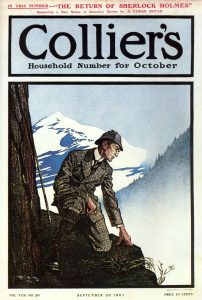
Almost ten years after killing Holmes off at the Reichenbach Falls, Conan Doyle brought his character back in “The Adventure of the Empty House.” The story first appeared in the September 26, 1903 number of Collier’s, with a cover illustration by Frederic Dorr Steele.
 The Secret Life of Women Pulp Artists—the sensational pulp magazines were illustrated by many legendary artists with colorful personalities. They often competed for freelance assignments. This pecking order included exceptional women such as Constance Bailey, Margaret Brundage, Dorothy Flack, Madge Geyer, Thelma Gooch, Alice Kirkpatrick, Zoe Mozert, Margery Stocking, Gloria Stoll, Xena Wright, and Irene Zimmerman. These women defied social norms and pursued their own art careers in the male-dominated world of publishing.
Please join PulpFest 2019 on Friday, August 16, as we learn all about “The Secret Life of Women Pulp Artists.” Pulp art historian David Saunders will share biographical profiles of these cultural pioneers who worked beyond glass ceilings.
Born in 1954, David Saunders is a New York artist. His work has been collected worldwide and is on view at the Museum of Modern Art, The Metropolitan Museum of Art, The Brooklyn Museum of Art, and the Hirshhorn Museum of Art in Washington, DC. He has taught art at Yale, Oberlin, and the Kansas City Art Institute, as well as art schools in France, Korea, Mexico, and Japan. David’s father was the legendary illustrator, Norman Saunders, while his mother, Ellene Politis Saunders, worked at Fawcett Publications as Chief Executive Editor for Women’s Day.
A New York artist, David’s work has been collected worldwide and is on view at the Museum of Modern Art, The Metropolitan Museum of Art, The Brooklyn Museum of Art, and the Hirshhorn Museum of Art in Washington, DC. He has taught art at Yale, Oberlin, and the Kansas City Art Institute, as well as art schools in France, Korea, Mexico, and Japan. He is probably the foremost scholar of American pulp illustrators. His free public website, Field Guide to Wild American Pulp Artists, includes hundreds of biographical profiles of these popular-culture creators. David continues to research, document, and promote a greater appreciation of pulp artists. To learn more, visit davidsaunders.biz, normansaunders.com, and theillustratedpress.com. Additionally, David is the creator of the Munsey Award and a Lamont Award winner.
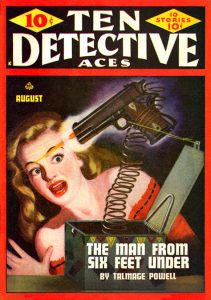
Irene Zimmerman — who used the pen name Irene Endris — started her commercial art career during the 1920s in newspapers and The Golden Book Magazine. In the 1930s, she began drawing pen-and-ink interior illustrations for Harry Donenfeld’s spicy pulp magazines. Zimmerman also painted covers for Crack Detective, Speed Detective, Ten Detective Aces — including the August 1946 number — and Liberty Magazine.
 Dashiell Hammett and the Detective Story—Dashiell Hammett was born on May 27, 1894, making 2019 the 125th anniversary of his birth. Hammett was not the first pulp author to write hardboiled detective fiction, but he was the most influential. His voice was original, steeped in cynicism bred by first-hand experience as a former Pinkerton Op. His stories and novels transcend their humble origins and are recognized as literature today. Hammett’s fiction and characters have left an indelible mark on popular culture nearly a century after he first appeared in the pages of SMART SET and BLACK MASK.
While legendary Hammett characters such as The Continental Op, Sam Spade, Nick & Nora Charles, and Ned Beaumont started in the pulps (and slicks), they reached an even wider audience in film, radio, and television. Humphrey Bogart, the team of William Powell and Myrna Loy, and George Raft brought Spade, Nick & Nora, and Ned Beaumont to the silver screen before being succeeded, respectively, by Howard Duff on radio, the team of Peter Lawford and Phyllis Kirk on television, and Alan Ladd in the silver screen remake of THE GLASS KEY. The nameless Continental Op was less faithfully transferred in ersatz adaptations for radio and a spin-off film version as Brad Runyon (rather than Casper Gutman) in THE FAT MAN, and 25 years later in a television mini-series with James Coburn as Hamilton Nash in THE DAIN CURSE. Less memorable variations of these properties preceded and followed these notable versions. Despite the undeniable charm of Nick and Nora on the big and small screen and Bogart’s career-defining portrayal of Sam Spade in John Huston’s classic film version of THE MALTESE FALCON, no Hammett adaptation has remained entirely faithful to the written word or matched the depth and flawed moral complexities displayed by Hammett’s characters on the printed page.
The shining light of the BLACK MASK school of detective fiction left behind another legacy, albeit one that is less celebrated 85 years later. Alongside FLASH GORDON creator Alex Raymond, Hammett launched SECRET AGENT X-9 in 1934. The newspaper strip was enormously successful in its day, spawning not one, but two Saturday matinee movie serials from Universal Pictures in the 1930s and 1940s. The newspaper strip continued for many decades, crossing over into comic books as well, and eventually becoming SECRET AGENT CORRIGAN.
Hammett’s background as a Pinkerton man infused his detective stories with a realism few other writers could match. An unfaithful husband and an often absent father, he was a flawed man. His literary output teetered as he debated deserting his wife and family. Like Sam Spade in the closing chapter of THE MALTESE FALCON, Hammett faced the consequences of his actions and, in the process, forever extinguished the spark of moral turpitude that lit his creative flames. Twenty years later, he teetered on the moral brink again when he struggled with what freedom really meant as an American citizen. His guilt over his violent past as a literal Union strikebreaker fueled his defense of workers’ rights late in life. He tried to make a better choice and was condemned in his own era for resolving to stick to his values once he recognized the wages of sin. A veteran of both World Wars, he served time in a state penitentiary for defending civil rights against the House Un-American Activities Committee. He was released from prison a broken man and died of the tuberculosis that had plagued him since the First World War.
Friday night, August 16, at PulpFest 2019, critically acclaimed pop culture historian and 2006 Lamont Award recipient John Wooley of Reverse Karma Press presents “Dashiell Hammett and the Detective Story.” Joining him will be ADVENTURE HOUSE publisher and editor John Gunnison. Plan to be present for a celebration of the life and work of the single greatest writer of hardboiled detective fiction, the pulp writer who has achieved the greatest literary acclaim, and a man whose work is still justly celebrated for being as vital and influential today as it was when he typed his first story nearly a century ago.
 Written by William Patrick Maynard.
H. C. Murphy painted the initial cover for Dashiell Hammett’s five-part serial, “The Maltese Falcon.” It was originally published in the September 1929 through January 1930 issues of Black Mask. The story introduced the iconic private detective, Sam Spade.
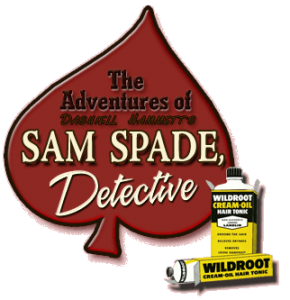
The Adventures of Sam Spade was a radio series loosely based on Dashiell Hammett’s morally complex private eye, Sam Spade. The show ran for 13 episodes on ABC in 1946, 157 episodes on CBS in 1946-1949, and 51 episodes on NBC in 1949-1951. It starred Howard Duff as Sam Spade and Lurene Tuttle as his secretary, Effie. William Spier produced and directed the series, which was sponsored by Wildroot Cream Oil Hair Tonic.
The Key of Imagination: The Twilight Zone and the Pulps—Rod Serling’s THE TWILIGHT ZONE ran on CBS from 1959 to 1964. It remains in syndication today. A new version of the series — narrated by filmmaker Jordan Peele — premiered on CBS All Access on April 1, 2019. Sixty years after its original debut, Rod Serling’s remarkable creation remains deeply embedded in the public consciousness.
The creator of THE TWILIGHT ZONE was born on December 25, 1924, in Syracuse, New York. His brother, the late novelist and aviation writer Robert Serling, said:
“We were fairly close as kids, and we played together a hell of a lot, despite the seven-year difference. The two of us used to read AMAZING STORIES, ASTOUNDING STORIES, WEIRD TALES — all of the pulps. If we saw a movie together, we’d come home and act it out, just for the two of us.”
After serving in World War II as an army paratrooper, Rod Serling entered Antioch College in Ohio. He majored in language and literature and became involved in the college’s radio programming. While still in college, he began to sell his radio and television scripts. Long an admirer of Norman Corwin — a writer and producer who used entertainment to explore social issues — Serling complained that he was “. . . bitter about everything and at loose ends.” He began writing “. . . to get it off my chest.”
Rod Serling’s big break came in 1955 when KRAFT TELEVISION THEATER produced his drama, “Patterns.” It won him his first of six Emmy awards. Serling’s “Requiem for a Heavyweight,” written for PLAYHOUSE 90, won him another Emmy in 1956. “The Comedian,” starring Mickey Rooney, won Serling a third Emmy in 1958.
At the top of the entertainment world but still dissatisfied, Rod Serling began searching for a new way to get things off his chest. He had previously written science fiction and fantasy while working for THE STORM, a television series that aired live in the Cincinnati area. He had also attempted to sell a few science fiction scripts to the ABC series, TALES OF TOMORROW. However, having written no published science fiction or fantasy and — according to author Ray Bradbury — knowing little about the field, Serling turned to these genres for his first television series. In a 1963 interview published in the first issue of GAMMA, Rod Serling explained:
“Because I loved this area of imaginative storytelling — and because there had never been a TV series like it. The strength of TWILIGHT ZONE is that through parables, through placing a social problem or controversial theme against a fantasy background you can make a point which, if more blatantly stated in a realistic frame, wouldn’t be acceptable. Because of this from time to time, we’ve been able to make some pertinent social comments on conformity, on prejudice, on political ideologies, without sponsor interference. It offered a whole new outlet, a new approach.”
 Although he wrote or adapted nearly sixty percent of the series’ 156 episodes, Rod Serling also employed writers Ray Bradbury, Earl Hamner, Jr., Jerry Sohl, and his “three writing gremlins,” Charles Beaumont, George Clayton Johnson, and Richard Matheson. Most were actively writing science fiction or fantasy for the magazines of the day.
Join PulpFest 2019 on Friday, August 16, as we welcome Nicholas Parisi for “The Key of Imagination: THE TWILIGHT ZONE and the Pulps.” He will be discussing the creation and history of Rod Serling’s fantastic program and its relationship to the science fiction and fantasy pulps and digests. A former staff writer and editor for GOOD TIMES magazine, Nicholas is the author of ROD SERLING: HIS LIFE, WORK, AND IMAGINATION.
PulpFest 2019 will begin on Thursday, August 15, and run through Sunday, August 18. Join PulpFest at the DoubleTree by Hilton Hotel Pittsburgh – Cranberry, just north of Pennsylvania’s “Steel City,” in Mars, PA.
You unlock this door with the key of imagination. Beyond it is another dimension — a dimension of sound, a dimension of sight, a dimension of mind. You’re moving into a land of both shadow and substance, of things and ideas. You’ve just crossed over into The Twilight Zone.
Rod Serling was interviewed for the first issue of Gamma, a short-lived science fiction magazine that debuted in 1963. In addition to the Serling interview, five authors who wrote for The Twilight Zone also had stories in the issue — Charles Beaumont, Ray Bradbury, George Clayton Johnson, Richard Matheson, and John Tomerlin. The cover painting for Gamma #1 was by Morris Scott Dollens, an artist who got his start in the science fiction fanzines of the late 1930s.
 Charles Beaumont: The Short Life of Twilight Zone’s Magic Man—a prolific writer of both fiction and nonfiction, Charles Beaumont was born on January 2, 1929. According to award-winning writer and editor Roger Anker, “In a career which spanned a brief thirteen years,” Beaumont wrote and sold “ten books, seventy-four short stories, thirteen screenplays (nine of which were produced), two dozen articles and profiles, forty comic stories, fourteen columns, and over seventy teleplays.”
Beaumont grew up with the pulps. He wrote for PLAYBOY in 1962:
“Were they any good? No. They were great. DOC SAVAGE, THE SHADOW, THE SPIDER, G-8 AND HIS BATTLE ACES, THE PHANTOM, ADVENTURE, ARGOSY, BLUE BOOK, BLACK MASK, THRILLING WONDER STORIES, MARVEL TALES — and all the hundred-and-one other titles that bedizened the newsstands of America in the halcyon days — provided ecstasy and euphoria of a type unknown to this gloomy generation. They made to crawl deliciously young scalps. They inspired, excited, captivated, hypnotized — and, unexpectedly, instructed — the reckless young …”
During the summer of 1946, Beaumont met author Ray Bradbury in Los Angeles. Through a mutual interest in comic strips, the two became friends. Bradbury also became Beaumont’s writing mentor, reading and critiquing the budding author’s work. “When I read the first one, I said: ‘Yes. Very definitely. You are a writer,’ recalls Bradbury. ‘It showed immediately … Chuck’s talent was obvious from that very first story.’”
Charles Beaumont’s professional writing career began with the novella, “The Devil, You Say?” published in the January 1951 issue of AMAZING STORIES. He soon appeared in the pulps of his day — primarily digest magazines — IF, IMAGINATION, INFINITY SCIENCE FICTION, THE MAGAZINE OF FANTASY AND SCIENCE FICTION, MANHUNT, ORBIT SCIENCE FICTION and others. In September 1954, Beaumont’s “Black Country” appeared in PLAYBOY. Before long, his stories were appearing in prestigious magazines such as COLLIER’S, ESQUIRE, and THE SATURDAY EVENING POST.
Beaumont also began to write for television, authoring episodes for programs including ALFRED HITCHCOCK PRESENTS, THE D. A.’S MAN, FOUR STAR PLAYHOUSE, HAVE GUN, WILL TRAVEL, NAKED CITY, ONE STEP BEYOND, ROUTE 66, THRILLER, WANTED: DEAD OR ALIVE, and, most importantly, THE TWILIGHT ZONE. Beaumont wrote twenty-two episodes for Rod Serling’s classic series, including “The Howling Man,” “Living Doll,” and “Number 12 Looks Just Like You.” He also authored a number of screenplays, including THE HAUNTED PALACE, THE MASQUE OF THE RED DEATH, and THE CIRCUS OF DR. LAO.
At the height of his writing career, Beaumont began to suffer from a mysterious ailment. “By 1964, he could no longer write. Meetings with producers turned disastrous. His speech became slower, more deliberate. His concentration worsened … after a battery of tests at UCLA, Beaumont was diagnosed as having Alzheimer’s Disease; he faced premature senility, aging, and an early death.” He died on February 21, 1967, at the age of thirty-eight.
Join PulpFest 2019 on Friday, August 16, for an authorized screening of Jason and Sunni Brock’s documentary, CHARLES BEAUMONT: THE SHORT LIFE OF TWILIGHT ZONE’S MAGIC MAN. “The story of a man whose life was in many ways more incredible than any of his stories,” the film features Forrest J Ackerman, Christopher Beaumont, Ray Bradbury, Roger Corman, Harlan Ellison, George Clayton Johnson, S. T. Joshi, Richard Matheson, William F. Nolan, William Shatner, John Shirley, John Tomerlin, and others.
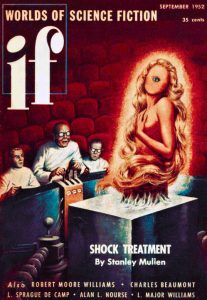
Although Charles Beaumont is highly regarded for the teleplays that he wrote for Rod Serling’s The Twilight Zone, he started as a pulp writer. After his first story appeared in Amazing Stories, his second published story — “The Beautiful People”— appeared in the September 1952 issue of If: Worlds of Science Fiction. The author was prominently listed on the magazine’s cover, which featured a painting by Ralph Joiner. In 1963, John Tomerlin adapted the story for The Twilight Zone. It was first broadcast on January 24, 1964, as “Number 12 Looks Just Like You.”
If you can’t wait for our special viewing of Charles Beaumont: The Short Life of Twilight Zone’s Magic Man, you can pick up a copy via Amazon or by clicking here.
Saturday, August 17, 2019
 Contemporary Pulp: Writing Genre Fiction—PulpFest is proud that over 30 writers will be attending our 2019 convention. “Back in the day,” the authors who worked in the rough-paper industry liked to call themselves scribes, word-slingers, penny-a-worders, and, perhaps most fondly, fictioneers. Join PulpFest as we celebrate today’s fictioneers — the authors writing today’s pulp fiction!
At 3:15 PM on Saturday, August 17, please join Fu Manchu continuation author William Patrick Maynard in the PulpFest 2019 programming hall for a look at contemporary genre fiction. Joining him for the panel will be a quintet of established authors.
John C. Bruening is the co-founder of Flinch Books, publisher of Bruening’s critically acclaimed Prohibition-era pulp hero series MIDNIGHT GUARDIAN that began with 2016’s HOUR OF DARKNESS and continues with the 2019 publication of THE ANNIHILATION MACHINE. Bruening has also edited Flinch! Books‘ adventure, horror, and science fiction anthologies BIG TOP TALES, RESTLESS, and QUEST FOR THE SPACE GODS.
Recently named the Director of Publishing for Edgar Rice Burroughs, Inc., Christopher Paul Carey is also among the most accomplished of the stable of licensed authors in THE WILD ADVENTURES OF EDGAR RICE BURROUGHS series. He is also the authorized continuation chronicler of Philip Jose Farmer’s KHOKARSA series that bridges the works of Edgar Rice Burroughs and H. Rider Haggard. Carey has authored the novels SWORDS AGAINST THE MOON MEN, BLOOD OF ANCIENT OPAR, HADON — KING OF OPAR, EXILES OF KHO, and THE SONG OF KWASIN. He is also an accomplished editor, comic book writer, essayist, and short-fiction author.
2019 Munsey Award nominee Win Scott Eckert launched the first Wold Newton website, The Wold Newton Universe in 1997. Over the next twenty-two years, he has written or co-written novels and short stories featuring characters such as Philip José Farmer’s Patricia Wildman, cult favorites Honey West and T. H. E. Cat, and classic properties such as The Green Hornet, Zorro, The Phantom, The Lone Ranger, The Green Ghost, Phileas Fogg, The Domino Lady, and Sherlock Holmes. His latest novel is HUNT THE AVENGER. A tireless chronicler of Farmer’s idiosyncratic view of a broad shared universe, Eckert has shown remarkable fidelity to Farmer’s vision and inspires many who have followed in his wake.
Author of the Edgar-nominated HECTOR LASSITER historical crime series, Craig McDonald is an award-winning novelist, journalist and editor. The HECTOR LASSITER series chronicles the exploits of a fictional BLACK MASK author and his encounters with such notable figures as Ernest Hemingway, Orson Welles, Ian Fleming, and Lester Dent. McDonald’s internationally acclaimed works have found a global audience and have also been adapted as a graphic novel. Simon & Schuster and Macmillan Press have published his works.
Some argue that a man who has penned so many introductions needs one of his own, but Will Murray’s accomplishments and the esteem in which his peers hold him demand recognition. Will Murray is the legendary author, historian, and comic book writer who continues to set the bar for everyone else in the field. The official continuation author of Doc Savage, Murray has also been licensed to continue the adventures of Tarzan, The Shadow, and King Kong. A tireless researcher of pulp and comics history, Murray has written extensively for both Marvel and DC Comics and co-created Squirrel Girl with the late Steve Ditko. Recipient of numerous industry awards for his scholarship, his fiction has also been recognized by Pulp Ark and Pulp Factory with Awards for Best Series Revival and Best Novel, respectively. A Lamont Award recipient in 1979 for his contributions to the betterment of the pulp community, Will Murray is as vital 40 years later as ever.
Written by William Patrick Maynard.
Hailed by author and science fiction scholar Richard Lupoff as a “masterpiece of science fiction” and a “pioneering work of the modern school of social extrapolation in science fiction,” Edgar Rice Burroughs’ classic lunar trilogy continues in Christopher Paul Carey’s Swords Against
the Moon Men, with cover art by Chris Peuler and Interior Illustrations by Mark Wheatley.
 The 2019 Munsey Award—George Vanderburgh has been named the winner of the 2019 Munsey Award. Nominated by the general pulp community, George was selected by previous winners of the Lamont, Munsey, and Rusty Awards.
The Munsey is a fine art print created by David Saunders and published by Dan Zimmer of The Illustrated Press. It is presented annually to an individual or organization that has bettered the pulp community. Bill Lampkin — winner of the 2018 Munsey Award — presented this year’s award.
George Vanderburgh has published over 600 books through his Battered Silicon Dispatch Box, many of them directly related to the pulps. He was largely responsible for finally getting all of Fred Davis’ classic Moon Man stories back into print. And what about his Peter the Brazen series, his five volumes featuring the work of Seabury Quinn, THE COMPLEAT ADVENTURES OF THE PARK AVENUE HUNT CLUB, his Green Ghost set, THE COMPLEAT SAGA OF JOHN SOLOMON, THE ADVENTURES OF THE GOLDEN AMAZON, THE COMPLEAT ADVENTURES OF THE SUICIDE SQUAD, and others? He has also given us numerous collections of detective fiction, including volumes featuring the Thinking Machine, Dr. Thorndyke, and Martin Hewitt. On his website, he says his future plans include several books reprinting pulp authors who have been unjustly forgotten. Along with the late Robert Weinberg, George co-edited Arkham House Publishers until April Derleth’s death. A regular attendee of pulp conventions, George has helped longtime and new fans collect tales of some of the most fantastic heroes from the pulps. At this year’s PulpFest, George presented, “The Game’s Afoot: Sherlock Holmes and the Pulps.”
Congratulations to George on this well-deserved award.
Others nominated for our 2019 award included Mike Ashley, Richard Bleiler, Camille Cazedessus, William Contento, Win Scott Eckert, Ralph Grasso, Stephen Haffner, Rich Harvey, Chris Kalb, Rick Lai, Sheila Vanderbeek, Chuck Welch, Howard Wright, and Dan Zimmer.
 Farmer of the Pulps: A Harvest of Influences—Philip José Farmer is arguably the most influential pulp figure to emerge since the Golden Age. His Wold Newton family of crossover fiction provides the pulp equivalent of the Sherlockian Great Game for its many followers; continues to inspire sectarian groups who form their own variations of crossover chronologies; confounds or infuriates the most ardent canonical purists; and enriches the pulp community as a whole through the peerless research and scholarship into pulp history undertaken in its wake. Since 2011, PulpFest has partnered with FarmerCon to bring pulp fans the biggest and best pulp con in the East while hosting an annual gathering for Wold Newtonians to celebrate our shared literary family tree.
On Saturday, August 17, FarmerCon XIV showcases a panel discussion, “Farmer of the Pulps: A Harvest of Influences,” moderated by Paul Spiteri (co-editor of FARMERPHILE magazine and editor of the anthology, PEARLS OF PEORIA). The panel will explore the pulp origins and influences on some of Philip José Farmer’s most notable characters. It will also delve into Phil’s unique take on classic pulp characters in his writings, and the care and research he took to ensure they were treated with the reverence they deserved. Joining Paul on this panel will be a trio of distinguished and erudite pulp scholars.
Garyn G. Roberts, Ph.D., has written extensively about the pulps, both professionally and as a fan. He has edited or co-edited some of the best collections from the pulps, including A CENT A STORY: THE BEST FROM TEN DETECTIVE ACES, MORE TALES OF THE DEFECTIVE DETECTIVE IN THE PULPS, THE COMPLEAT ADVENTURES OF THE MOON MAN, THE MAGICAL MYSTERIES OF DON DIAVOLO, and THE COMPLEAT GREAT MERLINI SAGA. His THE PRENTICE HALL ANTHOLOGY OF SCIENCE FICTION AND FANTASY, a university-level textbook, is notable for the attention paid to the pulp magazines. Professor Roberts received the Munsey Award in 2013 to honor his many contributions to the pulp community.
Recently named the Director of Publishing for Edgar Rice Burroughs, Inc., Christopher Paul Carey is also among the most accomplished of the stable of licensed authors in THE WILD ADVENTURES OF EDGAR RICE BURROUGHS series. He is also the authorized continuation chronicler of Philip José Farmer’s KHOKARSA series that bridges the works of Edgar Rice Burroughs and H. Rider Haggard. Carey has authored the novels SWORDS AGAINST THE MOON MEN, BLOOD OF ANCIENT OPAR, HADON — KING OF OPAR, EXILES OF KHO, and THE SONG OF KWASIN. He is also a seasoned editor, comic book writer, essayist, and short-fiction author.
Fantasy and horror writer Jason Scott Aiken is also the host and producer of “Pulp Crazy,” a video podcast devoted to pulp magazines since its inception in 2013. Jason has used this forum to provide overviews of pulp characters and authors, delve into the many pulp genres, and review pulp stories and novels. Jason has also provided audio recordings from PulpFest, with particular coverage of FarmerCon.
Additionally, Meteor House will debut their latest fantastic collection of stories by Philip José Farmer at FarmerCon XIV! GREATHEART SILVER AND OTHER PULP HEROES collects, for the first time in hardcover, the stories Phil wrote in the 1970s to pay tribute to the pulps he first devoured in his youth. The volume also features an introduction by pulp historian and panel member, Garyn G. Roberts, Ph.D. The collection gathers rare material that originally appeared in Byron Preiss’ WEIRD HEROES and in THE MAGAZINE OF FANTASY & SCIENCE FICTION.
Written by William Patrick Maynard.
Philip José Farmer was a child of the pulps. Born in 1918, the Science Fiction Grand Master grew up with the pulps. He particularly favored Edgar Rice Burroughs’ Tarzan of the Apes. Running a close second was Lester Dent’s Doc Savage.
The first edition of Farmer’s “biography” of Clark Savage, Jr. — Doc Savage: His Apocalyptic Life — was released by Doubleday in 1973. It featured dust jacket art by Walter Baumhofer, adapted from the April 1935 issue of Street & Smith’s Doc Savage Magazine.
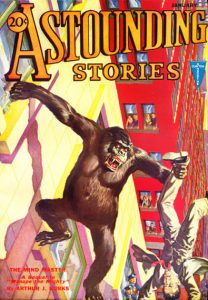 Born Writing: The Unparalleled Career of Arthur J. Burks—pulp writer Arthur J. Burks was fated to be better known for the quantity of his output than the quality of his fiction. A familiar name on many pulp covers, he was a highly effective storyteller who authored approximately 800 stories. On Saturday, August 17, at Pulpfest 2019, pulp authority John Locke, the 2004 recipient of the Lamont Award, will host a presentation, “Born Writing: The Unparalleled Career of Arthur J. Burks.”
We’re all familiar with the amazing million-word-a-year men of the pulps. This talk will focus on how Burks became one of them.
Burks was born to a farming family in Washington state on September 13, 1898. During World War I, he enlisted in the Marine Corps as a private; after rejoining the Corps during World War II, he retired as a Lieutenant Colonel. His real passion, though, was writing. While stationed in the Dominican Republic from 1921-24, he witnessed strange things which gave him material for his first professional sales to a new magazine, WEIRD TALES. In the 1930s, his work seemed to be everywhere. He wrote countless adventure, aviation, boxing, detective, and weird menace tales for AIR STORIES, ASTOUNDING STORIES, FIGHT STORIES, GANGSTER STORIES, MARVEL SCIENCE STORIES, POPULAR DETECTIVE, SKY FIGHTERS, SPORT STORY MAGAZINE, STRANGE TALES, TERROR TALES, THRILLING ADVENTURES, THRILLING WONDER STORIES, UNKNOWN, and many others. Burks’ series characters include deaf detective Ewart D’Strange, flyer The Winged Cavalier, New York Chinatown detective Dorus Noel, and gangland boxer Kid Friel.
His friendship with L. Ron Hubbard in the 1930s triggered Burks’s interest in the paranormal and metaphysics. By the 1960s, he was a popular fixture on the lecture circuit, sharing his knowledge with the curious and skeptical alike. Much of Burks’ fantasy fiction centers on the metaphysical. One of his best-known works (and one of the few to be published in book form), THE GREAT MIRROR (1942), concerns Martian technology utilized by Tibetan monks to foster ESP and matter transmission.
A writer to the very end, Burks died at age 75 on May 13, 1974.
We hope you’ll join pulp historian John Locke—the world’s foremost Burkologist—at PulpFest 2019 for this special hour-long presentation on the career of the highly prolific and vastly underappreciated Arthur J. Burks.
Written by William Patrick Maynard.
Arthur J. Burks was a prolific and successful pulp writer who usually wrote over one million words per year. He wrote hundreds of stories for the adventure, aviation, detective, fantasy, science fiction, sports, war, and weird menace pulps.
For Astounding Stories and its later incarnation, Astounding Science Fiction, Burks wrote fourteen stories. Most of them were of novella or longer length. “The Mind Master” — a two-part serial featured in the January (with cover art by H. W. Wessolowski) and February 1932 issues — concerns a mad scientist who replaces the brains of several apes with human brains. It’s part of a short series that Burks began in 1931 with the story, “Manape the Mighty.”
 Saturday Night Auction—Over the last few years, PulpFest has sold three major collections of pulps, books, fanzines, and related materials.
Are you thinking about selling off part or all of your pulp collection? Has a relative left you a pulp or book collection that you want to sell? Do you have a collectible magazine or perhaps a cover painting that you’d like to sell?
Please consider using PulpFest‘s annual auction to reach an enthusiastic group of collectors willing to bid on your memorabilia. To learn more about PulpFest’s auction services, please write programming director Mike Chomko at mike@pulpfest.com. You can also reach him at 2217 West Fairview Street, Allentown, PA 18104.
Adapted from Norman Rockwell’s cover for the April 29, 1922 issue of The Country Gentleman.
Thanks for Making PulpFest 2019 a Great Success—we first want to thank our regular dealers who have backed us since we mounted the first PulpFest in 2009. We are also happy to see dealers attending the convention for the first time or returning after a few years away.
We also have to thank everyone who attended the convention as a regular member. Without such support, our dealers would have no reason to come to PulpFest. Of course, thank you to all of the usual suspects who attend year after year. Thanks as well to all members who came to PulpFest for the first time or returned after a few years’ absence. Attendance at the 2019 convention was 430.
Year after year, countless individuals and organizations help make PulpFest such a great show. The PulpFest organizing committee would like to thank them for their invaluable assistance in making PulpFest 2019 a success. We could not have done it without you:
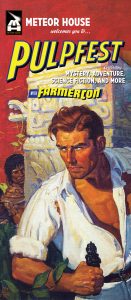 Our front desk staff – Maura Childers, Marge Coiner, Jack Cullers, and Sally Cullers.
Our panelists and presenters – Jason Aiken, Roger Alford, Jennifer Barnes and the writers from Raw Dog Screaming Press — Mike Arnzen, Carrie Gessner, John Edward Lawson, Jason Jack Miller, and Stephanie Wytovich — John Bruening, Christopher Paul Carey, Wayne Carey, Mike Chomko, Gene Christie, Jeremiah Dylan Cook, Bob Deis, Wyatt Doyle, Win Scott Eckert, John Gunnison, Rich Harvey, Morgan Holmes, Ed Hulse, John Edward Lawson and the writers from Dog Star Books — Matt Betts, J. L. Gribble, Heidi Ruby Miller, K. W. Taylor, Albert Wendland, and K. Ceres Wright — Sara Light-Waller, John Locke, William Patrick Maynard, Craig McDonald, Will Murray, Nicholas Parisi, Garyn Roberts, David Saunders, E. C. Skowronski, Paul Spiteri, Joab Stieglitz, Sara Tantlinger, George Vanderburgh, Chet Williamson, and John Wooley.
Thanks to Henry G. Franke, III and the Burroughs Bibliophiles for putting together our 2019 art show. We’d also like to thank Jason and Sunni Brock for authorizing our showing of their film, CHARLES BEAUMONT: THE SHORT LIFE OF TWILIGHT ZONE’S MAGIC MAN.
Many thanks to Mike Chomko and Barry Traylor for the time they devoted to assembling this year’s auction. Thanks also to our auctioneers John Gunnison and Joseph Saine and our auction staff, Maura Childers, Marge Coiner, and Sally Cullers.
We want to thank our technical staff – Bill Lampkin and William Patrick Maynard – and our behind-the-scenes help – Peter Chomko, Dan Zimmer, and Kate Knecht, Kirsty McCray, and Kyle Thompson and the terrific staff of the DoubleTree by Hilton Pittsburgh — Cranberry, including Austin and Stephanie, who helped a great deal with set-up.
The organizing committee would also like to thank the people who helped to create THE PULPSTER #28 – editor Bill Lampkin, assistant editor Peter Chomko, publisher Mike Chomko, Schuerholz Printing, plus contributors Richard Bleiler, Tony Davis, Doug Ellis, Scott Tracy Griffin, D. Kepler, Sara Light-Waller, Will Murray, Aaron H. Oliver, and Jess Terrell. We also want to thank James T. Roberts, Esq., for allowing us to reprint his father’s article about Sherlock Holmes. Many thanks are also offered to the magazine’s advertisers – Bear Manor Media, Black Hood Press, CONvergence, Heartwood Auctions, Meteor House Press, Mike Chomko Books, Murania Press, New Texture, the Pulp Factory Awards, Readercon, Recoverings, Stark House Press, ThePulp.Net, and the Windy City Pulp and Paper Convention.
Many thanks to the nominators and the Lamont Award, Munsey Award, and Rusty Hevelin Service Award winners who helped select this year’s Munsey winner, George Vanderburgh. Congratulations to George and to all of the nominees for our 2019 award. Thank you to 2018 Munsey winner Bill Lampkin for presenting this year’s award.
We’d like to thank the following organizations for the books and similar items that were donated to PulpFest for distribution to our members: Chaosium, Inc., Gordon Van Gelder and THE MAGAZINE OF FANTASY & SCIENCE FICTION, and Mike Chomko, Books. We would also like to thank the Windy City Pulp and Paper Convention for lending the convention their sound system. Thanks to Meteor House Press for sponsoring this year’s PulpFest banner and to our website sponsors, SmartWritingService.com and DoMyEssay.net.
Thanks must also be extended to John and Maureen Gunnison of Adventure House, David and Daniel Ritter of First Fandom Experience, Richard Meli of Heartwood Books and Art, Mike Croteau, Paul Spiteri and Win Scott Eckert of Meteor House Press, Mike Chomko, Books, Mark Redfield and Jennifer Rouse of Redfield Arts Audio, author Christopher Ryan, Steven Spilger of Mr. Polyester Books and Comics, Christopher Maffei of Well-Stacked Books, and Doug Ellis and John Gunnison of the Windy City Pulp and Paper Convention for sponsoring this year’s hospitality suite at the DoubleTree.
Finally, thanks to Ron Adams and Monster Bash, Jim Beard, Doug Ellis, Steve Ericson, Martin Grams, Steve Hager, Jeff Harper, Sara Light-Waller, Todd McDevitt and New Dimension Comics, Heidi Ruby Miller, Curt Phillips, Rick Thomas, Ray Walsh and the Curious Book Shop, Publicity Chair Karen Yun-Lutz and Confluence, and the many conventions, book and paper fairs, bookstores, comic and collectible shops, websites, magazines, newspapers, and other media outlets that helped to promote our show by distributing and displaying our advertising materials. We should also mention Christopher Bowser of Geek’s Guide to Pittsburgh, Hanna Lynn and PITTSBURGH CITY PAPER, and Mike Robertson of VisitPittsburgh, who helped in various ways.
 Again, thank you to the dealers, attending members, and supporting members of PulpFest 2019. Your encouragement and support made our convention a success. We hope to see all of you in the coming year — along with a good many newcomers — for PulpFest 2020.
If we’ve neglected anyone, please accept our apology and our gratitude. Write to mike@pulpfest.com, and we will correct the oversight.
Designed by PulpFest’s artistic director, William Lampkin, our PulpFest 2019 welcome banner — sponsored by Meteor House Press — features the work of artist Walter Baumhofer. His painting originally appeared as the cover of the March 1933 issue of Street & Smith’s Doc Savage Magazine.
Bill Lampkin adapted our PulpFest 2020 postcard from Margaret Brundage’s cover painting for the October 1933 issue of Weird Tales. Brundage’s work — one of the most iconic images ever created for “The Unique Magazine” — illustrates the first segment of Edmond Hamilton’s four-part serial, “The Vampire Master.”
Reviews and Recordings of PulpFest 2019—PulpFest 2019 is over, but you can partly relive it through the reports and recordings posted online.
We’re sorry if you couldn’t make PulpFest this year. You missed a pulp-packed weekend of programming, readings, signings, dealers, and more. Hopefully these links will encourage you to make the trip next August 6-9 to PulpFest 2020.
Read all about it
- Lewis Forro posting as “The Supreme Leader” once again has a bit of fun with his photographic report from PulpFest 2019 on his blog, The Leader’s Chronicles.
- Mike Glyer has posted about this year’s Munsey Award winner, George Vanderburgh, at his File 770 blog.
- J.L. Gribble posted her report of PulpFest on her blog.
- Ed Hulse, publisher at Murania Press, offers his report of traveling to PulpFest 2019 on his EDitorial Comments blog.
- Walker Martin‘s annual report on PulpFest has moved to Sai Shankar’s Pulp Flakes blog this year.
- Bill Lampkin of ThePulp.Net posted photos from PulpFest 2019 to Instagram throughout PulpFest 2019, but you can now view them on his blog, Yellowed Perils.
For your listening (or viewing) pleasure
- Bold Venture Press, which has reprinted the Zorro stories, has posted a video of editor Rich Harvey’s presentation, “A Century of Zorro,” from PulpFest 2019.
- ThePulp.Net has posted audio recordings and photos of 11 PulpFest 2019 panels (almost seven-and-a-half hours) on its website, as well as through its Pulp Event Podcast. The podcast is available for free through the iTunes App Store or Google Play store
- And ThePulp.Net did a Facebook Live video walk-through of the PulpFest 2019 dealers’ room
This year’s PulpFest may be over, but there’s plenty of time to start planning to attend 2020’s gathering. The convention returns to the DoubleTree by Hilton Hotel Pittsburgh – Cranberry, just north of Pittsburgh, from Thursday, August 6, through Sunday, August 9. See you then!
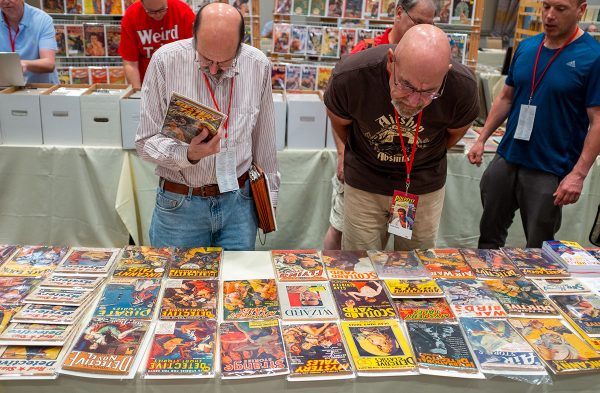
Written and compiled by Bill Lampkin, who also provided the photograph of the PulpFest 2019 dealers’ room.