
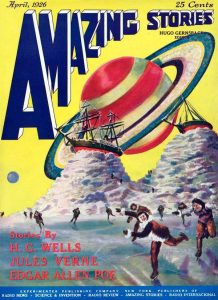
It was hard to miss the first issue of Amazing Stories on the newsstand. Letter-sized, larger than the typical pulp magazine, with three-dimensional block letters trailing across its masthead and a bright yellow backdrop that framed an alien landscape and a bright red, ringed planet and small moon, the magazine certainly stood out on the sales rack. Frank R. Paul was the artist.
The names on the front cover of the magazine’s early issues were also major selling points: Edgar Allan Poe, Jules Verne, H. G. Wells, Garrett P. Serviss, Edgar Rice Burroughs, A. Merritt, and others. As Gernsback wrote in his editorial for the pulp’s first issue: “By ‘scientifiction’ I mean the Jules Verne, H. G. Wells, and Edgar Allan Poe type story—a charming romance intermingled with scientific fact and prophetic vision.” That is what the readers of Amazing Stories sought: “They wanted to be entertained, to escape, to experience that sense of wonder that good visionary fiction brought.” (Mike Ashley, The Time Machines).
Using stories drawn from the Munsey magazines, Blue Book, The Strand, and other sources, Gernsback reprinted science-fiction classics and eventually paired them with new stories generated through contests. Through these competitions, Gernsback began to build a stable of new writers willing and able to write scientifiction: Miles J. Breur, Clare Winger Harris, David H. Keller, S. P. Meek, A. Hyatt Verrill, Harl Vincent, and others. Through his letter column, “Discussions,” he drew readers into his world of wonder.
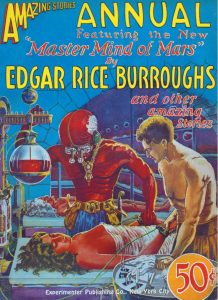 Within months, the new specialty magazine was selling over 100,000 copies of each issue. By establishing the first specialized science-fiction magazine, Gernsback tapped a vein of wonder shared by lonely individuals prone to “imaginative flights of fancy.” Next would come Amazing Stories Annual, published in the summer of 1927 and featuring Edgar Rice Burroughs’ The Mastermind of Mars. Amazing Stories Quarterly followed in the winter of 1928. Then, in the August 1928 number of Amazing Stories, Gernsback introduced his readers to E. E. “Doc” Smith’s “The Skylark of Space” and Philip Francis Nowlan’s “Armageddon—2419 AD,” the first tale to feature Buck Rogers. These two “space operas” would color science fiction for well over a decade, turning it into “that crazy Buck Rogers stuff.”
None of the penny dreadfuls, dime novels, or pulp magazines published from the turn to the middle of the twentieth century were created in isolation. A great, sometimes troubling, world buzzed around the butcher, the baker, the cop, the bobby-soxer, the factory worker, the Gibson girl, and the kid as they flipped a coin on the counter, left the newsstand, and walked home with a copy of magic in their hands.
 The magazine that transmogrified scientifiction into science fiction was certainly true to its name: AMAZING STORIES. Through war, police actions, political upheaval; through reprints and originals; through a remarkable set of editors, AMAZING persevered into the twenty-first century.
Join PulpFest 2016 at 8:45 PM on Friday, July 22, as we welcome Joseph Coluccio, president of the Pittsburgh Area Fantasy and Science Fiction Club, to our programming stage in the Union Rooms on the second floor of the Hyatt Regency Columbus for a look at AMAZING STORIES during the pulp era.
It is Mr. Coluccio’s intention to consider the history – to about mid-century – of the content found in the pages of AMAZING STORIES, not in the context of the world at large, but in comparison to the rich popular culture of the time – science, radio, film art, and literature – that surrounded and influenced the magazine. Cover art, words, and anecdotes are all that are left of those early, amazing years. Through a series of sometimes exciting, sometimes disastrous editorial decisions, AMAZING STORIES reflected changes right back into the flowing current of everyday taste. Relive those times through the words of Hugo Gernsback, T. O’Connor Sloane, Raymond A. Palmer and Howard Browne, brought to you by PARSEC‘s Joseph Coluccio.
Join “Summer’s AMAZING Pulp Con” as we salute the 90th anniversary of the first continuing science fiction magazine. The convention will take place from July 21 through July 24 at the Hyatt Regency Hotel and the city’s spacious convention center in the Columbus Arena District. You’ll have a FANTASTIC time.
Frank R. Paul painted the cover for the first issue of Amazing Stories, dated April 1926, and the 1927 Amazing Stories Annual, illustrating Edgar Rice Burroughs’ The Mastermind of Mars. The artist is widely considered the grandfather of science fiction art.
In July 2012, longtime science-fiction fan Steve Davidson revived Amazing Stories as an online magazine and ebook. About two years later, it was revived as a print magazine. Its first new issue – pictured at the head of our article and dated April 2014 – features cover art by Frank Wu. According to the artist, the painting reworks Frank Paul’s cover for the magazine’s first issue.