
One of the major themes of PulpFest 2016 will be the 90th anniversary of the first continuing science-fiction magazine, AMAZING STORIES. In addition to our Guest of Honor, Ted White – the magazine’s longest-serving editor (and its companion title, FANTASTIC) – we’ll offer a presentation on the magazine itself, put together by Joseph Coluccio, president of the Pittsburgh Area Fantasy and Science Fiction Club. Mr. Coluccio will discuss the pulp era of AMAZING, when Hugo Gernsback, T. O’Connor Sloane, Ray Palmer, William Hamling, and Howard Browne helmed the world’s first science-fiction magazine.
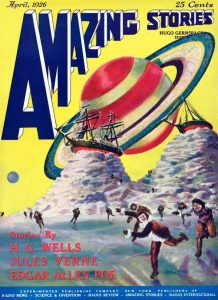 AMAZING STORIES debuted on March 10, 1926. Its inaugural issue really stood out on the newsstand. It was larger than the typical pulp magazine, with three-dimensional block letters trailing across its masthead and a bright yellow background framing an alien landscape, a ringed planet and a small moon. Frank R. Paul painted the cover, which illustrated Verne’s “Off on a Comet.”
The names on the front cover of the magazine’s early issues were also major selling points: Edgar Allan Poe, Jules Verne, H. G. Wells, Garrett P. Serviss, Edgar Rice Burroughs, A. Merritt, and others. The readers of AMAZING “… wanted to be entertained, to escape, to experience that sense of wonder that good visionary fiction brought.”
Using stories drawn from the Munsey magazines, BLUE BOOK, THE STRAND, and other sources, Gernsback offered reprints of science-fiction classics, eventually coupling these with new stories generated through contests. Through various competitions, Gernsback began to acquire a stable of new writers willing and able to write scientifiction: Miles J. Breur, Clare Winger Harris, David H. Keller, S. P. Meek, H. Hyatt Verrill, Harl Vincent, and others. Through his letter column, “Discussions,” he drew readers into his world of wonder.
Within months, the new specialty magazine was selling over 100,000 copies per issue. By establishing the first specialized science-fiction magazine, Gernsback tapped a vein of wonder shared by lonely individuals prone to “imaginative flights of fancy.” Next would come AMAZING STORIES ANNUAL, published in the summer of 1927 and featuring Edgar Rice Burroughs’ “The Mastermind of Mars.”AMAZING STORIES QUARTERLY followed in the winter of 1928. Then, in the August 1928 number of AMAZING STORIES, Gernsback introduced his readers to E. E. “Doc” Smith’s “The Skylark of Space” and Philip Francis Nowlan’s “Armageddon—2419 AD,” featuring Anthony “Buck” Rogers. These two “space operas” would color science fiction for well over a decade, turning it into “that crazy Buck Rogers stuff.”
Despite its seeming success, the Gernsback publishing empire continually struggled with cash flow. By plowing money into his radio interests and paying extremely hefty salaries to himself and his brother, Gernsback offered generally low word rates. Coupled with a slow payment schedule, often months after a story had been published, few authors were interested in writing for the company. In early 1929, Gernsback’s suppliers demanded payment on past-due bills, leading the publisher to file for bankruptcy. Experimenter Publishing Company went into receivership, ending Hugo Gernsback’s involvement with the first science-fiction pulp, AMAZING STORIES.
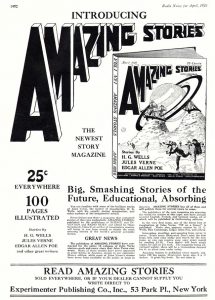 Another theme of PulpFest 2016 – the 150th anniversary of H. G. Wells‘ birth – will likewise tie into our AMAZING story. Herbert George Wells, who rose to prominence in the late nineteenth century, was educated in the sciences and was a literary genius. It would be difficult to deny Wells’ importance to the development of both science fiction and AMAZING STORIES. Along with Ray Cummings, Edgar Allan Poe, and Jules Verne, Wells is mentioned in the advertising copy for the first issue of the new science fiction magazine. The ad ran in the April 1926 issue of RADIO NEWS.
During his three years as editor and publisher of the first science-fiction magazine, Gernsback turned to Wells’ fictional output for nearly thirty stories, reprinting such tales as “The Country of the Blind,” “The Crystal Egg,” “The Empire of the Ants,” “The First Men in the Moon,” “The Invisible Man,” “The Island of Dr. Moreau,” “The Man Who Could Work Miracles,” “A Story of the Days to Come,” “The Time Machine,” “The Valley of the Spiders,” “The War of the Worlds,” and “When the Sleeper Wakes” in his flagship title and its companions.
Our presentation, “Traveling through Time with H. G. Wells,” will feature Garyn G. Roberts, winner of the 2013 Munsey Award. Professor Roberts has written extensively about the pulps, both professionally and as a fan. His work, THE PRENTICE HALL ANTHOLOGY OF SCIENCE FICTION AND FANTASY, a college-level textbook, is notable for the attention paid to the pulp magazines.
These are just some of the ways PulpFest 2016 will celebrate ninety years of the first science-fiction magazine: AMAZING STORIES. We hope you’ll join us from July 21 through July 24 at the Hyatt Regency and the city’s spacious convention center in the Columbus, Ohio Arena district for “Summer’s AMAZING Pulp Con!”
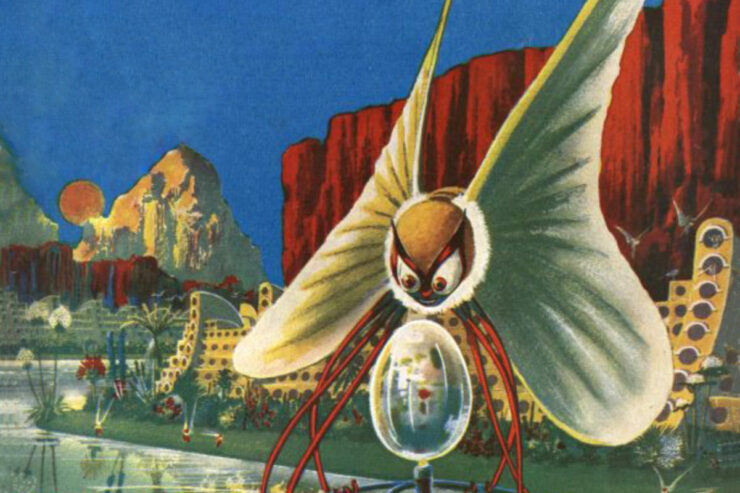
Our featured image is excerpted from Frank R. Paul’s cover for the May 1926 issue of Amazing Stories, illustrating H. G. Wells’ short story, “The Crystal Egg.” According to the contents page, it shows Mars as seen “through the crystal egg from the Earth.”
Hugo Gernsback edited and published Amazing Stories from April 1926 through April 1929. He then lost control of the magazine. His favorite artist was Frank R. Paul – now known as the “grandfather of science-fiction art” – who painted both the first and last covers of Gernsback’s Amazing Stories.
In July 2012, longtime science-fiction fan Steve Davidson revived Amazing Stories as an online magazine and ebook. About two years later, it was revived as a print magazine. Its first new issue – pictured at the head of our article and dated April 2014 – features cover art by Frank Wu. According to the artist, the painting reworks Frank Paul’s cover for the magazine’s first issue, dated April 1926.
After this post first appeared in early 2016, we ran a seven-part series on the history of Amazing Stories, written by popular culture historian Mike Ashley. The series originally ran in the January through July 1992 issues of Amazing Stories, and pulp and science fiction fan Curt Phillips brought it to our attention. We ran a slightly revised version of the series in 2026, during our celebration of Amazing Stories‘ centennial. The first post, “The Amazing Story: The Twenties – By Radio to the Stars,” appeared March 2, 2026.