 Pardon the play on words in the title, but it was hard to resist with the seventh STAR WARS movie, THE FORCE AWAKENS, premiering in theaters worldwide at the end of this week. But why write about STAR WARS on a website devoted to PulpFest, Summer’s AMAZING Pulp Con?
Two words: Leigh Brackett. Four more words: THE EMPIRE STRIKES BACK. Many consider it the best film in the STAR WARS series, and Leigh Brackett wrote the original treatment. Shortly after delivering her untitled screenplay to Twentieth Century Fox, the so-called “Queen of the Space Opera” passed away. THE EMPIRE STRIKES BACK went on to become one of the highest-grossing films of all time, and in 1981, it received a Hugo Award for best dramatic presentation.
Born 100 years ago on December 7, 1915, Leigh Brackett was Edmond Hamilton’s wife. Together, they helped popularize the so-called “space operas” of the pulp magazines.
Hamilton was the leading science fiction contributor to WEIRD TALES during the 1920s. With stories about alien invasions, space police, and evolution gone wild, the author became known as “world-wrecker” Hamilton. A few years later, Standard Magazines’ Leo Margulies asked him to work up something involving a “Mr. Future, Wizard of Science.” Eventually, the character evolved into Captain Future, a super-scientist headquartered on the Moon. He and his “Futureman” would save the known universe in every issue.
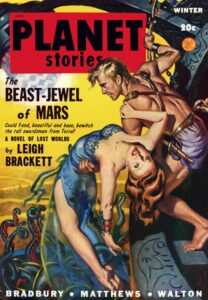
Leigh Brackett came later to the pulps, selling her first story to ASTOUNDING SCIENCE FICTION in late 1939. The bulk of her science fiction appeared in Fiction House’s PLANET STORIES and Standard’s THRILLING WONDER STORIES and STARTLING STORIES.
A native of Southern California, Leigh Brackett began collaborating on screenplays in the mid-1940s. Supposedly, Hollywood film director Howard Hawks was so impressed by her crime novel NO GOOD FROM A CORPSE that he had his secretary call in “this guy Brackett” to help William Faulkner write the script for THE BIG SLEEP. Released in 1946 and starring Humphrey Bogart and Lauren Bacall, it is considered a film noir classic. During the fifties and sixties, Brackett, Hawks, and actor John Wayne collaborated on several motion pictures, including RIO BRAVO, HATARI, EL DORADO, and RIO LOBO. Leigh Brackett died in 1978.
In 1972, Brackett and Hamilton served as the guests of honor at the first Pulpcon, the forerunner to PulpFest. Years later, in 2009, the town of Kinsman, Ohio – where Brackett and Hamilton lived – began celebrating this famed couple of pulp history. The celebration evolved into KinCon, a convention exploring the worlds of Edmond Hamilton and Leigh Brackett. Although the event is currently on hiatus, KinCon continues to celebrate these two exceptional pulp fiction writers through its website on Facebook.
Like KinCon, PulpFest seeks to draw attention to the profound effect that the pulps had on American popular culture, reverberating through a wide variety of media — comic books, movies, paperbacks and genre fiction, television, men’s adventure magazines, radio drama, and even video and role-playing games. Planned as the summertime destination for fans and collectors of vintage popular fiction and related materials, PulpFest honors pulp fiction and pulp art by drawing attention to the many ways the magazines and their creators — people like Leigh Brackett and Edmond Hamilton — have inspired writers, artists, film directors, software developers, game designers, and other creators over the decades.
Join PulpFest 2016 to be part of this great celebration of American popular culture. Start making your plans right now to join the 45th convening of “Summer’s AMAZING Pulp Con” in 2016. It will take place July 21 through July 24 at the Hyatt Regency Columbus and the Greater Columbus Convention Center in the beautiful downtown of Columbus, Ohio.
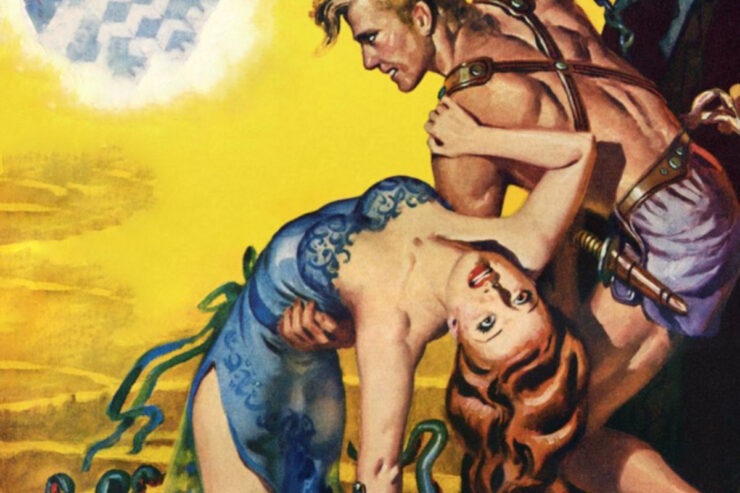
After studying art by correspondence, Allen Anderson worked as a staff artist for Fawcett Publications in Minneapolis from 1929 to 1939. He moved to New York City in 1940 and began painting covers for pulp magazines published by Ace Magazines, Fiction House, Harry Donenfeld, and Martin Goodman. He also painted comic book covers for Ziff-Davis from 1949 to 1953. From 1947 through 1953, he contributed about thirty cover paintings to Planet Stories – including the Winter 1948 issue – a Fiction House pulp magazine best remembered for the many entertaining space operas that appeared in its rough paper pages. Later, Anderson opened a small advertising agency and worked as a sign painter.