 Not only will we celebrate science fiction’s “Golden Year of 1939” and “75 Years of Fantastic Fiction,” but PulpFest 2014 will also pay homage to “The Weird-Menace Magazines of 1934.” Called shudder pulps, these magazines enjoyed a brief period of popularity that began in late 1933 and ran until 1941, when a concerted reform movement ended the genre.
Noted pulp authority Don Hutchison, author of The Great Pulp Heroes, contributed “Pulp Horrors of the Dirty Thirties,” a look at the weird-menace genre, to this year’s issue of The Pulpster, our award-winning program book. Offered here are just a few of the gory details.
Pulp Horrors of the Dirty Thirties: An Excerpt
Back in the days of bread lines and hobo jungles, millions of readers found escapist thrills in cheaply produced magazines printed on rough pulpwood paper. Pulp magazines catered to every imaginable reading taste, from detective yarns to pirate stories, from jungle adventures to science fiction and even romance. But the wildest of them all were the notorious horror tomes known collectively as the shudder pulps.
The so-called “shudder” or “weird-menace” titles were a blood-red splash of color in the grey days of the Great Depression. They announced their monthly wares with circus-poster-style covers featuring voluptuous underdressed beauties being pursued by hordes of leering lunatics as bent as boomerangs. Their promise: cheap thrills, and plenty of them.
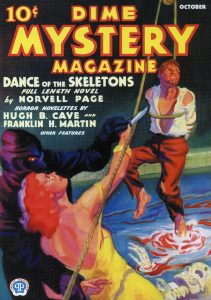 In their nightmare universe, it was always a dark and stormy night. Tethered damsels suffered in the clutches of fiends such as hell-mad surgeons, warped scientists, and masked and cowled cultists, eagerly abetted by legions of demented dwarfs and horny hunchbacks. They stripped, whipped, and boiled their curvaceous victims with the enthusiasm of medieval inquisitors. Even the requisite rock-jawed heroes of these stories suffered a purgatory of horrors in order to rescue their brutally treated fair maidens.
The weird-menace magazines lasted only a few years, roughly from 1933 to 1941, when blue-nosed watchdogs helped propel them out of the market. Unlike earlier horror magazines with their literate but eldritch mysteries, the new breed of terror pulps dared to go where no newsstand magazines had gone before. These few magazines were largely responsible for the low opinion people held (and still hold) of pulp fiction as a whole. Many dealers sold them under the counter, and New York’s mayor, Fiorello La Guardia, singled them out when he warned pulp publishers to clean up their act or get out of town.
Seasoned pros wrote stories to a strict formula, and shudder pulps featured some of the most unashamedly lurid fiction and art ever produced for the newsstands of middle America. Each month they announced their presence with covers illustrating in chromatic detail the titillating promise of stories like: “Flesh For the Goat Man,” “The Corpse Wants Your Widow,” “Food for the Fungus Lady,” “Mate For the Thing in the Box,” and “Summer Camp for Corpses.”
The first of the new breed of fiction mags, Dime Mystery, lurched onto the newsstands in October 1933. It was the brainchild of Popular Publications’ resourceful young publisher Henry Steeger and took off like a rocket. Popular Publications lost little time in producing not one, but two companion monthlies: Terror Tales, followed by Horror Stories.
Readers responded in large numbers to the lure of these purple-prose setups and the inevitable payoff in hell-spawned horrors. Soon, other publishers rushed to print similar books. Chief among them was publisher Ned Pines, whose Thrilling Mystery was a clone of Popular’s Dime Mystery. Believing the public can never get too much of a bad thing, more newcomers tested the limits of sensationalism. There was Ace Mystery, Eerie Mysteries, Eerie Stories, Mystery Novels and Short Stories, Mystery Tales, Spicy Mystery Stories, Uncanny Tales, and others.
In the early 1940s, the public rejected the permissiveness and thrill-seeking of the thirties. When New York Mayor Fiorello La Guardia threatened to rid his city of sex-and-sadism magazines, publishers retrenched in fear of losing newsstand sales as well as their U. S. postal mailing privileges. As shudder pulp stalwart Bruno Fischer described it, “Clean-up organizations started throwing their weight around and gave editors jitters, and artists and writers were instructed to put panties and brassieres on the girls.”
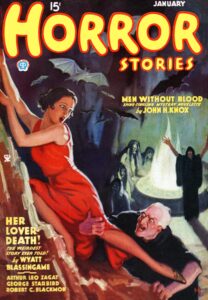 Dime Mystery was retooled as a straight mystery magazine. Spicy Mystery soldiered on for a while, then retitled itself Speed Mystery. Terror Tales and Horror Stories were shut down in 1941. Pulp fiction’s bloody reign of terror had ended, not with a bang but with a whimper. Unfortunately, by discarding key ingredients of their appeal, the magazines failed to innovate, much less attract new readers. With the coming of World War II, people could no longer view the extent of human madness and misery as mere fiction, much less enjoy it. In a more innocent time, people thought the brand of horror perpetrated by the fiends of the shudder pulps was purely imaginary. Now people knew such things – and worse – were possible.
If you’d like to read the unabridged version of the article, it will be appearing in the PulpFest 2014 program book, The Pulpster. To get a copy, become a convention member. The convention will take place August 7-10 in Columbus, Ohio. If you can’t make it to Columbus in August, become a supporting member of PulpFest 2014. We’ll mail you a copy.
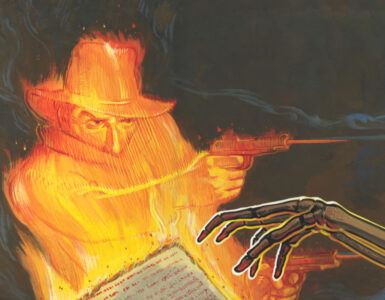
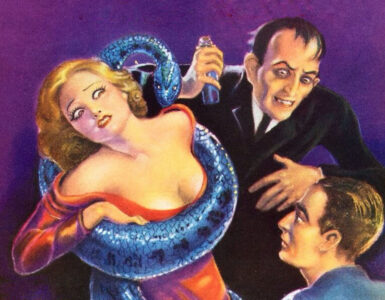
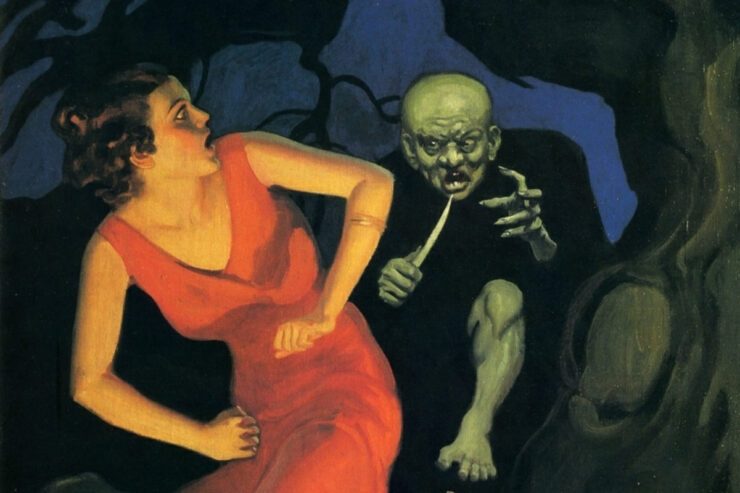
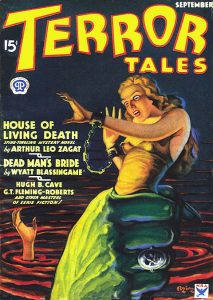
Our featured image is excerpted from John Newton Howitt’s cover for the November 1934 issue of Terror Tales. Our lead image is the September 1934 number of Terror Tales with cover art by Rudolph W. Zirm. The second image is Dime Mystery Magazine for October 1933 with cover art by Walter M. Baumhofer. The final image is John Newton Howitt’s cover for the January 1935 issue of Horror Stories.