The following posts explore the history of pulp magazines and originally appeared on the PulpFest website between January 29 and June 24, 2013.
Enter the Phantom
 Jan. 29, 2013 – In 1933, Franklin Delano Roosevelt was inaugurated as the 32nd president of the United States of America, proclaiming that “We have nothing to fear but fear itself.” Adolph Hitler was named the Chancellor of Germany, amid promises of a parliamentary democracy. San Francisco broke ground on the Golden Gate Bridge. King Kong premiered in New York City, and the hero pulp revolution began.
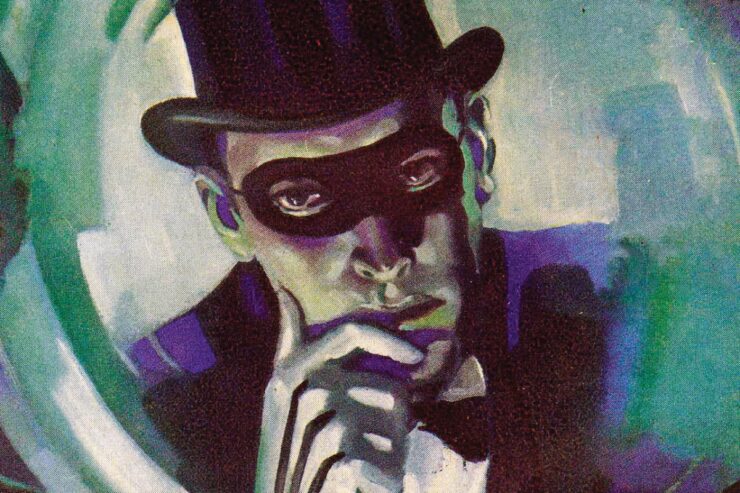
The tremendous success of Street & Smith’s The Shadow Magazine prompted the return of the single-character periodical. The first of these hero pulps was The Phantom Detective. Launched by Ned Pines’ Thrilling Group, the Phantom was the alter ego of Richard Curtis Van Loan, a man about town. A veteran of the First World War, this moneyed playboy had grown bored with life. A family friend recommended he “try his hand at solving a mysterious crime which had stumped the police.” His initial success led Van Loan to dedicate his life and fortune to combat crime, making the Phantom “a name known and admired by the police of every nation.”
The first issue of The Phantom Detective was dated February 1933. The Summer 1953 issue would be its final number. The Phantom Detective was the longest-lived hero pulp, lasting just over twenty years.
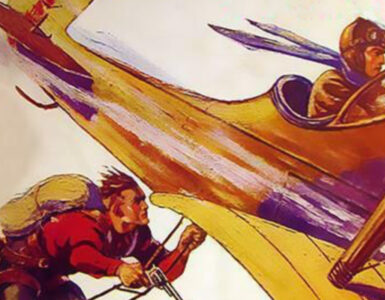
Bertram Glover contributed the cover art for the February 1933 issue of The Phantom Detective, the first of several hero pulps Standard Magazines/Better Publications published. Our featured image is excerpted from Glover’s cover.
Kenneth Robeson Coming to PulpFest
Feb. 2, 2013 – Following the astounding success of their first single-character pulp, The Shadow Magazine, Street & Smith set out to duplicate its good fortune in the adventure magazine market. Working with the company’s business manager, Henry W. Ralston, editor John Nanovic spent a year developing a scientist-adventurer who would travel the globe, right wrongs, and punish evildoers. In late 1932, Lester Dent, a former telegraph operator turned pulp writer, joined them. Soon thereafter, Doc Savage, the world’s first superhero, was born.
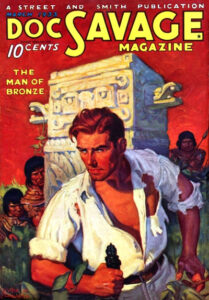 Doc Savage Magazine premiered early the next year with its first issue dated March 1933. The lead novel, “The Man of Bronze,” introduced Clark Savage, Jr. to a disheartened country thirsting for heroes. Amidst the dark days of the Great Depression, the magazine was an immediate success.
Although the first tale of Doc Savage and his five trouble-busting assistants was credited to Kenneth Roberts, a name belonging to a former journalist and author of historical novels, later novels in the series were proclaimed the work of Kenneth Robeson, a house name that hid the identity of Lester Dent and Laurence Donovan, who occasionally filled in for the series’ lead author.
PulpFest is pleased to announce that Will Murray, the current “Kenneth Robeson,” will present at the 2013 convention for fans of pulp magazines and pulp fiction. The author of a dozen Doc Savage novels for Bantam Books and Altus Press, Will hopes to be Kenneth Robeson for a long time to come.
Murray discovered Doc Savage in 1969, when he bought a copy of Bantam Books’ Dust of Death. Before long, he began collecting the original pulp magazine and writing articles about the Man of Bronze for fanzines. This modest beginning led to Murray becoming one of the leading experts on Doc Savage and the pulps, the literary agent for the estate of Doc co-creator Lester Dent, a scriptwriter for The Adventures of Doc Savage program for National Public Radio, and the latest “Kenneth Robeson.”
Murray penned seven Doc novels for Bantam Books back in 1991-93. Twenty years later, he’s doing it again for Altus Press with the Wild Adventures of Doc Savage series. For the eightieth anniversary of “The Man of Bronze,” Will teamed Doc with another legend who first appeared in 1933 — King Kong — in the novel Skull Island.
Walter M. Baumhofer painted the front cover art for the March 1933 issue of Doc Savage Magazine, published by Street & Smith.
The World’s Greatest Detective
 Feb. 18, 2013 – Nick Carter, created by John Russell Coryell, debuted in 1886 in Street & Smith’s New York Weekly. Five years later, Frederic Dey and other writers took over, penning over a thousand stories featuring the “Little Giant.” The character was so popular that when Detective Story Magazine began in 1915, Street & Smith claimed “Nicholas Carter” was its editor.
By 1933, interest in the old Nick Carter stories was beginning to wane. It was the era of the hardboiled detective, with characters such as Dashiell Hammett’s Continental Op and Sam Spade, Carroll John Daly’s Race Williams and Vee Brown, and Frederick Nebel’s “Tough Dick” Donahue and Jack Cardigan tearing up the pages of rough-paper magazines like Black Mask and Dime Detective.
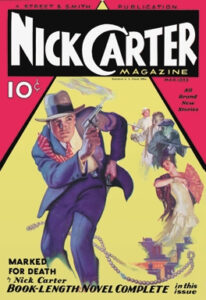
It was also the time of the pulp hero. With The Shadow Magazine flying off America’s newsstands, Street & Smith decided to expand the single character field with magazines featuring adventure and detective heroes. For the latter, it was decided to create a hardboiled version of the “Little Giant” of the dime novels, and Nick Carter Magazine was born. Dated March 1933, the new pulp would sport a cover by Jerome Rozen and lead with the novel “Marked for Death,” by author Richard Wormser (writing as “Nick Carter”). Nick Carter Magazine would run through June 1936.
Jerome Rozen contributed the cover art for the first issue of Nick Carter Magazine, dated March 1933. Thanks to Sanctum Books for the great cover scan.
The World’s First Superhero
There was death afoot in the darkness. It crept furtively along a steel girder. Hundreds of feet below yawned glass-and-brick-walled cracks – New York streets. Down there, late workers scurried homeward. Most of them carried umbrellas and did not glance upward.
Feb. 19, 2013 – Eighty years ago, the words above helped convince readers to buy Doc Savage Magazine when it appeared on newsstands in mid-February 1933. Sporting a front cover painted by the “King of the Pulps,” Walter M. Baumhofer, and published by Street & Smith, the new rough paper magazine promised “a thrilling saga of a scrappy outfit hunting a treasure and being hunted in turn.”
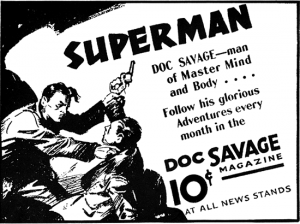 “The Man of Bronze,” credited to Kenneth Roberts, was by Lester Dent, a writer who broke into the pulp market in 1929 with an aviation yarn published by Top-Notch Magazine. In the ensuing years, he had sold about three dozen stories to a variety of magazines including Air Stories, Detective-Dragnet Magazine, Scotland Yard, Sky Riders, War Birds, and Western Trails.
Impressed by Dent’s ability to combine an “extravagant plot, scenes and action with comparatively high credibility and reasonableness of motivation,” the author was invited to the offices of Street & Smith to join business manager Henry W. Ralston and The Shadow Magazine editor John L. Nanovic in a brainstorming session to flesh out a new adventure series they were planning.
Although Doc Savage Magazine wasn’t the first hero pulp to debut in 1933, it would become the most popular single-character magazine launched that year, trailing only The Shadow in total issues published. The character would go on to inspire not only original pulp readers, but also fans of the Bantam paperback reprints that appeared from 1964 through 1990. Likewise, today’s readers enjoy the original pulp tales collected by Sanctum Books and Will Murray’s new adventures of the Man of Bronze, published by Altus Press.
Join PulpFest 2013 over the last weekend of July to celebrate eighty years of Doc Savage and the pulp heroes of 1933.
The Birth of Dr. Fu-Manchu
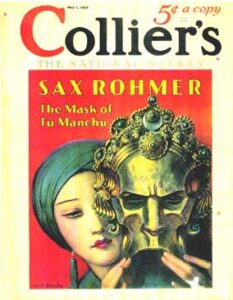 March 2, 2013 – One hundred years ago, in the February 15, 1913 issue of Collier’s, Arthur Henry Sarsfield Ward, better known as Sax Rohmer, introduced American readers to Dr. Fu-Manchu in “The Zayat Kiss.”
Imagine a person, tall, lean, and feline, high-shouldered, with a brow like Shakespeare and a face like Satan, a close-shaven skull, and long, magnetic eyes of the true cat-green. Invest him with all the cruel cunning of an entire Eastern race, accumulated in one giant intellect, with all the resources of science past and present. Imagine that awful being, and you have a mental picture of Dr. Fu-Manchu, the yellow peril incarnate in one man.
Although Rohmer did not create the “yellow peril” story, his tales of “the devil doctor” were certainly the most influential in that genre.
During his life, Sax Rohmer penned several accounts concerning his creation of Dr. Fu-Manchu. Supposedly inspired by a “Mr. King,” a wealthy man of mystery said to control all the Chinese gambling, drug traffic, and tongs of London, Rohmer claimed that Fu-Manchu arose from a chance encounter that he had one night in the Limehouse district of the city. In “How Fu Manchu Was Born,” published in the September 29, 1957 issue of This Week, he wrote:
I saw a tall and very dignified man alight, Chinese, but different from any Chinese I had ever met. He wore a long, black topcoat and a queer astrakhan cap. He strode into the house. He was followed by an Arab girl, or she may have been an Egyptian.
The chauffeur closed the car door, jumped to his seat, and backed out the way he had come in. The headlights faded in the mist … and Dr. Fu Manchu was born!
Join PulpFest in July as we celebrate the centennial of Sax Rohmer’s enduring literary icon, Dr. Fu Manchu, and the 130th anniversary of Rohmer’s birth onSidney H. Bragg, “G-8, Flying Spy of the Pulps.” Xenophile #11 February 15, 1883.
W. T. Benda’s cover for the May 7, 1932 issue of Collier’s appears above, courtesy of The Page of Fu Manchu. It illustrates the author’s novel, “The Mask of Fu Manchu.” Published in book form in 1932, it is considered the fifth novel in the series.
The Pulp Heroes Take to the Air
May 27, 2013 – Americans in 1933 had “nothing to fear but fear itself,” and the pulp heroes introduced that year were proving the country’s new president absolutely correct. During that harrowing year, The Phantom Detective, Nick Carter, and Doc Savage had met and defeated “The Emperor of Death,” “Maniacs of Science,” “The Red Skull,” and other adversaries. As the year wore on and the Great Depression savaged other genres, the new hero pulps surged ahead, their magazines disappearing from America’s newsstands. The publishers noticed.
After Fiction House introduced Air Stories in the summer of 1927, aviation fiction became a standard part of the industry. With the launch of War Birds in early 1928, Dell Publishing added war to the mix. Riding the tide of “air-mindedness” inspired by Charles Lindbergh’s heroic flight, both magazines proved instant hits. Similar titles were rushed to the stands.
Following the stock market crash of 1929, “the vision that aviation would lead mankind to a higher level of civilization … came plummeting down to earth,” taking much of the air pulp market with it. However, the genre was far from dead.
In 1932, a trio of air-war magazines was born – Popular Publications’ Dare-Devil Aces and Battle Birds, and the Standard’s Sky Fighters. Their pages filled with the exploits of flying aces of the First World War, these pulps were “especially sought after by boys raised on the courageous exploits of fathers and uncles who had served in the Great War, boys who kept themselves busy building model planes constructed of balsa wood.” Little wonder that the next pulp heroes to be introduced in 1933 would take to the air.
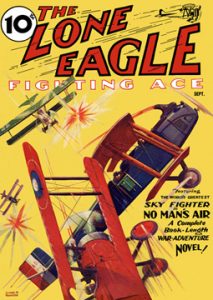 Borrowing one of the nicknames given to Lindbergh following his nonstop flight from New York to Paris, Standard Magazines was first to the stands with The Lone Eagle. Relating the heroic adventures of Air Intelligence Agent John Masters, “the world’s greatest Sky Fighter,” as proclaimed on the magazine’s cover, the pulp debuted in the late summer of 1933.
“Masters showed a natural affinity for a stuttering machine-gun, and as his natural proficiency increased, he built up a dark and terrible reputation about his name. He became the “Lone Eagle” of the skies … He showed an indomitable courage and a dynamic driving power, in pushing to a successful conclusion his secret missions. Many men feared him, many hated him–an occasional one loved him.”
Those words, written by F. E. Rechnitzer, appeared in “No Man’s Air,” the lead novel for the first issue of the new hero pulp. A former World War I Allied pilot and prisoner-of-war, Rechnitzer is believed to have written many of The Lone Eagle’s adventures under the “Lt. Scott Morgan” house name. Robert Sidney Bowen probably contributed most of the later novels. In all, 75 tales of “the world’s greatest Sky Fighter” appeared through the spring of 1943 when the magazine would fly off into the sunset as The American Eagle.
One month after the debut of Standard’s air hero, Popular Publications premiered G-8 and His Battle Aces, featuring Robert J. Hogan at the controls. An air cadet at the end of the First World War, Hogan turned to writing after losing employment as an airplane salesman. Although he also wrote sports and western fiction, Hogan was a regular for the air pulps, scoring big with his Smoke Wade and Red Falcon stories.
In the summer of 1933, Henry Steeger, co-founder of Popular Publications, asked Hogan to create a book-length air character patterned after The Shadow and Doc Savage, pitting “a super protagonist and his loyal side men against heinous forces of power and evil.”
“We have decided to make you a special agent of the spy system of America. A special independent system…. No one will take command over you. You may choose any assistants you wish. You may take matters entirely in your own hands. You will answer to no one but us, and that will be at your discretion. Your first job will be to stop this deadly plan of the fiend, Krueger…”
Determined “to avoid similarity and dullness with a healthy injection of fantasy,” Hogan created diabolical masterminds to match wits with his flying spy. According to Sidney H. Bragg in “G-8, Flying Spy of the Pulps,” published in Xenophile #11 in 1975:
Herr Doktor Kreuger, a fiendish, thick-lensed gnome whose outsized brain conceived surgically altered man-beasts and mammoth bird monsters, deadly rays and flying swords … Chu Lung, an oriental mercenary scientist with a retinue of padding hatchet men, and the huge Herr Stahlmaske, crazed and scarred in a fiery crash, who wore a bullet-shaped steel mask and commanded an underworld corps of disfigured brutes equipped with razored gloves. There were others with secret formulas from the ancient tombs of Egypt, voodoo priests and flying zombies from Haiti, cobra charmers and poison-dart mystics from India and Africa, and even a tribe of defrosted Vikings from northern glaciers.
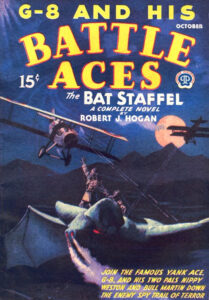 Debuting in “The Bat Staffel,” in the October 1933 number of G-8 and His Battle Aces, Hogan’s hero would appear in 110 adventures, battling “The Skeleton Patrol,” “Staffel of the Floating Heads,” “The Black Aces of Doom,” “Squadron of the Flying Dead,” “Skeletons of the Black Cross,” “Hordes of the Wingless Death,” and other hideous horrors of the hated Hun. The final issue of the Popular Publication was dated June 1944.
To learn more about these and the other great pulp heroes of 1933, register now for PulpFest 2013, running from Thursday, July 25 through Sunday, July 28.
Illustrating this section are Eugene Franzden’s cover for the first issue of The Lone Eagle, dated September 1933, and Frederick Blakeslee’s cover for the October 1933 issue of G-8 and His Battle Aces.
The Master of Men!
June 12, 2013 – Popular Publications got its start in late 1930 when Henry Steeger and Harold Goldsmith released their first four titles – Battle Aces, Detective Action Stories, Gang World, and Western Rangers. A year later, they were joined by two more – Underworld Romances and the magazine that helped send the company to the top of the pulp chain, Dime Detective Magazine.
In spring and summer 1933, Henry Steeger planned additional releases. Two targeted the western and love genres, while the others were aimed at the single-character market. “At this point in pulp history, individual titles became very popular, so we decided to try out a few …”
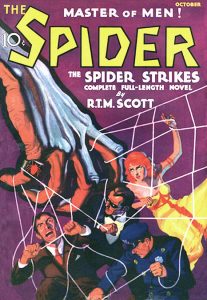 Popular Publications debuted its four new titles in September 1933 – Star Western and Lovers Magazine; its air-war hero pulp, G-8 and His Battle Aces; and the company’s answer to the phenomenally popular Street & Smith character pulp, The Shadow Magazine.
R. T. M. Scott’s “The Spider Strikes” led off the first issue of The Spider, cover dated October 1933. A mystery novelist well known for his character Secret Service Smith, Scott would only write the first two novels of the magazine’s long run. He would, however, introduce many of the trappings that would endear the pulp’s characters to readers.
With its third issue, the magazine turned The Spider over to Norvell W. Page, a newspaperman turned pulp writer. Hidden behind the name Grant Stockbridge, Page would contribute 91 tales of the “Master of Men” – more than three-quarters of the magazine’s 118-issue run – writing with “heart, feeling and emotion.”
As the late Michael Avallone wrote in the June 1981 issue of Mike Shayne Mystery Magazine.
Richard Wentworth, playboy millionaire by day and caped crusader by night … Master of disguise, superbly conditioned body, keen, alert brain and altogether hair-trigger personality when the United States and the world were threatened by master villains, Yellow Perils, horrible hordes, devastating plagues, and killing, chilling terrorism. Wentworth became the craggy, grotesque Spider, leaving his vermilion trademark on the dead foreheads of The Enemy.
Started as a knock-off of the first single-character pulp, The Spider would eventually join Doc Savage, G-8 and His Battle Aces, Jim Hatfield (in Texas Rangers), The Phantom Detective and The Shadow, the magazine that inspired them all, as one of the longest-lived of the hero pulps, thanks largely to the white-hot prose of Norvell Page.
PulpFest 2013 salutes eighty years of The Spider and “The Pulp Heroes of 1933″ from July 25 – 28 in Columbus, Ohio.
Walter Baumhofer painted the cover for the first issue of The Spider, dated October 1933.
The Sheriff of Buzzard Gap
June 23, 2013 – When the powers at Street & Smith saw what a gold mine they had in The Shadow Magazine, they began planning a raft of companion titles, selecting four top pulp genres as their themes: adventure, detective, aviation, and western. The publisher covered the first two by releasing Doc Savage Magazine and Nick Carter Magazine early in 1933. Their aviation title, Bill Barnes, Air Adventurer, was held back until the beginning of the next year. But as soon as circulation figures showed the new single-character titles were winners, Street & Smith launched its western hero pulp, Pete Rice Magazine. Its first issue was dated November 1933. It ran the proclamation below.
Street & Smith Publications, Inc., the oldest and foremost fiction-publishing house in America, takes pleasure in presenting this first issue of Pete Rice Magazine to their discriminating readers. It is not “just another magazine,” but a publication which has been a long time in developing, and one which is aimed at the new, modern trend of public taste.
In this magazine you will feel the real pulse of the great West as it actually exists. The scenes and action will be familiar to all those who know of the West, and will be instructive to those who do not. The characters will live and breathe through these pages as no others have, and they will give you more entertainment than you have ever deemed possible from fiction before.
 “Pistol Pete” Rice was the sheriff of Buzzard Gap, Arizona, a clean-living, non-swearing, alcohol-avoiding paragon of frontier virtues and terror to outlaws who still lived with his mother. He was backed by two trusty deputies: 300-pound giant William Alamo Butler, better known as “Teeny,” and the town’s combination barber and medico, Lawrence Michael Hicks, colloquially known as “Misery.” Pete rode a sorrel horse named Sonny and was sometimes accompanied by a dog called Vulcan.
This hard-riding trio operated in the never-never land of the “Pulp West,” a vague, undated era in the magazine’s early issues. As the series progressed, the stories took on the quaint qualities of a 1930s Hollywood western film, where the sheriff and his posse would start out in an automobile and switch to horseback when the terrain got too rocky for rubber. In one story, Pistol Pete hopped a plane to Chicago to get his man. Unfortunately, trying to have the West both ways gave the magazine a fairly short lifespan. It folded in 1936 after just 32 issues.
Ben Conlon wrote all the Pete Rice novels as Austin Gridley. Afterward, Conlon took the series to Wild West Weekly, where Pete encountered other Street & Smith buckaroos such as Sonny Tabor. Eventually, Pete’s creator was replaced by other writers hidden by the Gridley house name. The series finally petered out in 1939 after some fifty adventures — not counting a short-lived radio program. Fans best remember Pete Rice Magazine because it shared cover artists with Doc Savage. Walter M. Baumhofer painted the cover art for both series until Robert G. Harris took them off his hands in time for Pete Rice‘s finale.
Although Pete Rice Magazine ran for less than three years, it paved the way for other western character pulps, beginning with Ranger Publications’ The Masked Rider Western Magazine in spring 1934 and, later that same year, Popular Publications’ Mavericks. The longest-lived western pulp hero, Jim Hatfield, would debut in the October 1936 issue of Texas Rangers. Standard Publications’ “Lone Wolf” hero would ride the range for 206 issues, heading into the sunset with its February 1958 number. Among the hero pulps, only The Shadow Magazine appeared more often.
Pistol Pete was the last of the pulp heroes of 1933 — seven in all. From July 25 – 28, join PulpFest in Columbus, Ohio, as we celebrate these characters who had “nothing to fear but fear itself” during the dark days of the Great Depression when the great pulp heroes were born.
The great Walter M. Baumhofer contributed the cover art for the first issue of Pete Rice Magazine, pictured above.
The Black Bat – The Forgotten Hero?
June 24, 2013 – An eighth single-character pulp debuted in 1933. Black Bat Detective Mysteries began with its October 1933 number, and ran for six issues, ending in the spring of 1934. The magazine’s lead novels featured a character called The Black Bat (not to be confused with The Black Bat that later appeared in Standard’s Black Book Detective Magazine.
Created by Murray Leinster, The Black Bat, whose real name was never revealed, was an omniscient amateur detective who worked closely with the police. The character was more of a defective detective than a pulp hero. Although Black Bat Detective Mysteries was technically a single-character magazine, it more closely resembled a detective pulp. Published by a small New York City outfit, Berryman Press, and with a limited run, the magazine had little impact on the pulp market.
The Great Pulp Heroes
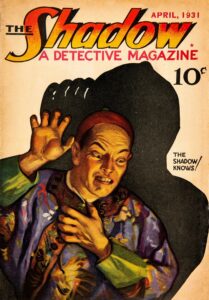 July 23, 2013 – The first pulp dedicated to a single character was The Shadow: A Detective Magazine, its initial issue dated April 1931. Following its astounding success, the leading pulp magazine publishers launched seven new titles in 1933 — The Phantom Detective, Nick Carter, Doc Savage, The Lone Eagle, G-8 and His Battle Aces, The Spider, and Pete Rice Magazine — what we now call the “hero pulp explosion of 1933.” These eight titles would, by and large, serve as the foundation for more than fifty titles released over nearly two decades. Although most of the single-character magazines that followed that initial burst of 1933 had relatively short lives, they helped to keep afloat an industry that was dying.
Stories of Sheena, Queen of the Jungle, published by Fiction House in the spring of 1951, was the last single-character magazine to reach the reading public. Within a few years of Sheena’s sole appearance in her own rough-paper title, the entire pulp magazine industry would be gone, the victim of changing public tastes. But for many of us who love the pulps, the hero titles introduced us to pulp collecting and helped keep alive the memory of the great pulp era.
From July 25 – 28, please join PulpFest 2013 at the Hyatt Regency in downtown Columbus, Ohio, to celebrate “80 Years of Doc Savage and the Hero Pulp Explosion of 1933.” You’ll find additional details by scrolling through this post.
Modest Stein was the cover artist for the April 1931 issue of The Shadow, A Detective Magazine. Street & Smith had previously used the artwork as the cover of the October 1, 1919 issue of The Thrill Book.
The original posts reproduced above were all written by Mike Chomko and/or Ed Hulse.