The following posts explore the history of pulp magazines and originally appeared on the PulpFest website between January 9 and ??, 2012.
Under the Moons of Mars
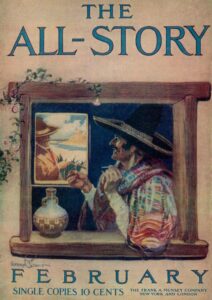 Jan. 9, 2012 – During the winter of 1912, readers of the Munsey pulp, The All-Story, casually picked up the February issue of the magazine at their newsstands or drugstores. It sported a cover featuring a Mexican in a sombrero, framed by a window. Little did these readers know that they were being introduced to an author who would soon become one of the leading practitioners of American popular fiction.
The All-Story for February 1912 featured a complete novel, ten short stories, and six serials, with “Under the Moons of Mars” listed above them all. The author of this “Romance of a soul astray” was listed as Norman Bean, a pen name for Edgar Rice Burroughs. Hiding behind a pseudonym in his early efforts as a professional writer, Burroughs would soon become one of the best-paid authors in the pulp market. Later in 1912, the new author made an indelible mark on American pop culture with the appearance of “Tarzan of the Apes,” published in its entirety in the October issue of The All-Story.
2012 marks the 100th anniversary of the initial publication of “Under the Moons of Mars,” better known by its book title, A Princess of Mars. In August, PulpFest 2012 will celebrate this occasion with a panel titled “Pulp Visions of Mars.” Additionally, author and artist David Saunders, who has written extensively on pulp illustration, will discuss J. Allen St. John, perhaps the artist most associated with Edgar Rice Burroughs’ work. Other events are still being planned.
Gordon H. Grant painted the cover art for the February 1912 issue of The All-Story. Well-known for his maritime watercolors, Grant also contributed covers to The Saturday Evening Post, Boy’s Life, and other periodicals.
John Carter
March 4, 2012 — One hundred years ago in March 1912, readers of Munsey’s The All-Story were nearing the halfway point of a six-part serial entitled “Under the Moons of Mars,” a story credited to Norman Bean. The work of a new fiction writer, the novel tells the tale of Captain Jack Carter of Virginia, and of his adventures on the planet Barsoom.
First advertised in the January 1912 issue of The All-Story as “a surprisingly vivid Interplanetary romance,” the original pulp version of Burroughs’ novel began with an editor’s note:
At the time of his demise, John Carter was a man of uncertain age and vast experience, honorable and abounding with true fellowship. He stood a good two inches over six feet, was broad of shoulder and narrow of hip, with the carriage of the trained fighting man. His features were regular and clear-cut, his eyes steel gray, reflecting a strong and loyal character. He was a Southerner of the highest type. He had enlisted at the outbreak of the War, fought through the four years and had been honorably discharged. Then for more than a decade he was gone from the sight of his fellows. When he returned he had changed, there was a kind of wistful longing and hopeless misery in his eyes, and he would sit for hours at night, staring up into the starlit heavens.
 In the pages that followed that brief editor’s note and for the five issues thereafter, the readers of The All-Story were told a most wondrous tale, of four-armed Tharks and red-skinned Heliumites, of fantastic airships and many-legged thoats, of vast dead seas and long-abandoned cities, and of a lost princess and the man from another world who won her heart, all created by a gifted storyteller named Edgar Rice Burroughs.
Now, one hundred years later, a new audience will soon meet Captain Jack. In less than a week’s time, Disney’s John Carter will debut in theaters everywhere. PulpFest 2012 will honor the wonderful creations of Edgar Rice Burroughs, beginning on August 9 at the Hyatt Regency in downtown Columbus, Ohio.
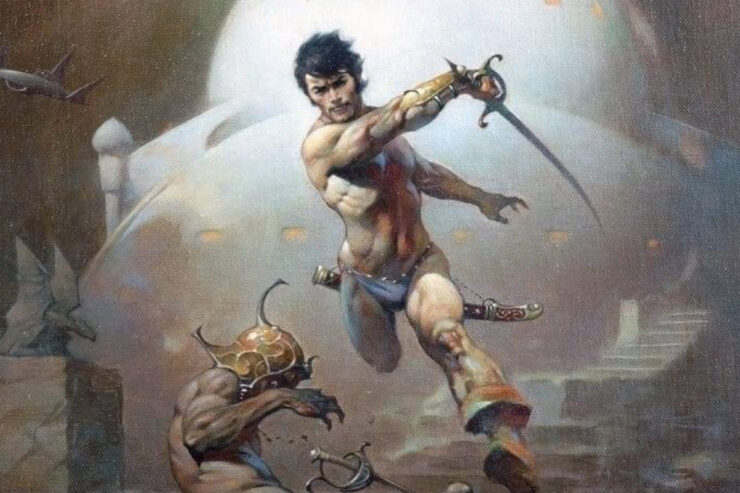
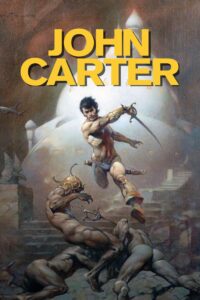
The art featured in Frank Frazetta’s John Carter film poster was originally used for the Science Fiction Book Club edition of Swords of Mars and Synthetic Men of Mars, published in 1975 by Nelson Doubleday. An excerpt from Frazetta’s poster art also serves as our featured image.