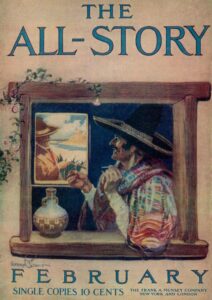
 During the winter of 1912, readers of the Munsey pulp, The All-Story, casually picked up the February issue at newsstands or drugstores. The cover featured a Mexican in a sombrero, framed by a window. Little did these readers know that they were being introduced to an author who would soon become one of the leading practitioners of American popular fiction.
The All-Story for February 1912 featured a complete novel, ten short stories, and six serials, with “Under the Moons of Mars” listed above them all. The novel, by a new fiction writer, tells the tale of Captain John Carter of Virginia and his adventures on the planet Barsoom.
First advertised in the January 1912 issue of The All-Story as “a surprisingly vivid Interplanetary romance,” the original pulp version of Burroughs’ novel began with an editor’s note:
At the time of his demise, John Carter was a man of uncertain age and vast experience, honorable and abounding with true fellowship. He stood a good two inches over six feet, was broad of shoulder and narrow of hip, with the carriage of the trained fighting man. His features were regular and clear-cut, his eyes steel gray, reflecting a strong and loyal character. He was a Southerner of the highest type. He had enlisted at the outbreak of the War, fought through the four years and had been honorably discharged. Then for more than a decade he was gone from the sight of his fellows. When he returned he had changed, there was a kind of wistful longing and hopeless misery in his eyes, and he would sit for hours at night, staring up into the starlit heavens.
The author of this “Romance of a soul astray” was listed as Norman Bean, a pen name for Edgar Rice Burroughs. Hiding behind a pseudonym in his early professional efforts, Burroughs would soon become one of the best-paid authors in the pulp market.
The start of a six-part serial, “Under the Moons of Mars” was a wondrous tale of four-armed Tharks and red-skinned Heliumites, of fantastic airships and many-legged thoats, of vast dead seas and long-abandoned cities, and of a lost princess and the man from another world who won her heart, all created by a gifted storyteller named Edgar Rice Burroughs.
Later in 1912, the new author made an indelible mark on American pop culture with “Tarzan of the Apes,” a novel published in its entirety in the October issue of The All-Story.
2012 marks the 100th anniversary of the initial publication of “Under the Moons of Mars,” better known by its book title, A Princess of Mars. In August, PulpFest 2012 will celebrate this occasion with a panel titled “Pulp Visions of Mars.” Additionally, author and artist David Saunders, who has written extensively on pulp illustration, will discuss J. Allen St. John, perhaps the artist most associated with Edgar Rice Burroughs’ work. Other events are still being planned.
And in March 2012, a whole new audience will meet Captain John when Disney’s John Carter debuts in theaters everywhere. How’s that for a centennial celebration?
Gordon H. Grant painted the cover art for the February 1912 issue of The All-Story. Well-known for his maritime watercolors, Grant also contributed covers to The Saturday Evening Post, Boys’ Life, and other periodicals.
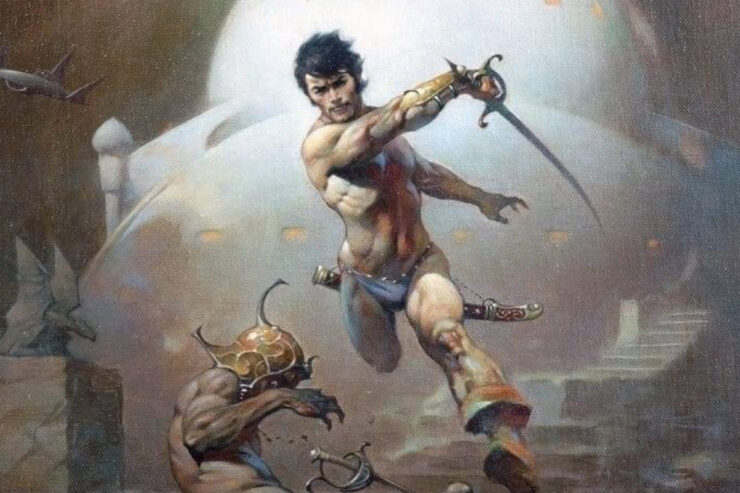
The art featured in Frank Frazetta’s John Carter film poster was originally used for the Science Fiction Book Club edition of Swords of Mars and Synthetic Men of Mars, published in 1975 by Nelson Doubleday. An excerpt from Frazetta’s poster art serves as our featured image.