
The following posts explore the history of pulp magazines and originally appeared on the PulpFest website between January 10 and June 10, 2011. You’ll also find plenty of pulp history throughout our PulpFest 2011 programming post.
Fifty Years After Hammett
 Jan. 10, 2011 – Today marked the 50th anniversary of Dashiell Hammett’s death, the Black Mask writer and author of classics such as The Maltese Falcon, The Glass Key, and the Continental Op stories. Although Carroll John Daly created the first hardboiled detective – Three Gun Terry Mack – it was Hammett, a former Pinkerton operative, who became the earliest master of the genre. His lean writing style, cynical characters, and complex plots were held up as models for other writers by Black Mask editor Joseph “Cap” Shaw.
Fifty years after his death, and nearly eighty years after the publication of his last novel, The Thin Man, Dashiell Hammett’s influence endures in mystery fiction. Much of his work remains in print, retaining its freshness and vibrancy.
For over thirty years, Don Herron, a nominee for the 2010 Munsey Award, has honored the author and former Pinkerton detective by leading the Dashiell Hammett Tour through San Francisco’s “mean streets.” The longest-running literary tour in the United States, Herron’s four-hour walk not only visits all the known Hammett residences in California’s Baghdad by the Bay, but also many of the locations mentioned or suggested in The Maltese Falcon and the author’s other works.
For further information about the Dashiell Hammett Tour, please visit Up and Down These Mean Streets, the official website of Don Herron.
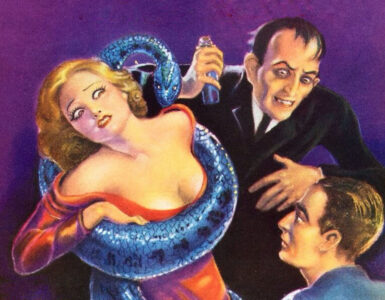
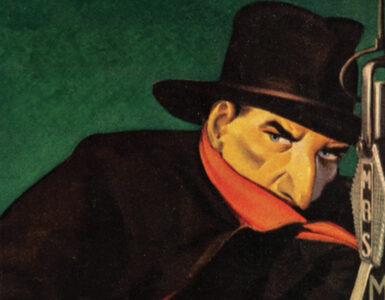
Our lead image is H. C. Murphy’s cover for the September 1929 number of Black Mask. The serialized version of Dashiell Hammett’s “The Maltese Falcon” began in the issue. An excerpt from Murphy’s cover also serves as our featured image.
A Century of C. L. Moore
 Jan. 24, 2011 – Born on January 24, 1911, Catherine Lucille Moore was one of the first women to write in the science fiction and fantasy genres, helping to pave the way for other female writers of speculative fiction. Her first story, “Shambleau,” was published in the November 1933 issue of Weird Tales and introduced readers to Northwest Smith, an interplanetary adventurer who appeared eleven times in “The Unique Magazine.”
About a year later, Moore’s Jirel of Joiry also debuted in Weird Tales. Appearing in a half-dozen stories between 1934 and 1939, Jirel was one of the first female protagonists of sword-and-sorcery fiction.
In 1936, Catherine met Henry Kuttner, another pulp-era writer. They married in 1940. Afterward, Moore and Kuttner collaborated on many stories, often using the pseudonyms “Lewis Padgett” or “Laurence O’Donnell.” Together, they created such classics as “Clash by Night,” “Mimsy Were the Borogroves,” “The Twonky,” and “Vintage Season.” From 1940 on, most of Moore’s efforts, collaborative or otherwise, appeared in Astounding Science-Fiction.
Gnome Press published C. L. Moore’s first book, Judgment Night, a collection of stories from Astounding, in 1952. Her most recent book, a collection by Moore and Henry Kuttner entitled Detour to Otherness, was published in 2010 by Haffner Press.
Catherine Moore died on April 4, 1987.
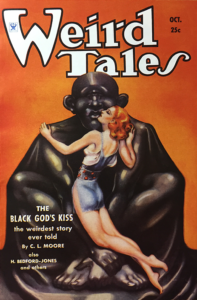
C. L. Moore’s first Jirel of Joiry story, “The Black God’s Kiss,” was originally published in the October 1934 issue of Weird Tales, with cover art by Margaret Brundage.
The First Hero Pulp
March 12, 2011 – Eighty years ago, on March 6th, 1931, the first issue of Street & Smith’s The Shadow, a Detective Monthly, appeared on American newsstands. The first modern single-character or hero magazine, it revived a fiction format that had disappeared decades earlier with the demise of dime novels.
In the pages of the pulp, wordsmith Walter B. Gibson refashioned the sinister narrator of CBS Radio’s The Detective Story Hour into the first dark hero, creating a crime-busting supersleuth who embodied the iconic power of classic melodrama villains like Dracula. Gibson’s novels also introduced the concept of super-crooks and super-crime, and became the template for hero pulps and scores of future comic book superheroes, many of which were created by devoted readers of The Shadow Magazine, including Bill Finger, Bob Kane, Jack Kirby, Stan Lee, and Jerry Siegel.
Earlier this month, Sanctum Books reprinted the original text of “The Living Shadow,” the first of Walter Gibson’s Shadow novels. Previous reprints used the Ideal Library edition of Gibson’s first Shadow adventure.
Join PulpFest 2011 over the last weekend of July as it celebrates the eightieth anniversary of The Shadow, a Detective Monthly, and the birth of the hero pulp. The festivities begin on Thursday night, July 28, with the showing of three film shorts featuring The Shadow’s first celluloid appearances. The first of these twenty-minute movies arrived in theaters while the second issue of Street & Smith pulp was still available on newsstands. PulpFest 2011 runs through Sunday, July 31.
100 Years of Talbot Mundy
 June 10, 2011 – When it comes to adventure fiction, Talbot Mundy was one of its greatest practitioners. Born William Lancaster Gribbon in 1879, Mundy began writing in his early thirties, following years of adventuring in India, Africa, and other parts of the world. Or so the story goes; much of his early life was romanticized over the years, largely by the author himself.
Talbot Mundy began writing professionally in 1911 with his first published piece, “A Transaction in Diamonds,” appearing in the February issue of Scrap Book, part of the Munsey line of magazines. Two months later, he made his first appearance in Adventure magazine. He soon became a fairly regular contributor to the magazine that Time Magazine called “The No. 1 Pulp” until his death in 1940.
Most of Mundy’s best fiction appeared in Adventure, including all the Jimgrim stories and important novels such as “Om,” “The Devil’s Guard,” and “The Ivory Trail.” However, it was in Adventure’s “classier” cousin, Everybody’s, that Talbot Mundy’s best-known work, “King of the Khyber Rifles,” was serialized, beginning with the May 1916 issue. The Bobbs-Merrill book edition appeared that November and proved an instant classic.
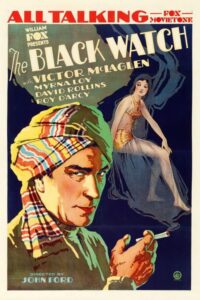
This summer, PulpFest will celebrate the 100th anniversary of Talbot Mundy’s first appearance in print with a showing of The Black Watch, a film adaptation of Mundy’s “King of the Khyber Rifles,” and the first sound picture by famed movie director John Ford. Released by Fox Movietone News in 1929, the film stars Victor McLaglen as Captain Donald Gordon King and Myrna Loy as Yasmani, a descendant of Alexander the Great whom her people prophesied would be a great conqueror. It also features both John Wayne and Randolph Scott in minor roles.
The Black Watch will be exhibited on Thursday, July 28, beginning at 10:30 PM.
The Fox Movietone News film poster for The Black Watch, starring Victor McLaglen and Myrna Loy.