 PulpFest 2026 will celebrate the centennials of Amazing Stories and Ghost Stories, plus a great deal more at this year’s convention. Hugo Gernsback’s groundbreaking science-fiction pulp and Bernarr Macfadden’s purportedly “true” magazine concerning the spirit world both debuted one hundred years ago.
Over its century of almost continuous publication, Amazing Stories has had its ups and downs. Within a few months of its debut in March 1926, Gernsback’s “scientifiction” pulp was selling more than 100,000 copies of each monthly issue. Just a few years later, it had filed for bankruptcy.
After Ziff-Davis purchased it in 1938, it was soon outselling its rivals, selling well over 100,000 copies every month. The so-called “Shaver Mystery” boosted sales even more, but afterwards, the pulp industry entered its doldrums. Despite the heroic efforts of editor Cele Goldsmith, Amazing Stories was sold again, this time to Sol Cohen’s and Arthur Bernhard’s Ultimate Publishing Company in 1965.
After turning both Amazing and its companion, Fantastic, largely into reprint magazines, the Ultimate Publishing version of Hugo Gernsback’s creation relied on another heroic editor, Ted White, to turn Amazing into a respectable magazine during the 1970s.
 Respectability is one thing, but circulation is another. Despite White’s efforts, the magazine continued to lose readers. When Ted White resigned in late 1978, Amazing was selling about 25,000 copies, mostly through newsstands.
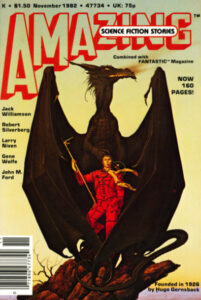
Elinor Mavor, editor of a restaurant trade magazine, took over both Amazing and Fantastic, keeping them afloat for a few more years until their purchase by TSR. The American game publishing company best known as the original publisher of Dungeons & Dragons, bought both historic titles in 1982. George H. Scithers, the founding editor of Isaac Asimov’s Science Fiction Magazine, was named editor of the new Amazing Stories, starting with the November 1982 number.
We hope you’ll join PulpFest on Thursday, July 30, at 7:50 pm as we welcome Darrell Schweitzer and John Gregory Betancourt to our programming stage for “Amazing Stories: The Scithers Years,” a presentation examining this period in the history of the first continuing science-fiction magazine.
A mystery, fantasy, and science fiction writer, John Betancourt, is also the publisher of Wildside Press. As such, he has made hundreds of stories from pulp magazines, digests, and early paperbacks available in print and ebook form. Formerly an assistant editor at Amazing Stories, John later helped to revive Weird Tales. The magazine garnered a World Fantasy Award in 1992 and a Hugo Award in 2009. In 2015, he also helped revive Weirdbook. He continues to publish it on a fairly regular basis. John also serves as the publisher of Sherlock Holmes Mystery Magazine and the revived Startling Stories, the classic science fiction pulp.
Darrell Schweitzer’s distinguished editorial career began with Isaac Asimov’s SF magazine (1977-1982), Amazing Stories (1982-1986), Weird Tales (1987-1994), Worlds of Fantasy and Horror (1994-1996), before returning to Weird Tales (1998-2007). The author of numerous science fiction and fantasy novels and short fiction, Darrell is also a notable authority on Lord Dunsany, H. P. Lovecraft, and Robert E. Howard. Twice nominated for a World Fantasy Award, he was the recipient of the 1992 Award for his successful revival of Weird Tales. Darrell has been selling at PulpFest for some time, and has been a regular contributor to The Pulpster for some time.
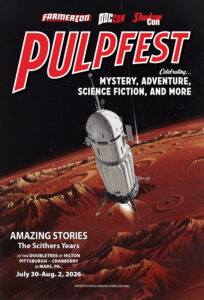
PulpFest 2026 begins on July 30 and runs through August 2 at the DoubleTree by Hilton Hotel Pittsburgh – Cranberry in Mars, Pennsylvania. In addition to honoring the centennials of Amazing Stories and Ghost Stories, we’ll also be celebrating the sesquicentennial of writer Jack London’s birth, the centennial of the birth of artist Robert Kennedy Abbett, and more at this year’s convention.
The general public is welcome to attend our programming free of charge. To learn more about our presentations, please click the 2026 Schedule link found on our website.
For those who also want to enjoy our dealers’ room, you can join PulpFest by clicking the register link found on our website. And don’t forget to book a room at the DoubleTree. They’re going fast!
 Remember, in addition to your membership in PulpFest 2026, you’ll also be a member of Doc Con 2026, FarmerCon XXI, and The Shadow Con 2026. That’s four conventions for one price! You can’t beat that deal.
If you’re interested in selling at PulpFest, all of our wall and foyer tables have been reserved. A few island tables are remaining for $110 per table. Please click the “register” link on our website to learn how to join the convention as a dealer.
One of the many creators who helped Amazing Stories establish the genre of science fiction was E. E. “Doc” Smith. Visit our YouTube Channel to catch Craig McDonald’s Pulp Author Spotlight on the author.
And while you’re there, please be sure to subscribe!
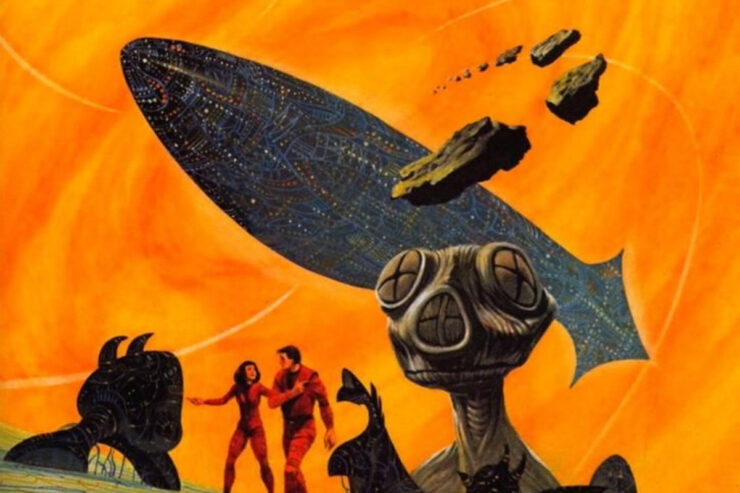
Our featured image was excerpted from Jack Gaughan’s cover art for Amazing Science Fiction Stories Combined with Fantastic Stories for January 1984. Gaughan was an American science fiction artist and illustrator, and a multiple winner of the Hugo Award in the category of Best Professional Artist.
Our lead image was adapted by William Lampkin from award-winning artist Vincent DiFate’s original cover art for the July 1986 number of Amazing Stories, the final issue of the magazine that was edited by George H. Scithers.
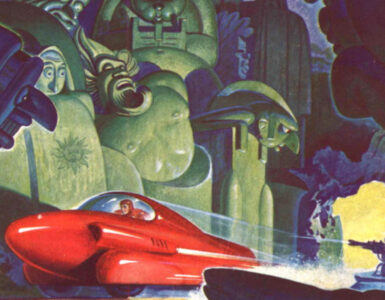
Multi-award-winning artist Michael R. Whelan painted the cover art for the November 1982 issue of Amazing Stories, the final number of the magazine that was edited by George H. Scithers.
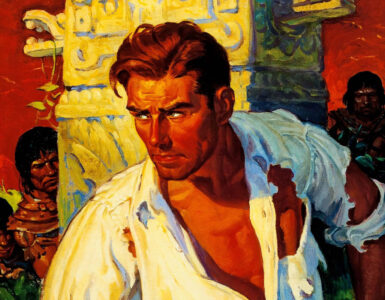
Our final image is Alex Schomburg’s cover for the January 1985 issue of Amazing Stories. Born in Puerto Rico on May 10, 1905, Schomburg moved to New York City in the early twenties to find work as a commercial artist.
In 1925, Schomburg met publisher Hugo Gernsback, about a year before the publisher launched the first specialized science-fiction magazine. Sixty years later, the artist’s last Amazing Stories cover appeared on this number of the magazine. He also painted the cover for the November 1984 issue. Schomburg died in 1998.