 Hiram Gilmore Bates III — better known as Harry Bates — was born October 9, 1900, in Pittsburgh, Pennsylvania. In his early teens, he began repairing clocks for his family’s long-established business. Although he attended college, he dropped out after two years and returned to his clocks.
Regardless of his background, the writing bug was in his blood. In 1922, Bates began editing a magazine called The Beach Comber. A year later, he was a reporter for The Philadelphia Inquirer, followed by a stint as a cameraman for a Yonkers silent film studio. By the end of the decade, he was employed by William Mann Clayton as the editor of Adventure Trails.
Per Harry Bates’ introduction to Alva Rogers’ A Requiem for Astounding, the young editor was summoned to Clayton’s office in 1929 to discuss a new magazine: Torchlights of History. Balking at both the title and the premise, Bates countered with an action-adventure science fiction magazine to be called Astounding Stories of Super-Science.
“As a name it lacked dignity, but no matter: it was gutsy and would compel attention, and it generally resembled Amazing and could be counted on to attract the eye of that magazine’s readers while pleasantly promising others that the stories would stun them.”
Generating a punchy title was only the first challenge he faced with his assignment. Bates was no fan of science fiction — or “scienctifiction” as Hugo Gernsback called it. He thought the stories in Amazing were “awful stuff,” “packed with puerilities,” and “written by unimaginables.” Finding competent writers for his new magazine was not going to be easy.
“My biggest difficulty, and a never-ending one, was the obtaining of suitable stories. Clayton and I agreed that story elements of action and adventure were necessary for Astounding’s survival . . . We could think of fewer than half a dozen fair-to-good pulp writers who had ever written stories of the kind we wanted, but we never doubted that some of my adventure writers could produce them.”
Harry Bates cautiously supported his science fiction writers. There were many exchanges back and forth, and a great deal of editing, rewriting, and patching. More than one writer quit, disillusioned by a rejected story. Despite the many trials and tribulations, one advantage Clayton had over the competition was that they paid better than their competitors: two cents or more a word upon acceptance, instead of a penny a word or less at publication. This allowed Astounding to draw from a pool of better writers.
Edmond Hamilton, Murray Leinster, Donald Wandrei, and Jack Williamson began to contribute regularly, attracted by the better word rates and prompt payment. Lesser lights such as Arthur J. Burks, Ray Cummings, Charles W. Diffin, Paul Ernst, Capt. S. P. Meek, Harl Vincent, and others could likewise be counted on to help fill out each issue.
“Astounding Stories is looking for material that will interest the readers who enjoy good stories laid in the present or future time and in which marvelous scientific devices yet to be actually invented play an important part. . . . Our requirements differ from those of other pseudo-scientific magazines in that they call for material that is not overweighted with scientific explanations to such an extent that the story itself suffers. In Astounding Stories, story values — plot, physical action, conflict, suspense, human interest, a hero and heroine to sympathize with, and a villain to dislike — are equal in importance to the accuracy and convincingness of the science that underlies the story.”
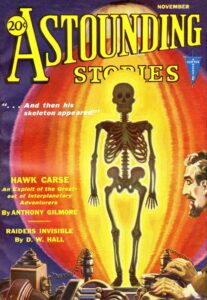 Bates also wrote for the new magazine, filling out issues as needed. This is how the popular “Hawk Carse” space opera began. The series was published in Astounding — beginning with its November 1931 number — under the pen name of Anthony Gilmore. A pseudonym (along with another pen name, H. G. Winter), it represented the work of Bates and his assistant editor, Desmond Winter Hall.
Relying on many of the tropes introduced by Edgar Rice Burroughs in his Mars and Tarzan yarns, the audience for Astounding Stories grew. With his science fiction pulp earning a profit, in 1931, William Clayton introduced a companion magazine, Strange Tales of Mystery and Terror, a rival to Weird Tales. Harry Bates was again at the helm.
But all was not well with Clayton Publications. Having decided to buy out his printer, William Clayton found himself unable to make the final scheduled payment. Despite shifting Astounding, Strange Tales, and other titles to less frequent appearances, by late 1932, Clayton was forced to declare bankruptcy. The company’s properties were sold at auction. Street and Smith picked up Astounding and made it a staple of the pulp era. It later metamorphosed into Analog Science Fiction and Fact, still being published today.
The final issue of Strange Tales was dated January 1933, while the final Clayton issue of Astounding Stories of Super-Science was dated March 1933. Altogether, Harry Bates edited all thirty-four issues of Clayton’s Astounding Stories and all seven issues of Strange Tales of Mystery and Terror before Clayton Publications went under.
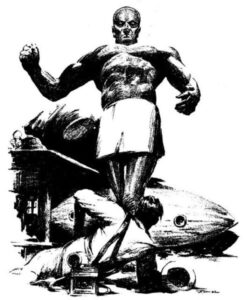 The folding of Clayton ended Bates’s career as a science fiction editor, but he continued to pen occasional stories over the next twenty years. He’s probably best known for the novelette, “Farewell to the Master” (Astounding Science-Fiction, October 1940). Director Robert Wise later adapted it as The Day the Earth Stood Still, released by 20th Century Fox in 1951.
When people think of Astounding Stories, they naturally connect it to its longtime editor, John W. Campbell. When they hear the phrase, “Klaatu barada nikto,” they only think of the movie from which it came, not the story on which it was based. Science fiction fans today are legion, and sci-fi writers are a dime a dozen. But a very long time ago, when science fiction was new, Harry Bates laid a foundation for the robust legacy that followed. He died in 1981, at the age of 80.
In addition to Adventure Trails/World-Wide Adventures, Astounding, and Strange Tales, Harry Bates also edited the short-lived Soldiers of Fortune.
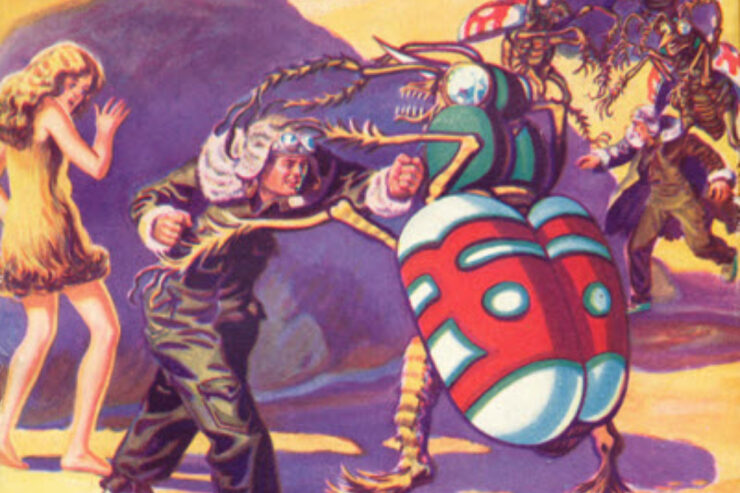
Our featured image is excerpted from Hans Wessolowski’s cover art for the first issue of Astounding Stories of Super-Science, dated January 1930. It illustrates the first segment of Victor Rousseau’s two-part novella, “The Beetle Horde.” Wessolowski would serve as the cover artist for all of the Bates issues of Astounding Stories and all seven issues of its companion title, Strange Tales of Mystery and Terror.
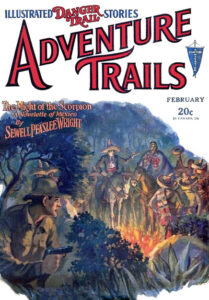
Our lead image is the February 1929 number of Adventure Trails, with cover art by Wessolowski. It may be the first Clayton pulp to be edited by Harry Bates.
The November 1931 issue of Astounding Stories — with cover art by Wessolowski — features the first of the Hawk Carse stories, written by Anthony Gilmore, a pen name used by Bates and his assistant editor, Desmond Winter Hall. Wessolowski’s cover art illustrates Hall’s story, “Raiders Invisible,” also featured in the issue.
Leslie Silberberg is a writer and popular culture enthusiast who began posting on our website in 2022. She enjoys the science fiction pulps, particularly the work of such leading female writers as Leigh Brackett, Claire Winger Harris, Zenna Henderson, Judith Merril, C. L. Moore, Margaret St. Clair, Wilmar H. Shiras, Francis Stevens, and Leslie F. Stone.
Leslie would like to acknowledge Mike Ashley’s The Time Machines: The Story of the Science-Fiction Pup Magazines; Sara Light-Waller’s PulpFest post about Bates, published on our site on October 6, 2020; the entry on Bates in Prabook: The World Biographical Encyclopedia; Alva Rogers’ A Requiem for Astounding; Julius Schwartz’s and Mortimer Weisinger’s interview of Bates in Science Fiction Digest, February 1933, and Sai Shankar’s Pulpflakes post on the Clayton pulps.