 Amazing Stories turns 100 years old in 2026. Launched in early 1926 by Hugo Gernsback, it was the world’s first magazine devoted to science fiction, or, as Gernsback called it, scientifiction.
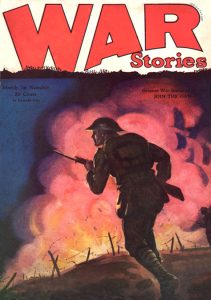
Despite its importance in the history of popular culture, Amazing Stories was certainly not the only fiction magazine to premiere in 1926. From Dell Publishing came War Stories, the first pulp to specialize in stories of battle. Fiction House tried entering the women’s market by releasing Love Romances. Doubleday debuted West, a magazine that continued for nearly 30 years. Bill Clayton launched Clues, a “Magazine of Detective Stories,” in late 1926. It was later picked up by pulp powerhouse Street & Smith and carried on for nearly ten more years. And then there’s Bernarr Macfadden’s Ghost Stories.
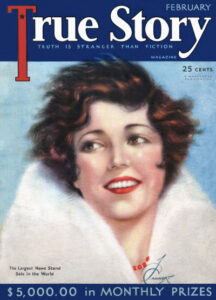
A bodybuilding and physical fitness fanatic, Bernarr Macfadden had become fabulously wealthy after debuting True Story in 1919. It featured first-person stories that were purportedly written by the readers of the magazine. It proved a tremendous success.
Harland Manchester reported in the August 1938 issue of Scribner’s Magazine:
“When Macfadden saw how things were going, he decided to compete with himself. He figured that when readers finished True Story, they might find it tedious waiting for the next issue. So he brought out True Romances, which caught on at once, then Dream World, and in 1926, True Experiences.”
Macfadden struck gold again with the first factual crime and detective magazine, True Detective Mysteries, released in 1924. A couple of years later, he tried to duplicate its success by debuting Ghost Stories.
The July 1926 Ghost Stories appeared on American newsstands on May 23, not long after Gernsback’s Amazing Stories had been introduced. With most of its features narrated in the first person, Ghost Stories purported to lead its readers on a journey to the spirit world.
“What could be more fascinating than to journey into an unknown world? What more enthralling than to read the unique, spooky, creepy tales of those who have made the journey? You will make the journey with them. You will stand behind the brink of eternity, you will tear aside the veil that shrouds the spirit world, you will be held spellbound as each new issue of Ghost Stories reaches you.”
Most likely the brainchild of Macfadden’s chief editor Fulton Oursler, a practicing magician with an interest in spiritualism, Ghost Stories was filled with first-person encounters with the supernatural, generally recounted by the very person who had the horrific experience. The confessor then “told” their story to one of Macfadden’s seasoned writers.
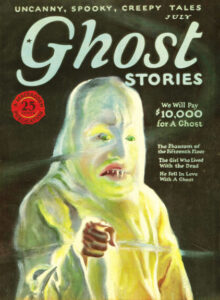 Dated July 1926, the cover of Ghost Stories’ first issue — painted by an unknown artist — looks sort of like a recruiting poster. Uncle Sam is pointing at the reader and saying, “I Want You!” This uncle, however, is wearing a white sheet and has fangs. It’s certainly not a good look for a recruiter, but the magazine did, for a time, prove to be a success. As Harold Hersey later described: “It had a short period of prosperity and then began to lose ground.”
The first issue of Ghost Stories was a bedsheet and priced at a quarter. It was printed on a better grade of paper than the standard pulp magazine, which allowed the printing of photographs, used to illustrate the stories and articles. These were choreographed in Macfadden’s studio and featured such stage and screen actors as Boris Karloff in dramatic poses, as well as the utilization of special effects such as double exposures to create ghostly figures. The photographs were meant to lend a sense of verisimilitude to the magazine.
Like Macfadden’s True Story, True Detective Mysteries, and his other magazines, the tales told by Ghost Stories were meant to be interpreted as “true.” Even a fictional tale such as John Taverel’s “The Apparition in the Prize Ring,” published in the April 1929 issue of Ghost Stories, was presented in a way meant to suggest that the story literally happened.
Actually written by Robert E. Howard, Taverel’s story begins: “Readers of this magazine will probably remember Ace Jessel, the big negro boxer whom I managed a few years ago.” The writer is implying that he personally experienced the story that follows.
Another method used to lend some credibility to Ghost Stories was through its editorial departments. “True Ghost Experiences,” Count Cagliostro’s “The Spirit World,” Gordon Hillman’s “Skeletons in the Closet of Famous Families,” Stella King’s astrology column, “Were You Born in . . .?” and others, allegedly presented factual information.
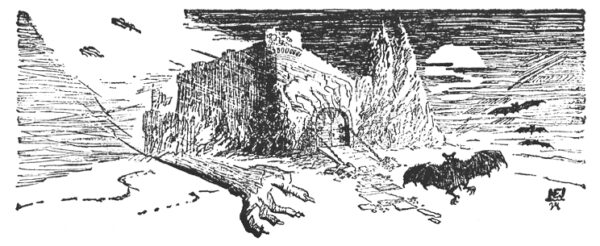 Although Ghost Stories also featured its fair share of fictional yarns, including classics by Algernon Blackwood, Robert W. Chambers, Nathaniel Hawthorne, Oscar Wilde, and others, as well as contemporary yarns by Hugh B. Cave, Jack D’Arcy, Nictzin Dyalhis, Paul Ernst, Walter B. Gibson, Robert E. Howard, Frank Belknap Long, Stuart Palmer, Victor Rousseau, and other pulp writers, it was, by and large, intended to be a confession magazine for spiritualists.
 Ghost Stories ran for a total of 64 issues, starting with its July 1926 number through its December 1931/January 1932 issue. Somewhat over half of its issues were in the bedsheet format, while the rest were pulp-size. Except for its final three issues, it was a monthly.
Unlike Amazing Stories and its future focus, Ghost Stories, which centered on ghosts and Spiritualism, was aimed at the past. With many people having lost loved ones during the First World War and the flu pandemic of 1918 – 1920, many hungered for contact with the departed. For a few short years, Macfadden’s Ghost Stories demonstrated to such people that they were not alone.
We’ll be saluting the centennials of Ghost Stories and Amazing Stories, plus a great deal more at PulpFest 2026. We hope you’ll join us from July 30 – August 2 at the DoubleTree by Hilton Hotel Pittsburgh – Cranberry in Mars, Pennsylvania for an Amazing time!
For more on Ghost Stories, please visit our YouTube Channel for Craig McDonald’s video on Bernarr Macfadden’s “haunted” magazine.
And if you’ve not done so already, join the nearly 1,000 pulp fans who’ve already subscribed to the PulpFest YouTube Channel.
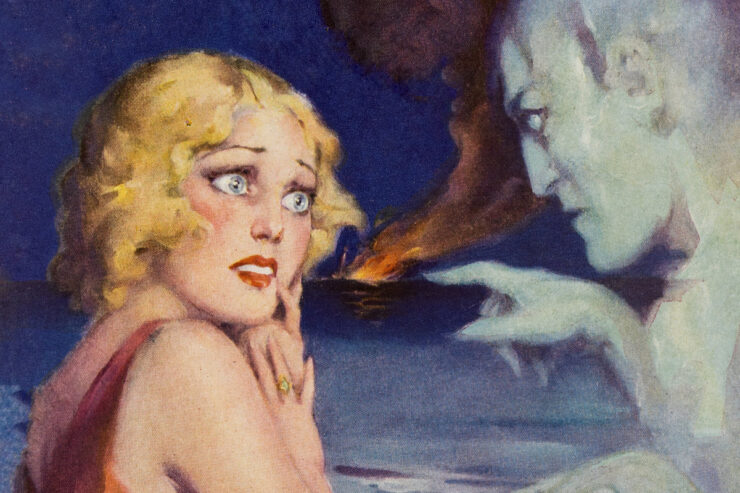
Our featured image was excerpted from Dalton Stevens’ cover art for the July 1930 issue of Ghost Stories. A successful commercial artist, Stevens’ life story is a tragedy fit for an issue of the magazine he illustrated. According to pulp art historian David Saunders, during the 1930s, Stevens “began to suffer a pronounced loss of vision in both eyes. His condition worsened until he became totally blind, at which point the despairing artist committed suicide at age sixty-one on August 14, 1939.”
Our lead image is the March 1, 1928 number of Dell’s War Stories, featuring cover art by Julius Erbit. With many people having lost loved ones during the First World War and the flu pandemic of 1918 – 1920, many hungered for contact with the departed. Macfadden’s Ghost Stories magazine was offered as a vehicle for spiritualist beliefs, providing some hope for those left behind.
True Story was the magazine that made its publisher, Bernarr Macfadden, a very wealthy man. Jules Cannert painted the cover art for the February 1930 number. The artist had a reputation for romantic pastel portraits of glamorous Hollywood stars and other beautiful women.
Ghost Stories for July 1926 featured a cover contributed by an unknown artist. For the first two years of the magazine’s publication, artist credits were not provided, nor were there visible signatures or markings. The first identified cover artist was Delos Palmer for the December 1927 issue of Ghost Stories.
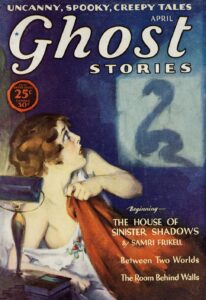
Dalton Stevens also painted the cover art for the April 1930 number of Ghost Stories, the first issue of the magazine to be published by Harold Hersey’s Good Story Magazine Company, then a subsidiary owned by Macfadden Publications. Hersey would assume ownership of the company in 1931. He canceled Ghost Stories one year later.
A fan of horror and fantasy fiction, Jeanne Harding attended her first PulpFest in 2023, helping to celebrate the centennial of Weird Tales. You can read more of Jeanne’s contributions to pulpfest.com — including her looks at the shudder pulps and Ed Emshwiller — by clicking here. PulpFest marketing and programming director, Mike Chomko, helped with Jeanne’s Ghost Stories post.