
 In the fall of 1929, Dell Publications editor Henry Steeger approached the business manager of Ace Publications — his longtime friend and former schoolmate, Harold Sanford Goldsmith — about starting a publishing company.
Armed with a $125,000 line of credit arranged by Eastern Distributing Company, the two men launched Popular Publications. Within a decade, Steeger’s and Goldsmith’s company was one of the powerhouses of the pulp industry.
But Popular Publications was not Steeger and Goldsmith alone. Steeger’s wife, Shirley, worked the slush pile during the company’s early years. Alexander Portegal was the firm’s art director, presiding over the interior drawings found in their magazines. In later years, Alden H. Norton, with whom Steeger planned to write a history of the pulps, spent many years managing the publisher’s titles. And there was H. Rogers Terrill.
Born in 1900, Rogers Terrill got started in the pulp industry as a writer. In 1927, he sold a short story to Street & Smith. Before long, he was hired as an editor at Fiction House, taking over the helm of Lariat Story Magazine.
A graduate of Columbia University, where he’d originally studied actuarial science, Terrill soon took on other titles. He continued to write as well, contributing stories to his employer’s Action Stories, Fight Stories, North•West Stories, and other pulps. He also wrote for Street & Smith’s Detective Story Magazine and Western Story Magazine.
As Fiction House continued to grow, so did Terrill’s workload. But then, the bottom dropped out. During a trip to California, senior Fiction House editor and co-founder, Jack Kelly, died at the age of forty-five.
Coupled with the Great Depression, Kelly’s sudden death left Fiction House virtually paralyzed. Forced to reorganize the company, surviving partner Jack Glenister had to let people go. Terrill found himself without a job. Thankfully, right across the street from his former employer was the upstart Popular Publications. And they needed help.
 According to Popular’s Jean Mithoefer, “We needed somebody and Terrill was pretty good at picking out stories — you know, buying — and also at editing. He was a pretty good editor.” His Fiction House contacts were nothing to sneeze at either.
The Rogers Terrill of Fiction House was very different from the editor hired by Steeger and Goldsmith in 1932. In “Why Manuscripts Come Home,” an article published in the April 1931 Writer’s Digest, Terrill had suggested:
“The thing must have snap. It must get somewhere swiftly. A story problem must be presented, or some vivid, dramatic, meaningful action described. Sometimes a character can safely carry an opening, though this is usually a dangerous expedient.”
About four years later, employed as the editor of various Popular Publications’ titles, Terrill would tell literary agent August Lenninger:
“We need stories with meaty plots which are the outgrowth of colorful and honest characterization … Primarily there must be real emotion in our stories; in addition to the physical conflict, they should have emotional drama. A story, for example, in which conflicting forces are at work, in which the hero has strongly conflicting desires — where he must make a choice that will reflect his true character. His most vital interests and desires require one course of action, but a debt of honor demands sacrifice of his own will. And while he is sorely tempted to protect his own interests, his better nature triumphs” (Writer’s Digest, January 1935).
Times were very much different when Terrill climbed onto the Popular bandwagon than when he’d signed on at Fiction House.
The twenties had been fat days for the pulp industry, with many writers sometimes earning a nickel or more a word. But in 1932, with the nation in the throes of the Great Depression, a different slant was needed.
And so, Henry Steeger, with the help of Rogers Terrill and others, began to remold his company. Together, they built a new Popular Publications, one that would eventually own such titans of the pulp industry as Adventure, Black Mask, and eventually, Argosy and the rest of the Munsey chain.
If, as Don Hutchison wrote long ago, Harry Steeger was “The King of the Pulps,” Rogers Terrill should be regarded as their crown prince. He was “The Rajah of the Pulps.”
 In 1943, the Rajah turned his pulps over to his assistants to become the managing editor of Argosy. From a magazine on life support, Terrill turned Argosy into a powerhouse, selling more than a million and a half copies a month in the years following World War II, and publishing stories such as Jack Schaefer’s “The Man from Nowhere.” It’s far better known by its Hollywood title, Shane.
In 1953, Rogers Terrill left Popular to open a literary agency. One of his clients was Richard McKenna, author of The Sand Pebbles. He continued agenting until he died in 1963, at the age of 62.
For more on Popular’s Rajah, track down a copy of Purple Prose 17, published in July 2003. It features Will Murray’s “The Reign of the Rajah,” a look at the career of H. Rogers Terrill.
While you’re looking, please visit our YouTube Channel for award-winning author and journalist Craig McDonald’s video on Rogers Terrill, Title Forthcoming with Link.
And while you’re there, please be sure to subscribe.
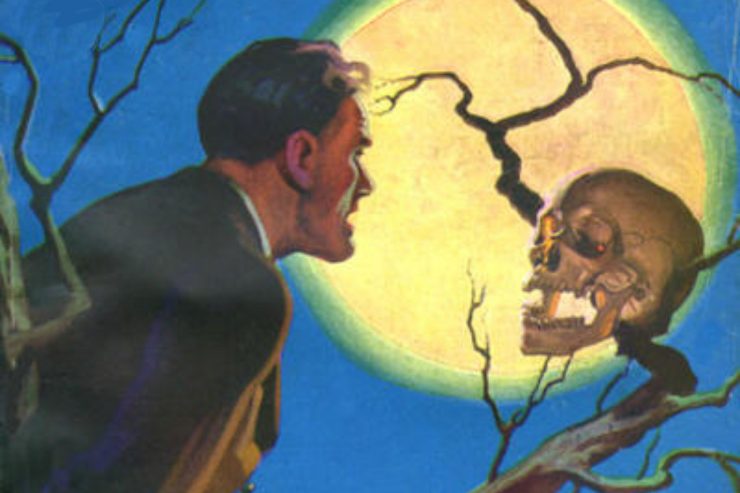
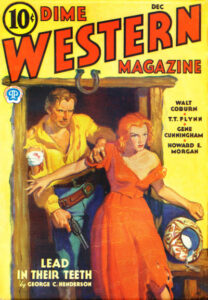
Our featured image is excerpted from William Reusswig’s cover for the May 1932 issue of Dime Detective Magazine, one of the first Popular Publications pulps to be edited by Rogers Terrill. Later that same year, Terrill introduced readers to a new type of pulp western in the first issue of Dime Western Magazine. Dated December 1932, it featured cover art by Walter M. Baumhofer. By the end of 1933, Terrill’s western pulp had surpassed Dime Detective as Popular’s bestselling title.
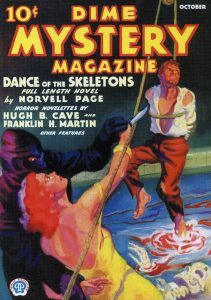
 The Rajah’s next project was to revive Popular’s moribund Dime Mystery Book Magazine. Shortening its title to Dime Mystery Magazine, he introduced a new genre to pulp readers — weird-menace fiction. Dated October 1933, it featured another Baumhofer cover, this time illustrating Norvell Page’s “Dance of the Skeletons.” Dime Mystery inspired many immitators, including Popular’s own Terror Tales and Horror Stories.
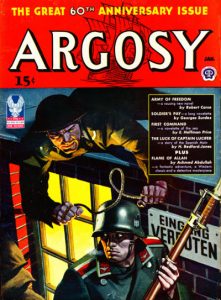
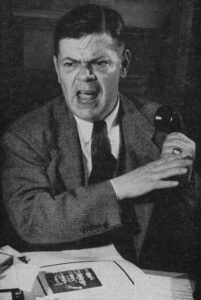
Roger Terrill’s last major project for Popular Publications was a revival of the former Munsey flagship title, Argosy. Our final magazine is the first issue to be edited by Terrill. Dated January 1943, it featured cover art by Peter Stevens. Our photograph of Terrill is from the June 14, 1948 issue of Newsweek, illustrating the article, “The Golden Fleece,” concerning the revival of Argosy.