
 Happy Labor Day!
Out with the Old! In with the New! We know that’s for celebrating the New Year, but read on. It fits!
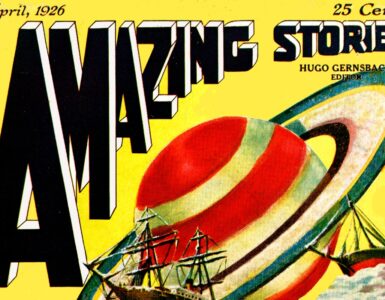
We’re offering a mixture of images this year to celebrate our themes for PulpFest 2025 — the “Masters of Blood and Thunder” and for PulpFest 2026 — a “Century of Amazing Stories!”
It’s not every year that Edgar Rice Burroughs turns 150 years old. Nor does Labor Day often fall on the bestselling author’s 150th birthday!
Edgar Rice Burroughs was far from a celebrated writer when he first took pen to paper. After trying his hand in the U.S. Cavalry, Burroughs worked a string of jobs and failed at several businesses: advertising copywriter, cowboy, door-to-door salesman, efficiency expert, pencil-sharpener wholesaler, prospector, railroad policeman, shopkeeper …
Flat broke and with a wife and two kids to support, he sampled some stories found in the pulp fiction magazines. Afterward, he tried his hand at writing. As he later told an interviewer:
“I remember thinking that if other people got money for writing such stuff, I might, too, for I was sure I could write stories just as rotten as theirs.”
Upon completing the first half of his story, he mailed his manuscript to the Frank A. Munsey Company. Not long thereafter, Thomas Newell Metcalf — managing editor of The All-Story — asked for more. Encouraged by Metcalf’s response, the would-be writer finished the novel and sold it to the publisher. “Today, that story is acclaimed by scholars as the turning point of 20th-century science fiction, and new editions of it continue to be published each year throughout the world.”
Serialized in six parts — beginning with the February 1912 number of The All-Story — Burroughs’ novel was called “Under the Moons of Mars.” His story, “Tarzan of the Apes,” would appear later that same year, published complete in the October 1912 issue of The All-Story. Two years later, Burroughs’ novel about a boy raised in the jungle would be a bestseller for A. C. McClurg.
Called “The Master of Adventure,” Edgar Rice Burroughs wrote about eighty novels during his lifetime, including the Mars, Venus, Pellucidar, Caspak, and Moon series. Tarzan, of course, is his most famous creation. One of the most successful fictional characters in history, Tarzan has appeared in films, comic strips, comic books, television, and video and computer games. Burroughs’ work has inspired writers, artists, filmmakers, scientists, and many more.
Years after his initial success, Burroughs’ power as a writer was waning. One of his last serialized novels — “The Synthetic Men of Mars” — had already appeared, serialized in 1939 by Munsey’s Argosy. But despite his lessened stature as a writer, Burroughs still had a good deal of drawing power.
 Ziff-Davis editor Raymond A. Palmer surely realized this when he purchased Edgar Rice Burroughs’ “Beware” in 1939. A nearly twenty-year-old novelette of royal intrigue and mystery that had been rejected multiple times, Palmer rewrote the story as a science fiction adventure. He published it in the second issue of Fantastic Adventures as “The Scientists Revolt,” using the Edgar Rice Burroughs byline. Despite it not being among his best efforts, the magic of Burroughs’ name on the cover worked, and the magazine sold. Palmer used this story as a springboard to convince Burroughs to revive his Barsoom, Pellucidar, and Venus series for Amazing Stories and Fantastic Adventures.
Tasked by his publisher to boost circulation or see Amazing Stories shuttered, Ray Palmer used a variety of methods to induce additional sales. He revamped the magazine’s editorial tone and emphasized science fiction fandom; he changed the slant of the pulp’s cover art from the quiet pastels of Leo Morey, to the vivid and suggestive covers of Robert Gibson Jones and Harold W. McCauley; he employed writers both old — Burroughs, Ray Cummings, Ralph Milne Farley — to new — Isaac Asimov, Robert Bloch, Malcolm Jameson, David Wright O’Brien — to instill a new outlook and style to Amazing; and he offered up new themes such as war stories with Japanese and German villains, and the Shaver yarns about advanced prehistoric civilizations and degenerated underground denizens, beginning in 1944.
Palmer, who began writing crime and science fiction stories himself during the late 1930s, wasn’t beyond publishing his own work in the magazines he edited for Ziff-Davis. Hiding behind various pseudonyms, he often accompanied these yarns with “biographies” of these “writers.” To further fool readers, he sometimes wrote editorials criticizing them or their work.
One such tale was “War Worker 17,” written by Palmer under the Ziff-Davis house name, Frank Patton.
Published in Amazing Stories’ “women in war work” issue, dated September 1943, Palmer’s story concerns a female crane operator in an airplane factory during the Second World War. Daydreaming about her lover in the military, she is unexpectedly transported to another world where she is examined by its advanced scientists. She’s eventually returned to Earth with the plans for a plane able to drop bombs with extreme accuracy. It’s hoped that this weapon will end the war within a few months.
Palmer’s methods certainly worked. By 1940, the circulation of Amazing Stories had grown nearly eightfold. Additionally, Ziff-Davis had launched a companion magazine — Fantastic Adventures — about midway through 1939.
We’ll be celebrating Amazing Stories, Raymond A. Palmer, Edgar Rice Burroughs, and more at PulpFest 2026. We hope that you’ll join us from July 30 – August 2 at the DoubleTree by Hilton Hotel Pittsburgh – Cranberry in Mars, Pennsylvania, for a salute to the centennial of Hugo Gernsback’s Amazing Stories, the first specialized science fiction pulp, and a lot more at PulpFest 2026.
Now, having read this far, please take the rest of Labor Day off. Read a pulp! You deserve it!
In the meantime, enjoy one of our Edgar Rice Burroughs videos on the PulpFest YouTube Channel.
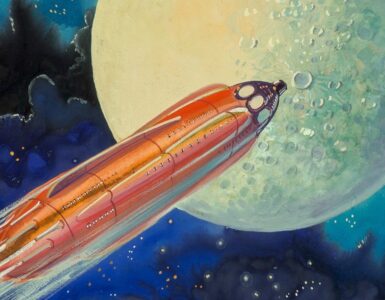
Our featured image was excerpted from Robert Gibson Jones’ cover for the September 1943 number of Amazing Stories, illustrating “War Worker 17,” a story by Raymond A. Palmer (as Frank Patton).
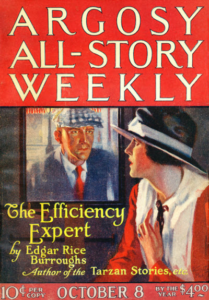
Our lead image is Stockton Mulford’s cover for the October 8, 1921 issue of Argosy All-Story Weekly, illustrating the first segment of Edgar Rice Burroughs’ four-part serial entitled “The Efficiency Expert.” It’s the story of a former “Big Man On Campus” who moves from job to job following college, before landing a position as an “efficiency expert” for a money-losing factory. It’s one of Burroughs’ few novels set in the contemporary America of his time.
Our final image is the cover for the July 1939 issue of Fantastic Adventures, the pulp’s second issue. The artwork is by Leo Morey.
Norman Bean is an Edgar Rice Burroughs fan who joined our staff of volunteer post-writers in August 2023. Norm has written about conventions, “pulp paleontology,” our dealers, and, of course, ERBFest and ERB himself. We look forward to his continued contributions.