 Now that the hustle and bustle of PulpFest 2025 is behind us, we’ll be settling down to a much slower pace for the rest of August and the eight months that follow. Until May of 2026, expect to see one post each week, going live on our website each and every Monday.
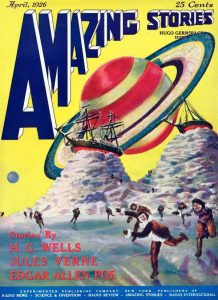
PulpFest 2026 will be saluting the 100th anniversary of Hugo Gernsback’s groundbreaking science fiction pulp, Amazing Stories. Its number one issue, dated April 1926, was the first specialized science fiction magazine to be published. In the ensuing years, many others would follow, from Science Wonder Stories to Astounding Stories to Galaxy Science Fiction and beyond.
We’ll be fleshing things out in the months ahead. Not only will we be lining up our programming for PulpFest 2026, but also for our associated conventions — Doc Con 2026, FarmerCon XXI, and the very first Shadow Con, dedicated to the “Master of Darkness.”
So be sure to bookmark pulpfest.com and sign up for the occasional PulpFest E-letter, focusing on the “behind-the-scenes” planning for next summer’s convention. Click here and provide your name and email address. Once you click the “submit” button, you’re subscribed.
You can also follow us on Facebook, Instagram, and X/Twitter! And don’t forget to subscribe to our YouTube channel to see our videos on pulp heroes, Weird Tales, Black Mask, and more.
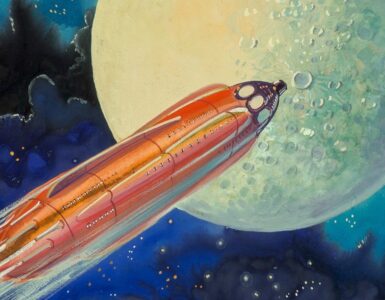
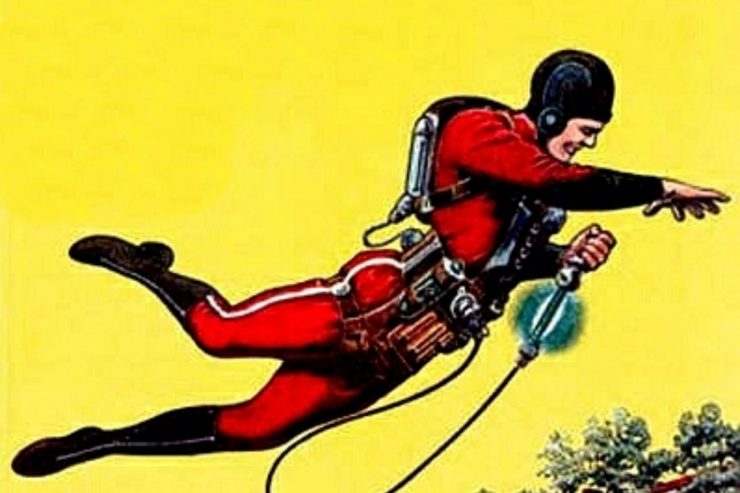
Our featured image is one of the most iconic covers to be published by Amazing Stories. It’s excerpted from Frank R. Paul’s cover for the August 1928 number, illustrating the first segment of Edward Elmer Smith’s & Lee Hawkins Garby’s three-part serial, “The Skylark of Space.” Also appearing in the issue was “Armageddon — 2419 A.D.,” the first of Philip Francis Nowlan’s Buck Rogers stories, H. G. Wells’ “The Moth,” and other early science fiction tales.
Our lead image is the first issue of the first science-fiction pulp, Amazing Stories, which was cover-dated April 1926. The cover art was also by Frank R. Paul, often called “The Grandfather of Science Fiction Art.” Other than Hugo Gernsback’s editorial, “A New Sort of Magazine,” that magazine consisted of all reprinted material, with stories by George Allan England, Austin Hall, Edgar Allan Poe, Jules Verne, H. G. Wells, and G. Peyton Wertenbaker.