
 When Ned Pines was asked by The American News Company to start a chain of pulp magazines that it would distribute for him, he knew he needed an editor. The young publisher requested Frank A. Munsey employee, Leo Margulies, to be the managing editor of his new enterprise. With the country gripped by the Great Depression, the two men came up with a daring idea for the rough paper market: a ten-cent pulp magazine.
Standard Magazines — better known as “The Thrilling Group” — launched Thrilling Detective, Thrilling Adventures, and Thrilling Love in late 1931. Each sold for a dime. Within two years, the line expanded, adding The Phantom Detective, The Lone Eagle, Sky Fighters, Thrilling Ranch Stories, and Thrilling Western. As Standard grew, Margulies became the company’s face.
Leo Margulies was born on June 22, 1905, and raised in Brooklyn, New York. After briefly attending Columbia University, he began working for the Munsey magazine chain, selling subsidiary rights to its stories. His mentor was the legendary editor, Bob Davis, the man who published the early works of Max Brand, Edgar Rice Burroughs, Ray Cummings, George Allan England, A. Merritt, and other popular writers.
 After Davis left the pulp industry, Margulies worked as head of East Coast research for Fox Films; helped to establish Tower Magazines, sold by Woolworth’s; and founded a literary agency. After joining Ned Pines’ new publishing venture, he developed a reputation “. . . not only for quick decisions on buying stories but also for swift payment — which made him a writers’ favorite.”
Respected by authors and editors alike, Margulies became known as “The Little Giant of the Pulps.” Author and screenwriter Steve Fisher wrote about the editor for a writers’ magazine:
“There was a sudden silence. Fifty people stopped eating and looked up. Leo Margulies made his usual dramatic entrance. . . . I thought for a moment (American Fiction Guild) president Art Burks was going to leap to his feet and salute.”
 During World War II, Leo Margulies enlisted in the military as a war correspondent. He was onboard the USS Missouri when the Japanese surrendered. Returning to the USA, he helped launch Pines’ Popular Library line of paperback books.
In the early 1950s, Margulies left Ned Pines’ employ and started a new publishing venture, King-Size Publications. He returned to the fiction market with two digest magazines — The Saint Detective Magazine and Fantastic Universe.
In later years, Margulies established Mike Shayne Mystery Magazine, The Man from U.N.C.L.E. Magazine, Zane Grey Western Magazine, and other fiction digests. He also revived Weird Tales in 1973-1974, with Sam Moskowitz as editor. Leo Margulies died on December 26, 1975 at the age of seventy-five.
As part of its tribute to Ned Pines’s Standard Magazines in 2015, PulpFest welcomed Margulies’ nephew, Philip M. Sherman, to the convention. Mr. Sherman discussed his uncle on both a professional and personal level: “Not only was Leo an outstanding editor and publisher . . . he was also an outstanding uncle.”
Although Philip Sherman passed away in 2019 at the age of 88, he was able to write a biography of his uncle. Leo Margulies, Giant of the Pulps: His Thrilling, Exciting, and Popular Journey was published in 2017 by Altus Press. It is available through Steeger Books and select booksellers.
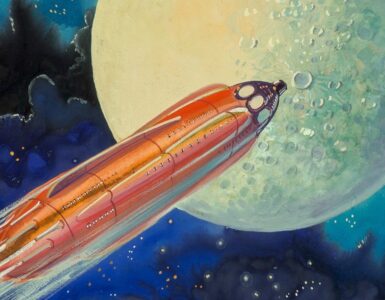
 Our featured image is excerpted from Hannes Bok’s original art for the December 1956 issue of Fantastic Universe, published by Leo Margulies’ King-Size Publications.
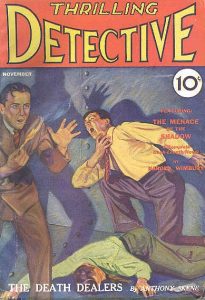
Howard Sherman painted the cover for the November 1931 Thrilling Detective. Along with Thrilling Love, it was the first pulp to be published by Ned Pines “Thrilling” line of pulp magazines.
Saint Overboard, by Leslie Charteris — originally published in 1936 by Hodder & Stoughton — was the first Popular Library paperback to be released. Published in 1943, it featured front cover art by H. Lawrence Hoffman, the artist who created the covers for the first 100 books issued by Ned Pines’ Popular Library.
According to John Locke’s introduction to Thrilling Detective Heroes, Leo Margulies “answered the higher calling of wartime. He and several other writers and editors joined the Navy for a stint in the Pacific Theater as war correspondents.”
Pictured above is Margulies in uniform during World War II. Many thanks to Matt Moring of Steeger Books for this photograph. It originally appeared in Will Murray’s study of the pulp western, Wordslingers.
Our final image is Weird Tales for Winter 1973, with cover by Bill Edwards. Edited by Sam Moskowitz, it was published by Leo Margulies’ Renown Publications.